
On this page
Solubility is a property under specified conditions
Solubility describes how much of a substance can be present in a saturated solution under stated conditions. IUPAC defines it through the composition of a saturated solution. A useful value therefore names the solute, solvent and relevant conditions, rather than attaching one universal number to a peptide.
Dissolution rate is a different question: how quickly material enters solution. A slowly disappearing solid is not, by itself, a measured solubility limit. Nor does rapid disappearance establish that all material remains as individual peptide molecules.
In research, the practical question is often whether a defined amount is recoverable in the intended analytical or experimental medium. That needs evidence for the actual molecular form and conditions, not a general rule based only on the product name.
The whole sequence matters
Charged and polar groups can interact favourably with water, while non-polar regions can favour association between peptide molecules. The backbone contributes too: its carbonyl and amide groups participate in interactions with both water and other peptides.
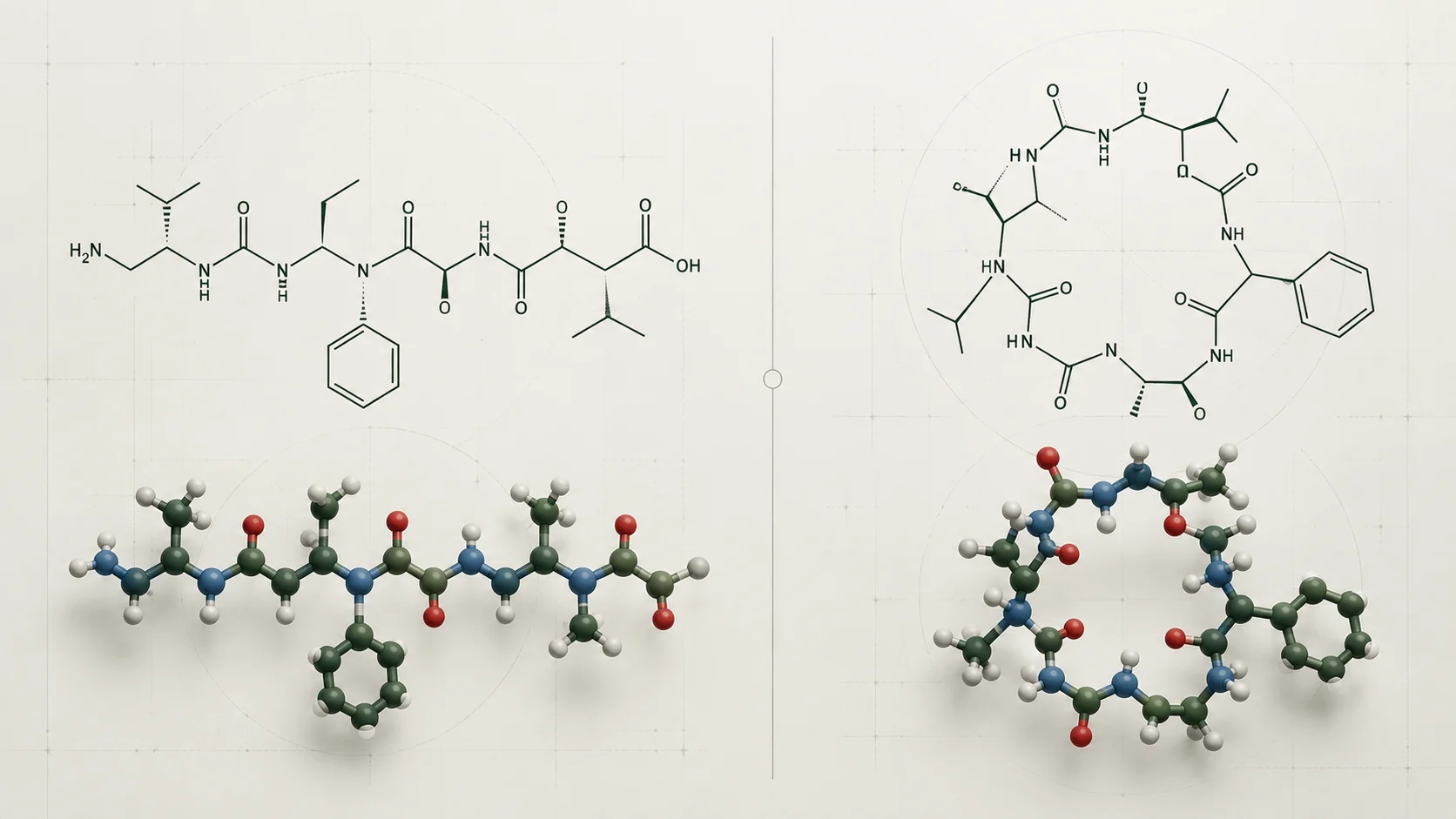
Sequence order determines which groups lie next to one another and which conformations are accessible. Two peptides with similar amino-acid composition need not behave identically. Terminal modifications, cyclisation and the stated counterion also change the chemical context.
Sarma and colleagues modelled short peptides and showed how backbone and side-chain interactions contribute to solubility and association. This is molecular-simulation evidence for selected model sequences, not a measured ranking of Lynx materials. Read the sequence Guide to identify residues and modifications before interpreting a solubility claim.
KPV illustrates why sequence matters: Dalmasso and colleagues identify it as Lys-Pro-Val. Lysine’s ionisable side chain helps frame a solubility question, but cannot supply a measured solubility value or preparation method.
pH changes charge and molecular interactions
pH influences whether ionisable groups carry charge. A peptide contains several possible sites, including some side chains and, where unmodified, its termini. The overall charge and its distribution affect interactions with solvent and neighbouring molecules.
The isoelectric point, or pI, is the pH at which the average net charge is zero. Reduced net charge can make electrostatic repulsion less effective, but pI alone cannot predict every solubility profile. Local charges, sequence and other interactions still matter.
Changing pH is not a universal solution to poor solubility. It can also alter chemical stability or the behaviour of the experimental system. The question is whether the conditions are justified for that peptide and that measurement, rather than whether one condition makes the sample look clearer.
Salts, temperature and solvent can change the picture
Ionic strength describes the contribution of dissolved ions to the solution environment. Ions can screen electrostatic interactions, and their chemical identities can introduce additional effects. Marek and colleagues studied this in amylin aggregation, showing why “more salt” is not a general prediction of better or worse behaviour.
Temperature affects molecular motion, interactions and the rate of change. A warmer sample may behave differently without demonstrating a stable improvement in solubility. Cooling it again can change the balance, and degradation is a separate possibility.
Solvent composition influences both solvation, the interaction of molecules with their solvent, and peptide association. Conditions suitable for an analytical measurement may not suit a different experimental system. This Guide explains the variables. It does not prescribe a solvent, pH adjustment or preparation recipe.
Dissolution and dispersion are not the same
| Observation | Possible interpretation | What appearance cannot settle |
|---|---|---|
| Visible particles or cloudiness | Undissolved material, precipitation or a dispersed particulate phase | Identity and quantity of the suspended material |
| A clear-looking liquid | No particles visible under those viewing conditions | Whether soluble aggregates or low-level particles remain |
| A change over time | Possible association, precipitation or chemical change | Which process occurred without further measurement |
A dispersion contains a distributed particulate phase rather than a simple molecular solution. Aggregation means peptide molecules associate into larger species. Some aggregates can remain dispersed or soluble. Precipitation produces a separate solid phase.
These processes can overlap, but the terms are not interchangeable. Visual inspection is a useful observation to record, not a complete analytical conclusion.
Measure recovery as well as appearance
A concentration measurement needs a defined sample basis and an appropriate assay. If only the liquid above settled material is analysed, the result describes that sampled fraction, not necessarily everything originally present.
Surface adsorption can also reduce recoverable peptide without creating an obvious precipitate. Hoofnagle and colleagues discuss handling and recovery in analytical peptide assays. Container history, concentration and time can therefore matter alongside the visible state.
Complementary measurements may examine soluble content, particle size or chemical changes, depending on the research question. No single visual or instrumental result should be relabelled as proof of every form of stability. The storage Guide covers exposure history. the degradation Guide explains chemical modifications.
What a useful solubility statement includes
- Exact sequence, terminal groups and supplied material form.
- Solvent composition, pH, ionic environment and temperature.
- The amount measured, sample basis and time of observation.
- The method used to distinguish dissolved material from other phases.
- Recovery and any changes observed during the experiment.
Predictions from sequence are a starting hypothesis. Peptide-specific measurements turn that hypothesis into usable evidence. The counterions Guide and lyophilisation Guide explain two further reasons that apparently similar powders can have different histories.
Lynx materials are for laboratory research only, not for human or veterinary use. This Guide provides no dosing, administration or personal-use preparation instructions.
References and further reading
- Solubility. DOI 10.1351/goldbook.S05740. IUPAC terminology.
- Peptide Solubility Limits: Backbone and Side-Chain Interactions. Sarma et al.. 2018. DOI 10.1021/acs.jpcb.7b10734. primary molecular simulation study.
- Ionic Strength Effects on Amyloid Formation by Amylin Are a Complicated Interplay between Debye Screening, Ion Selectivity, and Hofmeister Effects. Marek et al.. 2012. DOI 10.1021/bi300574r. primary peptide aggregation experiments.
- Recommendations for the Generation, Quantification, Storage, and Handling of Peptides Used for Mass Spectrometry-Based Assays. Hoofnagle et al.. 2016. DOI 10.1373/clinchem.2015.250563. laboratory consensus and selected experiments.