What is KPV?
KPV is Lys-Pro-Val, the three-residue C-terminal segment of α-melanocyte-stimulating hormone. It lacks the full hormone’s central melanocortin-binding motif, so its small size represents a different biological tool rather than a miniature equivalent of α-MSH. Its strongest mechanistic literature focuses on intestinal epithelial cells and immune-cell preparations.
PepT1, a transporter for small peptides, moved KPV into cells in experiments that also recorded lower NF-κB and MAP-kinase activation and reduced inflammatory cytokine output. Mouse colitis models provided a tissue-level extension of that work. A separate delivery study used engineered nanoparticles, illustrating how formulation can change uptake and measured outcomes. The transport mechanism, intracellular signals and response to an engineered carrier should therefore be distinguished when comparing KPV preparations.
Related scientific guides: KPV and BPC-157: structure and preclinical evidence.
KPV Research Areas
KPV entered intestinal epithelial and immune-cell preparations through PepT1, with lower NF-κB and MAP-kinase signalling and reduced inflammatory cytokine output. In two mouse colitis models, inflammatory tissue and cytokine measures also decreased. The work connects peptide transport with intracellular signalling, while keeping cell uptake and whole-tissue responses as separate measurements.
Dalmasso et al. · Gastroenterology · 2008PubMed
A hyaluronic-acid-functionalised KPV nanoparticle system produced stronger intestinal inflammatory and mucosal-repair results than the comparison carrier in a mouse colitis model. Cell experiments also examined delivery to epithelial cells and macrophages. The engineered carrier and hydrogel were part of the intervention, so the result cannot be assigned to free KPV alone.
Xiao et al. · Mol Ther · 2017PubMed
Molecular profile
- Compound
- KPV
- Amount
- 10 mg
- Sequence
- Lysine-proline-valine
- Residue count
- 3
- Molecular formula
- C16H30N4O4
- Molecular weight
- 342.43 g/mol
- CAS number
- 67727-97-3
- Chemical class
- Tripeptide
- Classification
- Research peptide
- Parent molecule
- L-Lys-L-Pro-L-Val (free acid)
- Available vial sizes
- 10 mg
Analytical verification
- Lynx report reference
- UKLY-292
- Reported purity
- 99.269%
- Analysis method
- RP-HPLC + ESI-MS
- Identity result
- Confirmed: KPV
- Analysis date
- 4 Sept 2026
- Report date
- 4 Sept 2026
Storage & Reconstitution
Store in appropriate cool, dry conditions. Refer to product-specific storage information when published.
Vials are supplied separately from bacteriostatic water and other preparation supplies.
For laboratory handling context, read Research peptide storage and stability. Product-specific information and the laboratory method take precedence.
For laboratory preparation, allow the sealed vial to reach room temperature before opening. Wipe the vial stopper and bacteriostatic-water stopper with an alcohol wipe. Add bacteriostatic water slowly down the inside wall of the vial, then swirl gently until dissolved. Do not shake.
Research literature
KPV Price (UK)
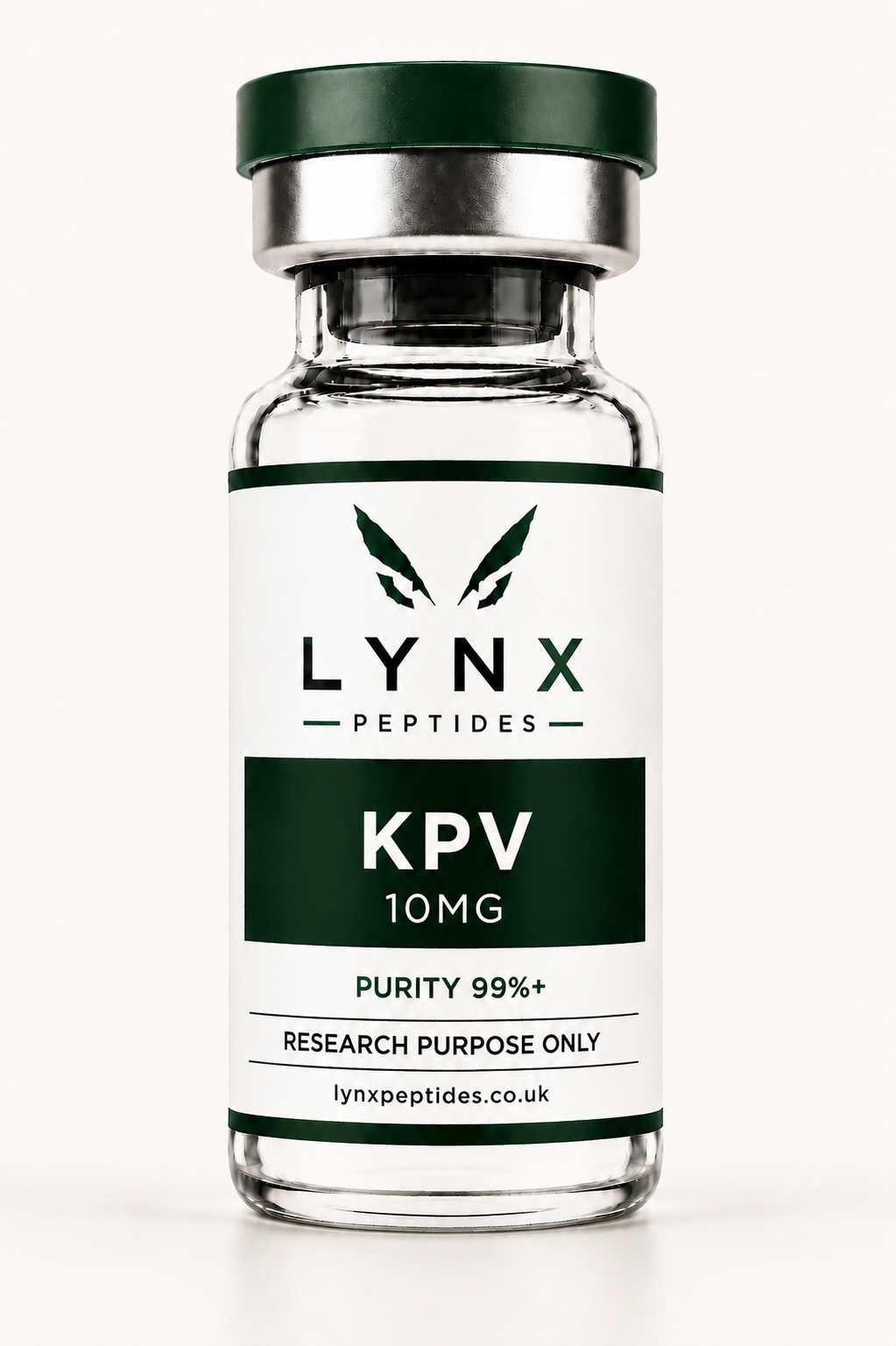
KPV is supplied in 10 mg vials for laboratory research. The current price is £24.99.
Current availability is shown below. UK orders of £49.99 or more qualify for free standard shipping. Eligible working-day orders placed before 4 PM are dispatched the same day.
| Vial size | Current price | Price / mg | Status |
|---|---|---|---|
| 10 mg | £24.99 | £2.50/mg | Checking stock |
Common questions about KPV
What is KPV?
KPV is a three-amino-acid peptide made from lysine, proline and valine; its name uses their one-letter codes. It corresponds to the tail of alpha-MSH, but does not contain the whole hormone. Its research includes inflammatory signalling in intestinal and immune cells, making this small fragment a distinct subject of study rather than a miniature version of every alpha-MSH action.
How is KPV related to alpha-MSH?
KPV is the final three amino acids of alpha-MSH. It does not contain the hormone's full receptor-active structure, so being a fragment does not give it every action of the parent molecule. Its research includes cellular uptake and inflammatory signalling, which is why laboratories distinguish the short KPV peptide from full alpha-MSH and its larger analogues.
Why is peptide uptake important in KPV research?
A peptide must reach the relevant part of a cell before it can affect an intracellular process. Intestinal-cell experiments linked KPV uptake through PepT1, a transporter for small peptides, to changes in inflammatory signalling. That helps explain why the transport system in the chosen cells matters alongside the amount of KPV added to an experiment.
How does KPV differ from Melanotan I or Melanotan II?
KPV is only the three-amino-acid tail of alpha-MSH. Melanotan I and II retain modified melanocortin receptor-active structures, giving them different receptor research profiles. KPV's intestinal-cell studies instead include peptide transport and inflammatory signalling. Their connection to the same parent hormone does not make them interchangeable compounds or mean they answer the same experimental question.
How is individual KPV different from the KLOW blend?
Individual KPV lets a laboratory examine that peptide's response without the other three KLOW components. KLOW combines KPV with GHK-Cu, BPC-157 and TB-500, adding copper-peptide and cell-movement research to the preparation. The blend fixes their ratios, while separate compounds allow the KPV contribution to be tested or adjusted independently.
How does KPV differ chemically from GHK-Cu?
KPV is the three-amino-acid sequence lysine-proline-valine; GHK-Cu is a different three-amino-acid peptide bound to copper. Sharing the same peptide length does not give them the same chemistry. KPV research includes peptide uptake and inflammatory signalling, while GHK-Cu introduces metal-binding chemistry, which is why both remain distinct components in the KLOW blend.
Can I buy KPV in the UK for research?
Yes. Lynx offers KPV as an individual 10mg laboratory research peptide in the UK. This listing shows the availability of KPV alone, not the KLOW blend.
What does the KPV batch testing show?
For the 10mg KPV vial, UKLY-292 reports 99.269% purity using RP-HPLC + ESI-MS.