On this page
Chemical and physical degradation
Chemical degradation changes molecular structure. Oxidation, deamidation and bond cleavage are examples. Physical changes include aggregation, precipitation or altered solid structure. The categories describe different observations, although they can occur together.
A visible change does not identify a chemical reaction. A chemical modification may occur without an obvious colour or texture change. Establish which property changed before assigning a mechanism.
Oxidation and susceptible residues
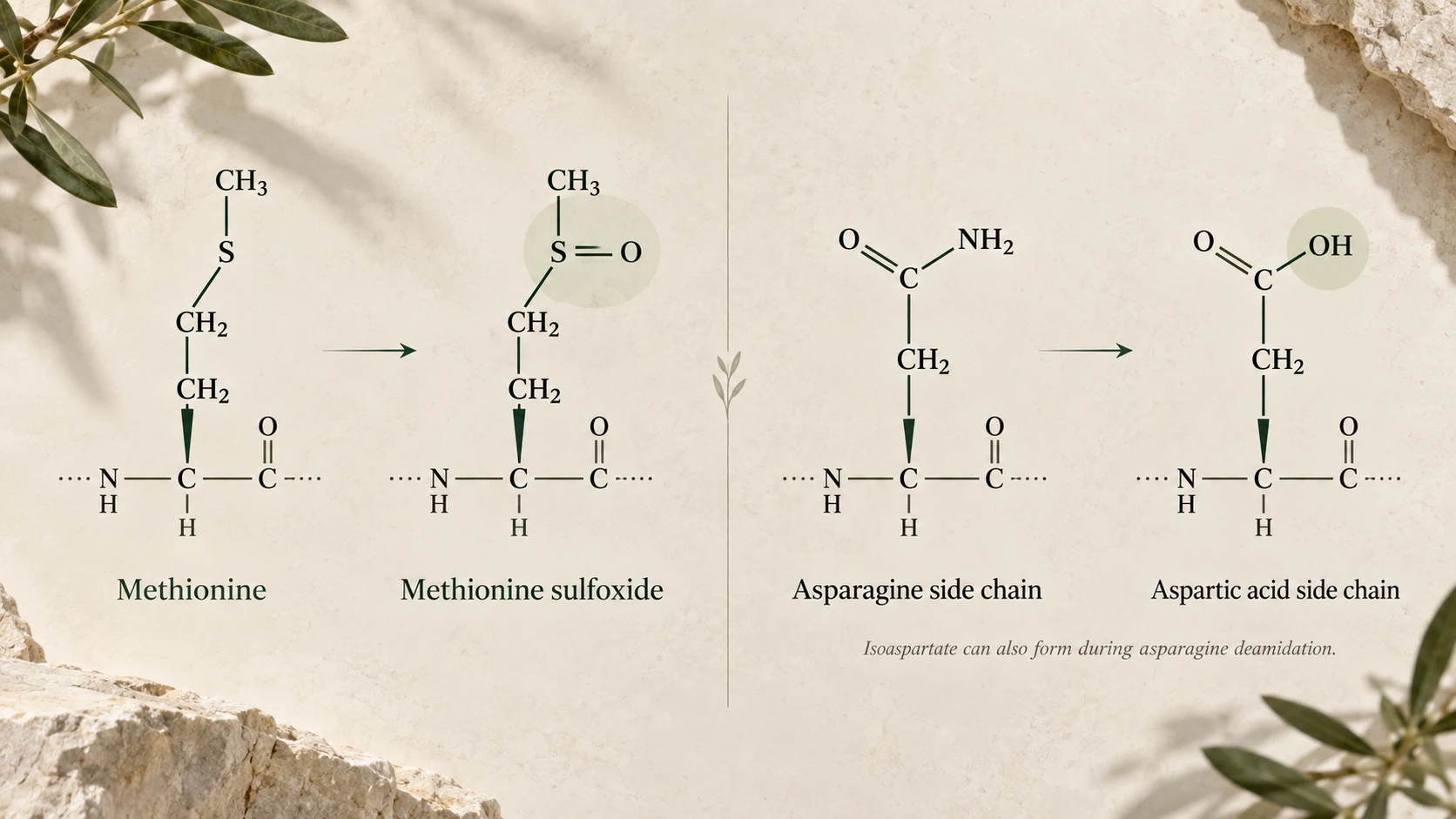
Oxidation can modify amino-acid side chains. Methionine is a common example: oxidation of its sulfur can produce methionine sulfoxide, with further oxidation possible. Cysteine, tryptophan, tyrosine and other residues can also participate in oxidative chemistry, depending on their environment.
A susceptible residue identifies a possible reaction site, not a measured degradation rate. Sequence, accessibility, molecular form and the oxidising species influence which products form. Oxygen exposure alone does not establish the extent of oxidation in a sample.
Deamidation is sequence-dependent chemistry
Deamidation replaces the side-chain amide of asparagine or glutamine with a carboxyl group. Asparagine can react through a cyclic succinimide intermediate under suitable conditions, producing aspartate and isoaspartate. Other pathways and product distributions are possible. Glutamine deamidation is distinct and is often slower under comparable conditions.
Neighbouring residues and local structure influence the reaction. An asparagine-containing sequence is not evidence that it has deamidated. One sequence’s rate cannot be applied to every peptide.
Goolcharran and colleagues compared model peptides with a specified protein under controlled conditions. The relationship depended on the reaction considered. Their study illustrates the value and limits of model systems, not a universal rate.
Environmental influences and their limits
Temperature, water availability, pH in a liquid system, light, oxidants and trace metals can influence chemical change. Packaging and exposure history affect the conditions a material experiences. Each factor’s influence depends on the reaction and material.
A dried solid and a dissolved sample are different chemical environments. A rate measured in one cannot simply be transferred to the other. General mechanisms do not establish storage instructions, expiry dates or stability specifications for Lynx products.
Compare the reaction with the evidence
| Reaction or observation | Evidence and limitation |
|---|---|
| Methionine to methionine sulfoxide | Addition of one oxygen gives an approximate +15.995 Da mass change. That shift alone does not locate or uniquely identify the oxidation site. |
| Asparagine or glutamine deamidation | The approximate +0.984 Da change can support a modification assignment. It does not by itself distinguish aspartate from isoaspartate or locate the residue. |
| A new chromatographic peak | May indicate a separated component. Retention time or peak area alone cannot name the reaction or establish identity. |
| Aggregation or precipitation | Requires suitable physical characterisation and recovery assessment. Chemical purity alone may miss material excluded during preparation. |
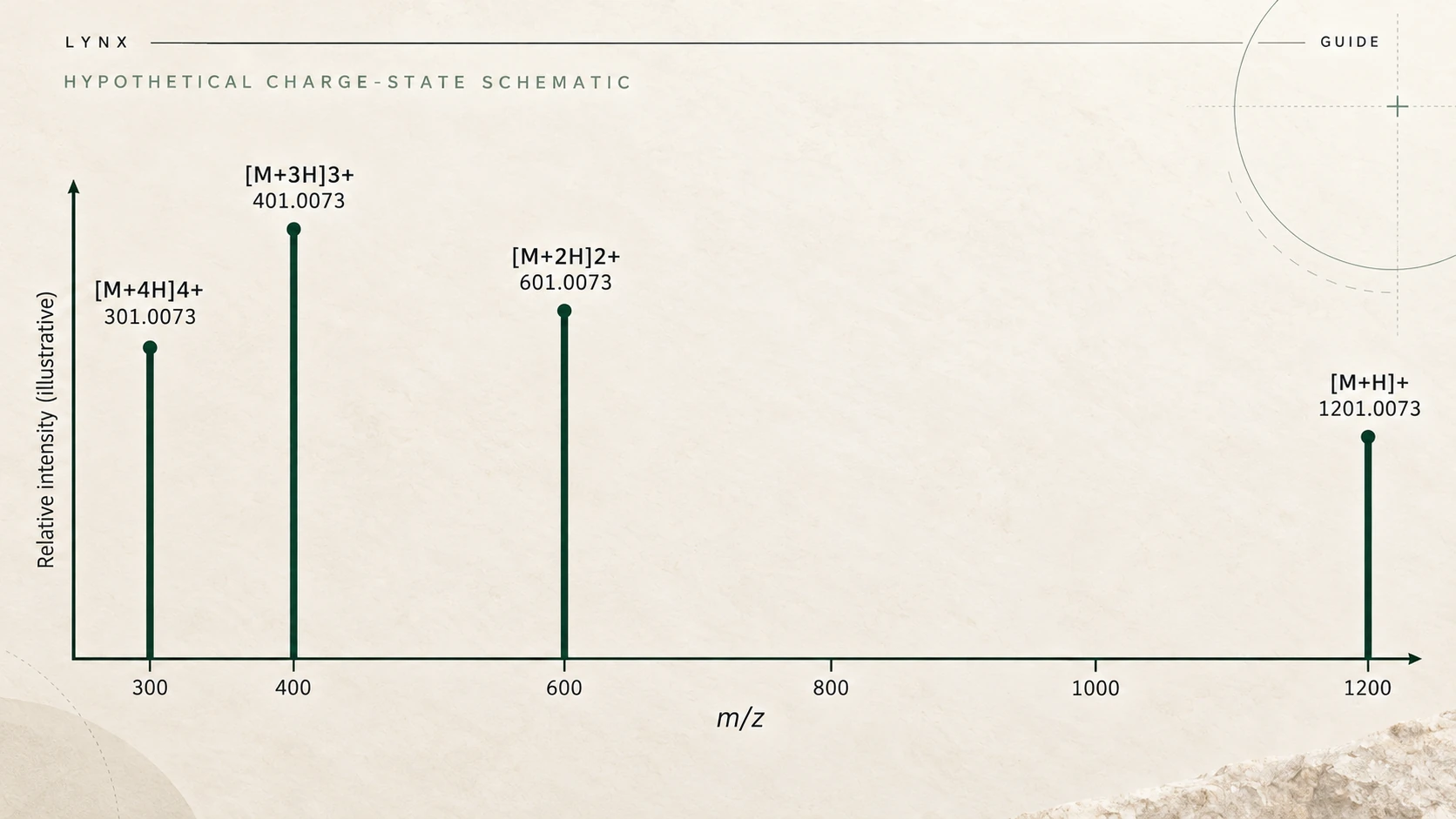
Mass differences refer to molecular mass. The observed mass-to-charge change depends on the ion’s charge state. Assignments need adequate resolution, controls and supporting evidence.
Chromatographic detection
A stability-indicating separation must distinguish relevant altered components from the original analyte. Some modifications change retention enough to resolve, while others co-elute. A clean-looking main peak does not establish that every modified form is absent.
Badgett, Boyes and Orlando demonstrated HILIC separation of selected peptides with methionine oxidation and asparagine deamidation where reversed-phase separation could be insufficient. The HILIC-MS study supports selecting a method for the question, not a claim that one separation is universally adequate.
Detector response, recovery and integration affect quantitation. See HPLC Peptide Purity Explained before interpreting relative peak area as a material amount.
Mass-spectrometry characterisation
Accurate mass can support a modification assignment. Tandem mass spectrometry adds fragment information that may help localise the changed residue. Intact mass or a nominal mass shift alone does not resolve every structural alternative.
Closely spaced signals, isotope patterns and charge states complicate interpretation. Isomeric products such as aspartate and isoaspartate have the same elemental composition and need additional evidence to distinguish. Quantitation needs a justified response model, rather than an assumption that all species ionise equally.
Sample-preparation artefacts
The sample can change during preparation or analysis. Dissolution, prolonged handling, digestion conditions and exposure to oxidants can introduce modifications or affect recovery. A modified species is not automatically proof that the original stored material contained it at the same level.
Blanks, handling controls, preparation-time comparisons and recovery checks can help distinguish material history from preparation effects. These are analytical design questions, not a universal preparation protocol. Report unresolved artefact risks rather than assigning every signal to storage degradation.
A historical purity result is not a stability study
A purity result describes the tested sample at the time of analysis, within the method’s scope. It does not establish a future rate of change, shelf life or the condition of another container.
Stability assessment requires suitable time-point data under defined conditions, methods that detect relevant changes and justified criteria. No such Lynx stability data are presented here. Do not extrapolate a literature experiment into a product-specific guarantee.
Use Analytical Testing and the COA guide to interpret evidence. Consult Quality Assurance for batch documentation and the Research Library for literature context. Lynx materials are for laboratory research only, not for human or veterinary use.
References and scope
- Goolcharran C et al. Comparison of the rates of deamidation, diketopiperazine formation and oxidation in recombinant human vascular endothelial growth factor and model peptides. 2000. Defined model sequences and experimental conditions.
- Badgett MJ, Boyes B and Orlando R. The Separation and Quantitation of Peptides with and without Oxidation of Methionine and Deamidation of Asparagine Using Hydrophilic Interaction Liquid Chromatography with Mass Spectrometry (HILIC-MS). 2017. Selected modified peptides and a specific analytical approach.
These papers do not report testing of Lynx materials or establish a common degradation rate for all peptides.
Explore research materials
Browse research materials and consult the documentation for the relevant product and batch.