On this page
What makes a molecule a peptide?
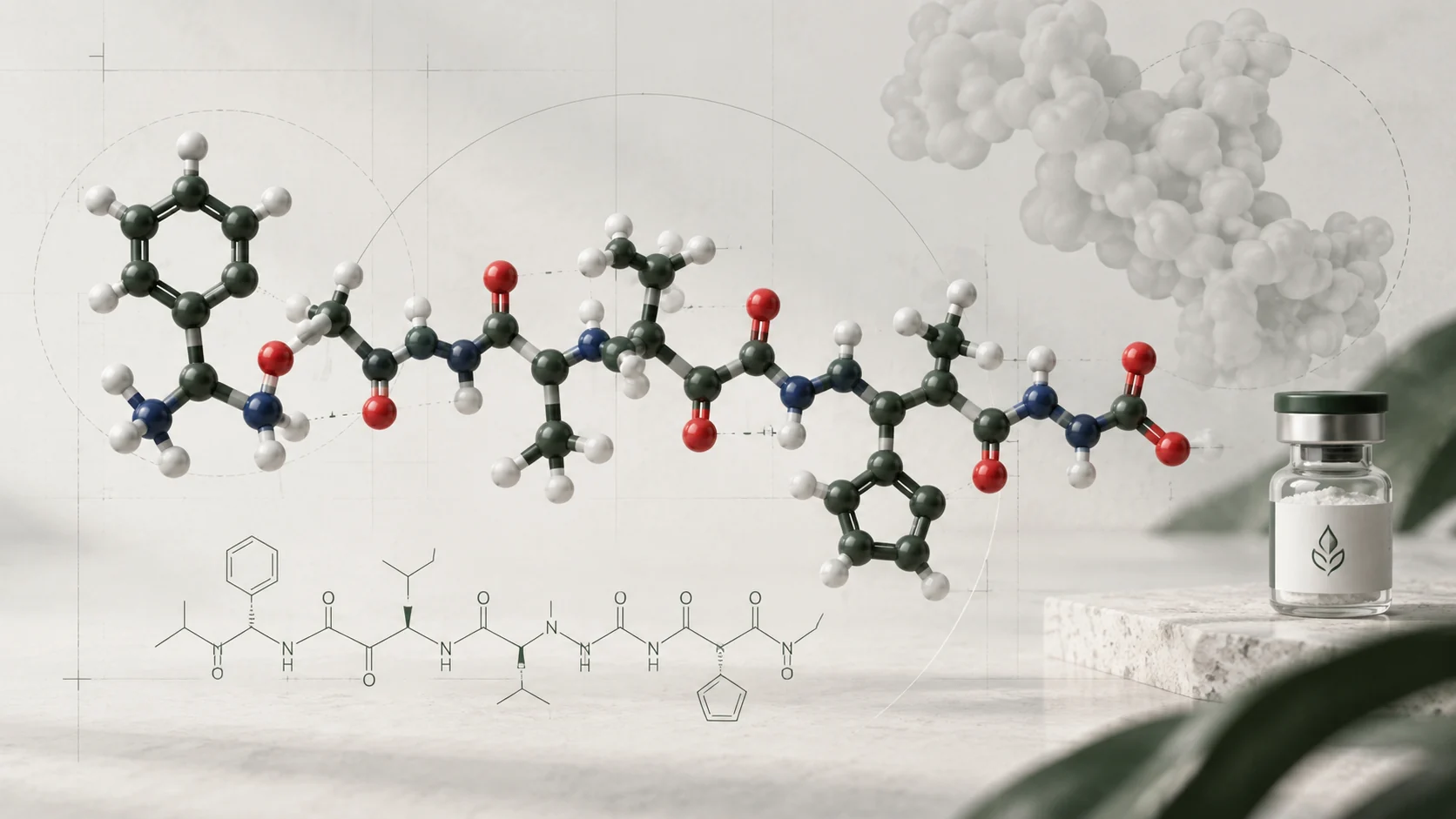
A peptide is a molecule containing two or more amino-acid residues joined through peptide bonds. These bonds are covalent amide linkages. The familiar picture is a chain of residues, but peptide structures can also contain rings and other connections.
The IUPAC definition of peptides is based on chemical structure. It usually concerns compounds derived from alpha-amino acids, although the definition also includes other amino carboxylic acids. A peptide need not be restricted to the amino acids commonly encountered in proteins.
Names such as dipeptide and tripeptide describe molecules with two and three residues respectively. Length is one useful descriptor. The order of residues, their configuration, the bonds between them and any additional chemical groups also help identify the molecule.
A molecular description specifies the structure being discussed. It does not, by itself, establish a biological finding or an analytical result for a particular material.
Amino acids, residues and peptide bonds
An amino acid contains amino and carboxyl groups. In the common alpha-amino acids, these groups are attached to the same carbon atom, which also carries a side chain. Side chains distinguish amino acids from one another. Glycine has hydrogen at this position, while alanine has a methyl group.
In an ordinary alpha-peptide backbone, a peptide bond connects the carbonyl carbon of one residue to the amino nitrogen of the next. The resulting amide connection can be represented as –C(=O)–N–. Joining free amino acids is formally described by loss of the elements of water. This describes the change in composition, not a laboratory synthesis procedure.
Once incorporated into the chain, each amino-acid unit is called a residue. The IUPAC residue definition distinguishes these units from free amino acids. A sequence containing three residues is not a mixture of three separate amino acids.
The backbone is the connected chain of atoms, with side chains attached to it. NCBI's introduction to protein structure explains this distinction between backbone and side chains.
| Term | Meaning when reading a molecular description |
|---|---|
| Residue | An amino-acid unit incorporated into the peptide |
| Backbone | The connected chain of atoms carrying the side chains |
| N-terminus | The amino end of a conventional open peptide chain, which may be modified |
| C-terminus | The carboxyl end of that chain, which may also be modified |
| Sequence | The stated order of residues |
| Topology | The pattern of connections, including whether a ring is present |
Reading a peptide sequence
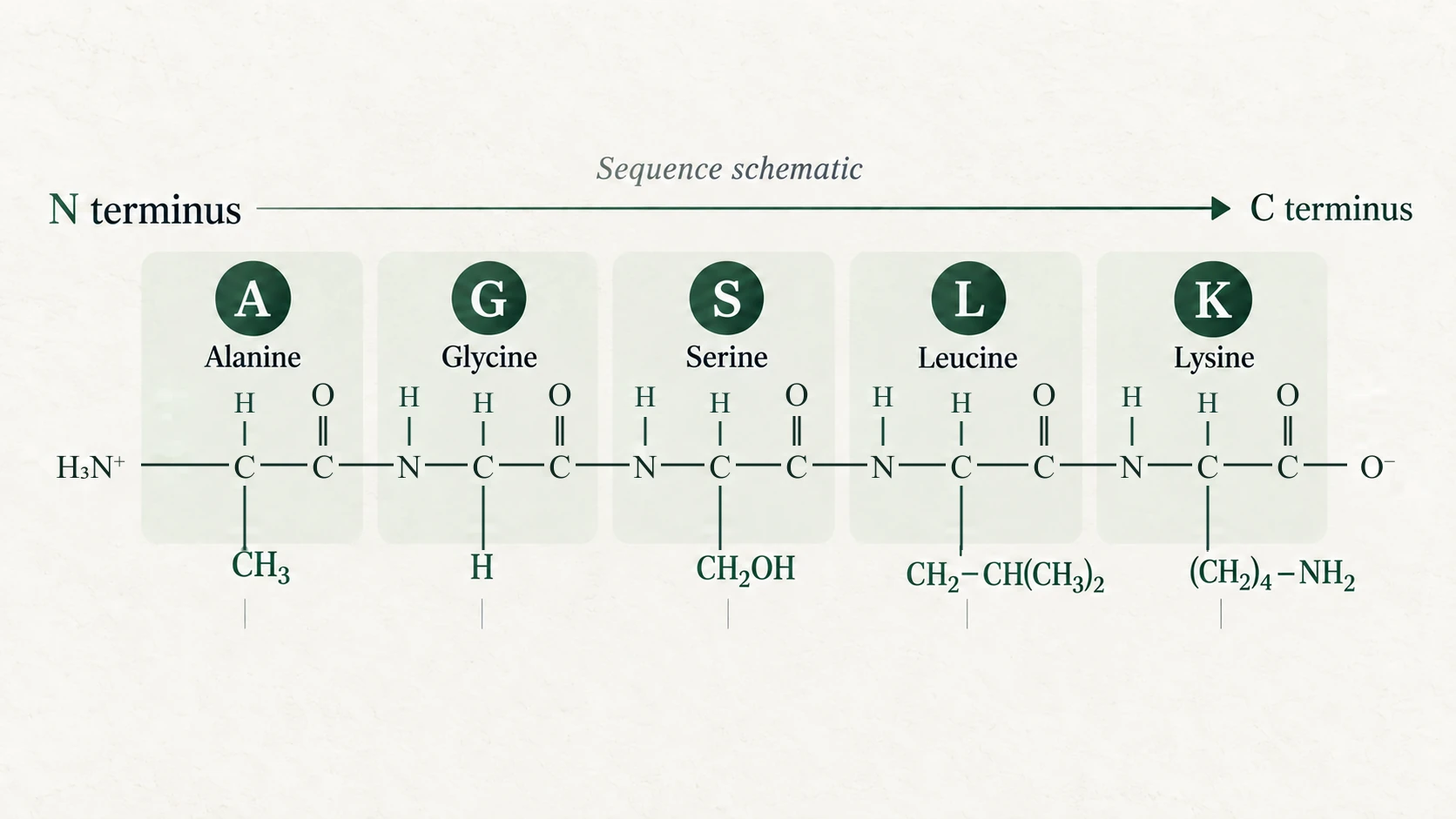
For a conventional open chain, a peptide sequence is written from the N-terminus to the C-terminus, usually left to right. Three-letter notation uses residue symbols such as Gly, Ala and Ser. One-letter notation writes the corresponding symbols G, A and S. The IUPAC one-letter code specifies these assignments and the reading direction.
For example, Gly-Ala-Ser and GAS describe the order glycine, alanine, serine. In this illustrative unmodified linear tripeptide, glycine is at the N-terminus and serine is at the C-terminus. There are three residues and two backbone peptide bonds. Ser-Ala-Gly reverses the order and describes a different sequence.
A sequence is not simply a list of the amino acids present. Position matters. The notation also needs a stated convention for unusual residues, modifications and stereochemistry.
Under IUPAC three-letter conventions, unqualified chiral residue symbols normally imply the L configuration. A D configuration must be indicated. Glycine is achiral. The D prefix in D-Ala is a stereochemical descriptor, whereas the one-letter residue symbol D means aspartic acid. They serve different purposes.
For a catalogue example, BPC-157 is described by the 15-residue sequence GEPPPGKPADDAGLV. Read from N to C, its first residue is Gly and its last is Val. The PubChem BPC-157 record provides a molecular reference. This sequence description does not establish the identity or composition of a particular supplied sample.
Linear and cyclic peptides
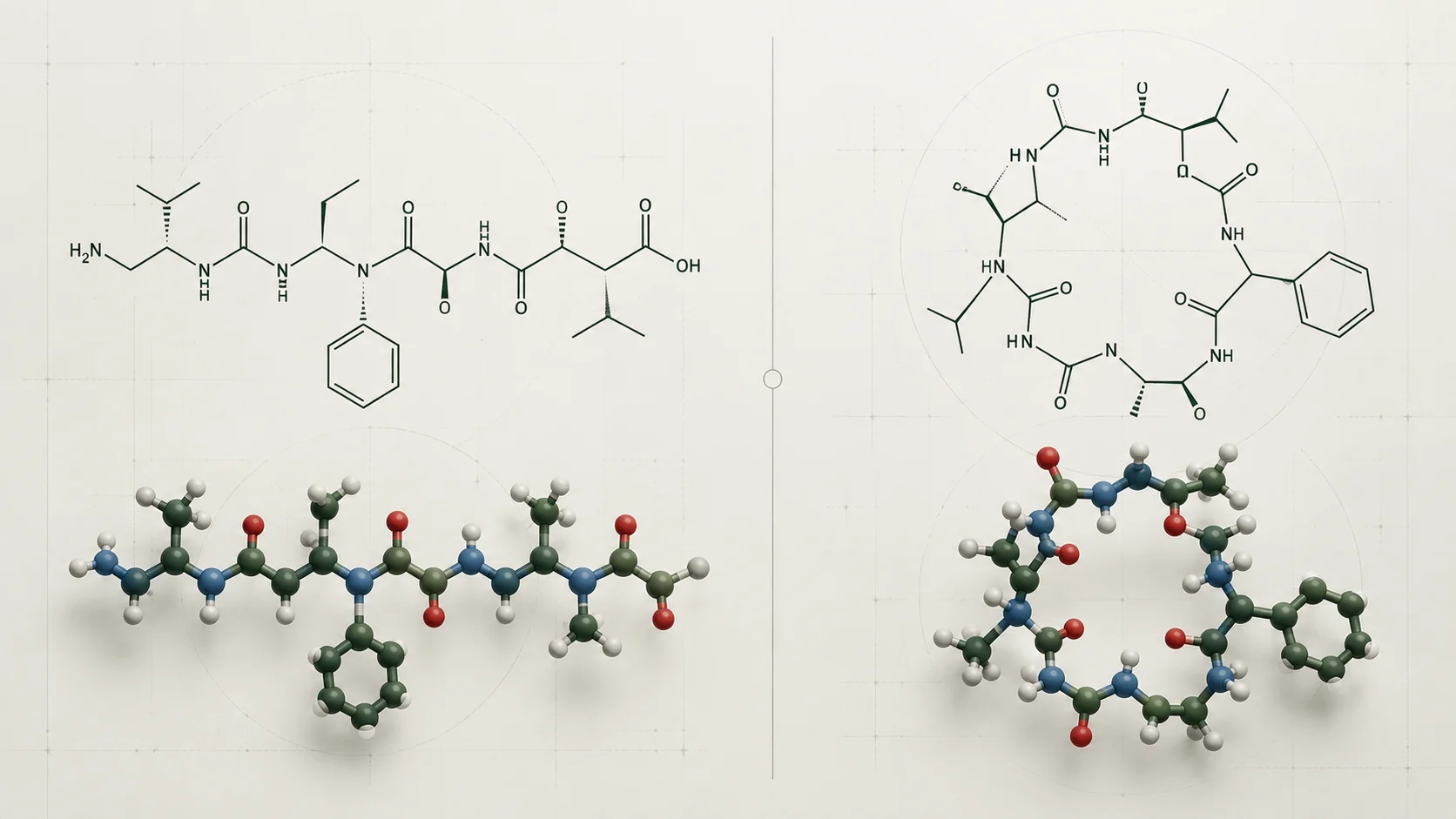
A linear peptide has an open backbone. Its chain can bend, coil or adopt a folded conformation without becoming chemically cyclic. Linear describes connectivity, not a requirement to look like a straight line.
A cyclic peptide contains a covalently closed ring involving part or all of the peptide structure. In head-to-tail cyclisation, a bond joins the former terminal groups. Such a molecule has no free backbone N-terminus or C-terminus. Other rings can involve side chains or a side chain and a terminus. Some cyclic peptides therefore retain terminal groups outside the ring.
IUPAC's peptide nomenclature recognises several kinds of ring closure, including peptide bonds and disulfide links. A disulfide connection is different chemistry from an amide connection.
An open chain has two backbone ends. A head-to-tail ring connects those ends. The residue list alone does not specify that difference. A cyclic sequence written on one line needs the ring connections to be defined. Its chosen starting residue is a notation choice rather than proof of a free N-terminus.
Terminal modifications and molecular form
The ends of an open peptide can carry additional groups. N-terminal acetylation attaches an acetyl group to the terminal nitrogen. C-terminal amidation changes a terminal carboxyl group into a carboxamide. These changes are part of the molecular description, even when the order of residues remains the same.
Using the same teaching sequence, Ac-Gly-Ala-Ser-NH2 describes an N-acetylated, C-amidated form. It differs from unmodified Gly-Ala-Ser. The example illustrates notation, not a Lynx product or an analytical finding. IUPAC peptide symbolism covers substituent notation, including Ac for acetyl, and its substituted-residue conventions describe terminal amides.
Key point: A residue sequence is a starting description of a peptide, not a complete account of every molecular feature.
Check terminal groups, residue configurations, unusual residues and any crosslinks alongside the sequence. A salt description or counterion identifies another aspect of the material. It should not be treated as a change to the residue order. Read the stated molecular form rather than assuming that similarly named materials are chemically identical.
Molecular mass and chemical identity
Peptide documentation often uses molecular weight as a general label. Strictly, IUPAC defines relative molecular mass as a dimensionless ratio. Molecular mass can be expressed in daltons, while molar mass is commonly expressed in grams per mole. Check which quantity and units the document supplies.
A theoretical mass is calculated for a specified chemical composition. The calculation needs to account for the stated sequence, terminal groups and other modifications. It also needs an isotope convention. An average mass uses an isotopic average, while a monoisotopic mass is calculated from the most abundant isotope of each element. NIST's peptide mass-calculator documentation distinguishes these calculations and the corresponding charged ions.
An experimental mass spectrum records ion signals at mass-to-charge ratios, written m/z. A peak position is not automatically the neutral molecule's mass. Charge state, adducts containing additional atoms, and the ion assignment affect that comparison.
Different structures can have the same elemental composition and mass. For example, rearranging the same residues without changing the terminal groups preserves composition while changing sequence. A mass comparison alone cannot settle every structural distinction. Molecular mass also says nothing about how much peptide was measured in a container.
Peptides versus proteins
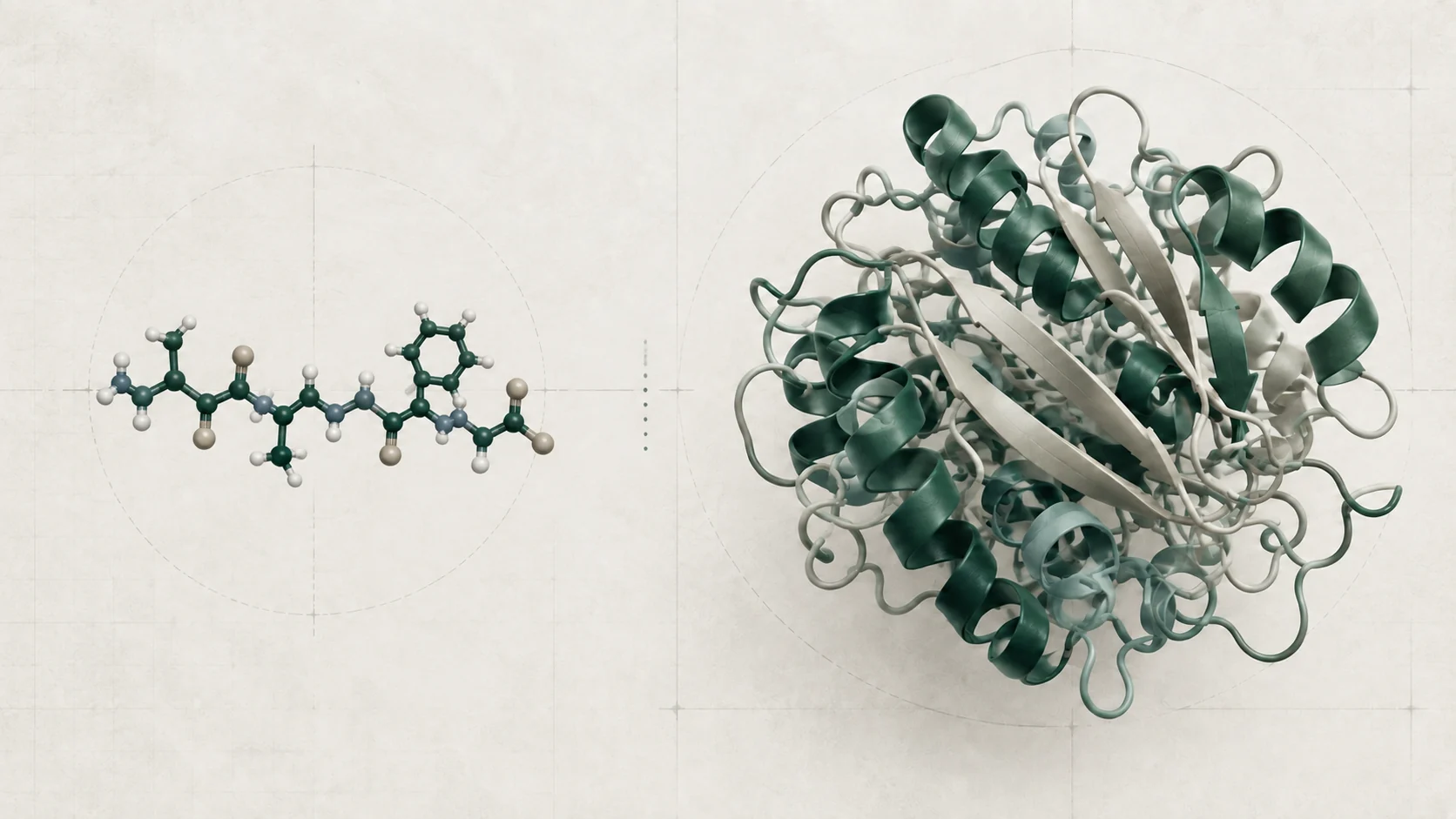
Peptides and proteins share amino-acid residues and peptide-bond chemistry. Peptide commonly refers to a shorter molecule, while protein commonly refers to a larger polypeptide molecule or an assembly of polypeptide chains. Usage varies between disciplines and individual molecules.
There is no single universal residue count that changes a peptide into a protein. The IUPAC protein definition itself qualifies its size boundary as imprecise. A numerical rule without that qualification can be misleading.
Sequence and three-dimensional conformation describe different levels of structure. A chain may fold, and several chains may associate, without changing the order of residues in each chain. Folding alone does not decide whether the name peptide or protein is appropriate. When comparing documents, the defined molecule and its structural features are more useful than the label alone.
Why structure matters in analytical testing
An identity assessment needs a defined target. A peptide name, sequence, terminal modifications and ring connections tell the analyst what structure the observations should be compared with. Omitting one of these details can leave the intended comparison ambiguous.
Mass spectrometry can contribute identity evidence. NIST's discussion of spectral matching explains why matching criteria and measurement conditions matter. An intact-mass comparison does not establish every feature of a peptide. Depending on the question, fragmentation data or other complementary measurements may be needed.
A chromatographic peak is not automatically a structural identification. Identity, chromatographic purity and measured content are separate analytical questions. Understanding Peptide Analytical Testing explains those distinctions in more detail. How to Read a Peptide Certificate of Analysis explains how to connect reported findings to the identified sample or batch.
Neither a sequence printed on a listing nor a theoretical mass is a substitute for the relevant analytical evidence. Keep the proposed molecular description separate from what a particular test has established.
Reading peptide information on Lynx
Start with the molecular information supplied for the material. Check these details before comparing documents:
- Read the exact name and sequence. Check residue order and any distinction between related forms.
- Check the additional structure. Look for terminal modifications, stereochemical labels and defined ring or crosslink connections.
- Read the mass label. Establish the units, calculation convention and molecular form to which it refers.
- Connect the documentation. Match available analytical findings to the stated sample and batch rather than relying on the product name alone.
- Separate the evidence types. Distinguish a structural description, an analytical observation and a finding from a published study.
The Quality Assurance library provides published analytical documentation. Review the report's actual scope rather than assuming that it characterises every structural feature.
The Research Library provides compound-specific research summaries and evidence limitations. When reading a study, check the molecule investigated and its experimental context. A similar name does not establish that a different molecular form has the same evidence. Molecular terminology alone does not establish a biological finding for an individual peptide.
Lynx materials are for research use only. Molecular information supports clear identification and interpretation within that research context.
Explore research materials
Browse research materials and consult the documentation for the relevant product and batch.