On this page
Start with the material, not a universal temperature
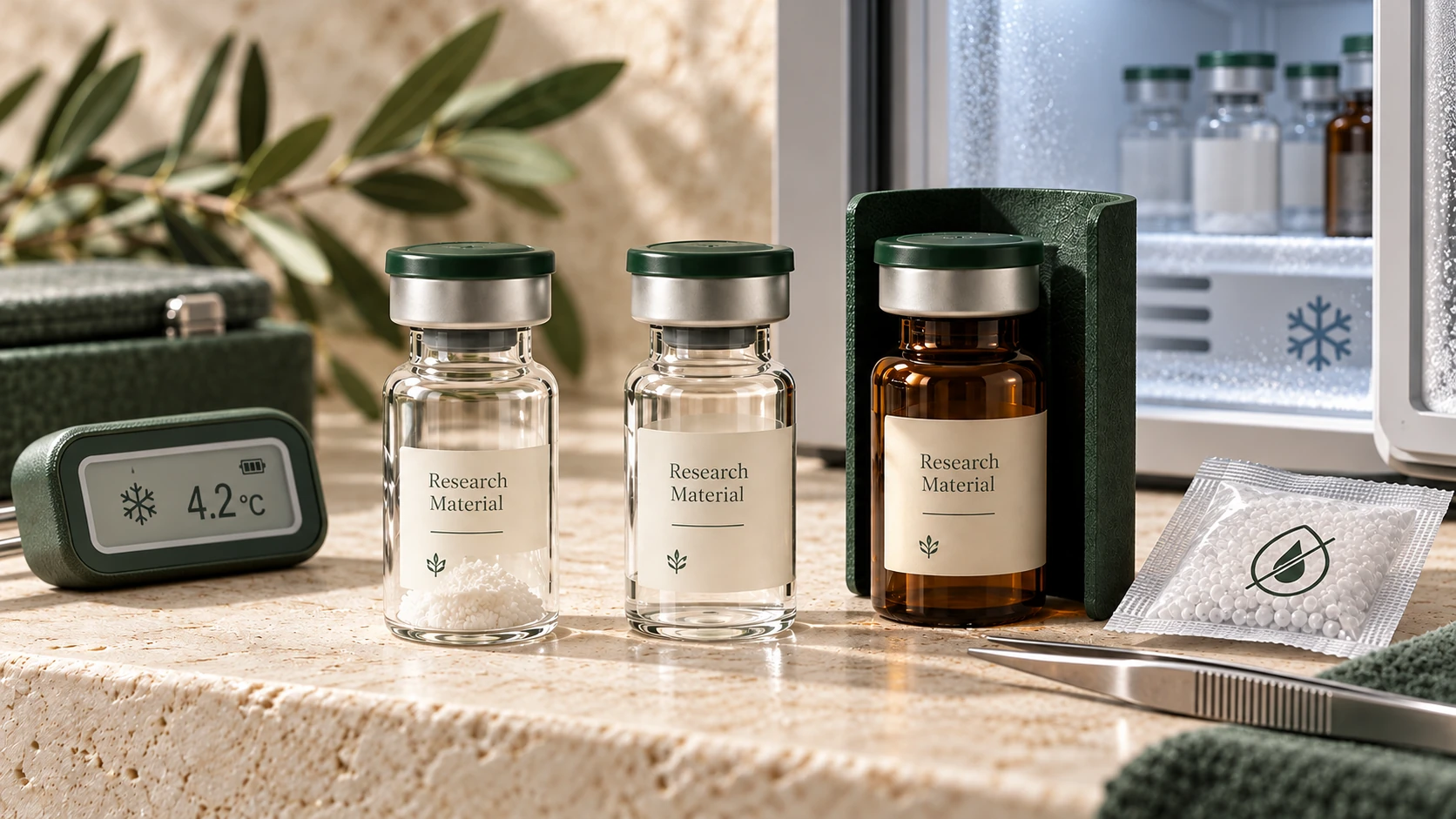
Practical storage guidance for research vials: Keep unopened lyophilised peptide powder cool, dry and protected from direct light, with the vial securely closed to limit exposure to moisture. For longer-term storage, −20°C or colder is commonly recommended for suitable lyophilised materials, provided the product's own storage instructions support freezing. After reconstitution, peptide solutions are generally kept refrigerated at 2–8°C and protected from light; handle them carefully to minimise contamination and unnecessary temperature changes. Do not shake reconstituted vials vigorously; if mixing is needed, gently swirl the vial instead to avoid unnecessary foaming and mechanical stress. When dissolving a lyophilised peptide for laboratory work, avoid vigorous shaking; gently swirl or roll the vial if mixing is needed, following the product's preparation instructions. Avoid repeated warming, cooling and freeze–thaw cycles unless the formulation has been shown to tolerate them.
These are useful general handling principles, not universal stability limits or expiry dates. The appropriate temperature, allowable storage time and treatment after opening depend on the peptide, diluent, formulation and supporting stability evidence. Follow product-specific instructions where available, and do not assume that refrigeration or freezing guarantees an unchanged sample.
Store a research peptide according to the supplier instructions for its exact molecular form, formulation and container. If those instructions are incomplete, ask for the supporting conditions and stability data. A generic rule such as “all peptides last a year in a freezer” is not a defensible substitute.
Stability means retaining specified characteristics over a defined period under defined conditions. Chemical identity, recoverable content and physical state can change differently. Decide which characteristics matter to the experiment before interpreting a storage claim. Hoofnagle et al., peptide handling and stability experiments examines selected analytical peptides, not the whole Lynx catalogue.
Record whether the material is lyophilised or in solution, its batch, stated counterion or formulation and container history. The lyophilisation guide explains why a dry-looking cake is not evidence of zero water or a validated shelf life.
Lyophilised material and solution are different systems
Freeze-drying removes much of the water, but the remaining solid can contain residual moisture, salts and other formulation components. It can still undergo chemical reactions. Thiol-disulfide exchange in defined growth-hormone-derived peptides demonstrates that drying and solid-state storage do not eliminate reactions in every peptide model. Those disulfide-containing models are not direct stability evidence for unrelated sequences.
In solution, pH, solvent, concentration, dissolved species and contact surfaces become part of the stability question. Loss of analytical signal can reflect chemical change, precipitation or adsorption, where material attaches to a surface. Hoofnagle et al., peptide handling and stability experiments found concentration-dependent signal loss in selected samples consistent with adsorption.
A storage statement for an unopened dry container does not establish the working life of a laboratory solution. Conversely, an experiment on a dilute solution cannot assign an expiry date to a lyophilised vial.
Temperature-dependent degradation
Temperature can affect reaction rates, but the relationship depends on the reaction and material state. Hawe et al., oxytocin degradation kinetics measured pH- and temperature-dependent loss of intact oxytocin in defined aqueous formulations using chromatography and complementary techniques. This is evidence for that system, not a temperature prescription for every peptide.
Cooling may slow some reactions without preventing adsorption or other changes. Freezing also changes the physical environment, so colder is not automatically better under every formulation and handling condition. A measured rate at an elevated temperature must not be extrapolated into a shelf life unless the model and relevant degradation pathways are justified.
Read the complete supplier statement: temperature range, material state, duration, packaging and any conditions after opening. “Keep cold” leaves several of those questions unanswered.
Moisture and oxygen exposure
Residual water and moisture uptake can affect a dried material's reactions and physical behaviour. In a primary study of lyophilised insulin, moisture promoted aggregation under the tested conditions. Costantino, Langer and Klibanov, moisture-induced aggregation of lyophilised insulin is a specific protein example, not a universal moisture threshold.
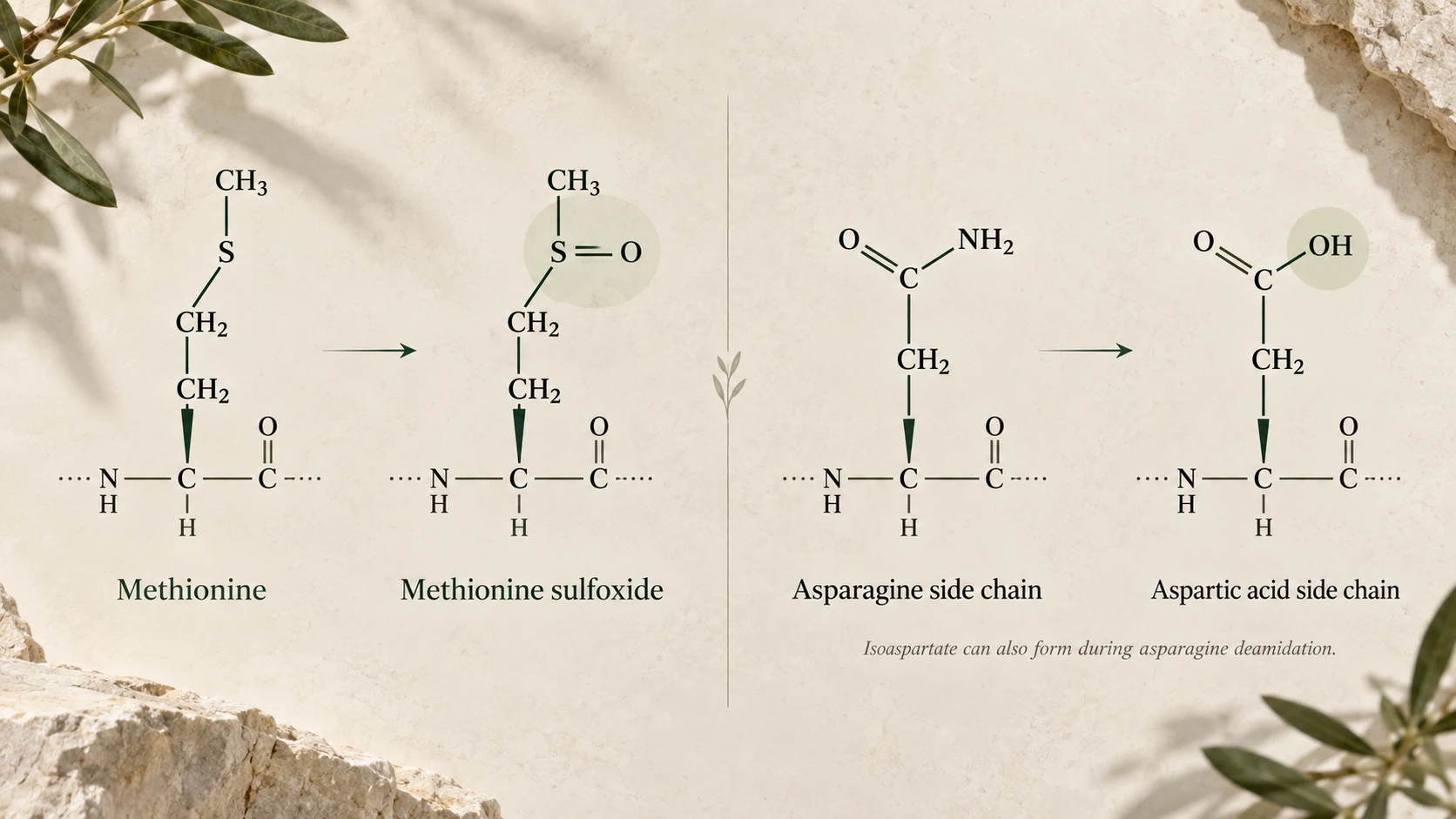
Oxygen and other oxidising species can modify susceptible residues. The extent depends on sequence, environment and exposure. An unopened container is not necessarily oxygen-free, and oxygen contact does not prove that measurable oxidation occurred. Understanding Peptide Oxidation and Deamidation explains the mechanisms and analytical limits, with primary studies.
Protecting the specified container from uncontrolled exposure and recording openings are sensible handling controls. They do not create a validated stability claim. Do not improvise a new atmosphere or packaging system without evidence that it is suitable for the material.
Light sensitivity needs its own evidence
Light exposure can introduce a different stress from temperature alone. Photostability assessment compares exposed material with suitable controls and examines relevant changes. The ICH Q1B photostability guideline describes this principle for drug substances and products. It is cited for study design, not as proof that Lynx materials meet medicinal-product standards.
A light-protection statement should identify the material and packaging it concerns. Neither an amber container nor the absence of visible colour change proves photostability. Where sensitivity is unknown, keep exposure records and seek compound-specific guidance rather than assigning a universal permissible exposure time.
Freeze–thaw effects are sequence- and formulation-dependent
Freezing can concentrate dissolved substances into unfrozen regions and alter the local environment. Repeated cycles are a separate exposure history from continuous frozen storage. The relevance of that stress must be assessed for the actual solution and its container.
Hoofnagle et al., peptide handling and stability experiments includes experiments in which selected peptide signals were similar after the tested freeze–thaw conditions. The same experiments found greater signal variability after ten cycles. Similar average signal therefore does not establish unchanged measurement reproducibility. A cycle is not automatically proof of damage, but these results also do not establish tolerance for another sequence, buffer or concentration.
Where a laboratory method uses frozen solutions, define and record the permitted cycle history within that method. Avoid unrecorded repeated handling. This is a traceability principle, not a universal aliquoting or preparation recipe.
Container integrity and handling records
Keep the material in the specified container unless an established laboratory method requires a change. A cracked vial, compromised closure or unexplained deposit warrants investigation. Appearance records are useful, but neither a normal cake nor a clear solution proves unchanged identity or content.
Hoofnagle et al., peptide handling and stability experiments discusses surface-related loss in analytical peptide solutions. Changing container material or concentration can therefore change recovery even when the molecular structure has not changed. A container that worked for one assay should not be assumed suitable for every peptide.
- Record material name, form, batch and receipt date.
- Retain the supplier's storage statement and its version.
- Record storage location, monitored temperature history and relevant light exposure.
- Record openings, transfers and solution freeze–thaw history where applicable.
- Document closure damage, unexpected appearance and any investigation or disposition.
Interpreting storage excursions and shelf life
An excursion is a departure from specified storage conditions. Record the observed range, duration, affected containers and whether the measurement represents the material's actual exposure. A brief air-temperature spike and prolonged warming of a sample are different histories.
Compare that history with supplier excursion data or a justified stability assessment. Where evidence is missing, the honest conclusion is uncertainty. Returning the container to its usual storage conditions does not demonstrate reversal of a chemical change.
| Question | Evidence to seek |
|---|---|
| Is the temperature range justified? | Time-point data for the identified material, formulation and packaging |
| Does the shelf life apply after opening? | Explicit scope and relevant handling conditions |
| Does an excursion remain acceptable? | Comparable exposure data and justified acceptance criteria |
| Has recoverable content changed? | A suitable quantitative assay, including recovery controls |
| Are new components present? | A stability-indicating method able to distinguish relevant changes |
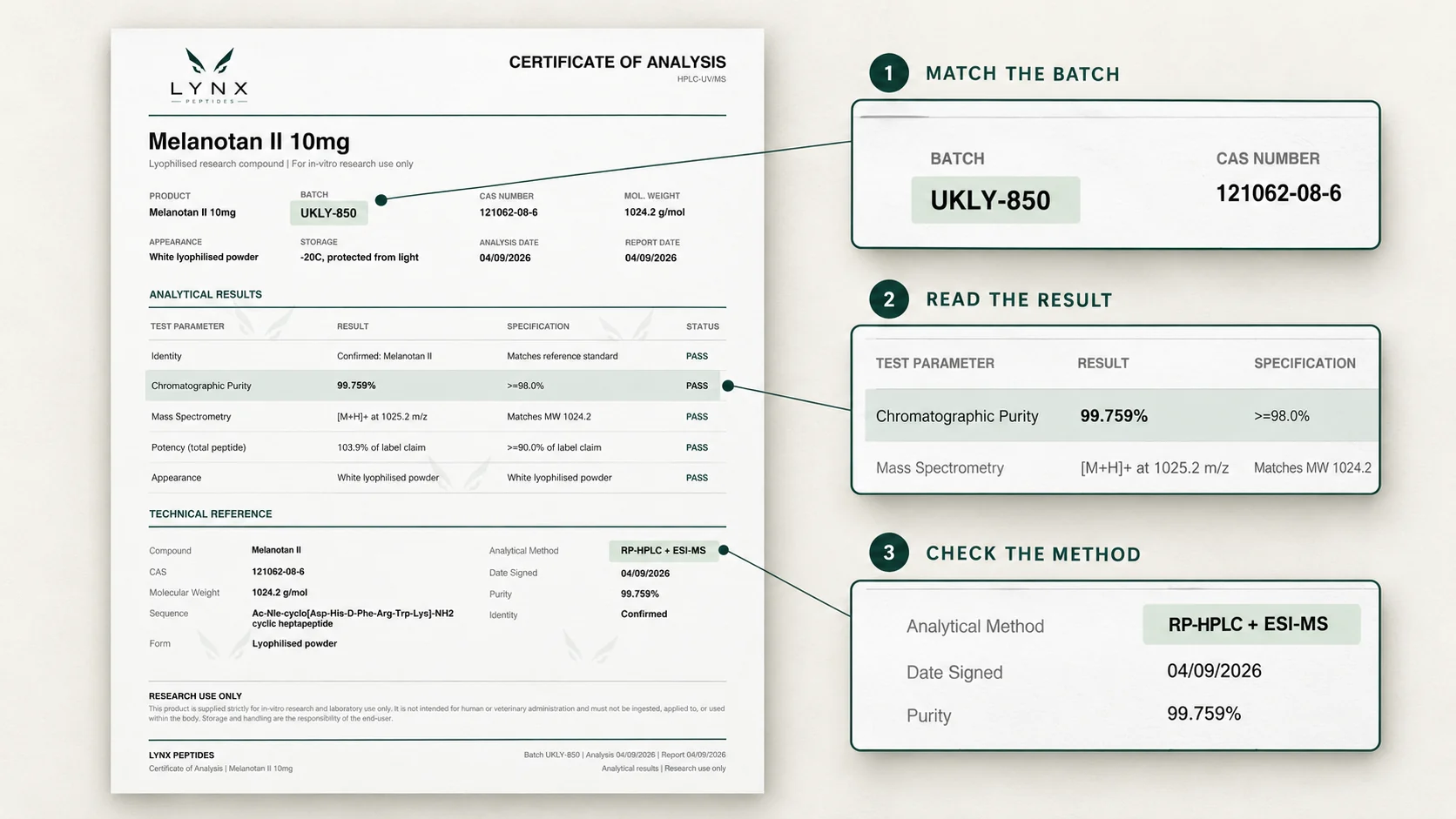
A stability-indicating method detects relevant changes rather than only repeating a headline purity percentage. ICH Q2(R2) analytical validation guideline relates validation to the intended measurement purpose. A historical COA is one observation, not a future stability study.
Use the COA guide, Analytical Testing and HPLC Purity Explained to separate identity, detector response and content. The BPC-157 research overview illustrates why biological literature also cannot establish a supplied batch's shelf life.
Lynx materials are for laboratory research only, not for human or veterinary use. This guide provides no preparation-for-injection, dosing or personal-use instructions.
References and evidence limits
- Hoofnagle AN et al. Recommendations for the Generation, Quantification, Storage, and Handling of Peptides Used for Mass Spectrometry-Based Assays. Clinical Chemistry, 2016. PMID 26719571. DOI 10.1373/clinchem.2015.250563. Recommendations with selected peptide experiments.
- Hawe A et al. Towards heat-stable oxytocin formulations: analysis of degradation kinetics and identification of degradation products. Pharmaceutical Research, 2009. PMID 19343484. DOI 10.1007/s11095-009-9878-2. Defined solution formulations.
- Thiol-disulfide exchange in defined growth-hormone-derived peptides. Chandrasekhar S and Topp EM. Journal of Pharmaceutical Sciences, 2015. PMID 25631887. DOI 10.1002/jps.24370. Growth-hormone-derived model sequences.
- Costantino HR, Langer R and Klibanov AM. Moisture-induced aggregation of lyophilized insulin. Pharmaceutical Research, 1994. DOI 10.1023/A:1018981208076. A lyophilised protein model.
- ICH Q1B photostability guideline. Pharmaceutical photostability study principles.
- ICH Q2(R2) analytical validation guideline. Method purpose and validation.
No Lynx-specific shelf-life, solution-lifetime or excursion-tolerance study is presented here.
Explore research materials
Browse research materials and consult the documentation for the relevant product and batch.