On this page
Read from the N-terminus to the C-terminus
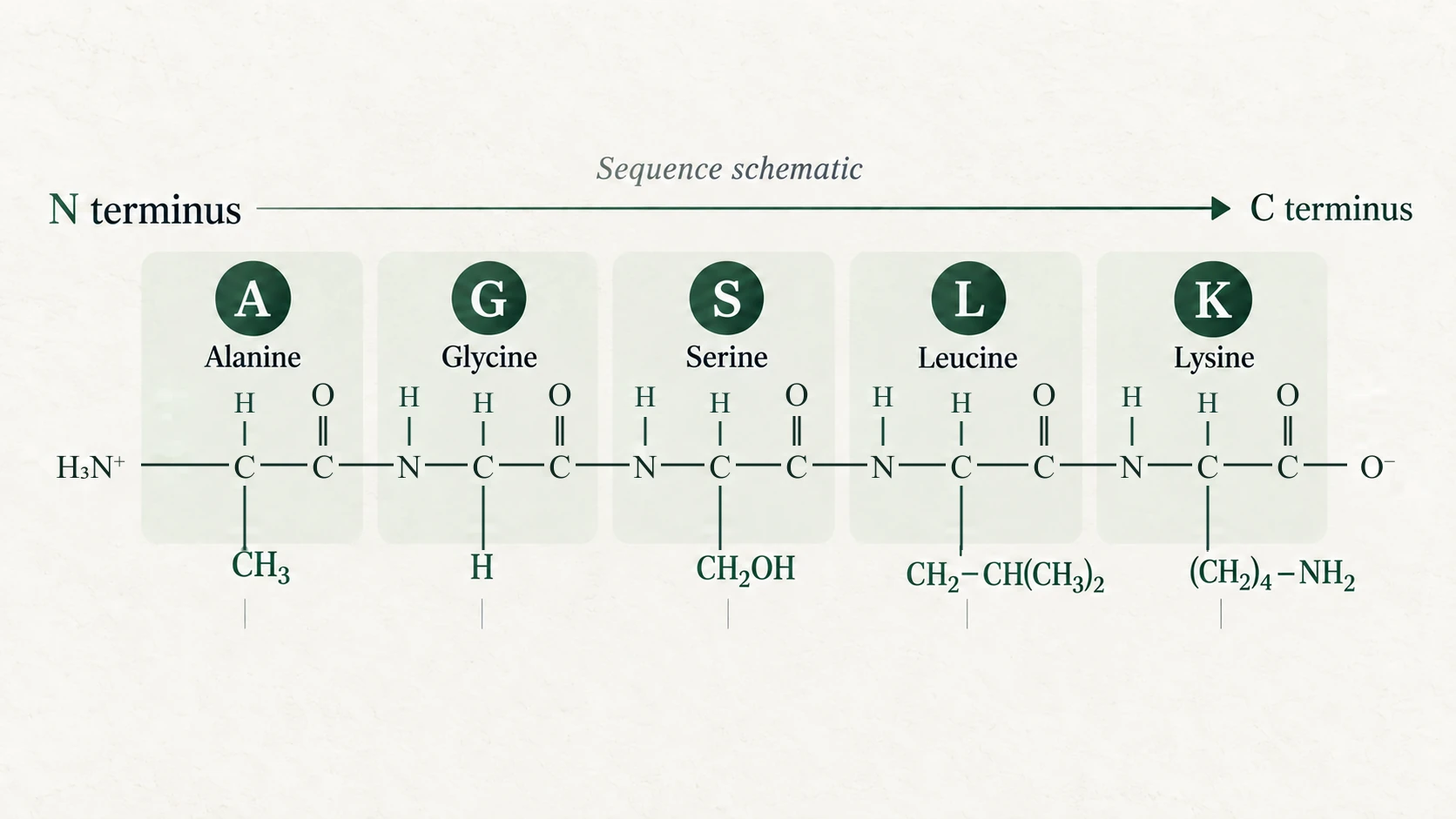
For a conventional open peptide chain, sequence symbols are written from the amino end, called the N-terminus, towards the carboxyl end, called the C-terminus. Each symbol represents an amino-acid residue incorporated into the chain, not a separate free amino acid. Reversing the symbols changes the described sequence. The IUPAC-IUB recommendations set out the direction and residue-symbol conventions.
Three-letter notation uses symbols such as Gly, Ala and Ser. Their one-letter counterparts are G, A and S. A one-letter D means aspartic acid. By contrast, the prefix in D-Ala specifies the D configuration of alanine. The two uses of D must not be confused.
| Residue | Three-letter | One-letter |
|---|---|---|
| Glycine | Gly | G |
| Alanine | Ala | A |
| Serine | Ser | S |
| Aspartic acid | Asp | D |
The What Is a Peptide? guide explains residues and peptide bonds. This page focuses on reading their written order and annotations.
Number residues and identify the ends
Residues are commonly numbered from the N-terminal end of the stated sequence. Position 1 is the first residue, position 2 the next, and so on. In a fragment, the numbering may instead refer to positions in a longer parent sequence. A label such as residues 4–7 should therefore identify the reference sequence and whether the fragment retains those parent positions.
For an open chain, the N-terminal and C-terminal descriptions tell you which groups terminate the backbone. If a terminal group is modified, the residue order can stay the same while the complete molecular form changes. A displayed sequence without end-group information may leave that form unspecified.
Example 1: an unmodified open chain
Illustrative notation: Gly-Ala-Ser, or GAS in one-letter code. Read left to right from N to C: glycine is residue 1, alanine residue 2 and serine residue 3. This example assumes an unmodified open-chain tripeptide with conventional free termini. Ser-Ala-Gly would be a different sequence, even though it contains the same three residue types.
This is a notation exercise, not a Lynx product specification or a measured sample. The IUPAC recommendation distinguishes the residue sequence from a complete statement of every molecular feature.
Terminal groups, D/L configuration and unusual residues
Ac- before the first residue denotes an N-terminal acetyl group. -NH2 after the last residue denotes a C-terminal amide. These are covalent modifications, not counterions. The counterions guide explains that distinction.
The usual unqualified symbols for chiral protein amino-acid residues imply L configuration under the IUPAC peptide convention. D configuration must be specified where relevant. Glycine has no chiral alpha carbon, so a D/L prefix is not applicable to ordinary glycine. A nonstandard residue needs its own defined name or symbol, such as norleucine written as Nle, rather than being silently forced into a standard one-letter code.
Example 2, illustrative terminal and stereochemical notation: Ac-Gly-D-Ala-Ser-NH2 has the same residue order as the first example, but alanine at position 2 is explicitly D, the N-terminus is acetylated and the C-terminus is amidated. It is therefore a different specified molecular form. This example does not claim such a material was tested or supplied by Lynx.
Fragments and cyclisation annotations
A fragment designation says that a shorter sequence is discussed relative to a longer parent. The parent identity, residue range and terminal chemistry should be stated because a fragment's new ends may differ from those in the intact parent. A name alone does not settle every structural detail.
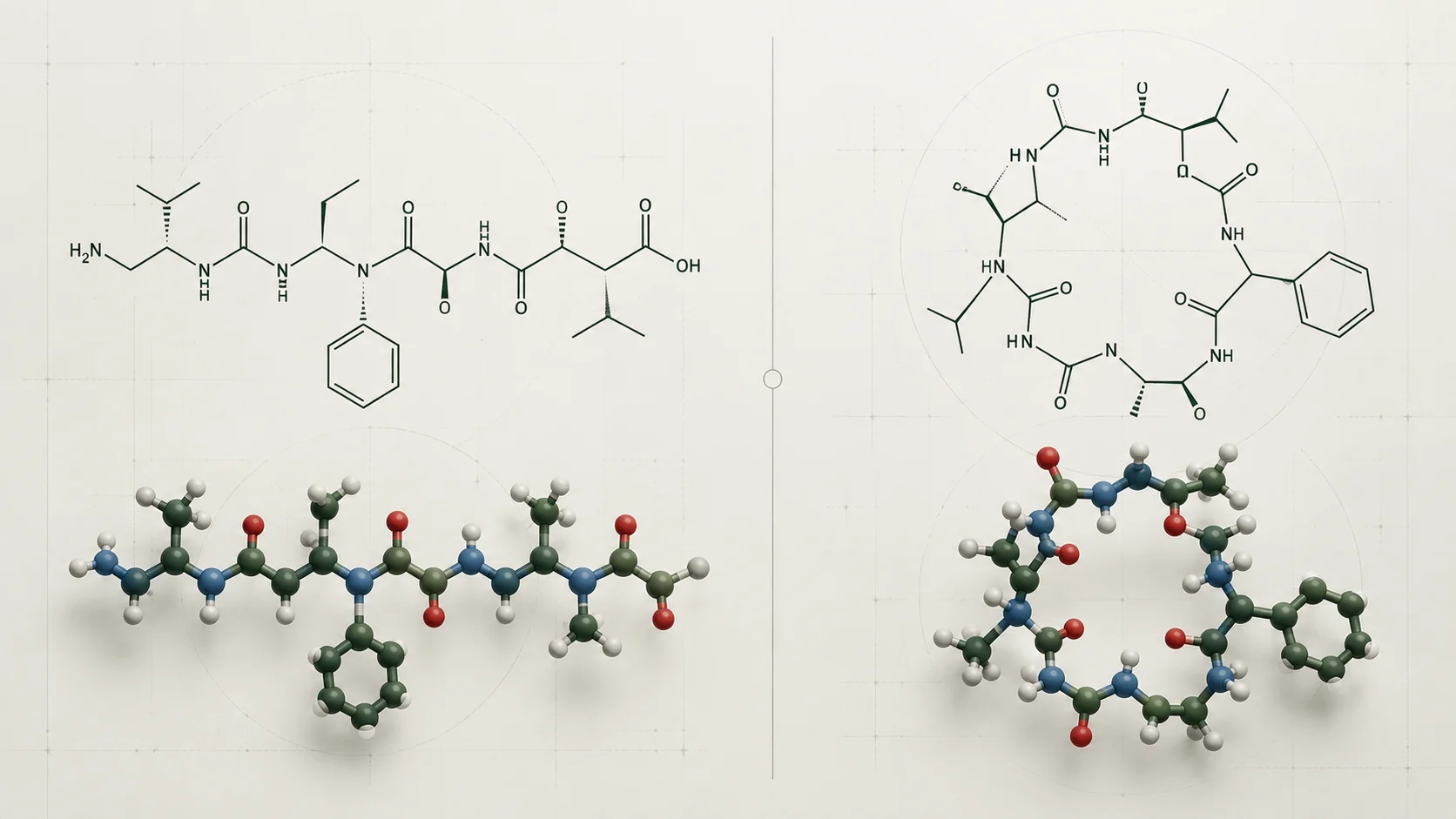
A cyclic annotation must identify the connection that closes a ring. Example 3, illustrative head-to-tail ring notation: cyclo(-Gly-Ala-Ser-) can be used here to indicate a head-to-tail ring made from those three residues. Unlike the open-chain Gly-Ala-Ser example, the backbone ends are joined, so there is no free backbone N- or C-terminus. This is a teaching shorthand, not a claim that every cyclic peptide uses that exact written convention. Side-chain-to-side-chain or side-chain-to-terminus rings need their linkage positions specified separately. See Linear vs Cyclic Peptides for the topology distinction.
A written sequence is not a test result
A sequence states a proposed residue order. It cannot establish that a particular sample contains that molecule, that its terminal groups or stereochemistry match, or how much specified peptide is present. Intact mass can support an identity assessment but may not distinguish sequence isomers or locate a ring connection. Relevant structural questions may require fragmentation or complementary measurements.
Chromatographic purity, molecular identity and measured amount are different questions. Read Understanding Peptide Analytical Testing and How to Read a Peptide Certificate of Analysis when assessing a tested material. Match any report to its sample and batch. The lab-report library contains available documentation, while the Research Library gives literature context rather than proof of a particular batch's identity.
Reference and further reading
IUPAC-IUB Joint Commission on Biochemical Nomenclature, Nomenclature and Symbolism for Amino Acids and Peptides (Recommendations 1983), Pure and Applied Chemistry 56 (1984), 595–624 is the primary notation reference for this guide.
For related context, see Peptides vs Proteins. The examples above are deliberately illustrative. They are not analytical findings or Lynx product salt-form, purity or identity claims. Lynx materials are for laboratory research use only.
Explore research materials
Browse research materials and consult the documentation for the relevant product and batch.