On this page
Counterions are not peptide modifications
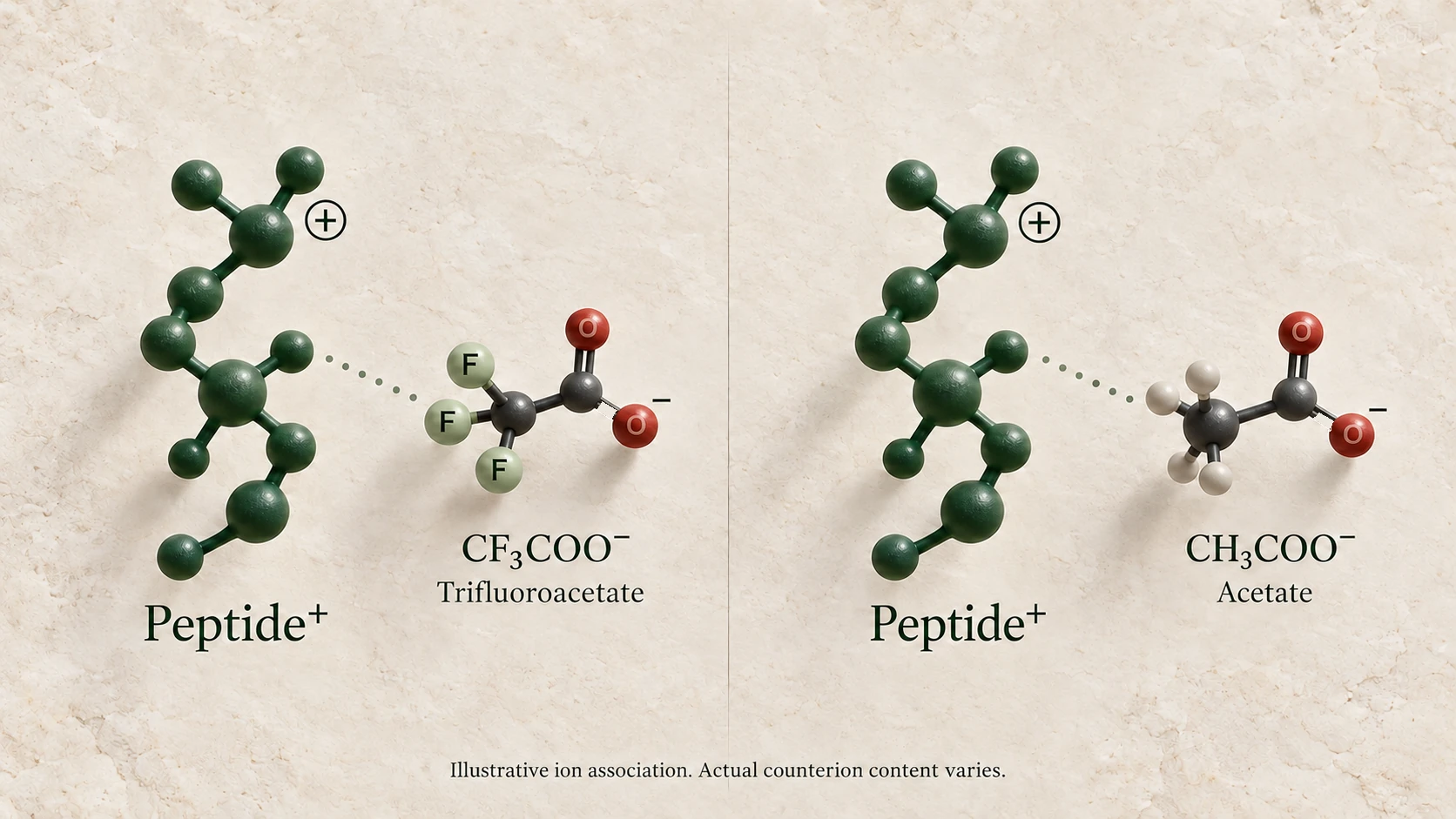
A peptide may carry an electrical charge because of its terminal groups and ionisable side chains. Oppositely charged ions can accompany it so that the material is electrically balanced. Trifluoroacetate, sometimes labelled TFA in peptide documentation, and acetate are two possible anions. Their association with a charged peptide is different from adding atoms through a covalent bond to its backbone or side chain.
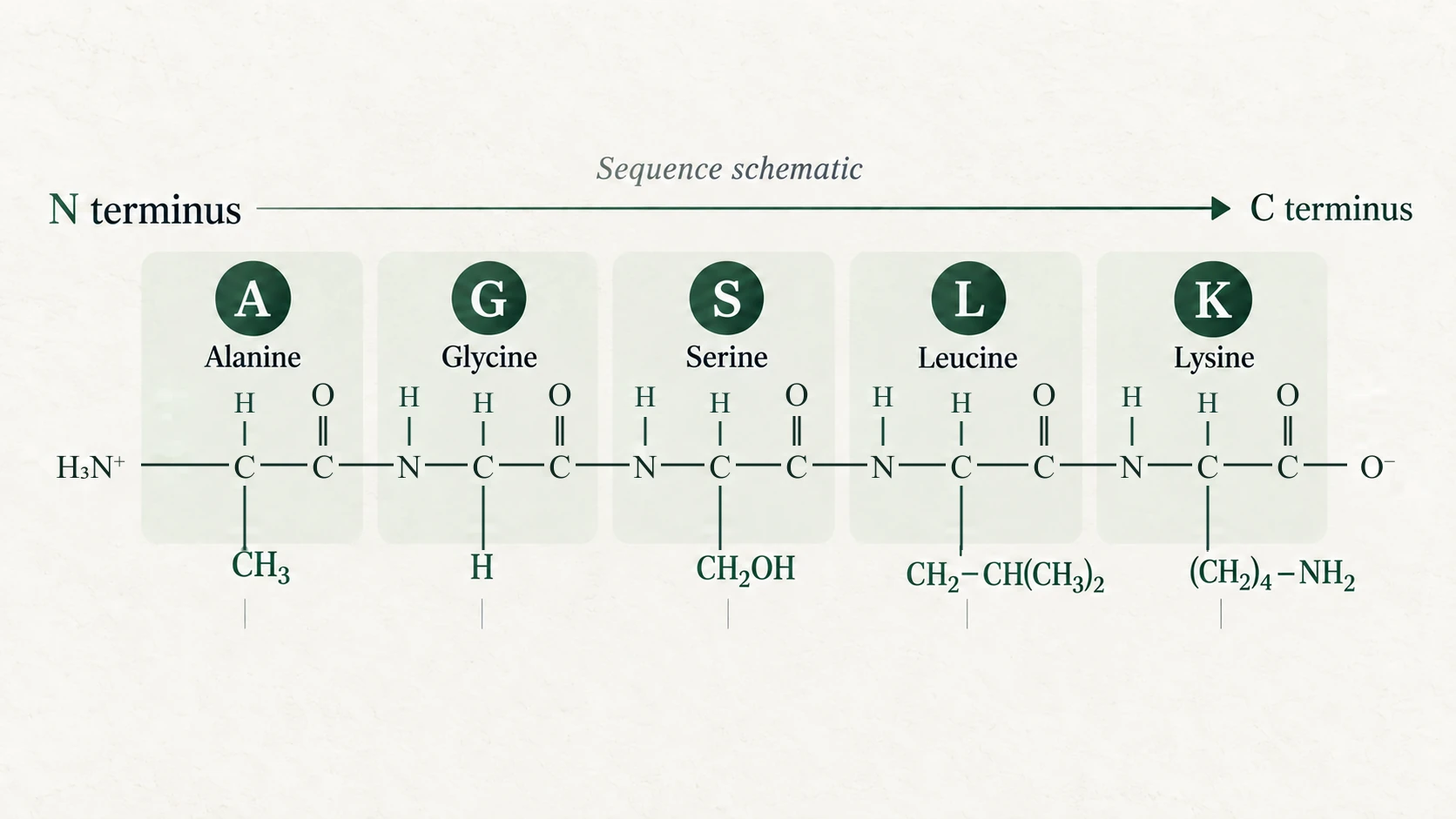
An N-terminal acetyl group is covalently attached to the peptide. Acetate as a counterion is a separate ion. The similar names do not make them interchangeable. Likewise, a sequence states residue order, not the complete counterion composition of a supplied material. See What Is a Peptide? and How to Read a Peptide Sequence for the structural notation.
Charge depends on chemical groups and conditions. A salt label should therefore be read as a material description supported by evidence, not as a fixed number of anions inferred from the sequence alone. Roux and colleagues studied trifluoroacetate associated with a specified cationic peptide. Their findings do not establish the salt form of unrelated materials.
How processing can influence salt form
Peptide synthesis and purification can expose a material to acids and mobile-phase components. Trifluoroacetic acid is used in some solid-phase synthesis workflows and TFA or acetate may be present in reversed-phase purification. Depending on the process and the peptide, associated anions can remain in the isolated material. Thermo Fisher application note 115 discusses measurement of TFA and acetate in peptide samples.
The use of a reagent during manufacturing does not prove its amount in a final batch. Nor does a supplier's generic process description establish the counterion composition of every product. The meaningful question is what the identified material was tested for, using a method suited to that anion.
Counterions, water and material mass
The total mass of a material as received can include peptide, associated counterions, water and other constituents. A theoretical mass calculated from a peptide sequence usually describes a specified molecular form under stated assumptions. It should not automatically be equated with the mass of a weighed salt preparation.
| Quantity | Question it answers |
|---|---|
| Calculated peptide mass | What mass is expected for the stated covalent molecular form and calculation convention? |
| Counterion result | Which anion was measured in the identified sample, and in what amount? |
| Water result | How much water was measured on the method's stated basis? |
| As-received material mass | What was the total mass of the sampled material before any basis correction? |
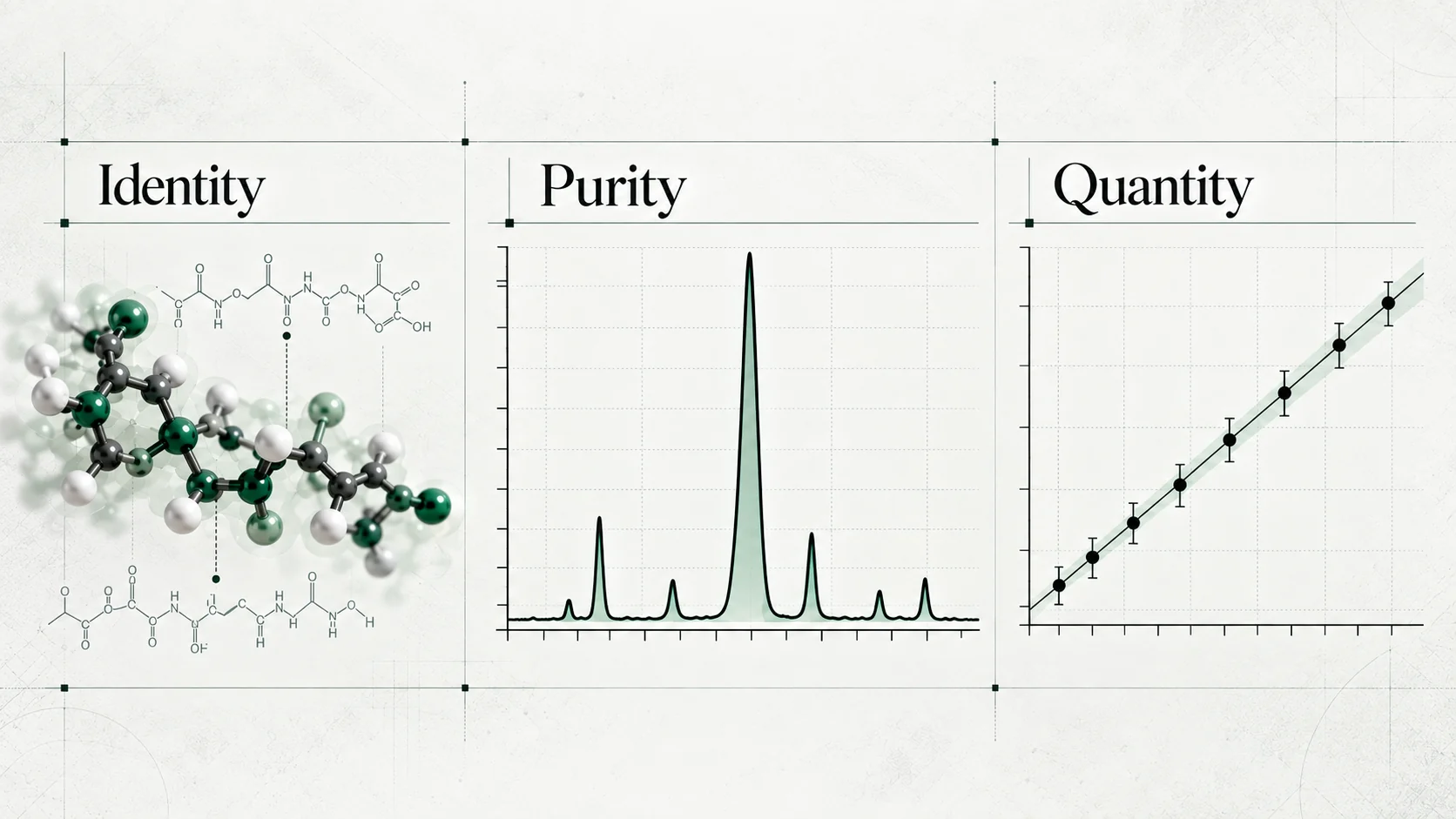
These quantities cannot be substituted for one another. If a report gives peptide content on a dry or counterion-corrected basis, check how that basis was established. Understanding Peptide Analytical Testing explains why identity, purity and quantity require separate interpretations.
Why HPLC and identity tests may leave the question open
An HPLC chromatogram shows detector response from components separated under a particular method. A peptide peak-area purity percentage does not automatically include or quantify small counterions. Their behaviour and detector response may differ from those of the peptide. HPLC Peptide Purity Explained covers the limits of an area percentage.
An intact-mass observation consistent with the expected peptide can support a molecular identity assessment, but it is not by itself a quantitative assay for acetate or trifluoroacetate in the original sample. Likewise, an amino-acid sequence cannot provide a measured salt percentage. Read the actual method and analyte list rather than inferring counterion coverage from the presence of HPLC or mass spectrometry on a report.
Techniques used for counterion analysis
Counterion-specific methods are chosen and evaluated for the sample and analytical purpose. The Thermo Fisher application note describes ion chromatography with conductivity detection to separate and measure fluoride, acetate and trifluoroacetate in peptide samples. Other approaches reported in the literature include capillary electrophoresis, nuclear magnetic resonance and infrared spectroscopy. Roux et al. used fluorine-19 and proton NMR and infrared measurements when examining a particular counterion study.
Seeing a technique name alone is not enough. A quantitative result needs appropriate calibration, selectivity, stated units and a measurement basis. A qualitative signal may support presence without establishing amount. Different methods can answer different questions, and a result from one peptide or preparation cannot be transferred to another.
How to read documented salt-composition evidence
Start by matching the report to the sampled material and batch. Then identify the exact anion tested, the procedure, the reported value and its units. A result in mass fraction, amount per sample or concentration in a prepared solution has a different denominator. Check any dilution or basis correction before comparing numbers.
- Sample connection: Is the tested material identified by batch, lot or laboratory sample code?
- Analyte: Does the report name acetate, trifluoroacetate or another ion explicitly?
- Result and basis: Is the value quantitative, qualitative or below a stated reporting limit? Is it as received or corrected?
- Method scope: Were selectivity, calibration and relevant limitations described for this sample type?
- Other mass contributors: Was water measured separately if the interpretation depends on it?
The COA guide explains how to connect reported findings to a batch. The lab-report library provides available documents. This guide does not assert a TFA or acetate form for any Lynx product whose specific documentation does not establish one.
References and further reading
- Roux S, et al. Elimination and exchange of trifluoroacetate counter-ion from cationic peptides. Journal of Peptide Science, 2008. A study of a defined cationic peptide and analytical approaches.
- Thermo Fisher Scientific. Application Note 115: Determination of Trifluoroacetic Acid in Peptides. An ion-chromatography method example.
For related molecular context, read Peptides vs Proteins, Linear vs Cyclic Peptides and the Research Library. Lynx materials are supplied for laboratory research use only.
Explore research materials
Browse research materials and consult the documentation for the relevant product and batch.