On this page
What lyophilisation means
Lyophilisation is freeze-drying. It removes water from a frozen material under reduced pressure, leaving a dried solid. The term describes how a material was processed. It is not a purity grade, an identity test or a statement that the material contains no water.
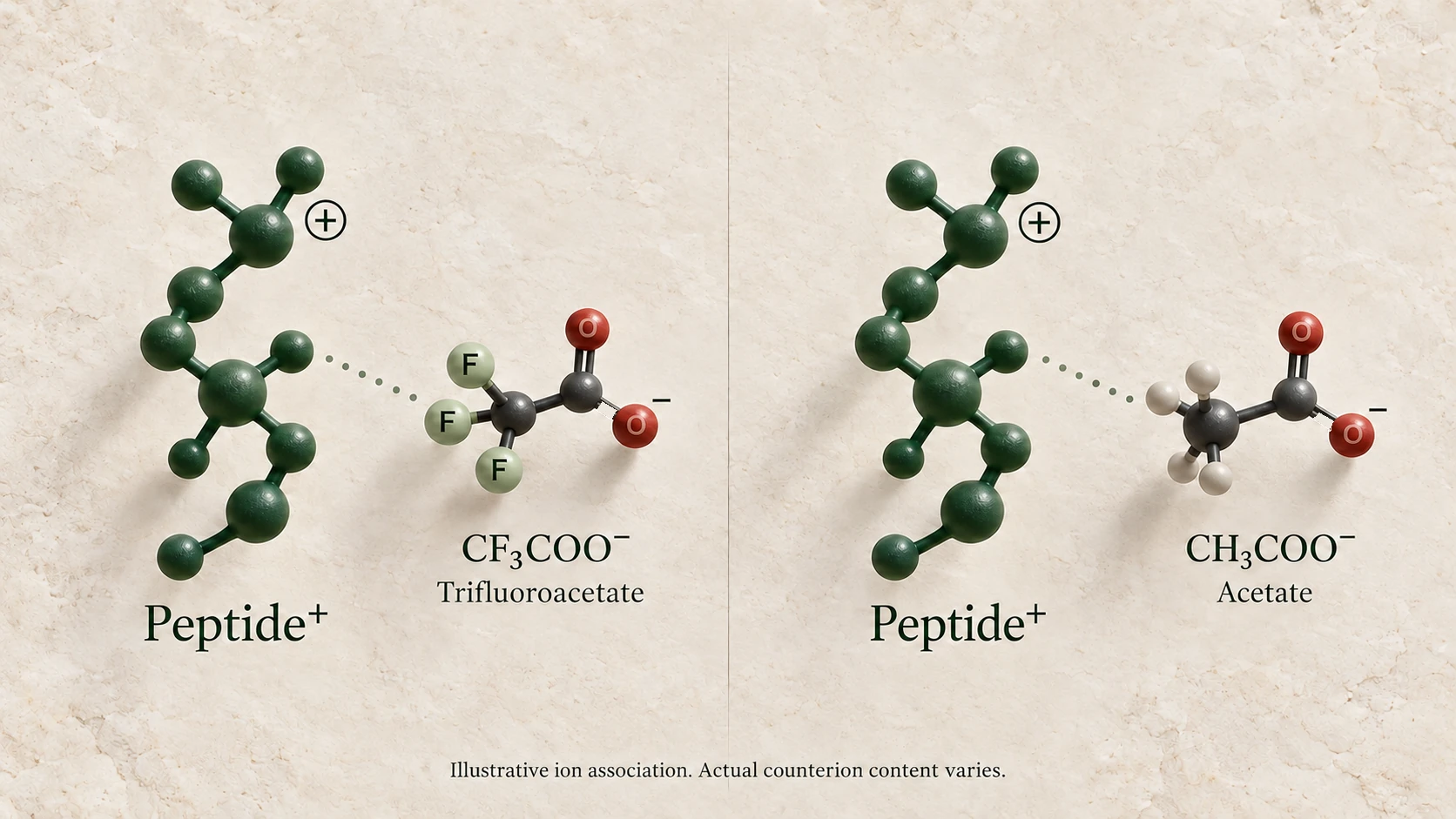
A lyophilised peptide material can include counterions or formulation ingredients as well as the peptide. Its visible structure belongs to that whole material. A photograph cannot separate those components or establish the peptide amount.
Freezing, primary drying and secondary drying
- Freezing
- Water forms ice while dissolved components become concentrated in the remaining unfrozen regions. Composition and freezing history influence the resulting structure.
- Primary drying
- Ice sublimes under reduced pressure. Sublimation is the transition from solid to vapour without passing through a bulk liquid phase. Removing ice can leave a porous solid structure.
- Secondary drying
- Further drying reduces water associated with the remaining solid, rather than removing the main ice phase. It does not guarantee zero residual moisture.
These stages describe the process conceptually. A suitable cycle depends on the material and equipment. They are not processing instructions for a particular peptide.
Why dried materials appear as cakes, films or powders
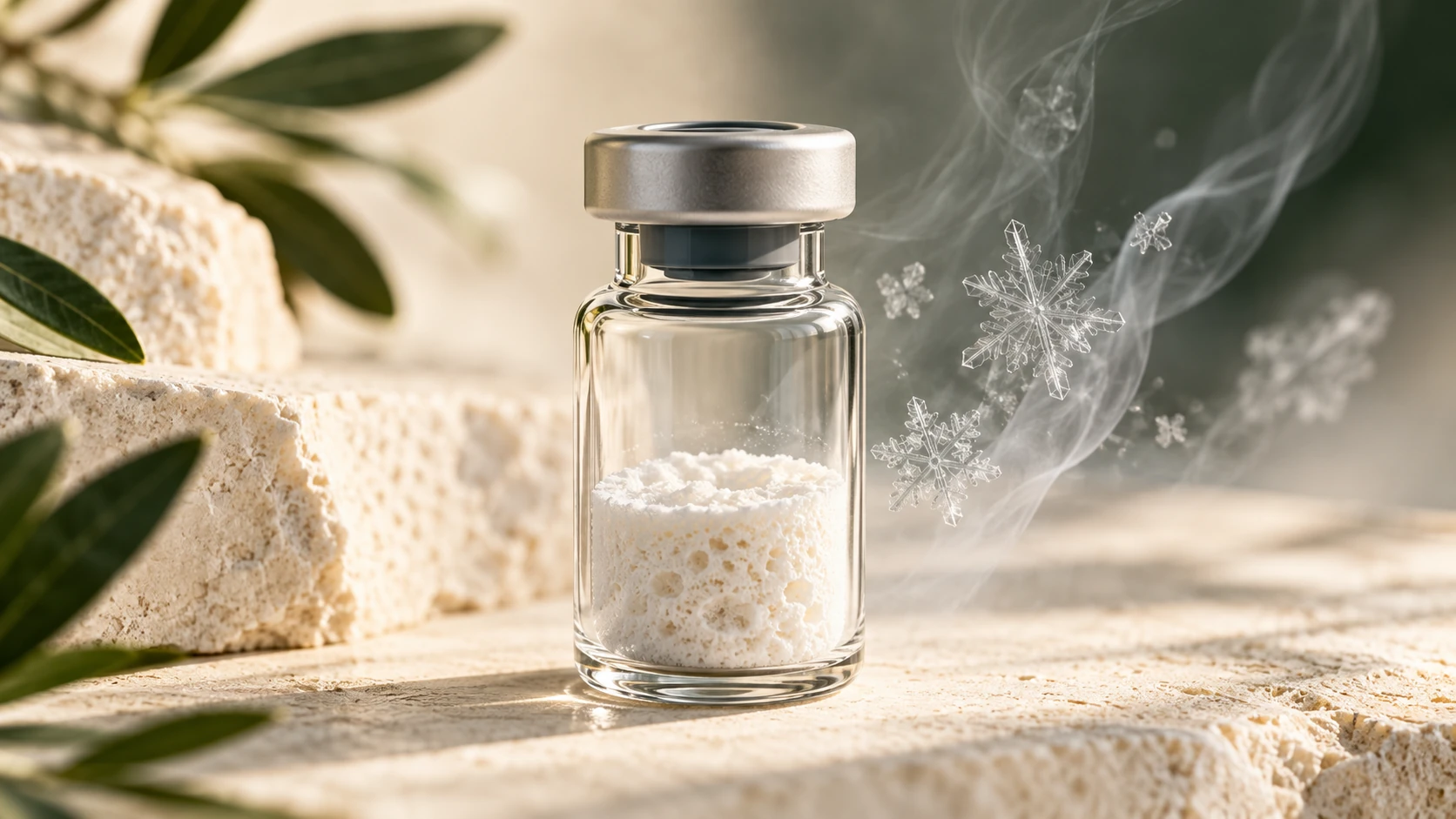
A coherent porous solid is often described as a cake. A thin deposit can look like a film, while a fragmented solid can appear powder-like. These are visual descriptions, not analytical classifications.
Fill depth, solids concentration, crystallisation, amorphous components and drying history can influence the final structure. Handling may also fragment a dried solid. None of these possibilities establishes the cause of an unfamiliar appearance in a specific container.
Rambhatla and colleagues investigated shrinkage in a sucrose model during freeze-drying. Their study connects structure with formulation and processing, but does not provide acceptance criteria for peptide vials.
Composition and processing affect appearance
Crystalline and amorphous solids organise differently. Formulation components influence the behaviour of the drying material, including its tendency to shrink or lose its porous structure. Similar peptide amounts need not produce the same visible volume or texture.
Schersch and colleagues compared collapsed and noncollapsed cakes in specified protein formulations using several analytical techniques. Under those experimental conditions, visual differences did not translate into a relevant difference in measured protein stability. Read the study and its formulation-specific scope.
That finding is not reassurance about an individual vial. It shows why appearance and analytical performance must be assessed separately. A different sequence, composition or processing history could behave differently.
Residual moisture and hygroscopicity
Residual moisture is water remaining after drying. Hygroscopicity describes a material’s tendency to take up moisture from its surroundings. A material can look dry while still containing water. Visual changes cannot quantify water uptake.
Water can influence the physical state and chemical behaviour of dried materials. Its effects depend on the material, packaging and exposure history. More drying is not a universal guarantee of better stability.
Water content requires a suitable measurement, such as a justified Karl Fischer method. Interpretation requires a material-specific specification and sampling context. The word lyophilised does not establish a universal moisture threshold, storage temperature or shelf life.
What appearance may suggest, and what it cannot prove
| Observation and possible interpretation | What it cannot establish |
|---|---|
| A porous cake may reflect structure left after ice removal | Peptide identity, purity, content or successful completion of a validated cycle |
| A film or powder describes the visible deposit | Its composition, cause or equivalence to another container |
| Shrinkage or collapse may justify reviewing process history | Whether the material passes or fails an analytical specification |
| Clumping or surface changes may justify investigating exposure | A measured moisture value or a confirmed degradation pathway |
| A photograph documents visible appearance at one time | Absence of contaminants, stability over time or suitability for use |
Lighting, scale and camera settings affect photographs too. If appearance is unexpected, document the observation and seek the relevant records. Do not classify a vial as safe or acceptable from its appearance.
Use analytical evidence for analytical questions
Identity, chromatographic purity, measured content and moisture answer different questions. Start with Understanding Peptide Analytical Testing and the method-specific limits in HPLC Peptide Purity Explained.
A Certificate of Analysis should identify the tested sample and explain its measurements. Check available batch documentation in Quality Assurance. A historical report does not establish the current condition of an untested container.
The Research Library provides literature context rather than an assessment of a particular vial. Lynx materials are for laboratory research only, not for human or veterinary use.
References and scope
- Rambhatla S et al. Cake shrinkage during freeze drying: a combined experimental and theoretical study. 2005. A sucrose model, not a peptide-vial quality standard.
- Schersch K et al. Systematic investigation of the effect of lyophilizate collapse on pharmaceutically relevant proteins I: stability after freeze-drying. 2010. Specific formulations and tested conditions, not a universal stability claim.
No Lynx stability experiment or material acceptance criterion is reported here.
Explore research materials
Browse research materials and consult the documentation for the relevant product and batch.