On this page
What makes a peptide linear or cyclic?
A peptide contains amino-acid residues connected through peptide bonds. Here, a residue means an amino-acid unit incorporated into the molecule. Linear and cyclic describe how those units are connected. Neither term establishes what the molecule does. IUPAC peptide nomenclature.
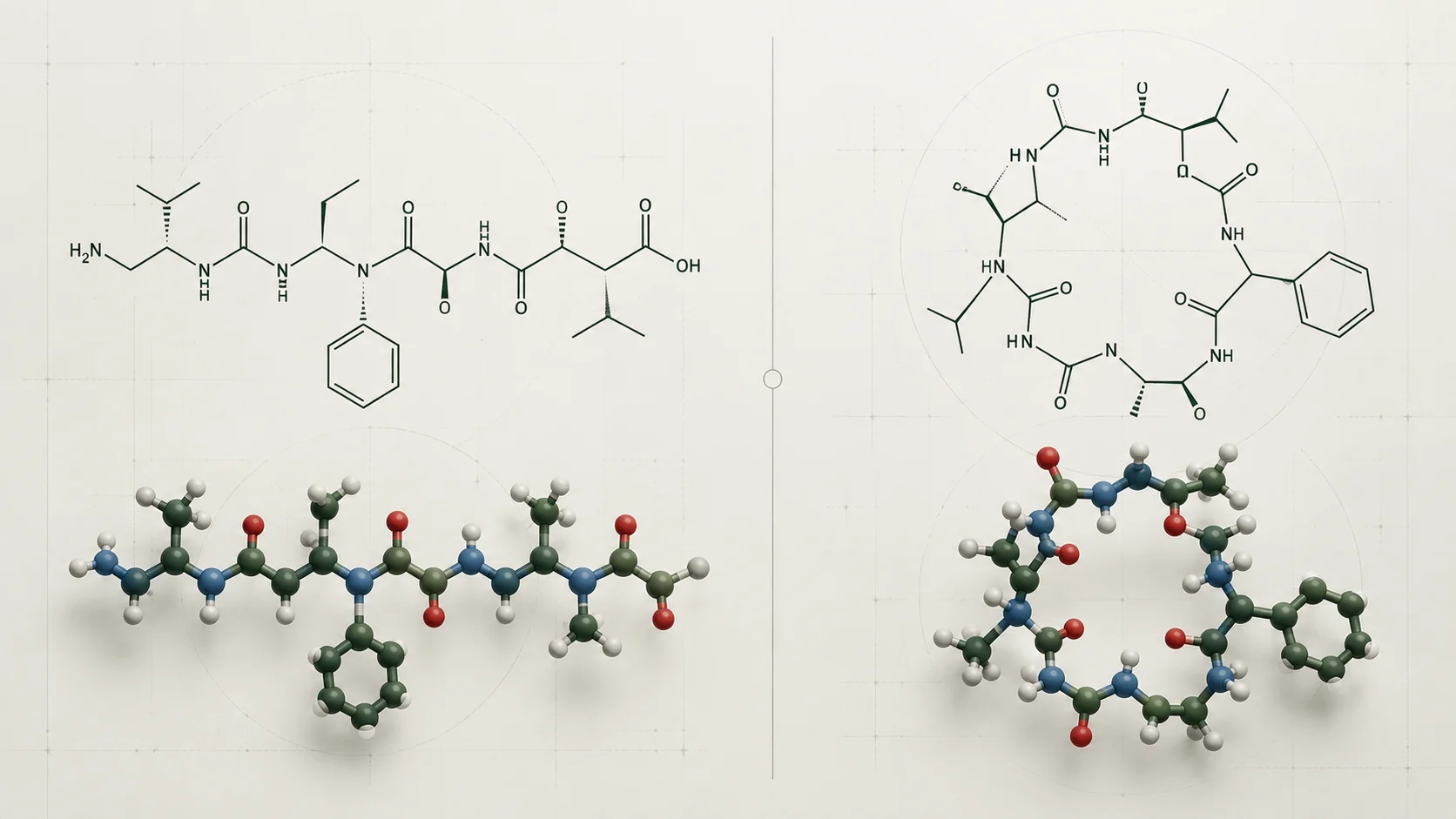
A linear peptide has an open-chain topology. A cyclic peptide contains a covalent connection that closes a ring involving part or all of the peptide chain. The connection can involve the backbone, side chains or a terminus. Different kinds of chemical bond can close that ring. IUPAC cyclic-peptide nomenclature, section P-103.3.6.
Topology means the pattern of connections. A linear peptide need not look straight in three dimensions, and a cyclic peptide need not form a flat circle.
Key point: Linear and cyclic describe connectivity. They do not, by themselves, describe purity, measured content or a single fixed shape.
Understanding an open peptide chain
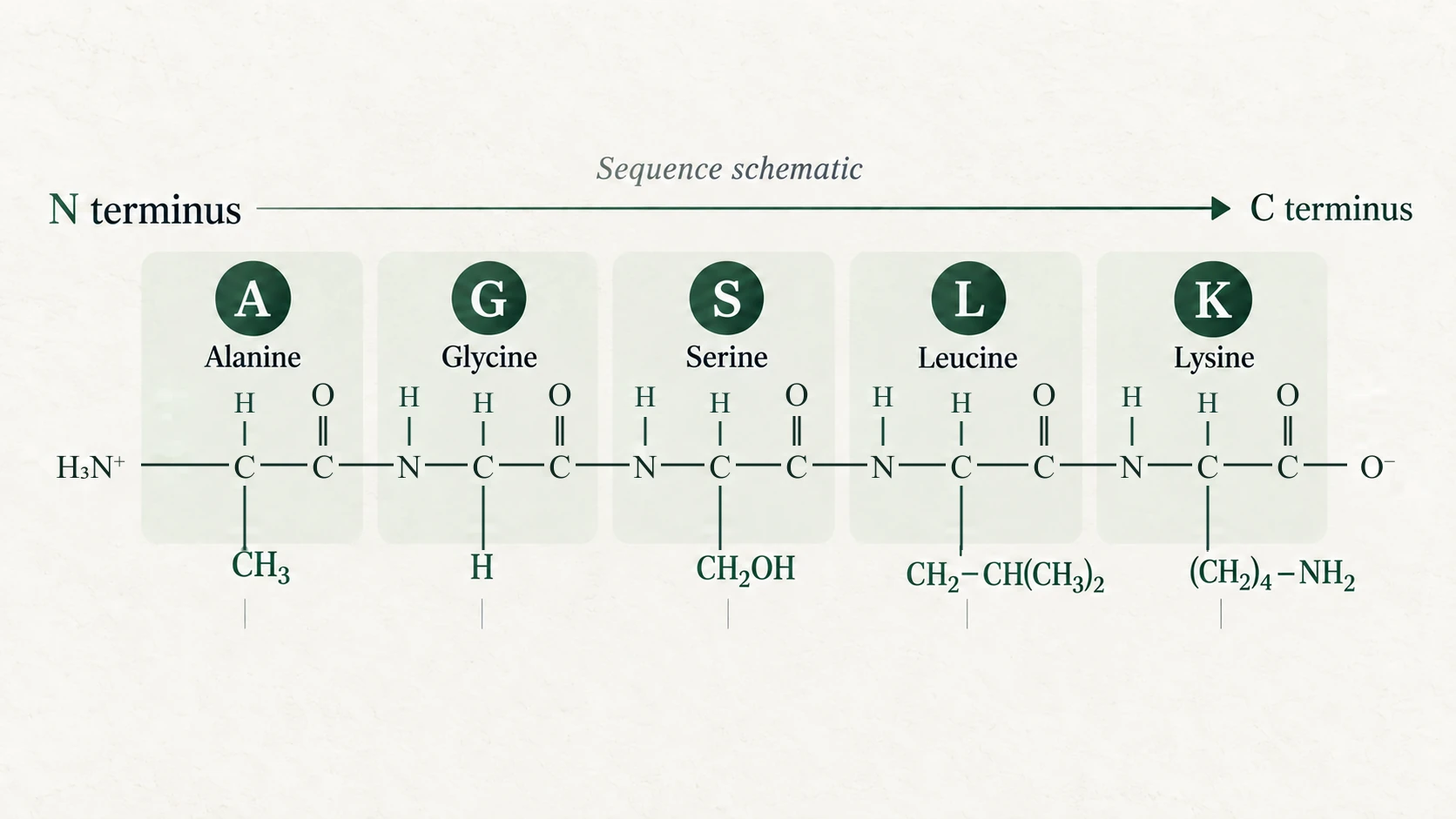
An ordinary open peptide backbone has two distinguishable ends. The N-terminus is the end associated with the first residue's amino group. The C-terminus is associated with the last residue's carboxyl group. These ends can be chemically modified without joining the chain into a ring. IUPAC peptide-chain nomenclature.
“Linear” describes an open chain, not a ruler-like shape. Rotations around accessible bonds allow the chain to adopt different conformations. A conformation is a spatial arrangement that can change without altering which atoms are covalently connected. IUPAC definition of conformation.
A curved drawing of an open chain is still linear in topology. Bringing its ends close together is not ring closure unless a covalent bond connects them.
Different ways to close a ring
Cyclisation creates an intramolecular connection, meaning a connection within one molecule. Several routes are possible. Hayes, Luk and Tsai, Approaches for peptide and protein cyclisation.
Head-to-tail cyclisation
The N- and C-termini join, commonly through an amide bond. The resulting backbone ring no longer has those free backbone ends.
Side-chain-to-side-chain cyclisation
Two residue side chains connect. An amide linkage between suitable side-chain groups is one possibility. The backbone termini can remain outside the ring.
Side-chain-to-terminus cyclisation
A side chain connects to either the N- or C-terminus. Depending on the reacting groups, the closure can contain an amide, ester or another linkage.
Disulfide-linked rings
Two cysteine side chains within the same peptide can form an S–S bond, creating a covalent loop. A disulfide connecting separate chains does not automatically create a ring within either chain. Disulfide connectivity can require specific analytical investigation. Primary study on disulfide-containing cyclic-peptide characterisation.
These categories describe connection sites. A useful structural description also identifies the bond type and the residues involved. “Cyclic” alone leaves those details unanswered.
Sequence and topology describe different things
A sequence records residue order. Composition records which residues are present and how many there are. The same residue composition can occur in a different order, or with a different pattern of connections. Neither a residue count nor a bare sequence is automatically a complete structural map. Cyclic-peptide notation needs to make the ring linkage clear, and stereochemical prefixes can distinguish residue configurations. IUPAC peptide symbolism, sections 3AA-19.2 and 3AA-19.5.
Consider this notation from the published Lynx Melanotan II COA:
Ac-Nle-cyclo[Asp-His-D-Phe-Arg-Trp-Lys]-NH2
The report describes a cyclic heptapeptide, meaning seven amino-acid residues. Six appear in the bracketed segment, while Nle, norleucine, precedes it. Ac indicates an acetyl group and the final NH2 indicates terminal amidation. D-Phe identifies the stated configuration of phenylalanine. Melanotan II COA, technical reference.
The molecular description uses an Asp-to-Lys side-chain lactam, a ring containing an amide linkage. It is not a head-to-tail closure of the entire backbone. This connectivity is described in the synthesis literature, and the compound record represents paired linkage positions at Asp and Lys. Primary Melanotan II synthesis paper, NIH PubChem, CID 92432.
This example explains notation only. The batch report is not a general analytical conclusion for every material bearing that name.
Conformational flexibility and structural constraint
An open chain can explore a range of spatial arrangements. Ring closure keeps the linked parts connected, restricting the arrangements available to the molecule. A ring can still bend or pucker, and cyclic peptides can have more than one accessible conformation. Chan, Hutchison and Morris, Understanding Ring Puckering in Small Molecules and Cyclic Peptides.
The result depends on ring size, residue identities and chemical environment. Cyclisation does not identify one universal shape or establish that every cyclic peptide is more stable than every linear peptide. Sequence–structure relationships need molecule-specific examination. Slough, McHugh and Lin, Understanding and designing head-to-tail cyclic peptides.
Terminal modifications and molecular form
N-terminal acetylation adds an acetyl group at the chain's amino end. C-terminal amidation replaces the terminal carboxyl hydroxyl with an amino group. Neither modification alone connects two distant parts of the molecule. An acetylated or amidated peptide can remain open-chain. IUPAC amino-acid derivative nomenclature, sections 3AA-7 and 3AA-9.2.
The description should specify terminal groups alongside residue order and any ring linkage. The same residue list can describe different molecular forms if terminal chemistry, residue configuration or connectivity differs. Different conformations do not necessarily mean different covalent structures.
Molecular mass and analytical evidence
Molecular mass reflects elemental composition. Ring formation or terminal modification may change that composition, depending on the chemistry. The mass expected for a specified molecular form is useful evidence, but different structural arrangements can share a mass. Intact mass alone does not necessarily locate a ring bond. Fragmentation and complementary measurements can supply additional structural information. Structure-aware tandem-mass-spectrometry study.
Mass spectrometry can examine mass and fragment patterns. NMR spectroscopy can add evidence about connectivity and spatial relationships. Appropriate methods depend on the structural question, and no one method should be assumed to settle every feature. Disulfide-containing peptide characterisation study.
For that analytical distinction, read Understanding Peptide Analytical Testing.
Linear vs cyclic peptides at a glance
| Feature | Linear peptide | Cyclic peptide |
|---|---|---|
| Topology | Open peptide chain | Covalent ring involving part or all of the chain |
| Termini | Distinguishable backbone ends, which may be modified | Depend on closure type, with ends potentially retained outside the ring |
| Sequence representation | Residue order plus relevant modifications | Residue order plus explicit ring linkage and modifications |
| Conformation | Open topology permits a range of arrangements | Closure adds constraints, but does not fix every spatial arrangement |
| Closure linkage | No peptide-chain ring closure | May involve backbone or side chains and different bond types |
| Identity evidence | Must support the specified molecular form | Must also address the relevant cyclic connectivity when required |
These structural distinctions do not rank either class or replace analytical evidence.
Reading structural information on Lynx
Start with the stated molecular form. Check residue order, terminal groups and the location and type of any ring closure. Then ask which features the analytical documentation actually examines.
Match the document to the relevant sample and batch, rather than treating a shared compound name as proof that reports are interchangeable. How to Read a Peptide Certificate of Analysis explains that documentation check. Published reports are available in the lab-report library.
Compound-specific studies belong in the Research Library. All Lynx materials remain supplied for laboratory research use only, not for human consumption.
Explore research materials
Browse research materials and consult the documentation for the relevant product and batch.