On this page
From amino acids to a peptide chain
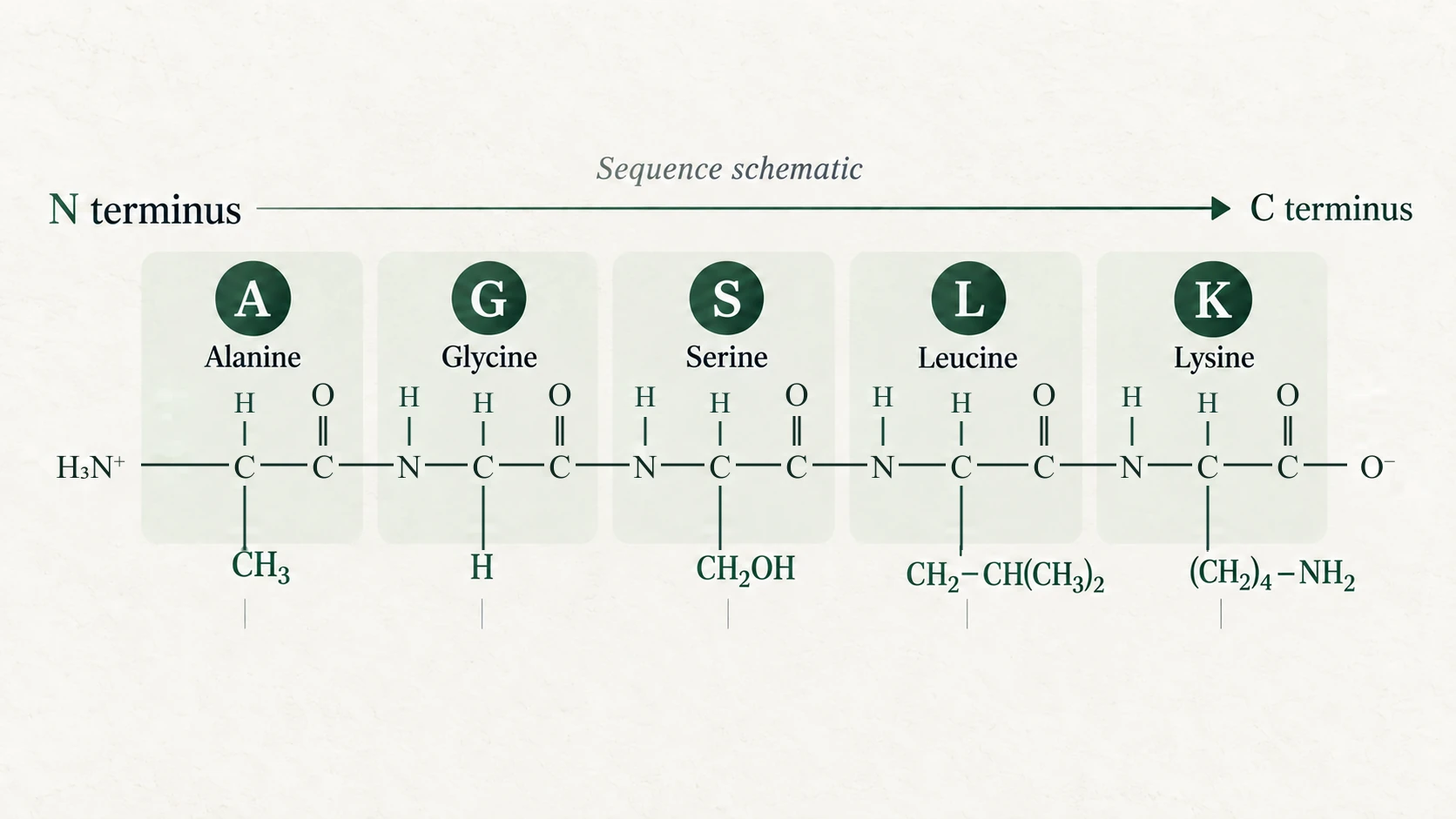
An amino acid has chemical groups that allow it to link to another amino acid. In the usual peptide backbone, the carbonyl carbon of one residue is connected to the nitrogen of the next through an amide linkage, called a peptide bond. IUPAC: peptides
Once incorporated into the chain, each amino-acid unit is called a residue. The order of those residues is the amino-acid sequence. A short linear sequence is usually written from its N-terminus towards its C-terminus. Those names refer to the two ends of the chain. NCBI: primary protein structure
For a simple example, Gly–Ala–Ser specifies glycine, alanine and serine in that order. Changing their order changes the sequence even though the same three amino acids are present. This is a terminology example, not a Lynx product or a laboratory result.
Peptide, polypeptide or protein?
The terms overlap. They are not three mutually exclusive categories.
Terminology panel
- Peptide: a molecule containing amino-acid residues connected through peptide linkages.
- Polypeptide: a term for a chain containing multiple residues. The IUPAC Gold Book defines polypeptides as peptides with ten or more residues, but usage in literature varies.
- Protein: a biological macromolecule comprising one or more polypeptide chains, often discussed in terms of its folded structure and molecular organisation.
Read these definitions alongside the convention used by the particular author. “Polypeptide” does not mean that a molecule cannot also be called a protein. IUPAC: polypeptides, NCBI: protein structure
Chain length and the limits of a cutoff
A chain with only a few residues is normally described as a peptide. Larger chains are more often discussed as proteins, especially when the account concerns their overall structure.
There is no universally enforced residue count that settles every case. IUPAC nomenclature recommendations describe a common convention around 50 residues but explicitly acknowledge that authors differ in where they use “protein”. That is different from declaring that residue 50 or 51 creates a new chemical category. IUPAC nomenclature, section 3AA-11
Key point
Chain length is a useful description, not a universal peptide–protein boundary.
Use the residue count together with the molecule's stated form and the terminology of its scientific context. Avoid inferring a particular structure from size alone.
The Lynx catalogue includes BPC-157, a 15-residue peptide described in the PubChem molecular record. It gives a concrete example of a short peptide chain. The residue count describes that molecule without creating a universal boundary between peptides and proteins or establishing a result for a particular batch.
Folding and levels of structure
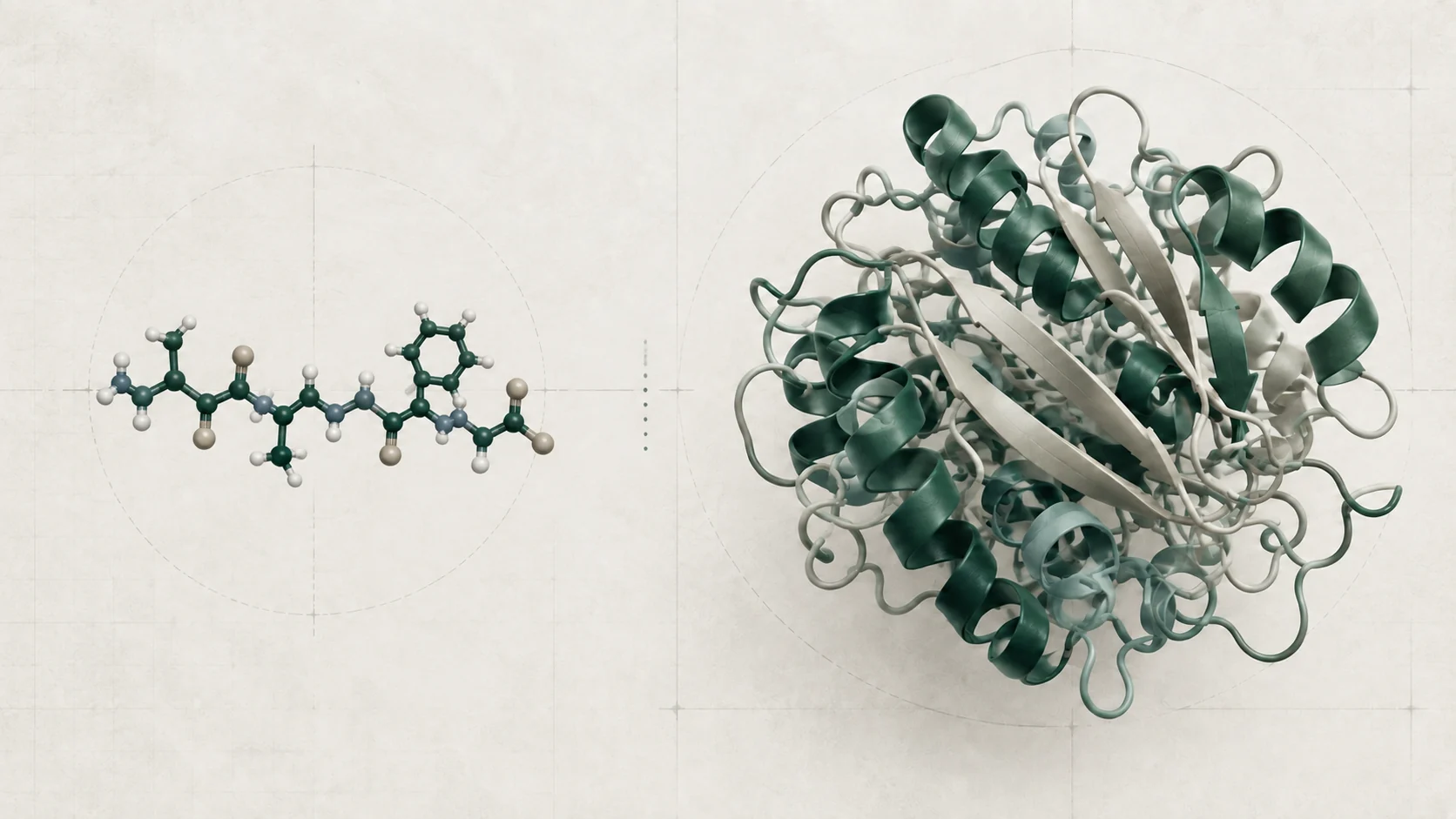
Protein structure is commonly described at four levels. They are different views of a molecule, not successive labels that replace one another.
- Primary structure: the amino-acid sequence.
- Secondary structure: local arrangements such as alpha helices and beta sheets.
- Tertiary structure: the overall three-dimensional arrangement of one polypeptide chain.
- Quaternary structure: the arrangement of multiple polypeptide chains in an assembly, where present.
A single-chain protein does not need quaternary structure. NCBI: the shape and structure of proteins
Ubiquitin provides a compact protein example. The experimentally determined structure in PDB entry 1UBQ contains a 76-residue chain with both helical and sheet regions. It illustrates how one sequence can form an organised three-dimensional structure, without establishing a length rule for every molecule. RCSB PDB: 1UBQ
Not every protein has a single persistent fold throughout its chain. Some proteins contain disordered regions, and some are intrinsically disordered. “Protein” therefore should not be defined solely as a rigid, folded object. Forman-Kay and Mittag: intrinsically disordered proteins
Short peptides can also adopt organised structures. An NMR study identified a native-like beta hairpin in a 16-residue peptide from protein G. That finding concerns the studied sequence and conditions, not every short peptide. Blanco, Rivas and Serrano (1994)
Linear, cyclic and modified molecules
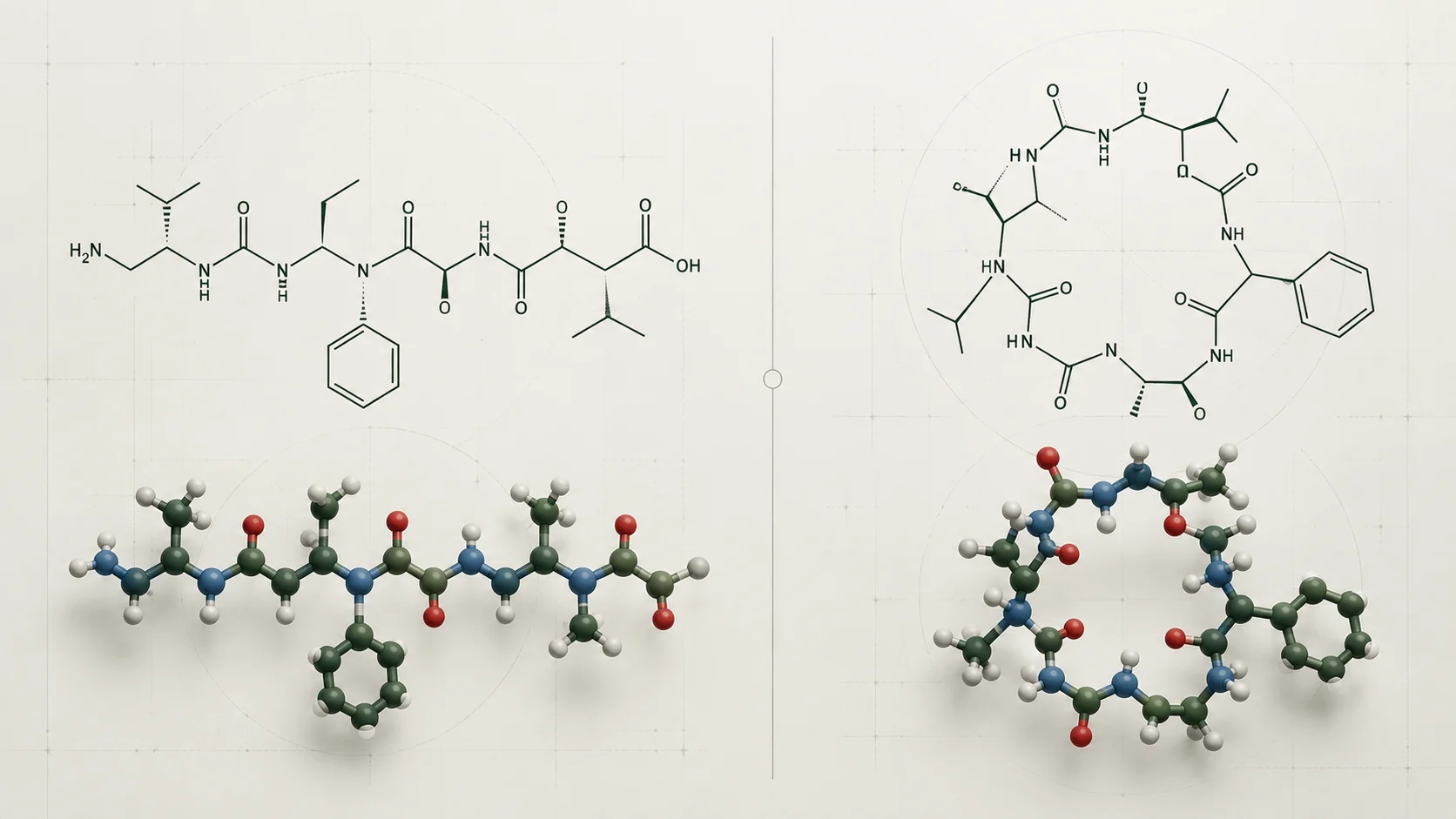
“Linear” describes the connectivity of a peptide backbone. It does not mean the molecule must remain straight in space. A cyclic peptide has a ring-forming connection. A head-to-tail cycle joins the chain ends, while other ring arrangements can involve side chains or different linkages. The connection must be specified to describe the molecular form. IUPAC Blue Book: cyclic peptides
As a structural example, the same written list of residues could describe an open chain or a head-to-tail cyclic form if the connection is not stated. The list alone would leave that distinction unresolved.
Chemical modifications can also matter. Acetylation, amidation and phosphorylation are examples recorded in protein sequence annotation. A modified molecule should not be treated as fully described by an unannotated sequence. UniProtKB user manual: modified residues
Disulphide connections require separate attention too. UniProt records which cysteine residues participate in intrachain or interchain disulphide bonds. Knowing that cysteine occurs in a sequence does not by itself specify those connections. UniProt: disulphide bond annotation
Sequence and molecular weight
Sequence describes residue order. Molecular mass describes the mass of a molecule, commonly expressed in daltons (Da) or kilodaltons (kDa). A kilodalton is 1,000 daltons. Strictly, “molecular weight” means relative molecular mass, a dimensionless ratio, although documentation often uses the phrase alongside a mass value. Read the units rather than relying on the label alone. IUPAC: molecular weight, IUPAC: quantities and units
A sequence-based calculation has assumptions. For example, ExPASy's ProtParam calculates properties from a supplied sequence but does not incorporate post-translational modifications or determine multimeric organisation. A calculated value is not automatically a measurement of the actual molecular form. ExPASy: ProtParam documentation
Even primary structure has a defined scope. IUPAC's sequence-based definition excludes disulphide positions and is not identical to a complete covalent structure. Folding, connectivity and modifications can require information beyond the sequence string. IUPAC: primary structure
A practical comparison
| Feature | Peptides | Proteins |
|---|---|---|
| Building blocks | Amino-acid residues linked through peptide bonds | The same chemical basis |
| Typical relative size | Generally shorter chains | Generally larger molecules, with exceptions and overlapping terminology |
| Chain organisation | Linear, cyclic or otherwise modified forms | One or more polypeptide chains |
| Structural description | Sequence and specified connections remain relevant even for a short molecule | Sequence, local structure, overall fold and any subunit arrangement |
| Folding | Do not infer an absence of structure from short length | Often folded, but disordered regions or proteins also occur |
| Sequence notation | Residue order plus explicit annotations where needed | Sequence plus chain, processing and modification information where needed |
| Molecular mass | Depends on the specified molecular form | Depends on the specified chains and molecular form |
| Analytical characterisation | Testing chosen for the identity or property being assessed | The same principle, with methods suited to the molecular question |
These are typical descriptions, not fixed classification rules or a ranking of materials. Sources: IUPAC nomenclature, NCBI structure, UniProtKB annotations, protein disorder.
Classification is not analytical evidence
A molecule's name or category states what it is described as. Analytical testing asks whether observations support that description for the sample examined.
Mass spectrometry can support identity assessment. For proteins, peptide fragmentation and mapping can provide additional sequence-related evidence. A mass match alone does not establish every connection or structural feature. The evidence must fit the question being asked. NIST: mass spectrometry and peptide identification
Identity, purity and quantity remain separate questions. A supplied sequence is not a purity measurement. A chromatographic area percentage is not automatically the amount of peptide in a sample. NIST's peptide reference-material work uses complementary approaches to assign peptide purity as a mass fraction. NIST: peptide value assignment
For the fuller distinction between an identity result, chromatographic purity and measured content, read Understanding Peptide Analytical Testing.
Reading research documentation
When comparing a paper, sequence record and analytical document, check that they describe the same molecular form. Note the sequence, chain or fragment, stated modifications, relevant connections and the mass convention where supplied.
Database annotations can contain experimental findings or predictions. UniProt, for example, distinguishes experimentally determined disulphide bonds from predicted ones. Read the evidence attached to an annotation rather than treating every entry as a direct measurement. UniProt: annotation evidence
For a particular material, also establish which sample or batch the report concerns and what each reported test measures. How to Read a Peptide Certificate of Analysis covers sample matching and the scope of each reported test.
Continue learning with Lynx
The Research Library provides compound-specific literature context. Published studies and analytical evidence for a supplied material answer different questions. Molecular terminology alone does not establish biological effects.
Lynx materials are for research use only, not for human or veterinary use.
Explore research materials
Browse research materials and consult the documentation for the relevant product and batch.