On this page
What Lynx means by GLOW
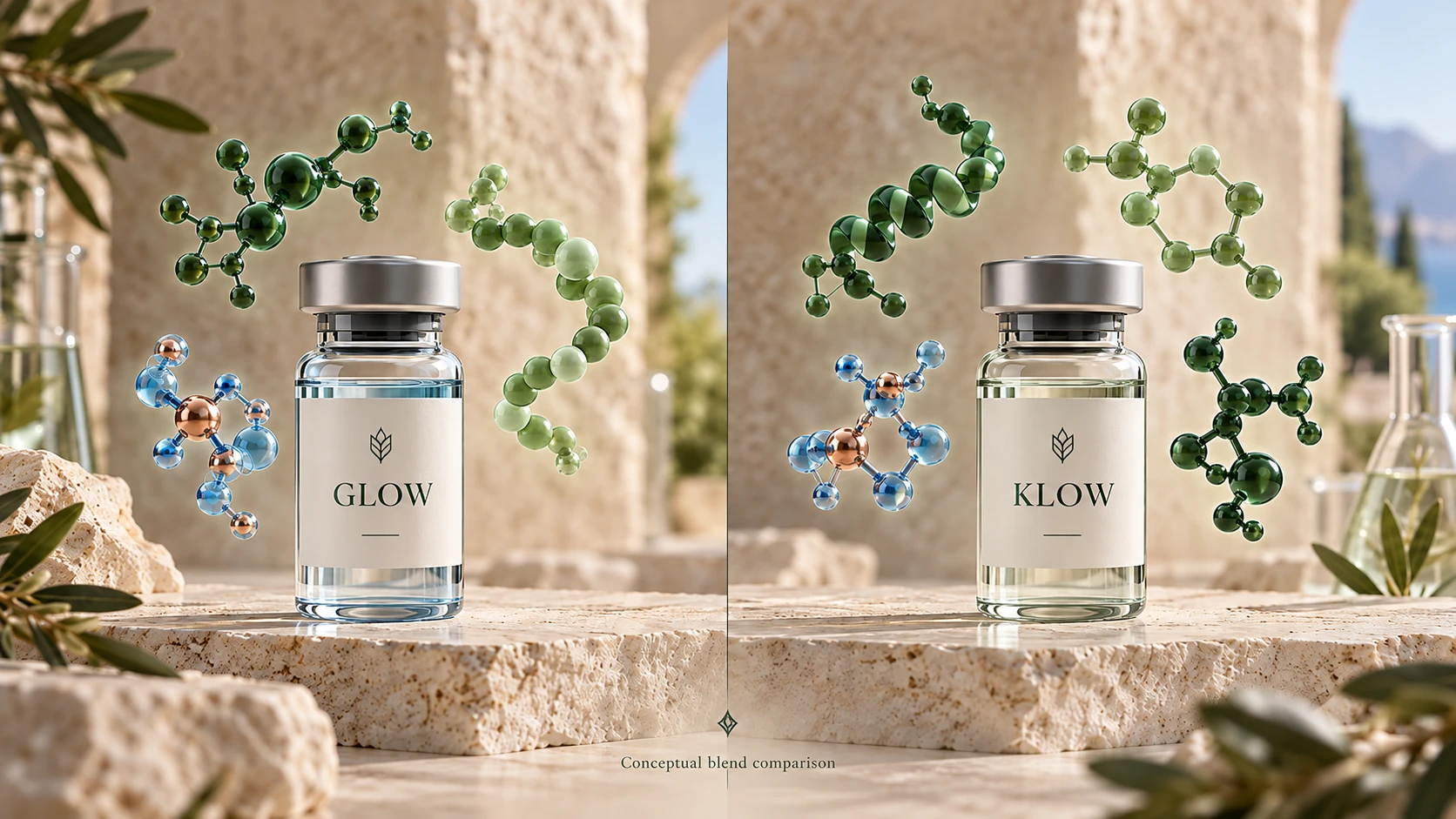
GLOW is a blend name, rather than the name of a single standardised molecule. The Lynx catalogue declares 50 mg GHK-Cu, 10 mg BPC-157 and 10 mg TB-500 in its 70 mg GLOW presentation. These are catalogue specifications. They do not replace measured composition for a particular batch.
The BPC-157 and GLOW catalogue pages distinguish the single research compound from the declared blend.
Other suppliers may use the same name with different amounts or identity descriptions. A meaningful comparison therefore identifies the supplier’s formulation instead of assuming every “GLOW stack” is identical.
The GLOW and KLOW composition Guide describes the declared formulations. Here the narrower question is what changes scientifically when BPC-157 is examined as one component of a mixture.
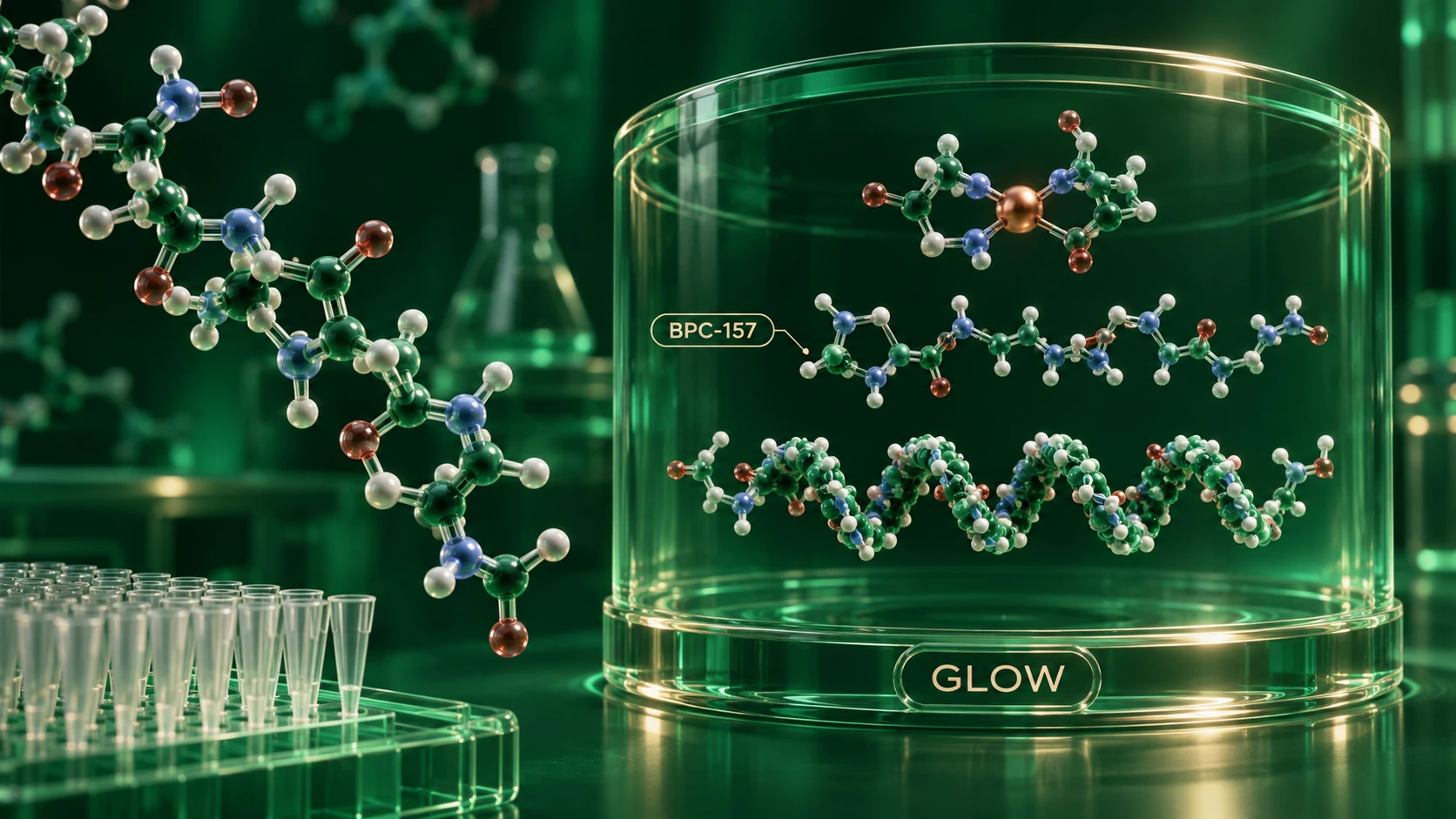
A single sequence and a three-component mixture
| Material | Description | Evidence to check |
|---|---|---|
| BPC-157 | A 15-residue synthetic peptide, GEPPPGKPADDAGLV | Sequence, terminal groups, measured identity and content |
| GHK-Cu in GLOW | Copper complex of Gly-His-Lys | Peptide identity and copper-associated composition |
| TB-500 in GLOW | Lynx profile specifies 43-residue thymosin β4 | Full-length or fragment identity and modifications |
| Finished GLOW blend | Declared 50 mg / 10 mg / 10 mg components | Component-specific identification, amounts and mixture stability |
The TB-500 name deserves particular care. It is used inconsistently in the wider market and literature discussions. Full-length thymosin β4 and a fragment such as LKKTETQ are different molecules. Findings for one cannot be assigned to the other from the name alone. The BPC-157 and TB-500 Guide preserves that distinction.
What BPC-157 component research contributes
Tendon-cell experiments investigated movement, attachment and survival under stress. They used rat-derived cells and explants, not a GLOW formulation. Endothelial and animal vascular work examined receptor trafficking and related signalling.
These studies help identify testable questions about a particular peptide. They do not demonstrate the behaviour of the same peptide after mixing with a copper complex and a thymosin-related material. Stability, recoverable concentration and biological exposure could change and would need measurement.
A research interpretation should retain the preparation, model and endpoint. “Tissue repair” is too broad to make migration in cultured cells interchangeable with an animal biomechanical measurement or a clinical outcome.
The other components have their own literatures
GHK-Cu fibroblast research examined collagen synthesis. A separate matrix-turnover study included comparisons with copper and copper-free GHK, illustrating why the metal-associated species matters. These are cell experiments with specified materials.
Malinda and colleagues studied thymosin β4 in rat skin wounds and cell-migration assays. That paper is evidence about thymosin β4 in those systems, rather than evidence about every TB-500-labelled product.
Grouping these findings by a common biological theme is a way to organise the literature. It cannot establish that the components retain their effects together, reinforce one another, or produce a superior result. The mixture must be tested as a mixture.
What would demonstrate a combination effect?
A useful design begins with a defined mixture and an outcome. It compares BPC-157 alone, the other components separately, relevant combinations and the full formulation. Matching concentrations and including vehicle controls helps distinguish a component effect from a formulation effect.
“Synergy” needs a defined reference model for the response expected from the components. Simply observing a change with the mixture, or reporting a larger signal than an untreated control, does not answer whether the interaction is synergistic.
The component papers cited here do not provide a controlled human comparison of BPC-157 with the declared Lynx GLOW formulation. Nor does a study of BPC-157 plus a thymosin-related material establish evidence for a three-component formulation containing GHK-Cu. Readers should check every ingredient before treating a blend study as relevant.
Mixtures introduce additional analytical questions
Each component needs a defensible identification and, where the ratio matters, its own quantitative result. Several signals may overlap in an HPLC method. Different molecules can produce different UV or mass-spectrometric responses, so peak heights alone cannot establish the declared mass ratio.
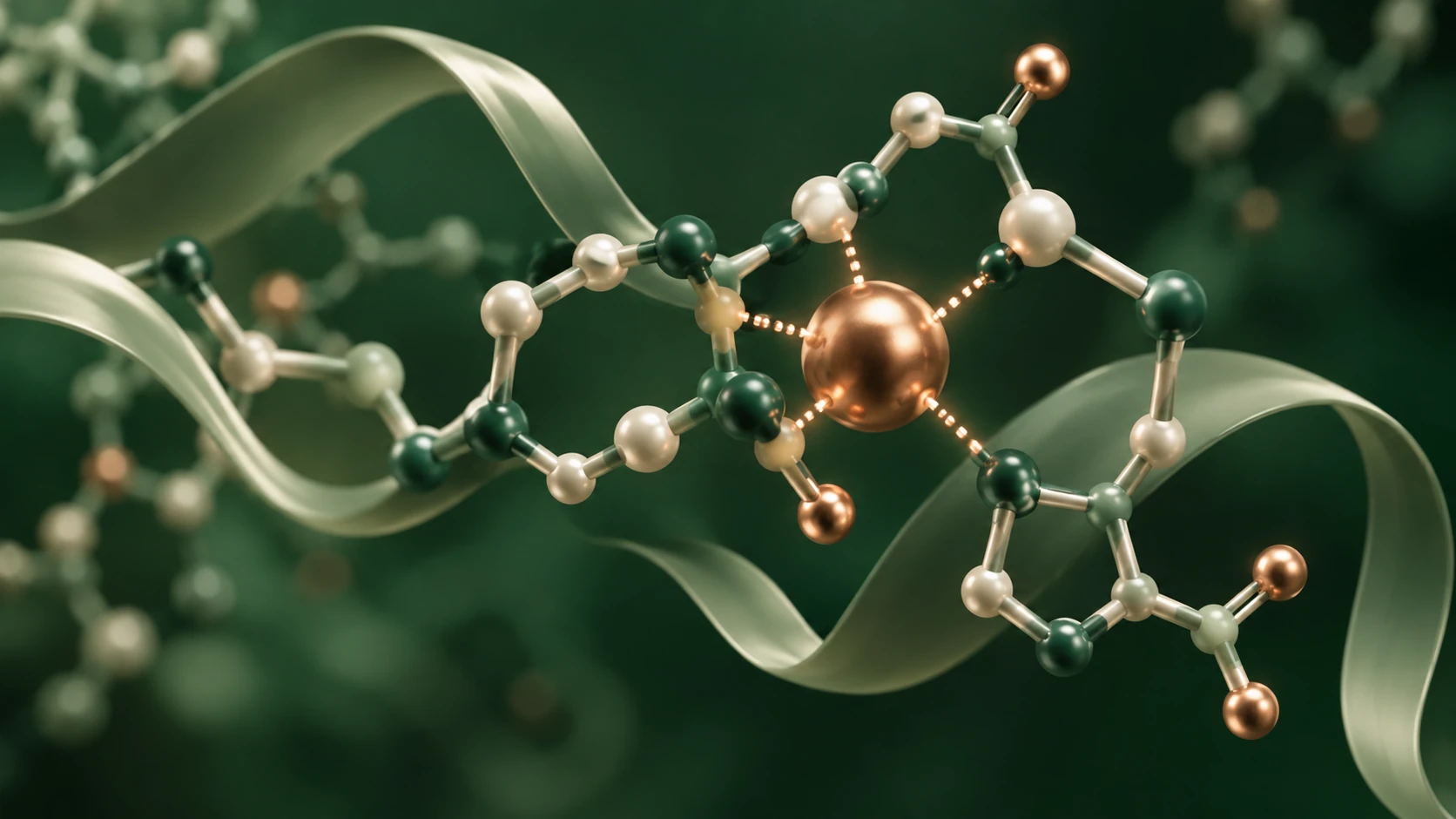
GHK-Cu also introduces metal-coordination chemistry. A mass consistent with the peptide component does not, alone, fully characterise copper speciation in the original mixture. The GHK-Cu Guide explains why conditions and the analytical question matter.
Compatibility needs separate study. A stable individual component does not establish a shelf life for a mixture, and the appearance of a solution cannot settle chemical stability. Consult the analytical testing overview and storage Guide for the relevant distinctions.
The comparison is a research-design question
BPC-157 offers a single named analyte for an experiment. GLOW introduces additional variables. Whether that is appropriate depends on the question, controls and characterisation. More components do not automatically create stronger evidence.
For causal interpretation, it is useful to know which component accounts for an observed change and whether the combination alters it. Without that information, a blend result may be difficult to reproduce or explain. The distinction is methodological, rather than a recommendation to use either material.
Published biological research also remains separate from the documentation of a supplied sample. Neither this Guide nor the component citations establish the identity, purity, sterility or effects of a Lynx batch.
Lynx materials are supplied for laboratory research only, not for human or veterinary use, diagnosis or treatment. This Guide provides no dosing or administration instructions.
Frequently asked questions
Does GLOW contain BPC-157?
The current Lynx catalogue specification lists BPC-157 alongside GHK-Cu and TB-500. Check the exact formulation rather than treating the blend name as a universal standard.
Is GLOW proven better than BPC-157?
The cited component literature does not establish superiority for the declared mixture. That would require a suitable direct comparison.
Does a 70 mg total show how much of each peptide is present?
The total is a declared sum. Establishing the actual amounts and ratio requires component-specific quantitative evidence.
Can TB-500 research always be treated as thymosin β4 research?
No. The name alone does not resolve full-length versus fragment identity. The molecular form in the experiment must match the claim.
References and study scope
- The promoting effect of pentadecapeptide BPC 157 on tendon healing involves tendon outgrowth, cell survival, and cell migration. Chang et al., 2011. Rat-derived tendon cells and explants.
- Therapeutic potential of pro-angiogenic BPC157 is associated with VEGFR2 activation and up-regulation. Hsieh et al., 2017. Endothelial cells and animal vascular models.
- Stimulation of collagen synthesis in fibroblast cultures by the tripeptide-copper complex glycyl-L-histidyl-L-lysine-Cu2+. Maquart et al., 1988. Fibroblast culture experiment.
- The tripeptide-copper complex glycyl-L-histidyl-L-lysine-Cu2+ stimulates matrix metalloproteinase-2 expression by fibroblast cultures. Siméon et al., 2000. Fibroblast culture with peptide and copper comparisons.
- Thymosin beta4 accelerates wound healing. Malinda et al., 1999. Rat skin wounds and cell migration assays using thymosin beta4.
- ICH Q2(R2): Validation of Analytical Procedures. ICH, 2023. Authoritative analytical validation guideline.