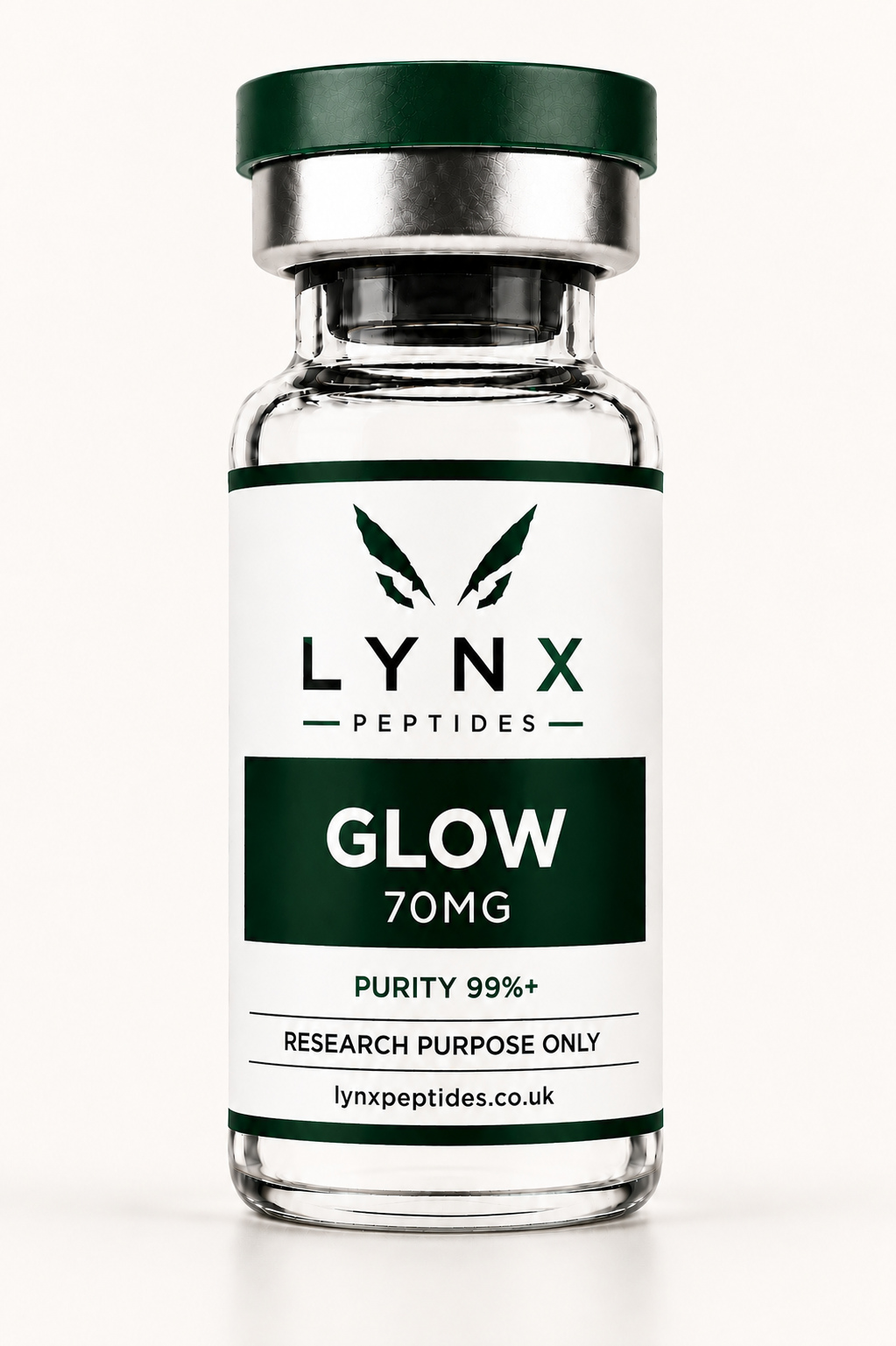
What is GLOW?
GLOW combines 50mg GHK-CU, 10mg BPC-157 and 10mg TB-500 in a 70mg vial. It is a formulation of three components, not a new peptide sequence. The rationale links copper-dependent matrix biology with peptide research on vascular signals, cytoskeletal organisation and cell migration.
Those themes come from experiments on individual materials. They do not add up to a demonstrated three-way effect in the finished GLOW blend. The fixed composition also couples the concentrations of all three constituents and introduces copper chemistry into the shared assay environment. Component identity is important throughout: Lynx specifies full-length thymosin β4 for TB-500, while some published TB-500 experiments concern short fragments. Keeping the compound and formulation clear is more informative than treating all repair-related observations as interchangeable.
Related scientific guides: GLOW and KLOW composition compared.
GLOW Research Areas
BPC-157 increased VEGFR2 expression and internalisation in endothelial cells, with activation of the VEGFR2–Akt–eNOS pathway. Tube formation and animal vascular measurements also changed, while VEGF-A expression in the cell experiments did not increase. Blocking endocytosis suppressed several responses, linking receptor trafficking with the observed angiogenic signal.
Hsieh et al. · Journal of molecular medicine (Berlin, Germany) · 2017PubMed
Full-length thymosin β4 promoted directional movement of cultured human endothelial cells and migration into an experimental scratch. Matrix metalloproteinase production also increased. These cell and implanted-matrix observations connect actin-related biology with vascular-cell movement, without making the assay a human wound-treatment result.
Malinda et al. · FASEB journal : official publication of the Federation of American Societies for Experimental Biology · 1997PubMed
GHK-Cu increased MMP-2 expression and secretion of its regulators TIMP-1 and TIMP-2 in dermal fibroblast cultures. Copper ions reproduced the MMP-2 response, whereas copper-free GHK did not. The finding broadens matrix biology from making connective tissue to regulating its breakdown and remodelling.
Siméon et al. · Life Sci · 2000PubMed
Molecular profile
BPC-157
- Amount
- 10 mg
- Sequence
- Gly-Glu-
Pro-Pro- Pro-Gly- Lys-Pro- Ala-Asp- Asp-Ala- Gly-Leu-Val - Residue count
- 15
- Molecular formula
- C62H98N16O22
- Molecular weight
- 1419.5 g/mol
- CAS number
- 137525-51-0
- Chemical class
- Synthetic peptide
TB-500
- Amount
- 10 mg
- Sequence
- Ac-SDKPDMAEIEKFDKSKLKKTETQEKNPLPSKETIEQEKQAGES-OH
- Residue count
- 43
- Molecular formula
- C212H350N56O78S
- Molecular weight
- 4963 g/mol
- CAS number
- 77591-33-4
- Chemical class
- Synthetic N-terminally acetylated peptide
GHK-CU
- Amount
- 50 mg
- Sequence
- Glycyl-L-histidyl-L-lysine
- Residue count
- 3
- Molecular formula
- C14H23CuN6O4+
- Molecular weight
- 402.92 g/mol
- CAS number
- 89030-95-5
- Chemical class
- Copper peptide complex
Analytical verification
- Lynx report reference
- UKLY-915
- Reported purity
- >99%
- Analysis method
- RP-HPLC + ESI-MS
- Identity result
- GHK-Cu + BPC-157 + TB-500 confirmed
- Analysis date
- 3 Sept 2026
- Report date
- 3 Sept 2026
Storage & Reconstitution
Store in appropriate cool, dry conditions. Refer to product-specific storage information when published.
Vials are supplied separately from bacteriostatic water and other preparation supplies.
For laboratory handling context, read Research peptide storage and stability. Product-specific information and the laboratory method take precedence.
For laboratory preparation, allow the sealed vial to reach room temperature before opening. Wipe the vial stopper and bacteriostatic-water stopper with an alcohol wipe. Add bacteriostatic water slowly down the inside wall of the vial, then swirl gently until dissolved. Do not shake.
Research literature
- Gastric pentadecapeptide BPC 157 accelerates healing of transected rat Achilles tendon and in vitro stimulates tendocytes growth.Staresinic et al. · J Orthop Res · 2003PubMed
- In vivo stimulation of connective tissue accumulation by the tripeptide-copper complex glycyl-L-histidyl-L-lysine-Cu2+ in rat experimental wounds.Maquart et al. · J Clin Invest · 1993PubMed
- Effects of topical copper tripeptide complex on CO2 laser-resurfaced skin.Leyden et al. · Arch Facial Plast Surg · 2006PubMed
- Therapeutic potential of pro-angiogenic BPC157 is associated with VEGFR2 activation and up-regulation.Hsieh et al. · Journal of molecular medicine (Berlin, Germany) · 2017PubMed
- Thymosin beta 4 stimulates directional migration of human umbilical vein endothelial cells.Malinda et al. · FASEB journal : official publication of the Federation of American Societies for Experimental Biology · 1997PubMed
- The tripeptide-copper complex glycyl-L-histidyl-L-lysine-Cu2+ stimulates matrix metalloproteinase-2 expression by fibroblast cultures.Siméon et al. · Life Sci · 2000PubMed
GLOW Price (UK)
GLOW is a 70 mg total research blend containing BPC-157 10 mg, TB-500 10 mg and GHK-CU 50 mg. The current price is £59.99.
Current availability is shown below. UK orders of £49.99 or more qualify for free standard shipping. Eligible working-day orders placed before 4 PM are dispatched the same day.
| Vial size | Current price | Price / mg | Status |
|---|---|---|---|
| 70MG | £59.99 | £0.86/mg | Checking stock |
Common questions about GLOW
What is in the GLOW 70MG blend?
GLOW contains the listed formulation of 50mg GHK-Cu, 10mg BPC-157 and 10mg TB-500, giving 70mg across three compounds. GHK-Cu contributes copper-peptide chemistry, while BPC-157 and thymosin β4-related TB-500 have different cell-response research backgrounds. The badge describes the combined amount, not a single 70mg peptide or equal quantities of all three.
Why are these three compounds studied together?
Their research meets around cell movement and the matrix that surrounds cells, but each component brings different biology. GHK-Cu involves copper binding, BPC-157 studies include migration and attachment, and thymosin β4 interacts with actin. Combining them makes those overlapping areas available in one preparation; it does not establish how the blend behaves without testing the blend itself.
How does GLOW differ from GHK-Cu alone?
GHK-Cu alone allows a laboratory to focus on the copper-bound peptide. GLOW adds BPC-157 and TB-500, introducing their separate cell-signalling and actin-related research into the same preparation. That changes the experimental question from what one compound does to how a fixed combination behaves, so an individual GHK-Cu finding is not automatically a GLOW result.
What is the difference between GLOW and KLOW?
KLOW adds 10mg KPV to GLOW's listed combination of GHK-Cu, BPC-157 and TB-500. KPV has its own inflammatory-signalling research, so the extra component changes more than the total vial amount from 70mg to 80mg. Each blend is a distinct formulation with its own certificate, rather than two strengths of the same mixture.
Can GLOW's components be adjusted separately?
No. The three compounds are already combined in fixed amounts. Diluting the vial changes the overall concentration but leaves their ratio unchanged. Separate compounds are needed to alter one component without changing the others, or to compare a combined response with each component alone; those are different experimental designs from using the supplied blend.
Is GLOW's blue colour a measure of purity?
No. The copper-bound GHK component accounts for the characteristic colour, but colour is not a measurement of blend purity or component amounts. Concentration and solution conditions can affect its appearance. The analytical report is what a laboratory uses to check the reported result, rather than judging the three-component formulation by its shade.
Can I buy GLOW in the UK for research?
Yes. The 70mg GLOW blend is offered by Lynx for UK laboratory research. Current availability is displayed on this formulation's product page.
Is the GLOW formulation independently batch tested?
GLOW's report is UKLY-915, with purity above 99% measured by RP-HPLC + ESI-MS. The sample includes GHK-Cu, BPC-157 and TB-500.