On this page
BPC-157 and TB-500 are not interchangeable identities
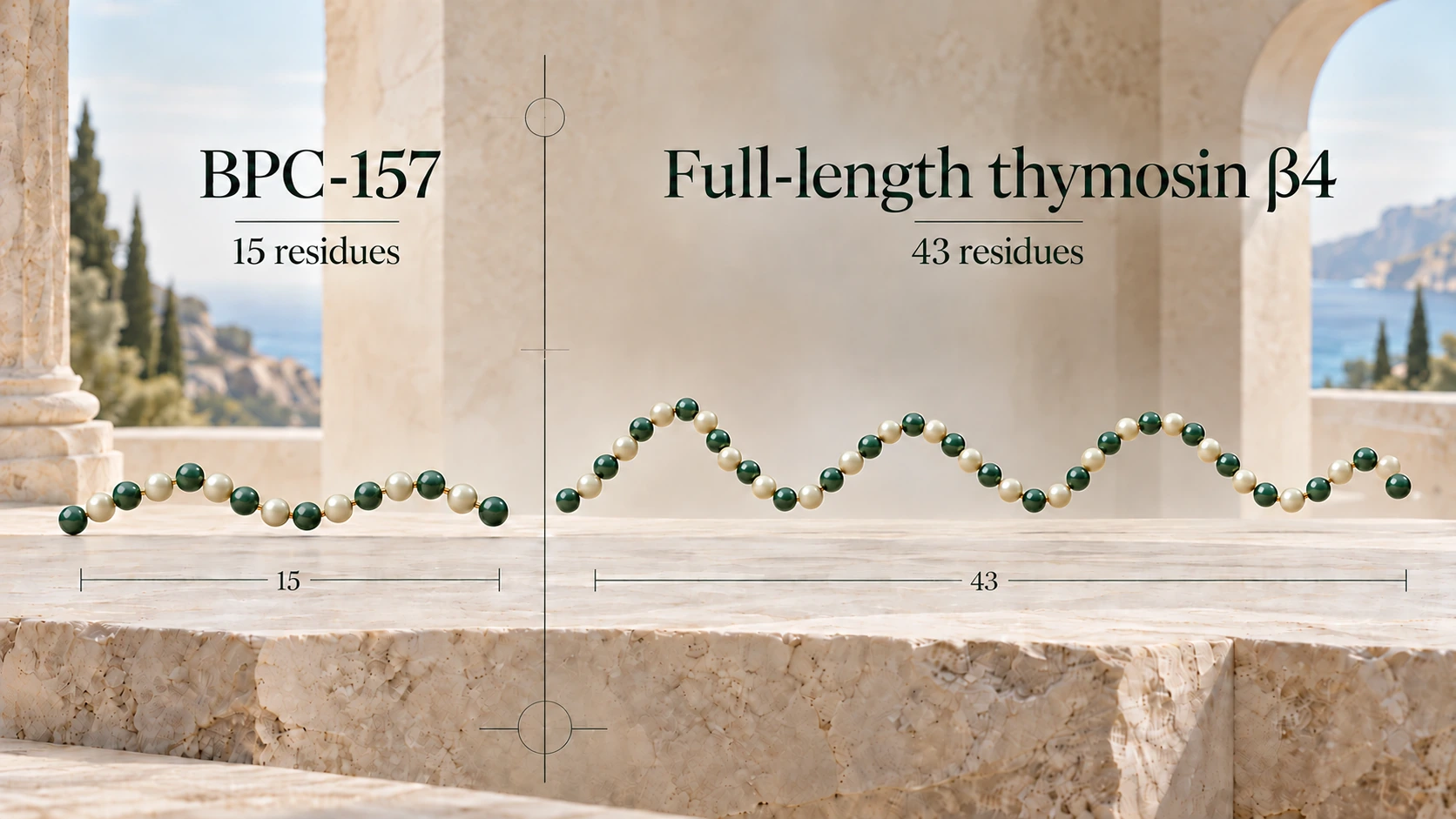
BPC-157 and TB-500 are structurally different research materials. BPC-157 denotes a 15-residue peptide. TB-500 requires more explanation because the trade name has been applied to both thymosin beta-4-related fragments and full-length material.
Lynx’s curated molecular profile describes its TB-500 as the N-acetylated, 43-residue full-length thymosin beta-4 sequence. That is a catalogue specification, not an independent batch identity finding.
| Material | Sequence or structural feature | Identity boundary |
|---|---|---|
| BPC-157 | 15 residues, GEPPPGKPADDAGLV. | A different sequence from thymosin beta-4 and its fragments. |
| Full-length thymosin beta-4 | 43 residues with N-terminal acetylation. The Lynx TB-500 molecular profile describes this form. | A full chain cannot be equated with a seven-residue fragment. |
| Fragment in the Esposito study | Ac-LKKTETQ, corresponding to residues 17–23 of thymosin beta-4. | Identified in a particular analysed preparation described as TB-500. Not evidence about a Lynx batch. |
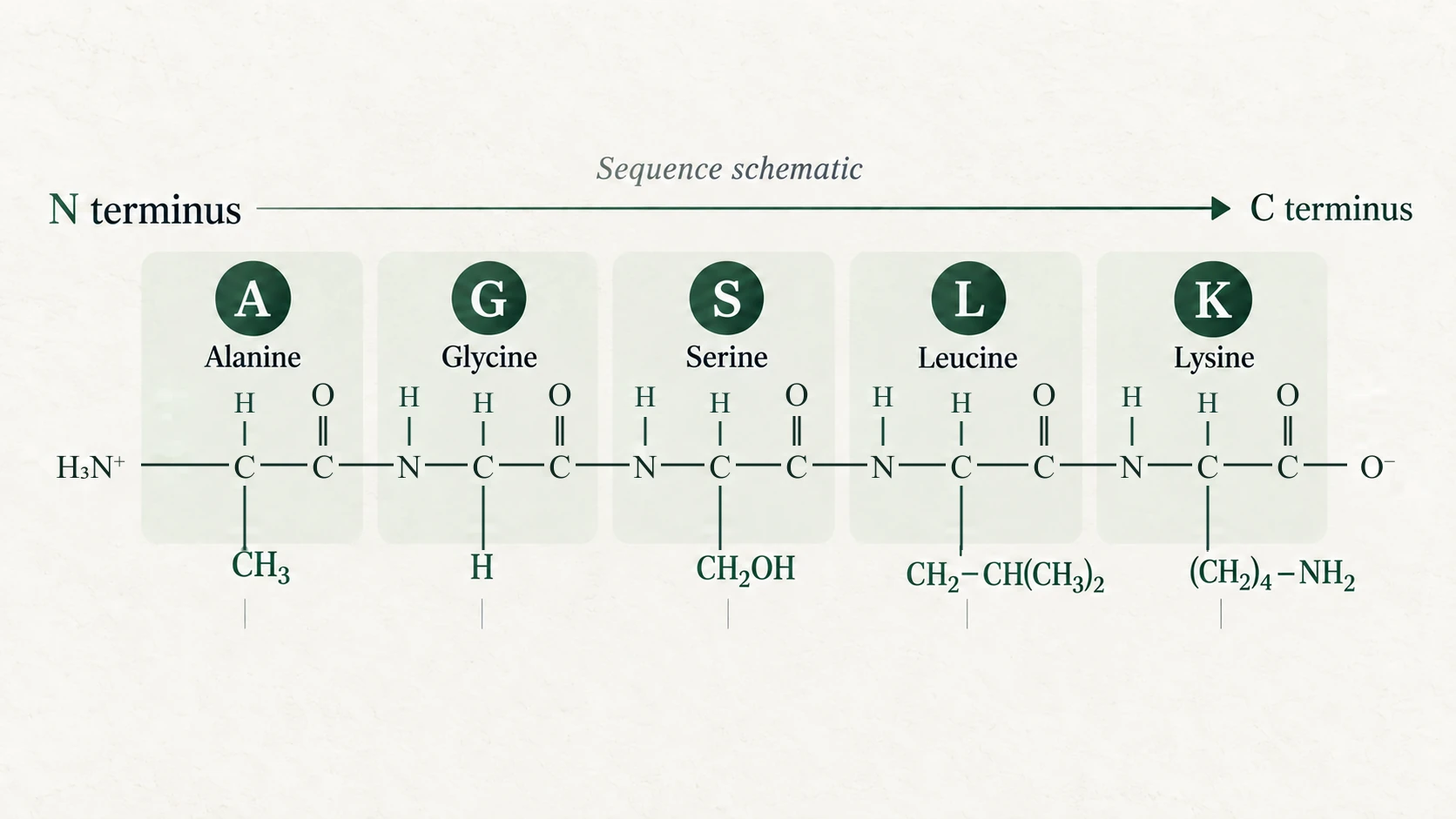
Esposito and colleagues (2012) identified the acetylated seven-residue fragment in an analysed preparation. Their work makes the naming ambiguity concrete. “Ac” indicates an acetyl group, not another amino acid. The peptide sequence Guide explains residue and terminal notation.
Cell migration and actin binding answer different questions
Chang and colleagues (2011) studied BPC-157 in rat tendon explants and tendon-derived fibroblasts. They measured outgrowth, migration and survival under oxidative stress. The MTT assay, a metabolic-activity readout used here to assess proliferation, showed no direct increase. Focal adhesion kinase (FAK) and paxillin phosphorylation rose without an increase in the total amounts of those proteins.
Phosphorylation is a chemical modification associated with signalling. Its measurement is different from measuring protein abundance. Migration is also distinct from proliferation. Treating all three as “cell growth” loses information about what the experiment actually found.
Au and colleagues (2008) examined full-length thymosin beta-4 interactions with actin. Actin forms part of the cellular machinery involved in shape and movement. The study found that residues distributed along the thymosin beta-4 chain contribute to binding. An experiment with a short fragment cannot automatically be assigned the same molecular interaction.
These papers investigate different questions using different systems. Neither is a head-to-head clinical comparison of BPC-157 and a defined TB-500 material.
Compare the model before comparing the result
| Study and material | Model and endpoint | Interpretation limit |
|---|---|---|
| Chang et al., 2011, BPC-157 | Rat tendon explants and fibroblasts. Outgrowth, migration, stress survival and signalling. | Cell and tissue-culture findings do not establish human injury outcomes. |
| Au et al., 2008, full-length thymosin beta-4 | Biochemical actin-binding experiments and sequence changes. | Molecular binding is not a therapeutic comparison. |
| Esposito et al., 2012, a TB-500-labelled preparation | Analytical identification of Ac-LKKTETQ. | An identity study, not evidence of efficacy or full-length batch equivalence. |
| Biçer et al., 2026, BPC-157, TB-500 and combination | Rat Achilles tendon transection and repair. Mechanical and histological observations. | Small preclinical groups and material-description limits prevent general human conclusions. |
Before interpreting a difference, check whether the studies used the same species, experimental injury, follow-up period and control. A force measured in a tissue specimen cannot be compared directly with a migration assay or a chromatographic identity result.
Even within one experiment, mechanical load, tissue appearance and molecular expression are separate endpoints. Agreement between them must be demonstrated rather than assumed.
What the 2026 direct comparison found
Biçer and colleagues (2026) studied 32 male rats in four groups, with eight animals each, after Achilles tendon transection and repair. The groups included a control, BPC-157, TB-500 and both compounds. Assessment was on day 30. Four tendons per group were allocated to mechanical testing and four to tissue analysis, so each endpoint used fewer samples than the group total.
The TB-500 group had a statistically significant maximum-load difference from control. The BPC-157 group’s increase was not significant. Histological findings varied by scoring system, and type I collagen expression did not differ significantly. The combination did not demonstrate an added advantage.
“Significant versus control” for one group and “not significant versus control” for another do not, alone, prove a significant difference between those two groups. These results cannot support a general claim that TB-500 is better than BPC-157 in people.
The publisher’s full text identifies supplier materials but does not provide sequence-confirming analysis for the experimental TB-500 batch. It should not be used to certify the identity or performance of another supplier’s material.
Combining compounds does not establish synergy
A combination group can test an outcome under a particular experimental design. It does not establish that the compounds interact beneficially across other models. Synergy requires evidence that an interaction exceeds a defined expectation, not just that both substances were present.
The Lynx BPC-157 + TB-500 Research Library article provides combination-specific literature context. The individual BPC-157 and TB-500 research entries keep the separate evidence bases visible.
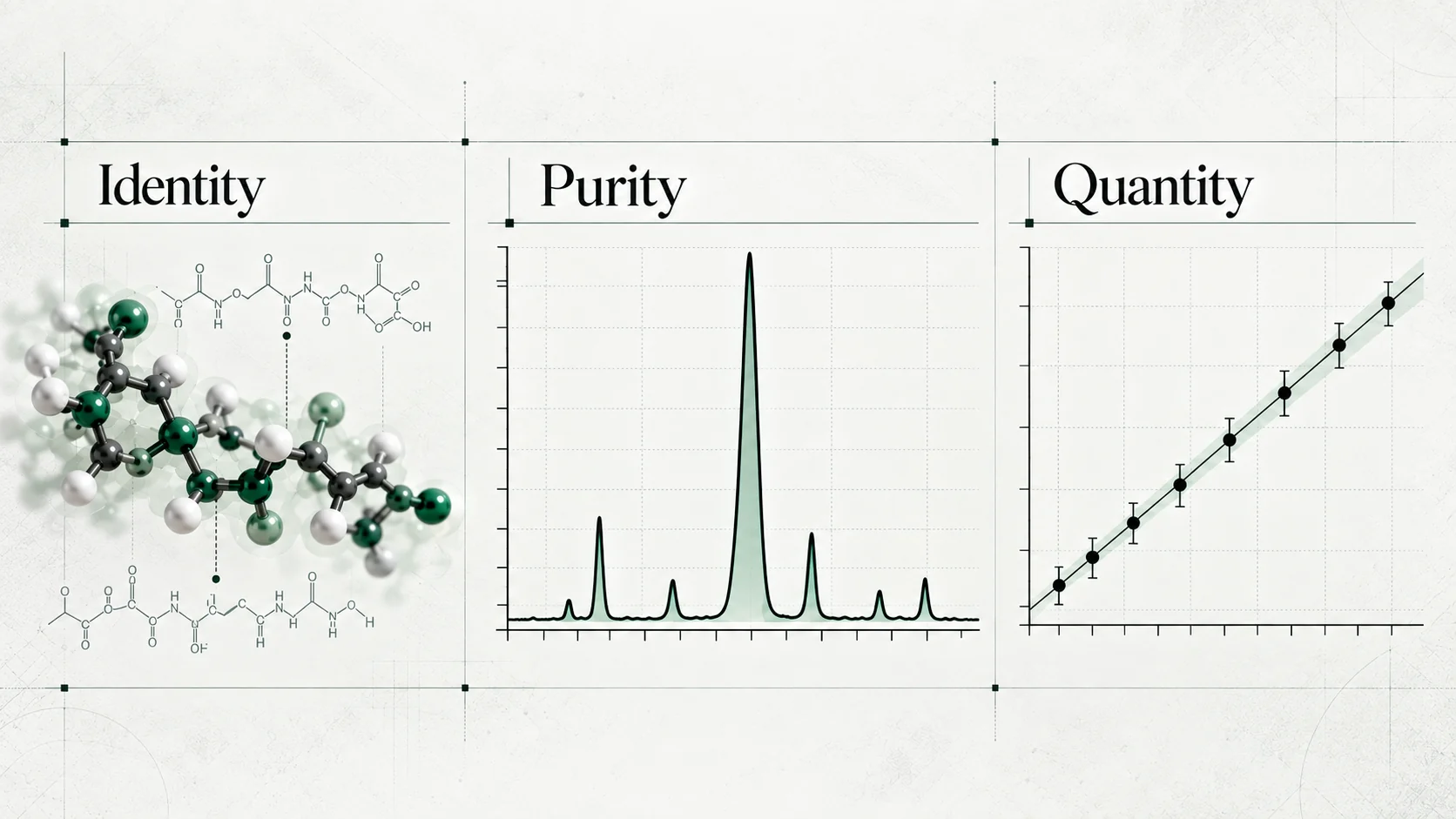
For analytical interpretation, identity must be checked for each component. A purity result for a mixture is not automatically a component-by-component measurement. The analytical testing Guide distinguishes identity, chromatographic purity and quantity.
What remains unresolved
The selected papers support molecular distinctions and specific preclinical observations. They do not establish a reliable head-to-head human therapeutic ranking. Important unresolved questions include exact TB-500 material identity, reproducibility across laboratories and whether findings persist under different experimental conditions.
A useful comparison names the molecule, model and measured result. It retains negative findings and uncertainty instead of reducing the evidence to a claim about which compound “works better”. This article offers no treatment-selection or combination-use advice.
Primary references
- Chang et al. (2011). BPC-157 in tendon explants and fibroblast experiments. Journal of Applied Physiology. PMID 21030672. DOI 10.1152/japplphysiol.00945.2010.
- Esposito et al. (2012). Identification of a TB-500-related fragment. Drug Testing and Analysis. PMID 22962027. DOI 10.1002/dta.1402.
- Au et al. (2008). Distributed thymosin beta-4 residues and actin binding. Biochemistry. PMID 18327913. DOI 10.1021/bi701769u.
- Biçer et al. (2026). Rat tendon comparison of BPC-157, TB-500 and their combination. Joint Diseases and Related Surgery. PMID 42542926. DOI 10.52312/jdrs.2026.2951.