On this page
What is BPC-157?
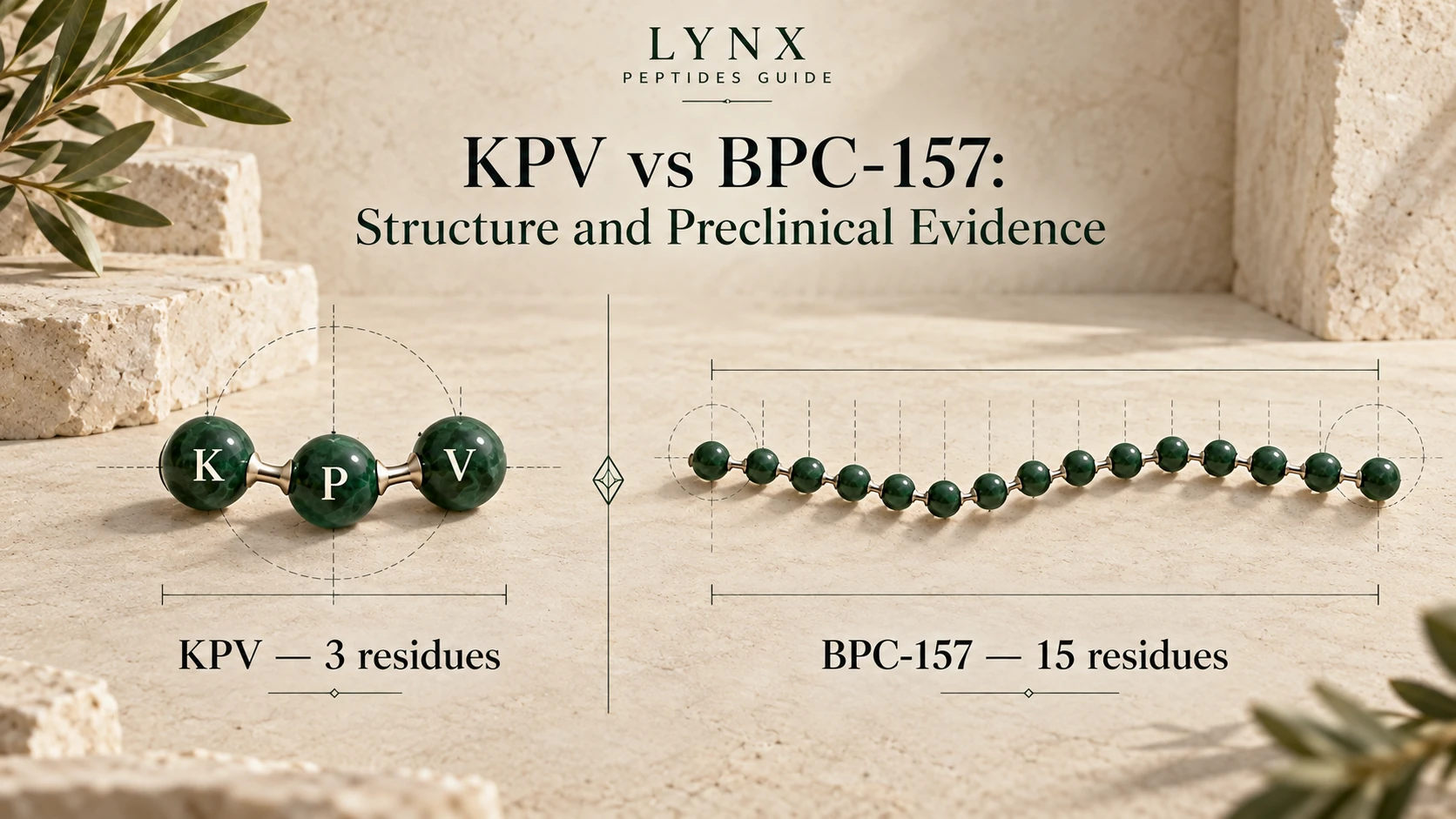
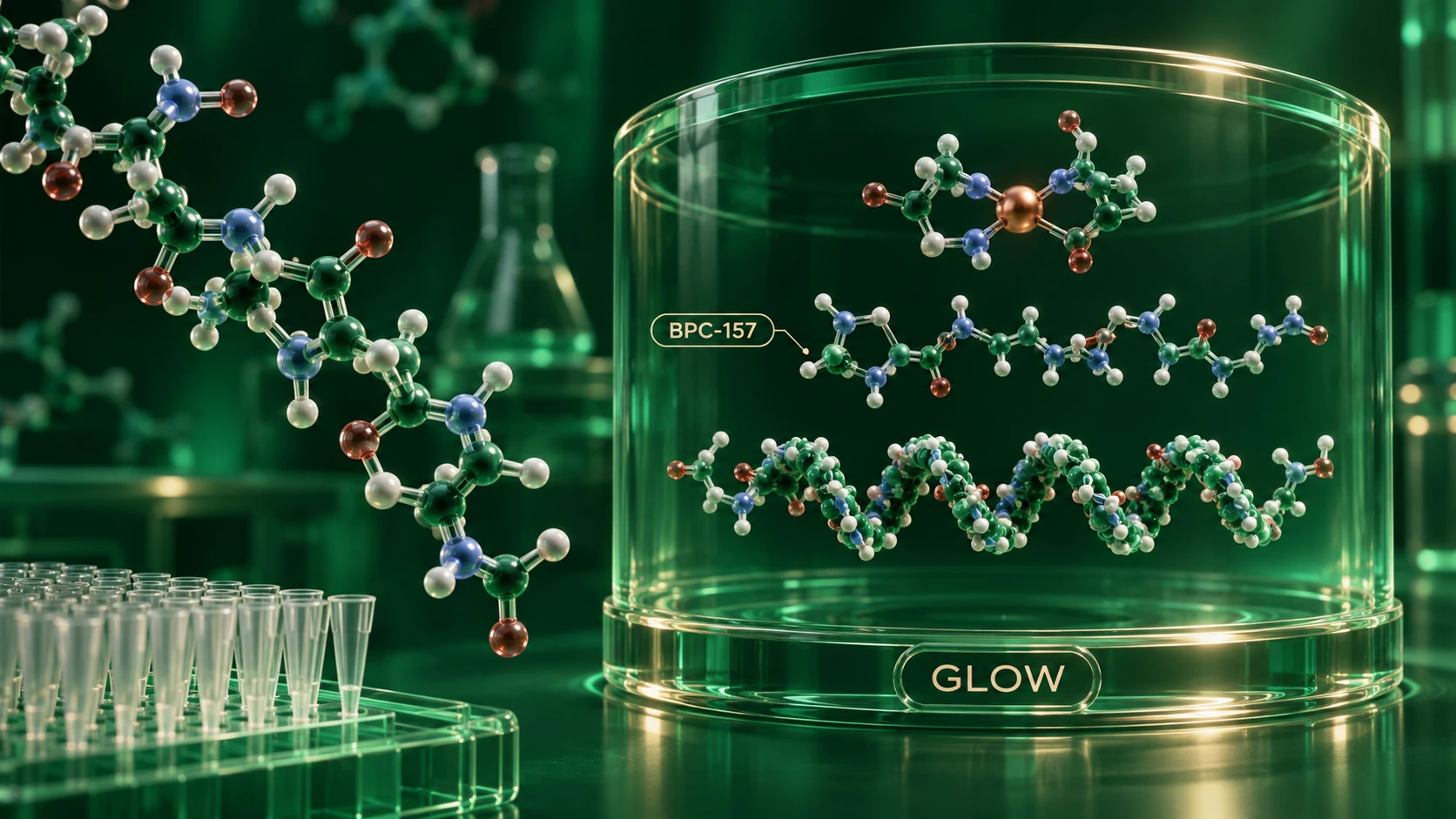
BPC-157 is a synthetic peptide with 15 amino-acid residues. The sequence reported in early research is GEPPPGKPADDAGLV. Its name is associated with “body protection compound” and a programme of gastric peptide research. Those historical terms are not a molecular target or an established human function.
The BPC-157 catalogue entry describes the supplied laboratory research material.
The 2003 tendon paper identifies the sequence and describes experimental work with the defined peptide. Researchers need to distinguish that material from a product named BPC-157, a modified derivative or a mixture. Sequence, terminal groups and analytical evidence belong in the material description.
The broader interest comes from repeated investigation across tissue and injury models. The BPC-157 Research Library entry organises selected papers by study. This Guide focuses on how the designs support, or fail to support, broader conclusions.
Why a broad literature attracts attention
A molecule investigated in tendon, vascular and gastrointestinal systems is easy to describe with one sweeping label. That is also where interpretation becomes vulnerable. Similar-sounding outcomes may involve different preparations, organisms, endpoints and control groups.
Repeated citations are not necessarily independent replications. Several papers may share investigators, methods or earlier assumptions. Readers should look for replication by other groups and for methods that allow another laboratory to reproduce the result.
Public interest and publication volume do not measure clinical certainty. A mechanism can be interesting while the evidence for a human outcome remains incomplete. Claims about “healing” should therefore be traced back to what was injured, what was measured and in which species.
Tendon repair models measure several different things
Staresinic and colleagues examined surgically transected rat Achilles tendons. Their assessments included functional, mechanical and tissue observations. A surgically created acute lesion is a controlled model, but it differs from a chronic human tendon complaint.
Chang and colleagues’ later cell work examined rat-derived tendon fibroblasts and explants. Migration, spreading and survival under oxidative stress changed, while ordinary proliferation was not directly increased. The experiments associated those findings with FAK and paxillin phosphorylation.
That distinction matters. More cell movement is not the same outcome as more cells, and phosphorylation is not the same measurement as total protein abundance. These observations help formulate mechanisms, while the causal pathway and its relevance across tissues require further tests.
Mechanical strength, histology and cell signalling provide complementary information. Combining them should make a conclusion more specific, rather than erase the differences between an animal injury and a human clinical problem.
Vascular signalling is a mechanistic question
Hsieh and colleagues linked BPC-157 exposure with VEGFR2 expression, receptor internalisation and downstream signalling in endothelial experiments. The work also included vascular observations in animal models. It does not show that BPC-157 simply supplies VEGF or increases every growth factor.
Receptor trafficking describes movement between the cell surface and intracellular compartments. It can change signalling without being equivalent to a larger amount of the receptor’s ligand. Experiments using pathway inhibitors help investigate that relationship, but the specificity of the inhibitor and the model remain relevant.
A pro-angiogenic observation is not a universal statement of benefit. The significance of vascular changes depends on the biological context. A useful research report names the measured response instead of treating a pathway as a guarantee of a desirable outcome.
Gastrointestinal studies need their model names
The cysteamine-colitis and colon-anastomosis study investigated experimental injury in animals. Chemical injury and a surgical join between sections of bowel are different models, even when discussed within the same paper.
Measurements from those systems can help explore tissue response and repair. They do not establish efficacy across human inflammatory bowel disease, and a reference to a development programme is not a substitute for published trial results.
When reading gastrointestinal findings, distinguish the initiating injury, species, timing, tissue examined and outcome. “Gut research” may mean a cell barrier assay, an animal lesion score or a clinical symptom scale. Their denominators and biological meaning differ.
The KPV and BPC-157 comparison illustrates why peptides studied in related areas still need separate molecular and experimental accounts.
Human reports exist, but their designs limit inference
Lee and Padgett’s 2021 retrospective report contacted patients after treatment for different types of knee pain. The series included BPC-157 alone and BPC-157 with a thymosin-related preparation. It lacked a randomised comparator and did not use a standardised functional outcome instrument.
That design can describe reported experience. It cannot isolate treatment effect from natural history, concurrent care, selection or expectation. Mixing interventions also makes it harder to assign an outcome to one peptide.
Lee and Burgess’s 2025 pilot assessed short-term observations in two participants. Its small size and limited observation period cannot establish an uncommon-harm rate or long-term safety. It should not be converted into a general declaration that BPC-157 is safe.
These reports deserve accurate description, rather than the statement that no human evidence exists. They also do not provide the controlled evidence needed to validate broad clinical claims.
Safety, authorisation and research labelling
Safety assessment needs more than the absence of a reported problem in a small study. It depends on defined exposure, systematic monitoring, follow-up and enough participants to detect the events of interest. Biological activity and uncertainty can coexist.
The cited animal and pilot studies do not establish a licensed treatment for human injuries. A research-use label does not itself confer medicinal authorisation. UK MHRA guidance addresses restrictions on advertising medicines, including unlicensed medicines.
Scientific discussion should therefore keep the study intervention, its evidence and the status of a supplied research material separate. This Guide provides no personal-use instructions and does not claim that a Lynx material reproduces a paper’s intervention.
How to assess the next BPC-157 paper
- Identify the exact sequence, terminal form and preparation.
- Record the model and distinguish a cell system, animal experiment and human study.
- Check randomisation, blinding, comparator and prespecified outcomes.
- Distinguish biological replicates from repeated readings of one sample.
- Look for effect estimates and uncertainty, not only a statement of statistical significance.
- Assess independent replication and whether negative findings were reported.
- Read harms and follow-up with the same attention as favourable outcomes.
Analytical identity, chromatographic purity and measured content support different parts of material characterisation. The analytical testing Guide explains those distinctions. None independently verifies a mechanism or clinical outcome.
For comparison research, ask whether the experiment actually tested both compounds under matched conditions. The BPC-157 and TB-500 comparison and GLOW comparison apply that question to common compound and mixture names.
Lynx materials are supplied for laboratory research only, not for human or veterinary use, diagnosis or treatment. This Guide provides no dosing or administration instructions.
Frequently asked questions
What does the BPC-157 sequence tell us?
It defines the order of 15 residues. A complete material identity also considers terminal groups and the analytical evidence for the sample.
Is most of the research preclinical?
The detailed mechanistic papers cited here use cell or animal systems. Small human reports add observations but do not provide a broad controlled efficacy or safety record.
Can animal tendon findings predict human injury recovery?
They support hypotheses for further investigation. Species, injury model, exposure and outcome differences prevent a direct prediction of human recovery.
Does an analytical report prove a peptide works?
It can support conclusions about the tested material within the method’s scope. Biological activity and clinical outcomes require separate experiments.
References and study scope
- Gastric pentadecapeptide BPC 157 accelerates healing of transected rat Achilles tendon and in vitro stimulates tendocytes growth. Staresinic et al., 2003. Rat tendon injury and cell experiments.
- The promoting effect of pentadecapeptide BPC 157 on tendon healing involves tendon outgrowth, cell survival, and cell migration. Chang et al., 2011. Rat-derived tendon cells and explants.
- Therapeutic potential of pro-angiogenic BPC157 is associated with VEGFR2 activation and up-regulation. Hsieh et al., 2017. Endothelial cells and animal vascular models.
- Stable gastric pentadecapeptide BPC 157 heals cysteamine-colitis and colon-colon-anastomosis and counteracts cuprizone brain injuries and motor disability. Klicek et al., 2013. Experimental animal injury models.
- Intra-Articular Injection of BPC 157 for Multiple Types of Knee Pain. Lee and Padgett, 2021. Retrospective human report, uncontrolled and heterogeneous.
- Safety of Intravenous Infusion of BPC157 in Humans: A Pilot Study. Lee and Burgess, 2025. Two-participant uncontrolled human pilot.
- Advertise your medicines. MHRA, 2025. Official UK advertising guidance.