On this page
The exact Lynx blend compositions
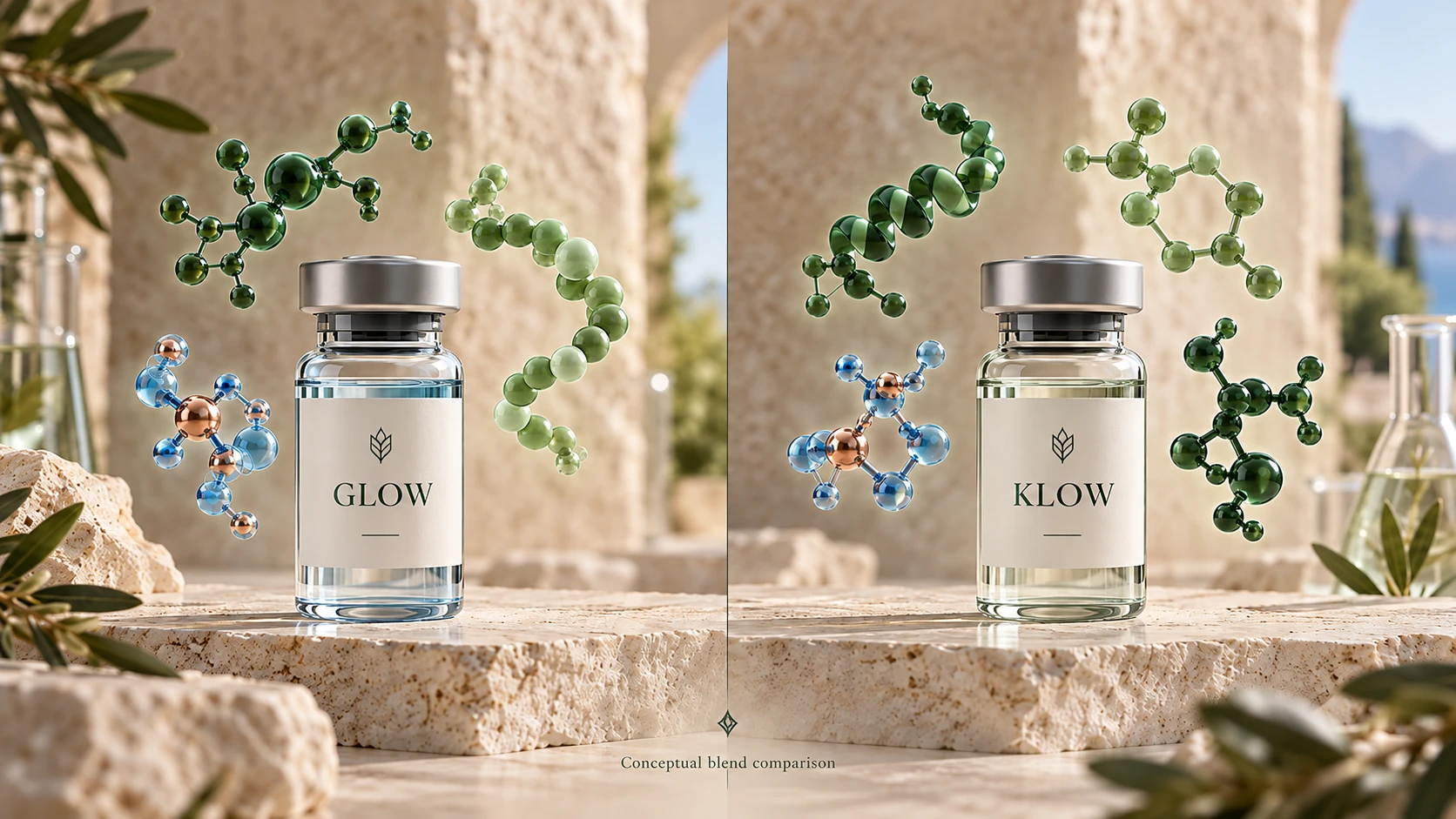
The Lynx catalogue names these products GLOW and KLOW. GLOW is specified as a 70 mg blend containing GHK-CU, BPC-157 and TB-500. KLOW is specified as an 80 mg blend containing those same stated component amounts plus KPV. These are supplier-declared amounts per vial, not doses, measured assay results or a newly formed molecule.
| Component | GLOW | KLOW |
|---|---|---|
| GHK-CU | 50 mg | 50 mg |
| BPC-157 | 10 mg | 10 mg |
| TB-500 | 10 mg | 10 mg |
| KPV | Not listed | 10 mg |
| Total labelled blend amount | 70 mg | 80 mg |
The names are not standard chemical identities. “Clover”, “Glo” or another supplier's blend name cannot be assumed to mean either formulation. Use the current material specification and corresponding batch documentation. The GLOW and KLOW research overviews explain the literature context. Their presence does not constitute independent measurement of a vial's composition.
Four components with different molecular identities
GHK-CU denotes the copper-associated Gly-His-Lys tripeptide material. It is distinct from copper-free GHK and from a simple mixture of free amino acids. BPC-157 is a 15-residue peptide. KPV is Lys-Pro-Val, a three-residue sequence corresponding to the C-terminal segment of α-MSH. Component length and name do not establish equivalent receptor activity.
Lynx's intended catalogue specification is TB-500 as N-terminally acetylated, full-length 43-residue thymosin β4. Product-page wording alone is not independent batch verification. Esposito et al. identified an acetylated 17–23 fragment in a material labelled TB-500. A fragment and the full-length peptide are different analytes. That paper is evidence for the naming problem, not confirmation of Lynx batch identity.
The available report summaries do not independently establish the full sequence and N-terminal acetylation of standalone TB-500 or the TB-500 components of GLOW and KLOW. An identity “pass” summary or purity percentage alone does not resolve those structural features. This limitation does not establish that a shorter fragment was supplied. Do not transfer findings between full-length thymosin β4 and a shorter fragment. See sequence notation and COA interpretation.
What individual-component studies investigate
| Component | Example of primary research | What the study does not establish |
|---|---|---|
| GHK-CU | Maquart et al., 1988: collagen synthesis in fibroblast cultures | Performance of GLOW or KLOW in humans |
| BPC-157 | Hsieh et al., 2017: VEGFR2-related signalling in endothelial experiments and an animal model | The behaviour of the supplied three- or four-component blend |
| Full-length thymosin β4 | Au et al., 2008: molecular actin-binding experiments | Equivalent activity of a shorter TB-500 fragment or a finished Lynx mixture |
| KPV | Dalmasso et al., 2008: PepT1-associated uptake, cellular signalling and mouse colitis models | An established clinical effect of KLOW |
These papers examine isolated components in specified experimental systems. They do not establish any biological effect of GLOW or KLOW. They used their own materials, models and conditions. In the Au study, wild-type thymosin β4 came from bovine spleen, while bacterially expressed mutants had a free N-terminal serine and were designated desacetyl-thymosin β4. Those mutant results do not directly establish the properties of the intended N-acetylated Lynx material. These are not head-to-head GLOW-versus-KLOW trials.
For fuller model-specific discussion, read the GHK-CU, BPC-157, TB-500 and KPV research pages. In particular, keep full-length thymosin β4 evidence separate from fragment studies.
Combining compounds does not demonstrate synergy
A shared scientific theme is a rationale for an experiment. It is not a result. Synergy would require the measured combined response to exceed an explicitly defined expectation from the individual responses. Simply observing a change after adding a mixture cannot distinguish synergy, an additive response or the effect of one component.
A defensible comparison would specify the model, endpoint and reference expectation, test the individual constituents and relevant combinations, and account for concentration and assay interference. This is a research-design requirement, not a claim that either blend has passed such tests.
The primary studies cited here do not establish that KLOW is clinically superior, that adding KPV improves every endpoint or that the blends reproduce all individual-component findings. No direct study of the finished Lynx formulations is presented in this guide.
A single compound and a fixed mixture ask different questions
With a single characterised compound, an experiment can vary that compound while keeping the rest of the system controlled. A fixed blend changes several constituents together. This makes it harder to attribute an observed response to one molecule.
The declared GLOW and KLOW compositions differ by KPV, but comparing whole blends also requires equal definitions of the sample basis. Equal total material mass would not give equal quantities of each shared component. Equal mass quantities of different peptides are not equal molecule counts, because their molecular masses differ.
These are reasons to state concentrations and comparison basis clearly in a study, not personal-use instructions. A multi-component formulation also introduces compatibility and recovery questions that a study of an isolated constituent may not address.
Identity, purity and content in mixtures
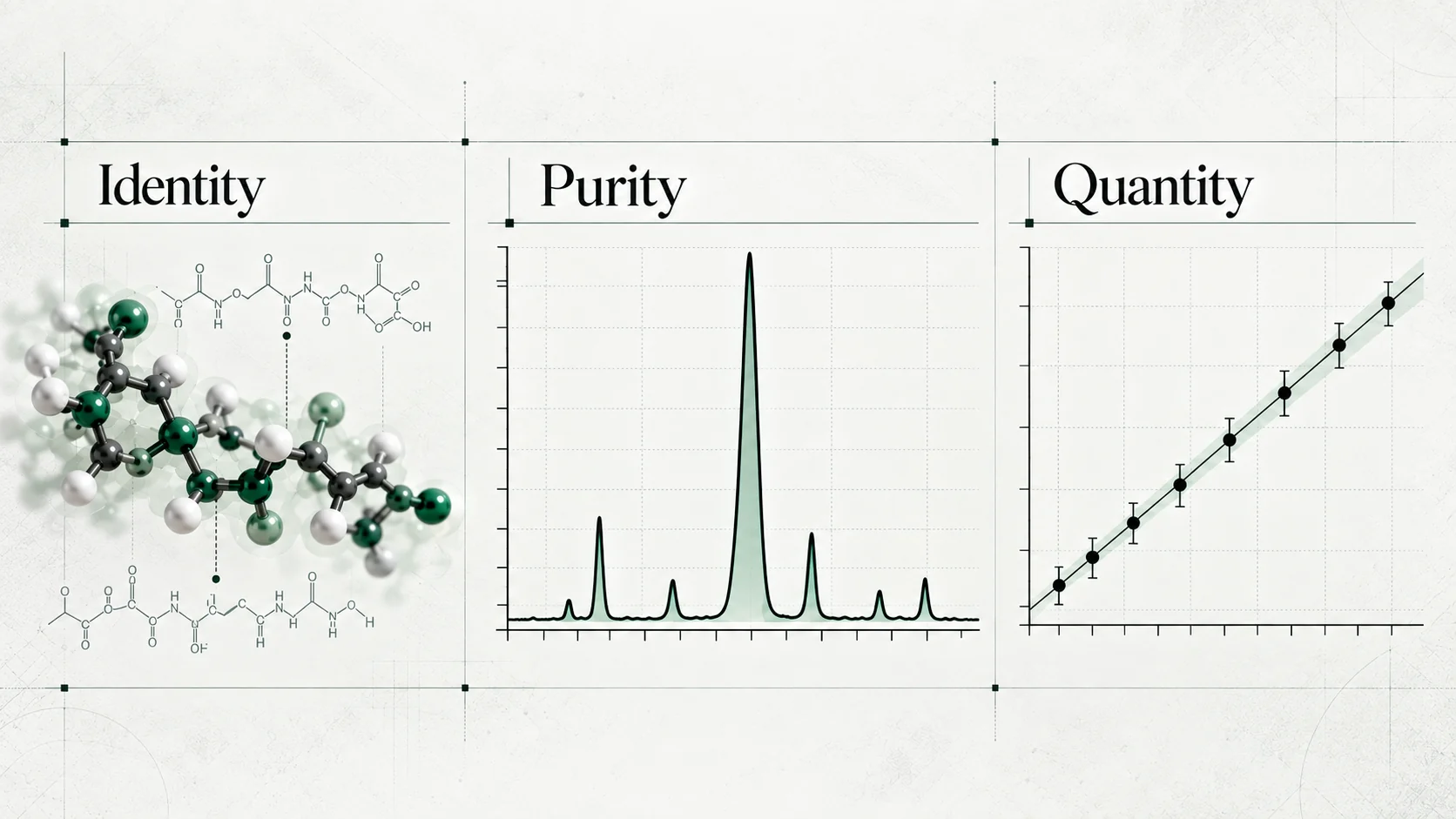
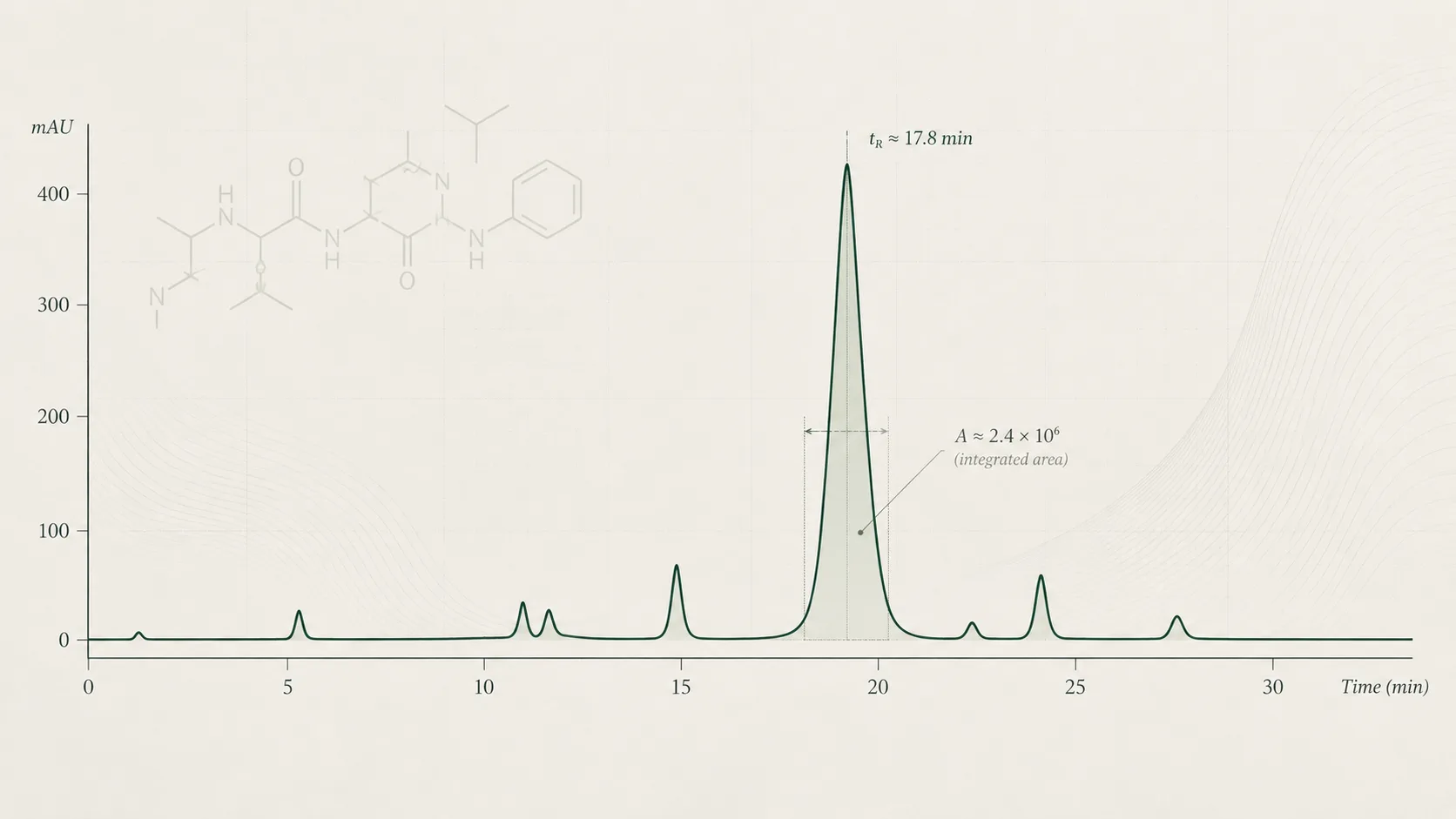
A mixture needs evidence for each intended analyte. A dominant chromatographic peak cannot identify all components, and several intended components should not automatically be classified as impurities. Peak assignments, resolved degradants and the denominator of any reported area percentage matter.
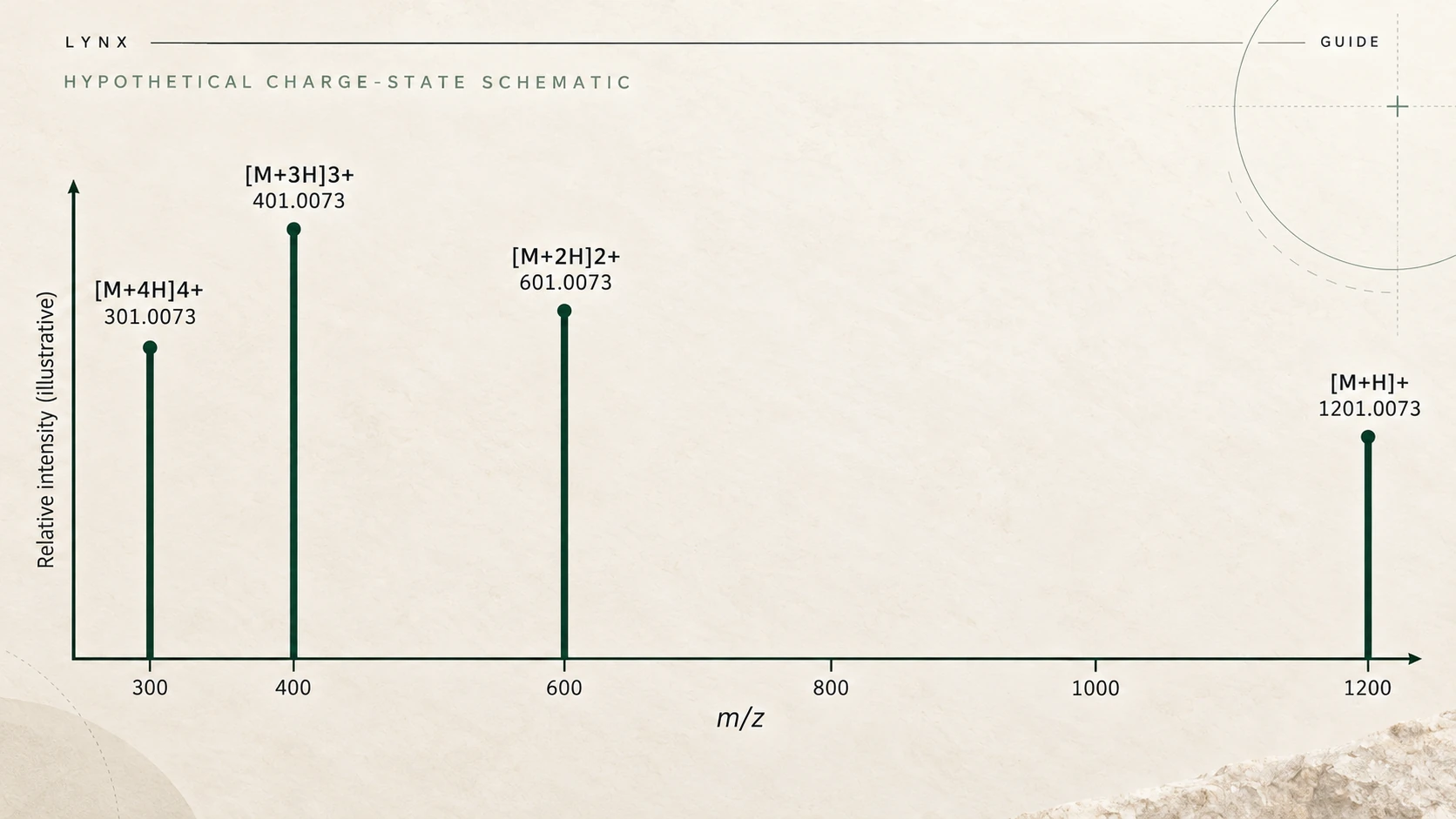
Detector responses and mass-spectrometry ionisation can differ between components. Co-elution can hide additional species. A relative signal ratio therefore cannot confirm the labelled mass ratio without a suitable quantitative method. ICH Q2(R2) analytical validation guideline relates specificity, calibration, accuracy and precision to the intended analytical purpose.
Ask whether the method distinguishes full-length thymosin β4 from the relevant fragment and whether it addresses the stated copper-associated form of GHK. Do not assume a peptide mass observation alone establishes the whole coordination state or every structural feature.
Read HPLC Purity Explained, Peptide Mass Spectrometry and Analytical Testing before equating chromatographic purity with composition or content.
Why batch-specific documentation matters
Match the blend name, declared components, material form, sample code and batch identifier. Then classify each reported result as identity evidence, chromatographic response or measured content. A report for one batch or one ingredient does not establish every characteristic of a subsequently combined material.
The lab-report library supplies available documents. A supplier specification describes the intended composition. An assay reports what was measured in a specified sample. Preserve that distinction, especially where TB-500 terminology is unresolved.
The practical scientific difference between the named blends is the additional declared KPV component. The effect of that difference remains a question for appropriately controlled mixture experiments.
Lynx materials are for laboratory research only, not for human or veterinary use. This guide provides no preparation-for-injection, dosing or personal-use instructions.
Primary references and scope
- Maquart FX et al. Stimulation of collagen synthesis in fibroblast cultures by the tripeptide-copper complex glycyl-L-histidyl-L-lysine-Cu2+. FEBS Letters, 1988. PMID 3169264. DOI 10.1016/0014-5793(88)80509-X.
- Hsieh MJ et al. Therapeutic potential of pro-angiogenic BPC157 is associated with VEGFR2 activation and up-regulation. Journal of Molecular Medicine, 2017. PMID 27847966. DOI 10.1007/s00109-016-1488-y.
- Au JK et al. Widely distributed residues in thymosin beta4 are critical for actin binding. Biochemistry, 2008. PMID 18327913. DOI 10.1021/bi701769u.
- Dalmasso G et al. PepT1-mediated tripeptide KPV uptake reduces intestinal inflammation. Gastroenterology, 2008. PMID 18061177. DOI 10.1053/j.gastro.2007.10.026.
- Esposito S et al. Synthesis and characterization of the N-terminal acetylated 17-23 fragment of thymosin beta 4 identified in TB-500, a product suspected to possess doping potential. Drug Testing and Analysis, 2012. PMID 22962027.
- ICH Q2(R2) analytical validation guideline.
The composition table follows the current Lynx catalogue specifications for GLOW and KLOW. None of these papers verifies the composition, compatibility, stability or clinical efficacy of a Lynx blend.