On this page
Start with the precise measurement basis
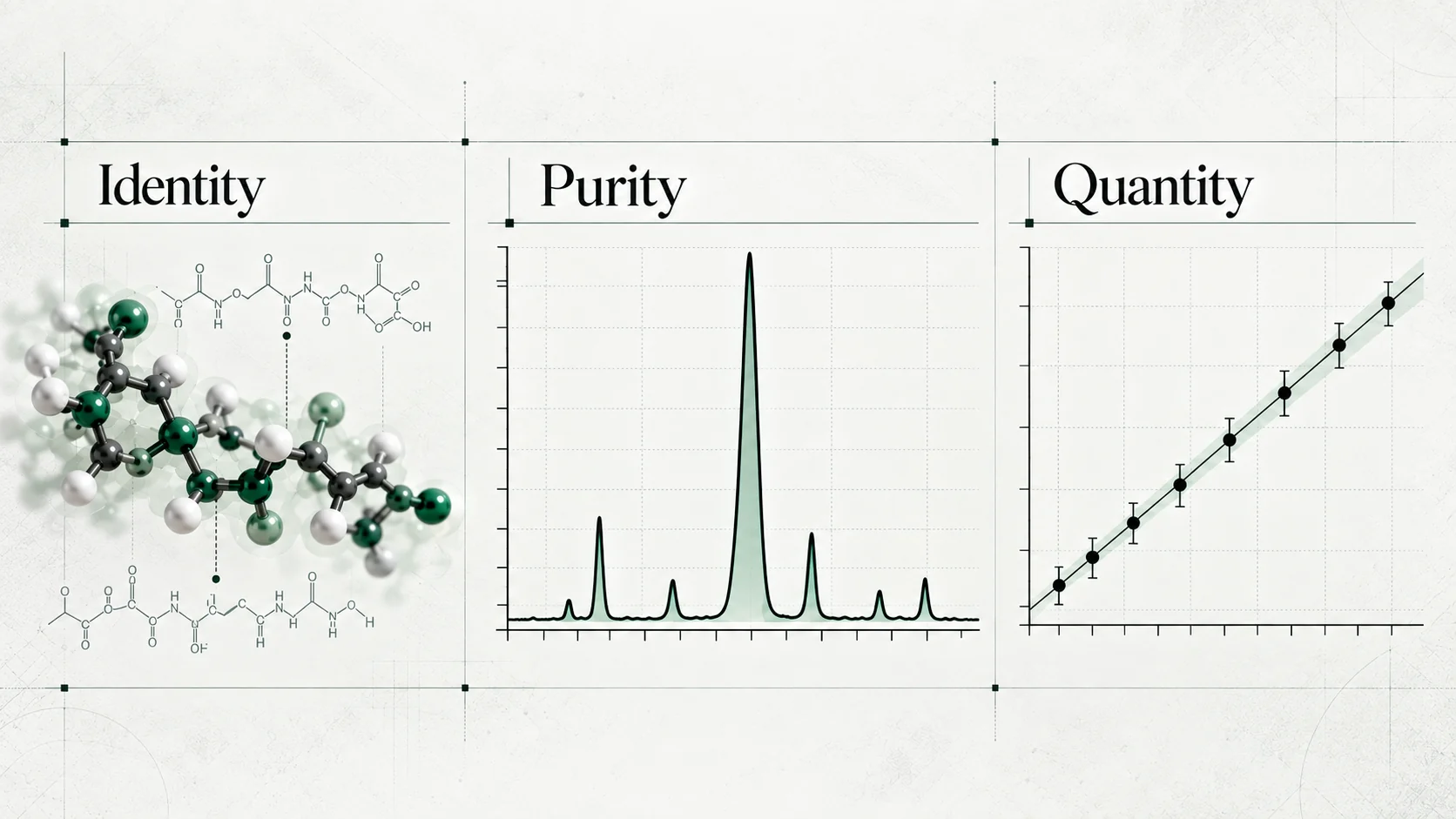
A content result needs to name the quantity being measured. Is it total peptidic material, the mass fraction of a specified target peptide or the amount in a particular tested container? These are different measurands, even when a report uses the general word “content”.
Bachem defines net peptide content as peptidic material relative to material such as counterions and residual water. Under that definition, peptidic impurities contribute to the peptidic fraction. It is not automatically the fraction consisting only of the requested peptide.
| Result description | Question it answers |
|---|---|
| Net peptide content | What fraction is peptidic material under the stated definition? |
| Target-peptide mass fraction | What mass of the specified peptide is present per mass of defined material? |
| Amount per tested container | What quantity was measured in the identified container? |
| Chromatographic area percentage | What share of included detector response was assigned to a peak? |
Always establish the denominator. An as-received result includes the material in the condition tested. A dry-basis result applies a specified correction. A percentage without that information can conceal an important difference in meaning.
Understanding Peptide Analytical Testing introduces the separate measurement questions. Here the focus is how amino acid analysis supports quantitative conclusions.
From a peptide chain to measured amino acids
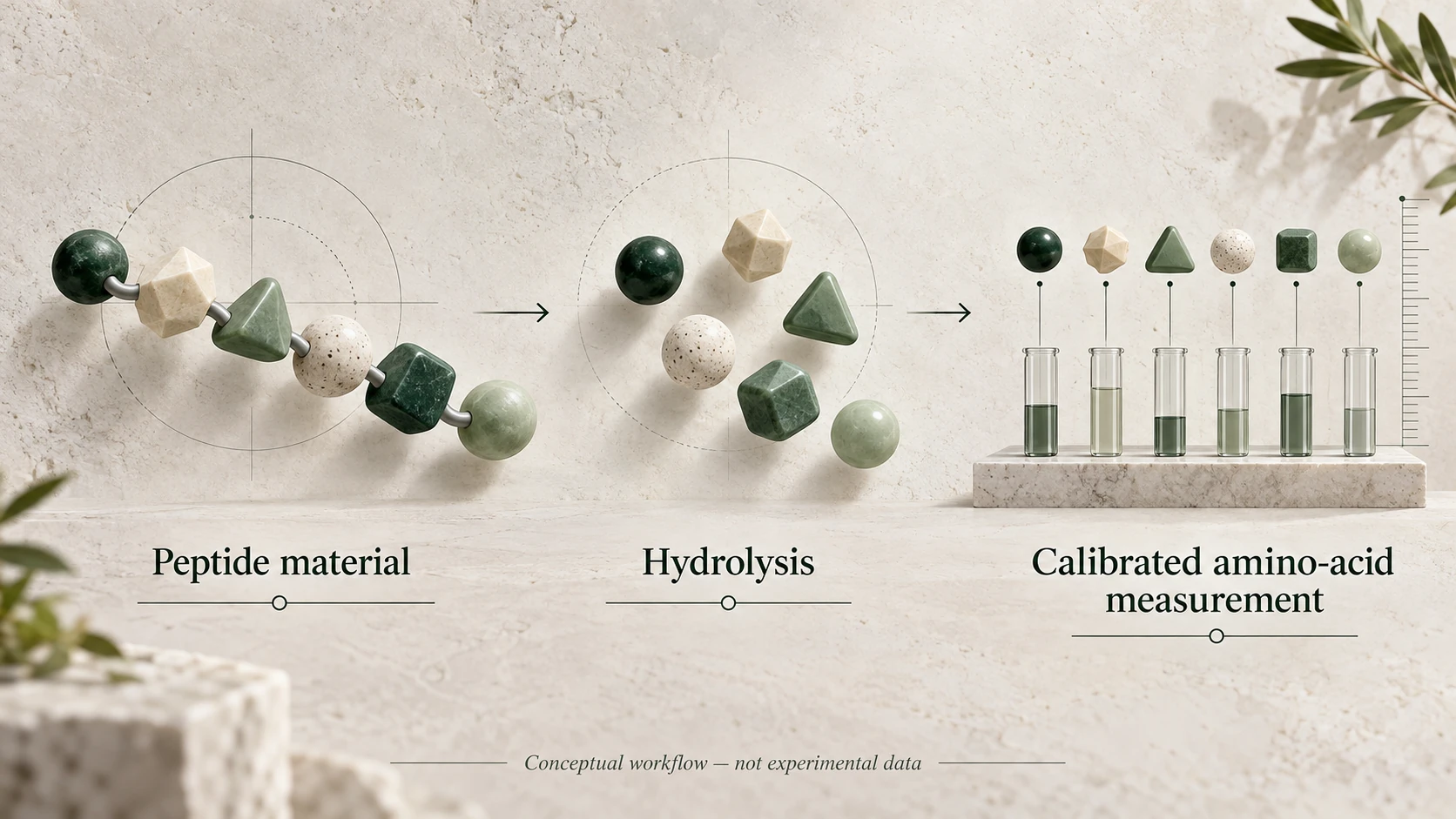
Amino acid analysis, or AAA, measures amino acids after suitable sample preparation. For peptide-content work, hydrolysis breaks peptide bonds and releases amino acids. The laboratory separates and quantifies selected products, then relates their amounts to the expected composition.
Hydrolysis removes sequence information. A composition result can support an expected residue balance, but it cannot by itself recover the original order of those residues. It also cannot automatically distinguish the target from another peptide containing the measured amino acids.
Waters’ hydrolysis reference explains that release and recovery vary with amino-acid chemistry. A method must account for the residues and modifications of the actual material, rather than assume that every sequence behaves identically.
The result therefore depends on the whole procedure, including sample identity, hydrolysis, transfer, separation, detection and calculation. A precisely measured amino-acid signal is useful only when those steps support the quantity the report claims to measure.
Relating residue measurements to peptide amount
For a known peptide, the number of copies of a selected residue provides a stoichiometric link. If one molecule contains two copies of that residue, the recovered amount attributable to those copies corresponds to twice the molar amount of peptide.
In the simplest justified case, peptide amount = amount of a selected amino acid attributable to the peptide ÷ copies of that residue per molecule. The qualification matters. The measured amino acid must be assigned appropriately, with recovery and background contributions addressed.
Several suitable residues can provide separate estimates. Agreement can support the calculation, while disagreement can reveal recovery problems, interference or an incorrect composition assumption. Those comparisons do not identify the explanation on their own.
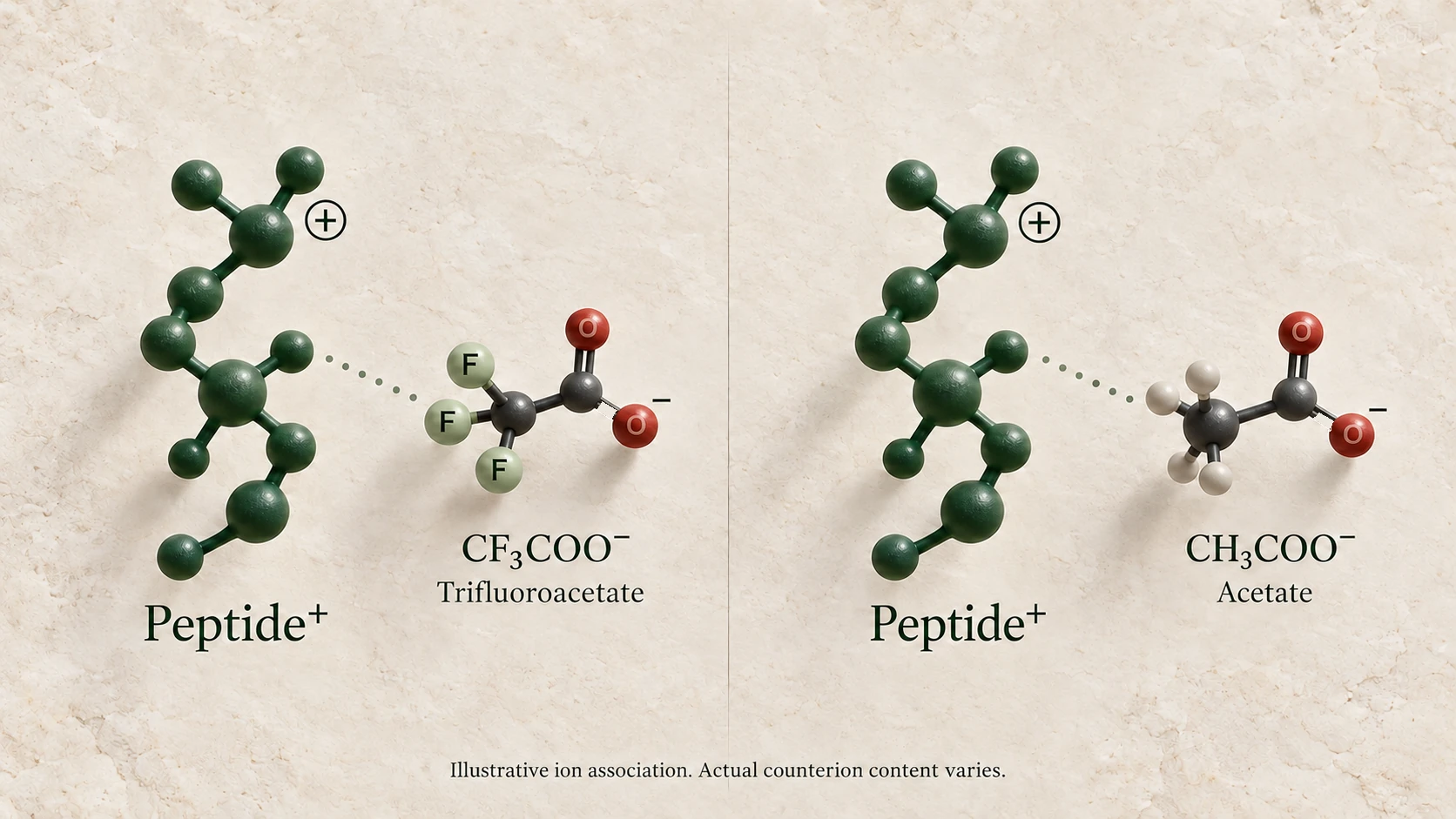
Converting a molar amount to mass also requires the specified molecular form. The peptide itself and a material containing counterions and water do not have the same mass basis. A quantitative report should state what formula or mass convention was used.
Calibration and reference materials
Calibration connects measured response with known amino-acid amounts. Reference values, preparation records and the applicable concentration range are part of that connection. A larger signal cannot be interpreted as a known amount without a justified measurement relationship.
NIST’s certification work for SRM 2389a used isotope-dilution LC-MS/MS and gravimetric information to assign amino-acid concentration values with associated uncertainty. It illustrates the role of characterised reference materials in quantitative analysis.
An amino-acid calibration solution addresses the measurement of free amino acids. It does not automatically establish that a peptide sample was hydrolysed completely or that every released residue was recovered. Calibration and sample-processing performance need separate consideration.
Traceability is a documented measurement relationship, not simply the presence of a familiar instrument or the name of a standard. The reference material must be suitable for the measurement being made, and its assigned values must enter the calculation correctly.
Recovery and analytical limitations
Standard acid hydrolysis does not preserve every amino acid equally. Asparagine and glutamine can be measured through their corresponding acid products. Tryptophan is not reliably recovered under standard acid conditions. Sulfur-containing residues and other sensitive amino acids can require specific treatment or a different approach.
This chemistry affects both residue selection and interpretation. A combined signal for an acid and its amide precursor does not establish their original proportions. Likewise, a missing hydrolysis product is not automatically evidence that its residue was absent from the intact peptide.
Incomplete release, losses during preparation, background amino acids and interfering signals can affect recovery. The method should demonstrate appropriate performance for its intended sample and result.
ICH Q2(R2) provides a framework for analytical characteristics such as accuracy, precision and specificity. It concerns pharmaceutical analytical procedures. It is a technical reference here, not a claim that a Lynx report has been validated against that guideline.
Precision and accuracy are different. Repeatable measurements can share the same bias. More decimal places do not compensate for an unresolved preparation loss or an incorrect measurement basis.
Why peptidic impurities need attention
A deletion sequence, another peptide or free amino acids may contribute to the selected amino-acid measurements. Hydrolysis can turn those different starting materials into shared products. AAA is therefore not inherently selective for the requested intact sequence.
NIST’s angiotensin I value-assignment research investigated impurity-corrected amino acid analysis alongside other measurement approaches. The correction is part of the quantitative assessment, not an optional detail added after calling all recovered amino acids the target peptide.
A chromatographic profile can help investigate peptide-related impurities, but an HPLC area percentage is not a universal mass correction. Different compounds may respond differently, and overlapping peaks can complicate the assignment.
Do not multiply an area percentage by a content percentage and describe the result as an exact measured target amount unless the laboratory has justified that calculation. The HPLC Guide explains why detector response and material mass are different bases.
Complementary approaches: qNMR and mass balance
No single measurement answers every composition question. Complementary methods can examine different parts of the material and help identify gaps in a content assessment.
| Approach | Contribution and limitation |
|---|---|
| Amino acid analysis | Quantifies selected hydrolysis products, with composition, recovery and impurity contributions assessed |
| Quantitative NMR | Relates suitable assigned signals to a quantitative reference, subject to signal separation and measurement conditions |
| Elemental analysis | Uses measured elemental composition and justified material assumptions, without automatically distinguishing peptide species |
| Mass balance | Assesses the specified component through measured impurity contributions, requiring a sufficiently complete assessment |
A subtraction cannot account for an impurity class that was never measured or otherwise justified. Similarly, agreement between methods is most informative when their sample basis and uncertainty are understood.
These are measurement principles, not a menu of tests assumed to exist for every product. The appropriate combination depends on the material and the analytical question. An unexplained disagreement should be investigated, not hidden by choosing the more favourable number.
What a content report should disclose
- Material and sample. Identify the tested sample and the available connection to its source material.
- Measurand and units. State whether the result concerns peptidic material, specified peptide, mass fraction or container amount.
- Measurement basis. Explain as-received or corrected basis and the defined molecular form.
- Method. Identify sample preparation, measured residues, detection and calculation approach.
- Calibration and performance. Describe the relevant references, recovery assessment and uncertainty where provided.
- Contributing components. Explain how peptide impurities, free amino acids and other relevant constituents were assessed.
- Scope. Keep the conclusion tied to the tested sample rather than extending it to untested containers or batches.
The absence of a content measurement should remain visible. A container label, a purity percentage or an expected sequence cannot supply a missing analytical result.
Read the COA Guide for wider reporting checks and the QA library for published documentation. The Research Library addresses literature rather than sample quantity. This article does not establish that Lynx offers AAA, qNMR or any other content method. Materials are for research use only, not for human or veterinary use.
References and further reading
- Bachem: Frequently Asked Questions. Definitions of net peptide content, gross weight and analytical measurements.
- Josephs et al.: SI-traceable value assignment of peptide purity using angiotensin I. Comparative analytical research, 2018.
- Lowenthal, Bunk and Phinney: Certifying NIST SRM 2389a by ID LC-MS/MS. Amino-acid reference-material research, 2010.
- Waters: Introduction to Hydrolysis. Laboratory reference for amino-acid release and recovery.
- ICH Q2(R2): Validation of Analytical Procedures. Technical framework for assessing analytical performance.
Explore research materials
Browse research materials and consult the documentation for the relevant product and batch.