On this page
What a COA can establish
A peptide Certificate of Analysis, or COA, records analytical findings for an identified sample or batch. It may include test methods, numerical results and a conclusion against stated specifications. An analytical report may provide similar evidence without carrying that title. Read the content rather than treating the document name as a guarantee.
Check what was tested, how it was tested and what the result describes. A COA can support the conclusions reached by its reported tests. It does not automatically establish every characteristic of the material, the contents of every container, or the suitability of the material for a particular research project.
The WHO model certificate of analysis offers a useful example of report organisation. It was developed for pharmaceutical quality-control documentation, not as a universal template that every research-peptide report must follow.
Match the report to the sample and batch
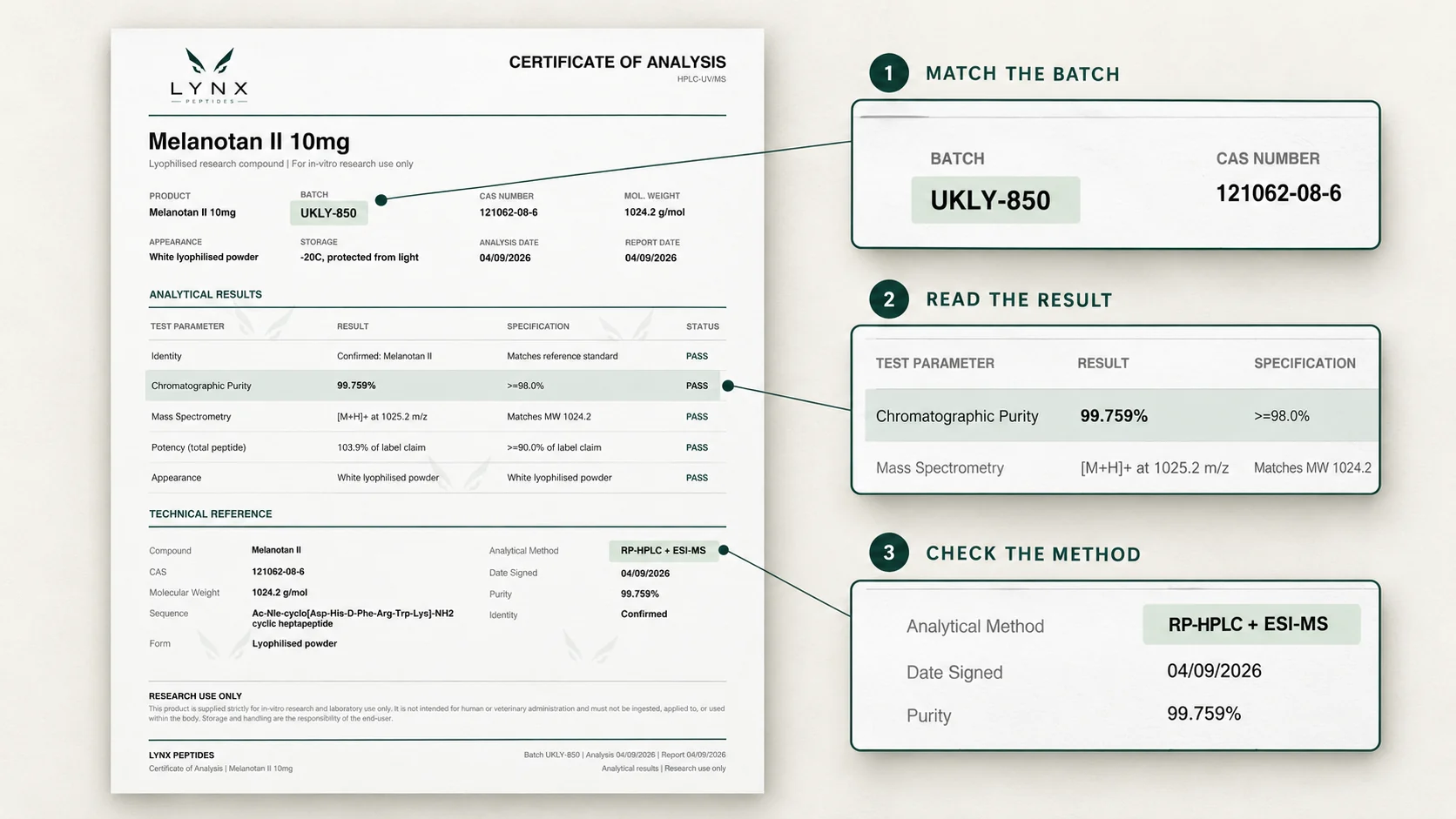
Start with the report reference, laboratory sample identifier and batch or lot number. These can be different identifiers. A laboratory may assign a sample code when material arrives, while a supplier uses a separate batch reference. If the codes differ, look for a documented connection rather than assuming they describe the same material.
Check the stated peptide name and material description against the relevant listing and batch information. Similar names do not make two batches interchangeable. A report on bulk material also does not automatically establish the amount in each subsequently filled container. That requires a documented connection and an appropriate measurement basis.
A batch number identifies the intended connection, but does not explain how the sample was selected. If you need to draw a conclusion about the whole batch, ask whether the sampling approach supports that conclusion. Identifying a sample and demonstrating that it represents a larger lot are different tasks.
Confirm that the document is complete, including referenced pages or attachments. Distinguish the organisation issuing the certificate from the laboratory performing the tests. A supplier summary and the underlying laboratory report serve different roles. A report's authenticity and its connection to a supplied batch are separate questions.
Look at sample receipt, analysis and report issue dates where available. The issue date is not necessarily the testing date. A retest or validity statement, when supplied, has its own conditions. A recent-looking date alone does not establish the current condition of stored material.
Read the method before the result
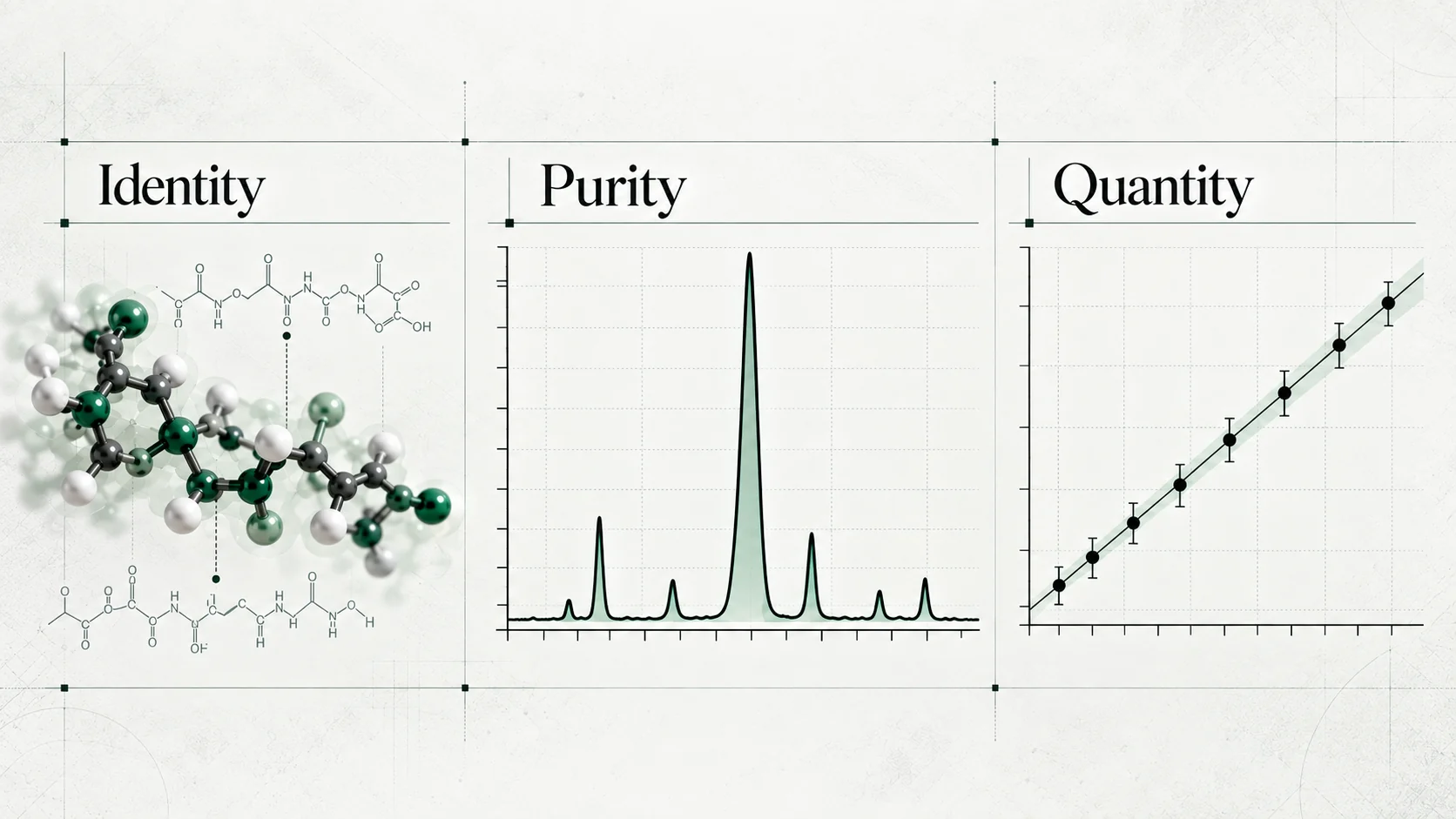
The method tells you which question a result can answer. High-performance liquid chromatography, or HPLC, can be used to examine a separation profile or, with a suitable quantitative procedure, measure content. Seeing “HPLC” on a report does not tell you which task was performed.
Identity evidence asks whether the observations support the stated substance. Mass spectrometry can provide an expected mass comparison, while other observations can add structural information. Check what the report actually concludes. An intact-mass match does not, by itself, establish a unique amino-acid sequence or distinguish every structural alternative. A retention time or prominent chromatographic peak alone is not proof of identity.
Look for a method reference or enough information to clarify the result, including the detector and calculation used where relevant. If a report combines techniques, confirm that the observations refer to the same sample.
ICH Q2(R2) relates analytical validation to the intended measurement purpose. It distinguishes identity, purity and quantitative testing rather than treating an instrument name as evidence that all three have been established. Its pharmaceutical scope does not imply that a research product is approved or that its methods have been validated to that guideline.
For the underlying distinctions, see Understanding Peptide Analytical Testing.
Separate chromatographic purity from measured content
Chromatographic area purity usually compares the integrated signal assigned to the main component with a defined total of integrated signals. The result depends on the separation, detector response and which peaks the calculation includes. Components can overlap in one peak, respond differently, or fall outside what the method detects.
An area percentage is not automatically a percentage by mass. It also does not establish the amount of peptide in a container. The IUPAC technical report on organic purity assignment, hosted by NIST, distinguishes relative chromatographic responses from mass-fraction measurements and discusses the additional impurity classes that may need assessment.
KEY POINT
A chromatographic purity percentage and a measured peptide amount have different measurement bases.
A quantitative result needs to identify the substance measured, the units and the basis. These examples describe different quantities:
| Reported expression | What to clarify |
|---|---|
| Chromatographic area % | Which signals form the total and how the assigned peak was identified |
| mg per tested container | Whether the analysis covered that container and reports the specified peptide rather than total material |
| mg/mL in an analysed solution | The preparation and dilution information needed to relate it to the original sample |
| mg/g or mass % | What material forms the denominator and whether the result is on an as-received or corrected basis |
Check whether the reported mass refers to the peptide itself or a defined salt form. Water, counterions and other constituents can affect the relationship between total material mass and peptide content. A dry-basis value should not be substituted for an as-received value without the necessary information.
NIST's peptide reference-material research compares complementary approaches to assigning peptide purity as a mass fraction. It illustrates a measurement challenge, not a finding about any Lynx batch.
INTERPRETATION NOTESuppose a hypothetical report gives 99.2% HPLC area purity but no content assay. That result does not establish 9.92 mg of peptide in a container labelled 10 mg. The area ratio and labelled amount cannot be combined to create an unmeasured content result. This example is not a Lynx laboratory finding.
Check the supporting data and acceptance criteria
Chromatograms and spectra help place a reported conclusion in context. Check their sample labels and method references against the report. A plot without a matching identifier cannot reliably connect the evidence to the material being reviewed.
For a chromatogram, look for labelled axes, the relevant time range, peak assignments and an integration table where provided. Peak height is not the same as integrated area. A cropped image or a single highlighted peak may omit information needed to interpret the reported percentage.
For a mass spectrum, look for the expected comparison and an explanation of the assignment. The horizontal axis may show mass-to-charge ratio rather than the neutral molecular mass. Reading the number without its charge assignment can lead to the wrong comparison. Ask the laboratory or report provider to explain an ambiguous assignment rather than inventing one.
Where an acceptance criterion is stated, compare it with the result for that same test. “Pass” means the reported criterion was met under the stated assessment. It is not a conclusion about every untested property. A report without a stated limit may still describe an analytical observation, but do not add your own supplier specification or assume a pass/fail decision was made.
If a quantitative value is close to a stated limit, ask how uncertainty was treated in the compliance decision. The displayed number alone may not explain the laboratory's decision rule.
Verify laboratory credentials and recognise limitations
A professional layout, signature or laboratory logo does not establish accreditation. If accreditation is claimed, check the named organisation, location and relevant testing scope in the accreditation body's records. UKAS explains that specific accredited activities appear in an organisation's accreditation schedule. A laboratory's accreditation does not automatically cover every test it offers.
ISO/IEC 17025 concerns the competence, impartiality and consistent operation of testing and calibration laboratories. A reference to the standard is not, by itself, evidence that the issuing laboratory holds accreditation for the work in the report.
Read qualification notes, deviations, detection limits and uncertainty statements where applicable. “Not detected” means the substance was not detected under the specified test conditions. It does not establish absolute absence. An omitted characteristic should remain unestablished unless another relevant test addresses it.
Measurement uncertainty describes the uncertainty associated with a measured value. If an uncertainty is given, check its units and how it is expressed before comparing results. The Eurachem/CITAC uncertainty guide explains its role in analytical measurement. Missing uncertainty information is a reason to ask what is needed for your interpretation, not proof that the measurement is exact or automatically invalid.
Keep conclusions within the tested scope. Identity, chromatographic purity and content evidence do not automatically establish sterility, biological activity, stability or other unreported characteristics. A useful document supports specific conclusions rather than an unrestricted assurance about the material.
A practical COA review checklist
Record questions alongside the relevant page or result so the provider can respond precisely.
- Confirm the material. Match the peptide name, form and available batch reference to the material being considered.
- Connect the identifiers. Establish how the laboratory sample code relates to the supplier's lot or batch. Do not substitute a report from another batch.
- Check the document. Read all pages, attachments and amendments. Identify the issuer and the laboratory responsible for the tests.
- Check the dates. Separate sample receipt, analysis and issue dates. Read any stated retest conditions.
- Classify each result. Is it identity evidence, chromatographic area purity, a quantitative assay or another measurement?
- Read the basis. Note the units, denominator, material form and any correction or dilution relevant to a quantitative result.
- Review the evidence. Match chromatograms and spectra to the sample and read assignments, integration details and available criteria.
- Verify claimed credentials. Check accreditation with the relevant body and establish whether its scope covers the reported work.
- Record the limits. Separate established findings from untested characteristics and unresolved questions. Ask for clarification where the batch link or measurement basis is missing.
Reviewing documentation with Lynx
The Quality Assurance library provides published analytical documents to review alongside available product and batch information. For the Melanotan II (MT2) listing, match the report's sample and batch identifiers to the corresponding product documentation. A matching product name alone does not establish that the report applies to the batch being reviewed.
Where documentation is supplier-provided, distinguish that source from testing commissioned independently by Lynx. This guide does not establish who commissioned any particular test or add analytical claims to a published report.
The Research Library provides literature context, while a COA describes the identified material and the tests reported for it. Literature findings do not replace batch analytical evidence.
Lynx materials are for research use only, not for human or veterinary use.
Explore research materials
Browse research materials and consult the documentation for the relevant product and batch.