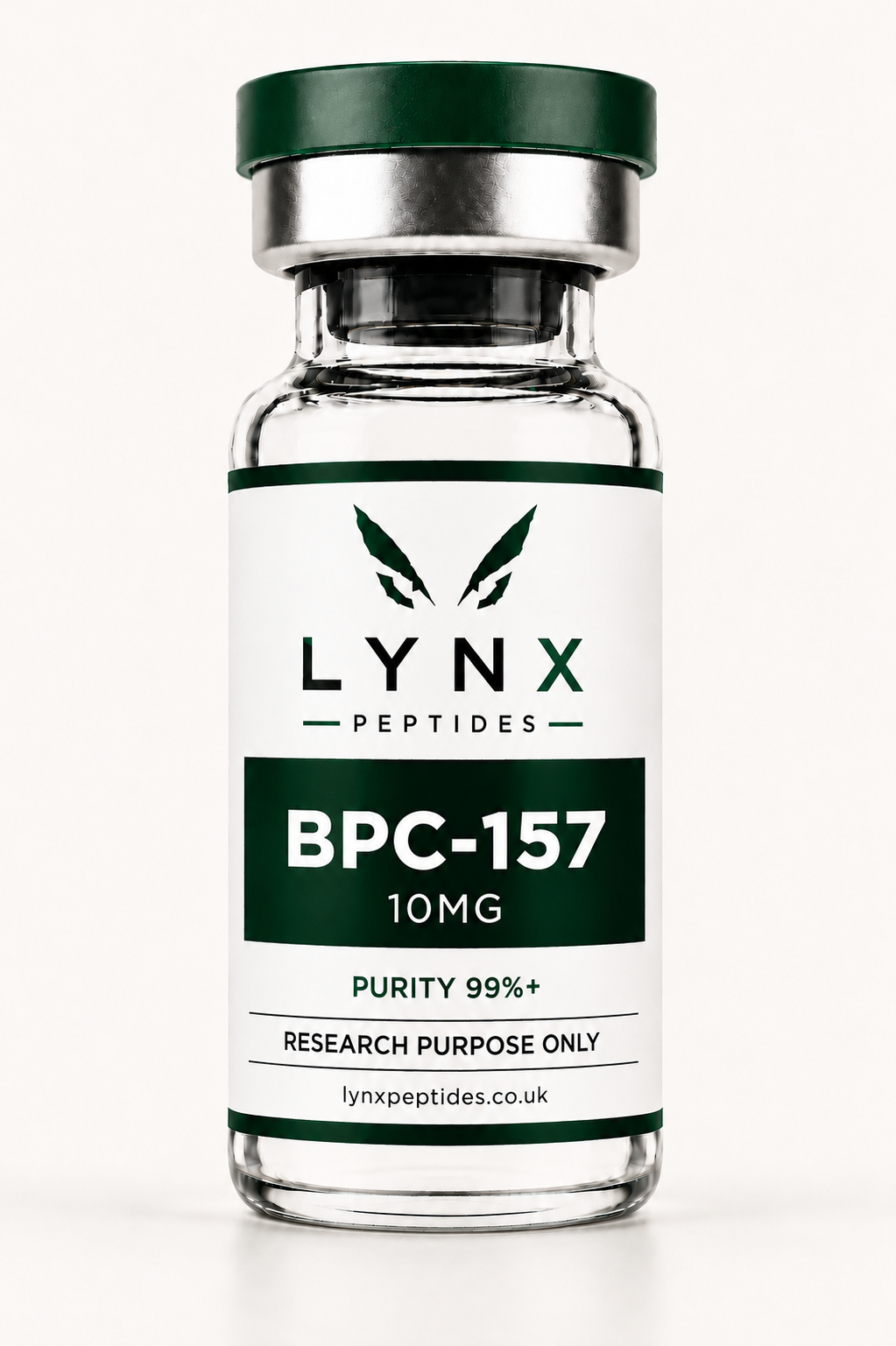
What is BPC-157?
BPC-157 is a defined, proline-rich sequence of 15 amino acids associated with gastric Body Protection Compound research. Its scientific interest extends beyond one tissue: gastrointestinal models examine mucosal injury, tendon experiments examine how repair cells move and attach, and vascular models examine signals involved in forming new vessels. These are related aspects of tissue biology, but each measures something different.
In tendon fibroblasts, migration and survival under oxidative stress have changed without a corresponding increase in ordinary cell proliferation. Endothelial experiments connect BPC-157 with VEGFR2 signalling, including receptor trafficking and downstream Akt–eNOS activity. Together, these observations give the peptide a more specific research identity than the broad label “repair peptide”. The strongest mechanistic detail comes from cell and animal experiments; interpreting it requires keeping the model, tissue and measured response in view.
Related scientific guides: BPC-157 and TB-500: molecular identity and evidence limits · KPV and BPC-157: structure and preclinical evidence.
BPC-157 Research Areas
BPC-157 increased tendon-fibroblast migration, spreading and survival under oxidative stress without directly increasing ordinary cell proliferation. FAK and paxillin phosphorylation rose, while total amounts of those proteins did not. The result connects cell movement with focal-adhesion signalling in rat-derived tendon cells.
Chang et al. · Journal of applied physiology (Bethesda, Md. : 1985) · 2011PubMed
BPC-157 increased VEGFR2 expression and internalisation in endothelial cells, with activation of the VEGFR2–Akt–eNOS pathway. Tube formation and animal vascular measurements also changed, while VEGF-A expression in the cell experiments did not increase. Blocking endocytosis suppressed several responses, linking receptor trafficking with the observed angiogenic signal.
Hsieh et al. · Journal of molecular medicine (Berlin, Germany) · 2017PubMed
Gastrointestinal injury models place BPC-157 in a broader discussion of mucosal repair and vascular growth signals. A narrative review also brings together tendon, ligament, muscle and bone observations, comparing them with EGF, FGF and VEGF research. Its breadth helps organise the preclinical literature, but it is not a controlled human result or a systematic estimate of benefit.
Seiwerth et al. · Curr Pharm Des · 2018PubMed
BPC-157 did not produce a direct angiogenic response in the cell cultures used in one experiment, while rat muscle and tendon injury models showed altered VEGF expression and vascular markers. The difference suggests that the injury environment can shape the measured response. It also cautions against treating all angiogenesis assays as interchangeable.
Brcic et al. · J Physiol Pharmacol · 2009PubMed
Molecular profile
- Compound
- BPC-157
- Amount
- 10 mg
- Sequence
- Gly-Glu-
Pro-Pro- Pro-Gly- Lys-Pro- Ala-Asp- Asp-Ala- Gly-Leu-Val - Residue count
- 15
- Molecular formula
- C62H98N16O22
- Molecular weight
- 1419.5 g/mol
- CAS number
- 137525-51-0
- Chemical class
- Synthetic peptide
- Classification
- Research peptide
- Available vial sizes
- 5 mg, 10 mg
Analytical verification
- Lynx report reference
- UKLY-428
- Reported purity
- 99.3%
- Analysis method
- RP-HPLC
- Identity result
- Confirmed - BPC-157
- Analysis date
- 27 Jul 2026
- Report date
- 27 Jul 2026
Storage & Reconstitution
Store in appropriate cool, dry conditions. Refer to product-specific storage information when published.
Vials are supplied separately from bacteriostatic water and other preparation supplies.
For laboratory handling context, read Research peptide storage and stability. Product-specific information and the laboratory method take precedence.
For laboratory preparation, allow the sealed vial to reach room temperature before opening. Wipe the vial stopper and bacteriostatic-water stopper with an alcohol wipe. Add bacteriostatic water slowly down the inside wall of the vial, then swirl gently until dissolved. Do not shake.
Research literature
- BPC 157 and Standard Angiogenic Growth Factors. Gastrointestinal Tract Healing, Lessons from Tendon, Ligament, Muscle and Bone Healing.Seiwerth et al. · Curr Pharm Des · 2018PubMed
- Gastric pentadecapeptide BPC 157 accelerates healing of transected rat Achilles tendon and in vitro stimulates tendocytes growth.Staresinic et al. · J Orthop Res · 2003PubMed
- Modulatory effect of gastric pentadecapeptide BPC 157 on angiogenesis in muscle and tendon healing.Brcic et al. · J Physiol Pharmacol · 2009PubMed
- The promoting effect of pentadecapeptide BPC 157 on tendon healing involves tendon outgrowth, cell survival, and cell migration.Chang et al. · Journal of applied physiology (Bethesda, Md. : 1985) · 2011PubMed
- Therapeutic potential of pro-angiogenic BPC157 is associated with VEGFR2 activation and up-regulation.Hsieh et al. · Journal of molecular medicine (Berlin, Germany) · 2017PubMed
BPC-157 Price (UK)
BPC-157 is supplied in 5 mg and 10 mg vial sizes for laboratory research. UK prices are 5 mg at £15.99 and 10 mg at £26.99.
Current availability is shown below. UK orders of £49.99 or more qualify for free standard shipping. Eligible working-day orders placed before 4 PM are dispatched the same day.
| Vial size | Current price | Price / mg | Status |
|---|---|---|---|
| 5 mg | £15.99 | £3.20/mg | Checking stock |
| 10 mgBest value | £26.99 | £2.70/mg | Checking stock |
Common questions about BPC-157
What is BPC-157?
BPC-157 is a synthetic peptide made from 15 amino acids, based on a sequence associated with a larger protein called Body Protection Compound. Its research includes cell movement, attachment and tissue-response signalling. These are different measurements: a peptide that changes how cells move does not necessarily increase how quickly they multiply.
Why is BPC-157 called a gastric peptide fragment?
The name refers to a sequence originally described in a larger protein associated with gastric juice. BPC-157 is the isolated, synthetic 15-amino-acid peptide, not gastric juice or an extract of that protein. Researchers study this defined sequence so they can examine its responses separately from the many other substances in gastric fluid.
What sequence does BPC-157 contain?
Its sequence is Gly-Glu-Pro-Pro-Pro-Gly-Lys-Pro-Ala-Asp-Asp-Ala-Gly-Leu-Val. The order matters because a peptide's identity depends on how its amino acids are arranged, not just how many it contains. The 5mg and 10mg vials contain the same listed sequence; the strength changes the amount supplied, not the molecule.
How does BPC-157 differ from BPC-157 + TB-500?
BPC-157 alone lets a laboratory examine that peptide's response without a second compound. The blend adds TB-500, whose thymosin β4-related research includes actin organisation, alongside BPC-157 research into cell migration and attachment. It supplies both in one preparation at a fixed ratio; separate vials allow each compound to be varied or tested independently.
What does BPC-157 cell-migration research examine?
It examines how cells move, spread and attach to their surroundings. In rat tendon-cell experiments, BPC-157 increased migration and spreading without directly increasing cell proliferation in the same assay. That is useful because movement and multiplication play different roles in a tissue response, and measuring one does not tell a laboratory what happened to the other.
Why is BPC-157 described as proline-rich?
Four of BPC-157's 15 amino acids are proline, including three next to each other near the beginning. Proline has a ring-shaped side chain that restricts movement at that part of a peptide backbone. That makes the arrangement of residues useful to consider in structural research, rather than describing BPC-157 only by its length.
Can I buy BPC-157 in the UK for research?
Yes. BPC-157 is listed in 5mg and 10mg vials for UK laboratory and in-vitro research. You can check stock for each strength on this page.
Is Lynx BPC-157 independently batch tested?
The 5mg BPC-157 batch reports purity above 99% by RP-HPLC (UKLY-343). For 10mg, UKLY-428 shows 99.3% using RP-HPLC.