What is KLOW?
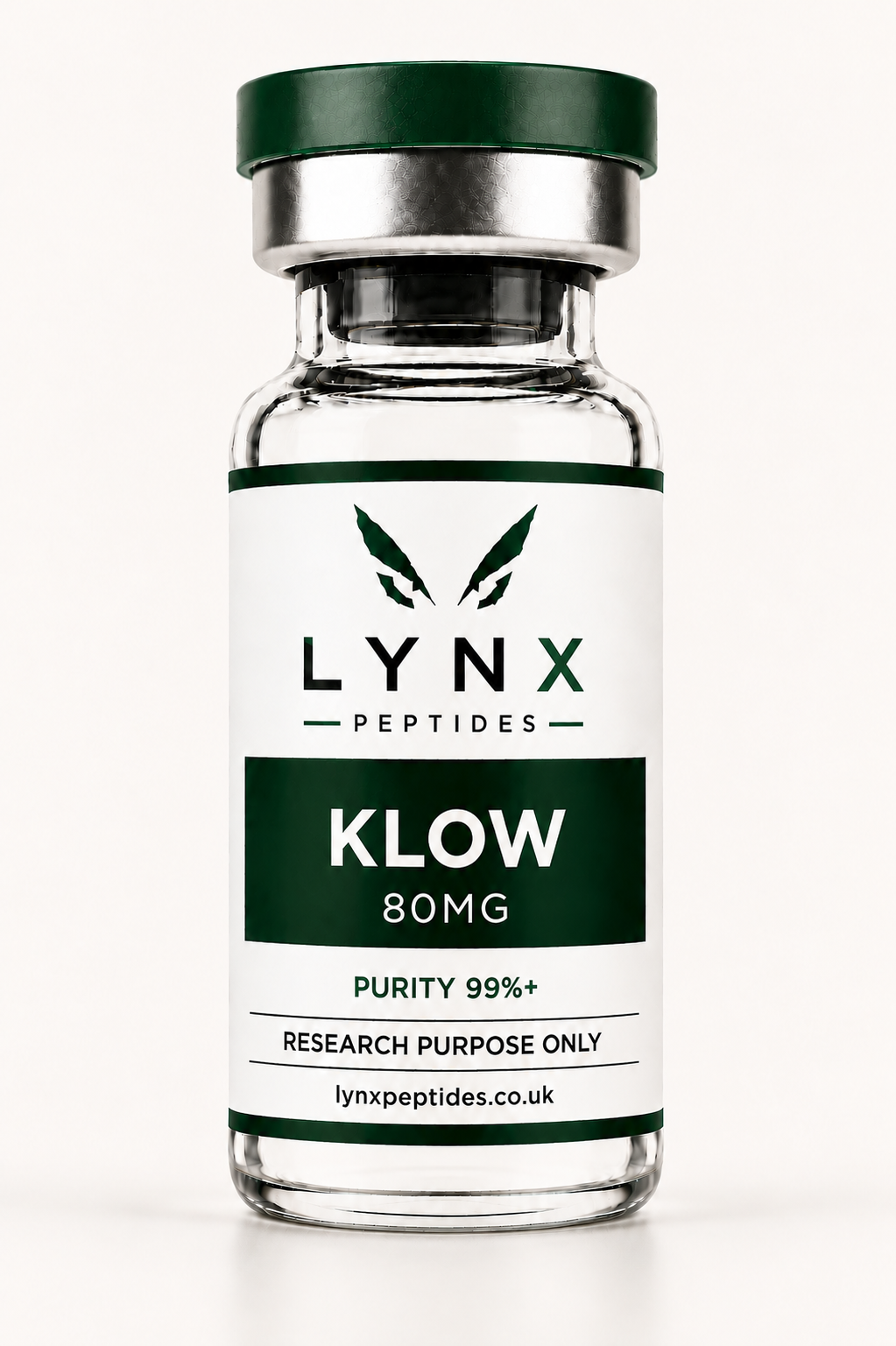
KLOW adds KPV to the GLOW combination: 50mg GHK-CU plus 10mg each of BPC-157, TB-500 and KPV, giving an 80mg formulation. KPV introduces a different research theme, linking peptide uptake in intestinal and immune cells with inflammatory signalling. The other components have literatures centred on matrix remodelling, vascular responses and actin-related cell movement.
The four constituents remain separate molecules in a fixed mass ratio. Published findings for one component do not establish that the four-component mixture reproduces them or produces synergy. Copper coordination also remains relevant when GHK-CU shares an assay with the other peptides. For TB-500, this page follows Lynx’s full-length thymosin β4 specification and treats shorter fragment studies separately. The useful scientific question is how defined components interact under controlled conditions, rather than whether more ingredients necessarily give a stronger response.
Related scientific guides: GLOW and KLOW composition compared.
KLOW Research Areas
KPV entered intestinal epithelial and immune-cell preparations through PepT1, with lower NF-κB and MAP-kinase signalling and reduced inflammatory cytokine output. In two mouse colitis models, inflammatory tissue and cytokine measures also decreased. The work connects peptide transport with intracellular signalling, while keeping cell uptake and whole-tissue responses as separate measurements.
Dalmasso et al. · Gastroenterology · 2008PubMed
BPC-157 increased tendon-fibroblast migration, spreading and survival under oxidative stress without directly increasing ordinary cell proliferation. FAK and paxillin phosphorylation rose, while total amounts of those proteins did not. The result connects cell movement with focal-adhesion signalling in rat-derived tendon cells.
Chang et al. · Journal of applied physiology (Bethesda, Md. : 1985) · 2011PubMed
Actin binding depended on residues distributed across full-length thymosin β4, not only its central short motif. Several substitutions markedly weakened association or stability of the actin complex. This helps explain why the complete molecule and an isolated fragment are distinct biochemical tools.
Au et al. · Biochemistry · 2008PubMed
GHK-Cu increased MMP-2 expression and secretion of its regulators TIMP-1 and TIMP-2 in dermal fibroblast cultures. Copper ions reproduced the MMP-2 response, whereas copper-free GHK did not. The finding broadens matrix biology from making connective tissue to regulating its breakdown and remodelling.
Siméon et al. · Life Sci · 2000PubMed
Molecular profile
GHK-CU
- Amount
- 50 mg
- Sequence
- Glycyl-L-histidyl-L-lysine
- Residue count
- 3
- Molecular formula
- C14H23CuN6O4+
- Molecular weight
- 402.92 g/mol
- CAS number
- 89030-95-5
- Chemical class
- Copper peptide complex
TB-500
- Amount
- 10 mg
- Sequence
- Ac-SDKPDMAEIEKFDKSKLKKTETQEKNPLPSKETIEQEKQAGES-OH
- Residue count
- 43
- Molecular formula
- C212H350N56O78S
- Molecular weight
- 4963 g/mol
- CAS number
- 77591-33-4
- Chemical class
- Synthetic N-terminally acetylated peptide
BPC-157
- Amount
- 10 mg
- Sequence
- Gly-Glu-
Pro-Pro- Pro-Gly- Lys-Pro- Ala-Asp- Asp-Ala- Gly-Leu-Val - Residue count
- 15
- Molecular formula
- C62H98N16O22
- Molecular weight
- 1419.5 g/mol
- CAS number
- 137525-51-0
- Chemical class
- Synthetic peptide
KPV
- Amount
- 10 mg
- Sequence
- Lysine-proline-valine
- Residue count
- 3
- Molecular formula
- C16H30N4O4
- Molecular weight
- 342.43 g/mol
- CAS number
- 67727-97-3
- Chemical class
- Tripeptide
Analytical verification
- Lynx report reference
- UKLY-253
- Reported purity
- >99%
- Analysis method
- RP-HPLC + ESI-MS
- Identity result
- KPV + GHK-Cu + BPC-157 + TB-500 confirmed
- Analysis date
- 3 Sept 2026
- Report date
- 3 Sept 2026
Storage & Reconstitution
Store in appropriate cool, dry conditions. Refer to product-specific storage information when published.
Vials are supplied separately from bacteriostatic water and other preparation supplies.
For laboratory handling context, read Research peptide storage and stability. Product-specific information and the laboratory method take precedence.
For laboratory preparation, allow the sealed vial to reach room temperature before opening. Wipe the vial stopper and bacteriostatic-water stopper with an alcohol wipe. Add bacteriostatic water slowly down the inside wall of the vial, then swirl gently until dissolved. Do not shake.
Research literature
- In vivo stimulation of connective tissue accumulation by the tripeptide-copper complex glycyl-L-histidyl-L-lysine-Cu2+ in rat experimental wounds.Maquart et al. · J Clin Invest · 1993PubMed
- Effects of topical copper tripeptide complex on CO2 laser-resurfaced skin.Leyden et al. · Arch Facial Plast Surg · 2006PubMed
- Gastric pentadecapeptide BPC 157 accelerates healing of transected rat Achilles tendon and in vitro stimulates tendocytes growth.Staresinic et al. · J Orthop Res · 2003PubMed
- PepT1-mediated tripeptide KPV uptake reduces intestinal inflammation.Dalmasso et al. · Gastroenterology · 2008PubMed
- The promoting effect of pentadecapeptide BPC 157 on tendon healing involves tendon outgrowth, cell survival, and cell migration.Chang et al. · Journal of applied physiology (Bethesda, Md. : 1985) · 2011PubMed
- Widely distributed residues in thymosin beta4 are critical for actin binding.Au et al. · Biochemistry · 2008PubMed
- The tripeptide-copper complex glycyl-L-histidyl-L-lysine-Cu2+ stimulates matrix metalloproteinase-2 expression by fibroblast cultures.Siméon et al. · Life Sci · 2000PubMed
KLOW Price (UK)
KLOW is a 80 mg total research blend containing GHK-CU 50 mg, TB-500 10 mg, BPC-157 10 mg and KPV 10 mg. The current price is £73.99.
Current availability is shown below. UK orders of £49.99 or more qualify for free standard shipping. Eligible working-day orders placed before 4 PM are dispatched the same day.
| Vial size | Current price | Price / mg | Status |
|---|---|---|---|
| 80MG | £73.99 | £0.92/mg | Checking stock |
Common questions about KLOW
What is in the KLOW 80MG blend?
KLOW's listed formulation contains 50mg GHK-Cu, 10mg BPC-157, 10mg TB-500 and 10mg KPV. Those four compounds total 80mg, rather than 80mg of one peptide. The formulation brings together copper-peptide chemistry, cell-movement research and KPV's inflammatory-signalling research, so each component contributes a different area of study.
How does KLOW differ from GLOW?
KLOW adds 10mg KPV to the three compounds and amounts listed in GLOW. KPV is studied in inflammatory signalling, including intestinal-cell experiments, so the added component changes the research preparation as well as the total mass. KLOW and GLOW have separate certificates and should be treated as different formulations, not simply different vial sizes.
What does KPV add to the research context?
KPV brings research into inflammatory signalling and how a small peptide enters intestinal and immune cells. That is a different emphasis from GHK-Cu's copper chemistry and the cell-movement research associated with BPC-157 and thymosin β4. Its inclusion lets those areas be examined in one formulation, while keeping the contribution of each component a separate question.
Why are four different compounds supplied together?
KLOW combines compounds studied in overlapping but distinct parts of cell biology: copper binding, attachment and migration, actin organisation and inflammatory signalling. A laboratory can examine that fixed combination as one preparation. To determine what each ingredient contributes, it would need comparisons with individual compounds or other mixtures; studies of an ingredient alone do not establish the blend's behaviour.
Can the amount of KPV be changed independently in KLOW?
No. KPV is already mixed with the other three compounds in fixed amounts. Changing the overall concentration changes all four together, while their ratio stays the same. Separate vials are needed to vary KPV independently or test a preparation without it, which helps distinguish its contribution from the response to the complete blend.
Is KPV chemically joined to the other KLOW components?
No. KPV is a separate peptide mixed with GHK-Cu, BPC-157 and TB-500, not a tail attached to one of them. The vial is a four-component formulation rather than a newly joined molecule. That matters when interpreting experiments, because a response to the mixture can involve several compounds whose individual concentrations change together.
Can I buy KLOW in the UK for research?
Yes. KLOW is listed as an 80mg four-component research blend with UK supply. You can see current stock beside the product's ordering controls.
Is the KLOW blend independently tested?
KLOW has certificate UKLY-253 for the four-component sample. Its reported purity is above 99%, with RP-HPLC + ESI-MS listed as the test method.