On this page
Three residues and fifteen residues
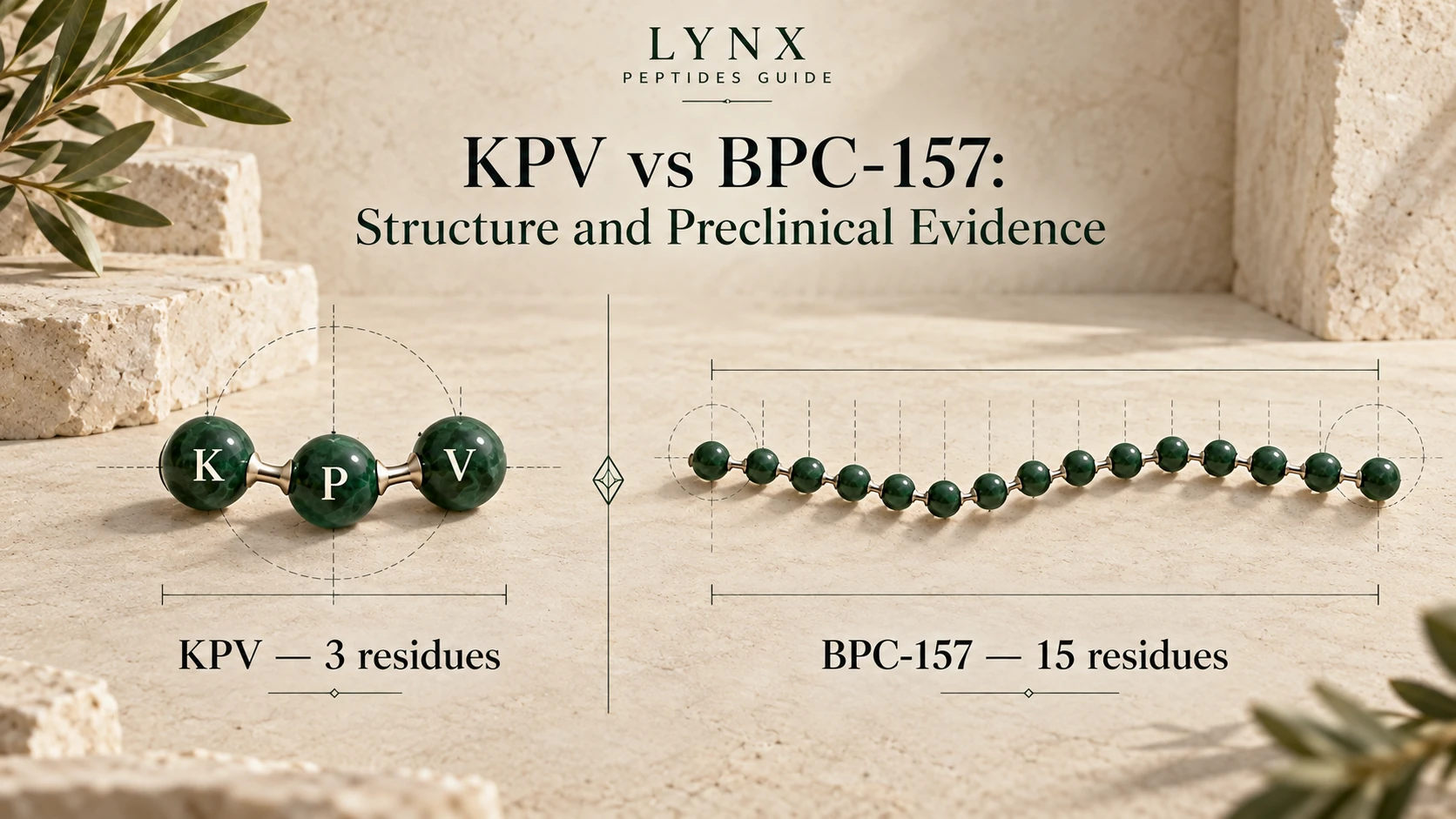
KPV and BPC-157 are different peptide sequences, not shorter and longer versions of the same molecule. KPV stands for lysine–proline–valine. BPC-157 is a 15-residue peptide with the sequence GEPPPGKPADDAGLV. Both appear in preclinical gastrointestinal literature, but that overlap does not establish equivalent biological behaviour.
| Feature | KPV | BPC-157 |
|---|---|---|
| Residue count | 3, a tripeptide. | 15, a pentadecapeptide. |
| Sequence | Lys–Pro–Val, written KPV in one-letter notation. | Gly–Glu–Pro–Pro–Pro–Gly–Lys–Pro–Ala–Asp–Asp–Ala–Gly–Leu–Val. |
| Research context | A C-terminal alpha-melanocyte-stimulating hormone fragment investigated in transport and inflammation models. | A distinct sequence investigated in experimental gastrointestinal and other preclinical models. |
| Material details | Free peptide and carrier-loaded KPV are separate experimental preparations. | Sequence, terminal chemistry and batch identity still require documentation. |
The What Is a Peptide? Guide covers residues and peptide bonds. Chain length is useful for identifying these molecules, but it cannot rank their effectiveness or predict their behaviour in a whole organism.
KPV transport and PepT1
Dalmasso and colleagues (2008) investigated KPV in intestinal cell lines, immune cells and mouse colitis models. Their experiments linked KPV uptake to PepT1, a transporter for dipeptides and tripeptides. PepT1 is a transport protein, not a melanocortin receptor.
The study reported changes in inflammatory signalling, including NF-kappa B, a regulator of gene expression, and mitogen-activated protein kinase (MAPK) pathways, alongside the transport experiments. A transporter can affect access to a cell. That is a different question from identifying a downstream molecular target.
The mouse work used chemically induced colitis models involving dextran sulphate sodium (DSS) or trinitrobenzenesulphonic acid (TNBS). These are experimental systems with particular mechanisms and limitations, not interchangeable representations of human gastrointestinal disease. The results support a preclinical research question, not a treatment claim.
The KPV Research Library entry provides the compound-specific literature context. KPV’s relationship to a fragment of alpha-MSH does not mean every property of the full hormone belongs to the isolated tripeptide.
A carrier-loaded peptide is a different preparation
Xiao and colleagues (2017) investigated KPV in a hyaluronic-acid-functionalised polymeric nanoparticle system, with a chitosan–alginate hydrogel formulation. A nanoparticle is a small carrier structure. Here, the peptide was one component of an engineered delivery system.
That system changes what is being tested. Loading, release, carrier interactions and localisation may contribute to a measured result. Findings for the complete formulation cannot be transferred directly to ordinary free KPV or another preparation merely because both contain the same sequence.
To separate formulation effects from peptide effects, compare the loaded system with appropriate carrier and free-peptide controls. State which comparison the experiment actually made. A favourable result for the complete preparation is not proof that every component independently produced it.
BPC-157 gastrointestinal experiments use other models
Klicek and colleagues (2013) examined BPC-157 in rat experiments that included cysteamine-induced colitis and a colon-to-colon anastomosis model. An anastomosis is a surgically joined section of tissue. Those experiments differ from the chemically induced mouse models in the KPV paper.
Species, injury mechanism and the tissue observation all affect what can be inferred. Outcomes from separate studies cannot be treated as a controlled KPV-versus-BPC-157 comparison. A difference between published findings may reflect design as well as material.
The BPC-157 Research Library entry covers its wider preclinical literature. Keeping the study conditions attached to each result is more informative than grouping all gastrointestinal observations under one broad claim.
Evidence quality depends on the question
| Evidence | What it examines | What it cannot establish |
|---|---|---|
| Dalmasso et al., 2008 | KPV uptake, cell signalling and mouse colitis observations. | Human benefit, BPC-157 superiority comparisons or universal transport across tissues. |
| Xiao et al., 2017 | KPV within an engineered carrier and formulation. | Equivalent behaviour of a free-peptide material. |
| Klicek et al., 2013 | BPC-157 observations in specified rat models. | A direct comparison with KPV in matched conditions. |
| Head-to-head human evidence | None of these cited studies provides a controlled human comparison. | A reliable ranking of human efficacy or safety. |
Cellular experiments can investigate transport or signalling more directly than a whole-animal tissue observation. Animal experiments add organism-level context but introduce further variables. These evidence types complement one another only when the connecting assumptions are stated.
Different controls, endpoints and formulations also prevent simple comparisons of effect size. A tissue score, a cytokine measurement and an uptake result measure different things.
Questions a useful comparison must leave open
Matched experiments would need defined material identities, appropriate controls and the same endpoints before a direct comparison became interpretable. The cited studies do not establish reliable head-to-head human superiority or long-term safety.
A multi-component blend introduces another level of uncertainty. The KLOW Research Library article discusses the blend context. Findings for isolated KPV or BPC-157 do not establish how the combination behaves, nor demonstrate synergy.
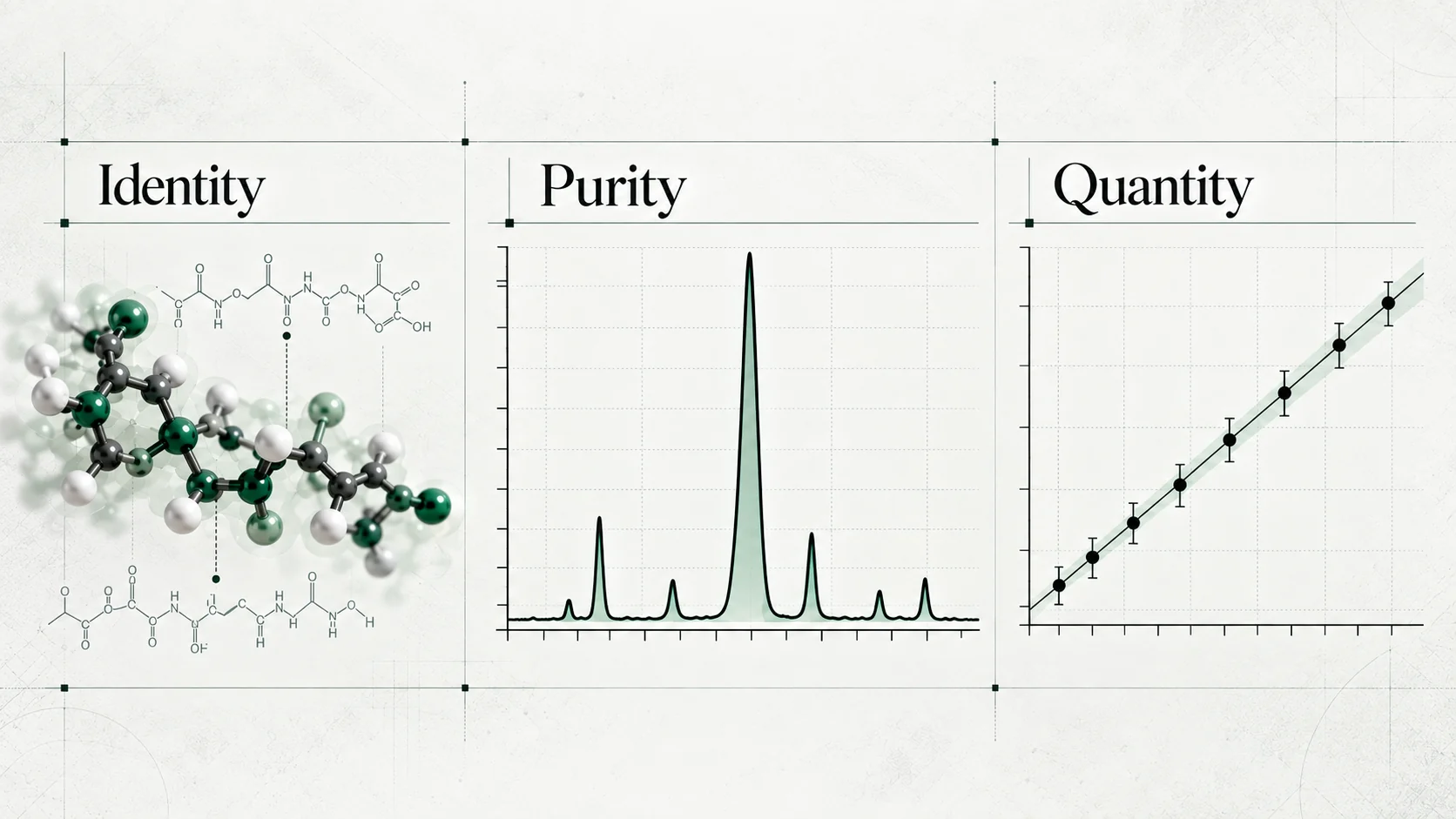
For research documentation, verify each component’s identity separately from purity and quantity. The analytical testing Guide explains those distinctions. Neither a shared topic nor a purity figure supplies missing biological evidence.
This comparison concerns experimental interpretation and offers no advice on treating gastrointestinal conditions or using the compounds in people.
Primary references
- Dalmasso et al. (2008). PepT1-related KPV uptake and preclinical intestinal models. Gastroenterology. PMID 18061177. DOI 10.1053/j.gastro.2007.10.026.
- Xiao et al. (2017). KPV in an engineered nanoparticle delivery system. Molecular Therapy. PMID 28143741. DOI 10.1016/j.ymthe.2016.11.020.
- Klicek et al. (2013). BPC-157 in gastrointestinal rat models. Journal of Physiology and Pharmacology. PMID 24304574.