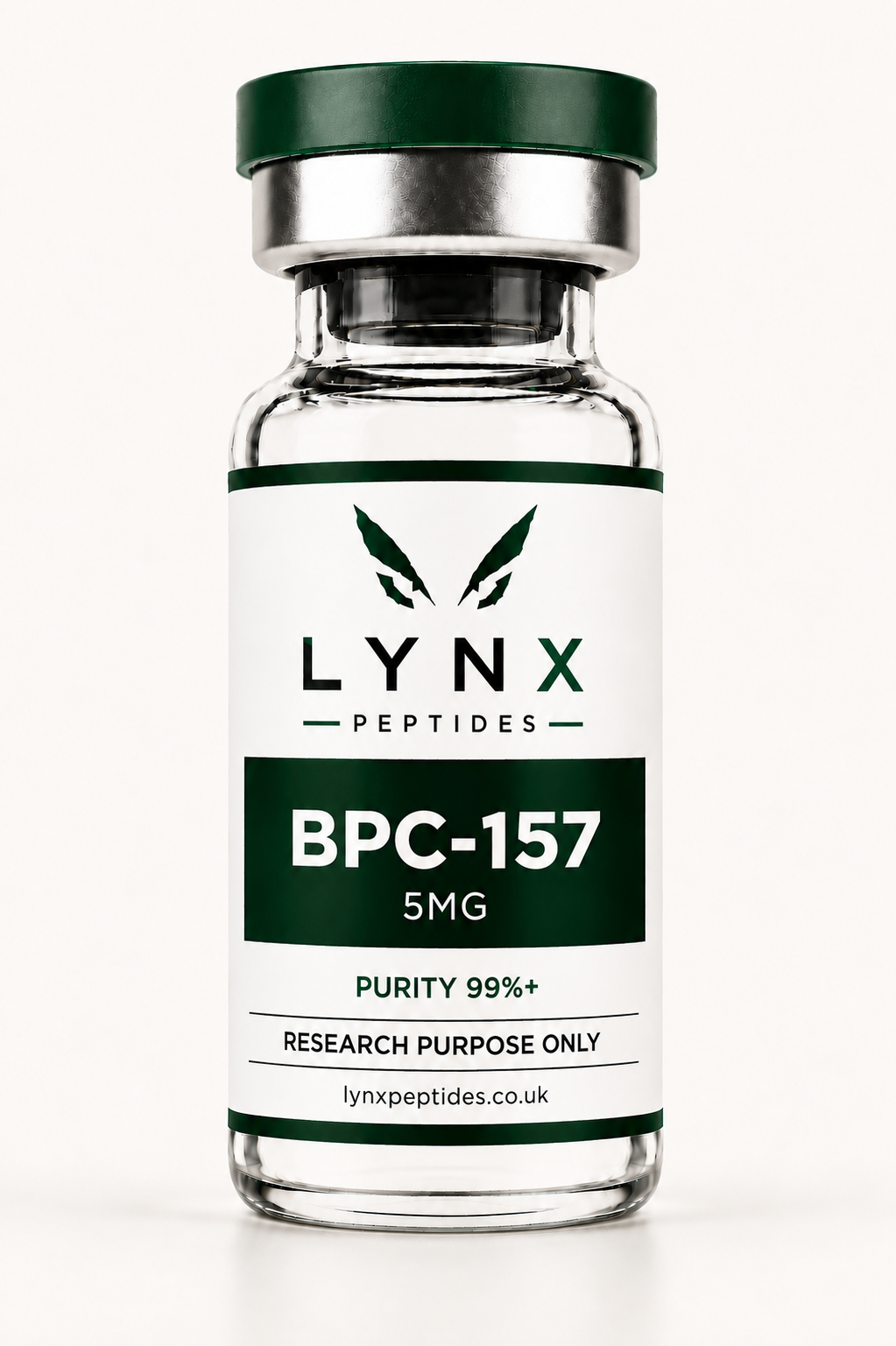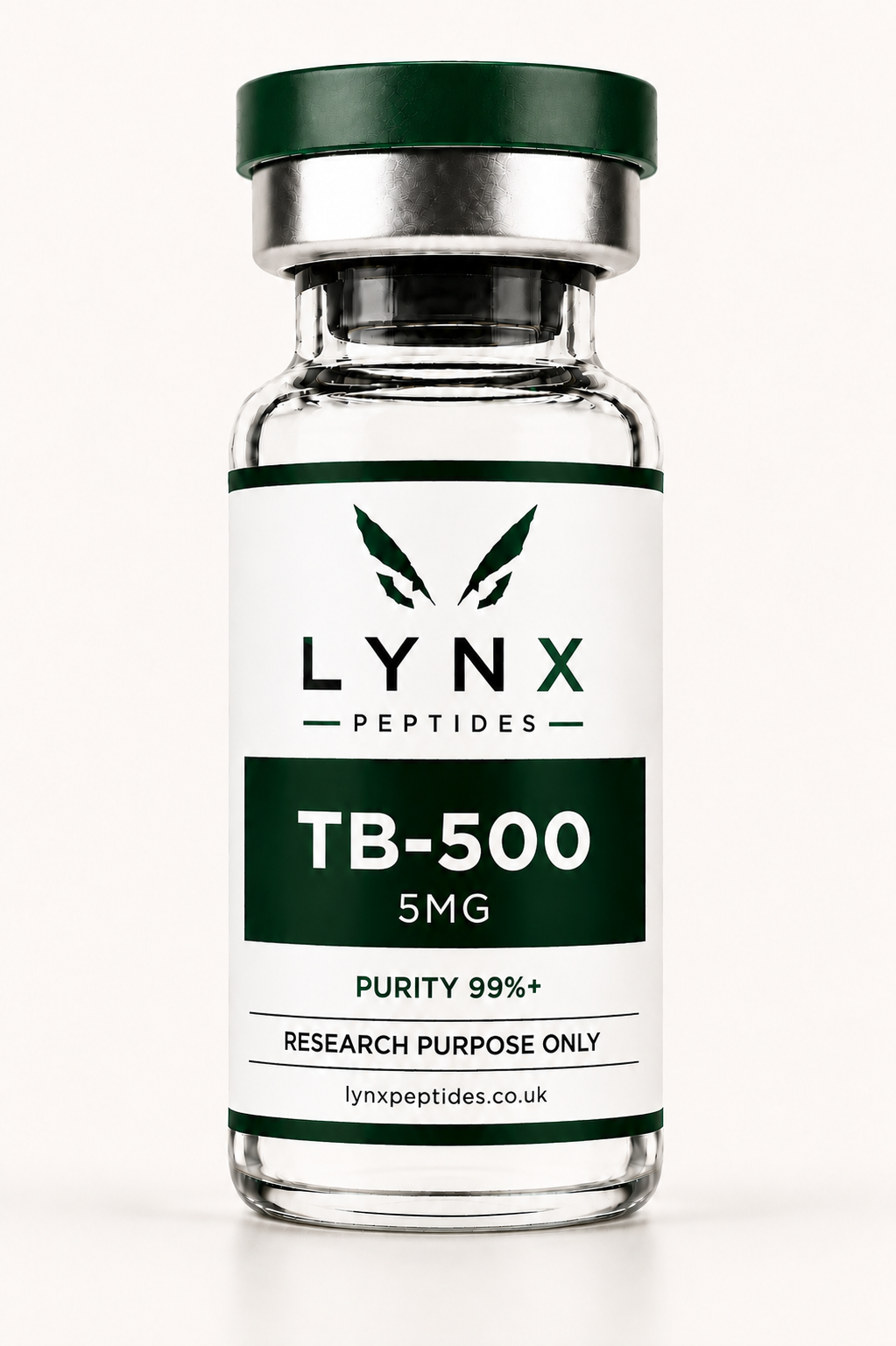
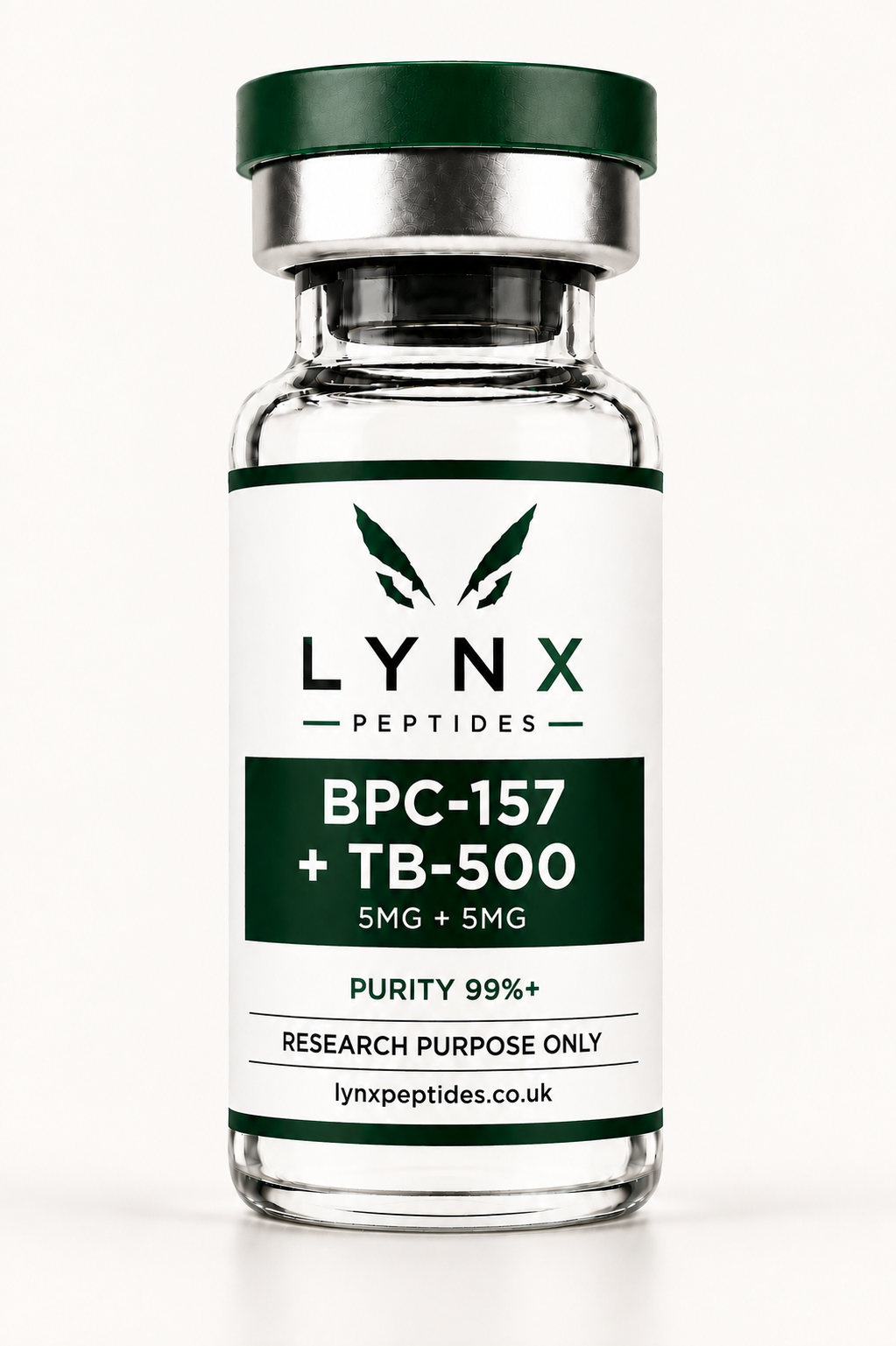
What is BPC-157 + TB-500?
This 10mg blend brings two chemically distinct peptides into one vial: 5mg BPC-157 and 5mg TB-500. BPC-157 has 15 residues, whereas the Lynx profile specifies TB-500 as N-terminally acetylated, 43-residue thymosin β4. Their individual literatures approach tissue biology from different directions, including focal-adhesion signalling, actin organisation and cell migration.
Equal mass does not mean equal numbers of molecules, and a fixed blend couples the concentrations of the two components. A controlled rat tendon experiment provides some direct combination context, but the mixture did not outperform the separate agents. That is a useful finding rather than evidence of synergy. The preparation used in that experiment also needs to be distinguished from a Lynx batch, particularly because TB-500 is a name applied to both full-length thymosin β4 and shorter fragments.
BPC-157 + TB-500 Research Areas
The BPC-157 and TB-500 combination did not add benefit over the individual agents in an exploratory rat Achilles-tendon study. Among 32 rats divided into four groups, TB-500 had the clearest significant load-to-failure and histological findings, while the combination improved one histology score. Collagen I expression did not differ significantly between groups. The eight-animal groups and four-week follow-up limit the conclusion, and the reported TB-500 preparation still needs identity matching before comparison with a catalogue vial.
Biçer et al. · Jt Dis Relat Surg · 2026PubMed
BPC-157 increased tendon-fibroblast migration, spreading and survival under oxidative stress without directly increasing ordinary cell proliferation. FAK and paxillin phosphorylation rose, while total amounts of those proteins did not. The result connects cell movement with focal-adhesion signalling in rat-derived tendon cells.
Chang et al. · Journal of applied physiology (Bethesda, Md. : 1985) · 2011PubMed
Actin binding depended on residues distributed across full-length thymosin β4, not only its central short motif. Several substitutions markedly weakened association or stability of the actin complex. This helps explain why the complete molecule and an isolated fragment are distinct biochemical tools.
Au et al. · Biochemistry · 2008PubMed
Molecular profile
BPC-157
- Amount
- 5 mg
- Sequence
- Gly-Glu-
Pro-Pro- Pro-Gly- Lys-Pro- Ala-Asp- Asp-Ala- Gly-Leu-Val - Residue count
- 15
- Molecular formula
- C62H98N16O22
- Molecular weight
- 1419.5 g/mol
- CAS number
- 137525-51-0
- Chemical class
- Synthetic peptide
TB-500
- Amount
- 5 mg
- Sequence
- Ac-SDKPDMAEIEKFDKSKLKKTETQEKNPLPSKETIEQEKQAGES-OH
- Residue count
- 43
- Molecular formula
- C212H350N56O78S
- Molecular weight
- 4963 g/mol
- CAS number
- 77591-33-4
- Chemical class
- Synthetic N-terminally acetylated peptide
Analytical verification
- Lynx report reference
- UKLY-468
- Reported purity
- 99.101%
- Analysis method
- RP-HPLC + ESI-MS
- Identity result
- BPC-157: Confirmed; TB-500 (Tbeta4): Confirmed
- Analysis date
- 3 Sept 2026
- Report date
- 3 Sept 2026
Storage & Reconstitution
Store in appropriate cool, dry conditions. Refer to product-specific storage information when published.
Vials are supplied separately from bacteriostatic water and other preparation supplies.
For laboratory handling context, read Research peptide storage and stability. Product-specific information and the laboratory method take precedence.
For laboratory preparation, allow the sealed vial to reach room temperature before opening. Wipe the vial stopper and bacteriostatic-water stopper with an alcohol wipe. Add bacteriostatic water slowly down the inside wall of the vial, then swirl gently until dissolved. Do not shake.
Research literature
- Effects of BPC-157 and TB-500 on Achilles tendon healing in rats: A histopathological and biomechanical study.Biçer et al. · Jt Dis Relat Surg · 2026PubMed
- The promoting effect of pentadecapeptide BPC 157 on tendon healing involves tendon outgrowth, cell survival, and cell migration.Chang et al. · Journal of applied physiology (Bethesda, Md. : 1985) · 2011PubMed
- Widely distributed residues in thymosin beta4 are critical for actin binding.Au et al. · Biochemistry · 2008PubMed
BPC-157 + TB-500 Price (UK)
BPC-157 + TB-500 is a 10 mg total research blend containing BPC-157 5 mg and TB-500 5 mg. The current price is £29.99.
Current availability is shown below. UK orders of £49.99 or more qualify for free standard shipping. Eligible working-day orders placed before 4 PM are dispatched the same day.
| Vial size | Current price | Price / mg | Status |
|---|---|---|---|
| 5MG + 5MG | £29.99 | £3.00/mg | Checking stock |
Common questions about BPC-157 + TB-500
What is in the BPC-157 + TB-500 blend?
One lyophilised vial contains the listed formulation of 5mg BPC-157 and 5mg TB-500. The compact 5+5MG badge shows those two amounts, not 10mg of either peptide. This is a combined preparation of different molecules: BPC-157 and the thymosin β4-related TB-500 component have different structures and research backgrounds.
Why are BPC-157 and TB-500 studied together?
Their research overlaps around cell movement and tissue responses, but they address different biological processes. BPC-157 experiments include migration and cell-attachment signalling; thymosin β4 research includes actin, a protein that helps cells maintain shape and move. A combined preparation allows those processes to be examined together, without assuming the blend produces the same response as either peptide alone.
How do the two peptide components differ?
BPC-157 contains 15 amino acids; the Lynx TB-500 profile uses acetylated, full-length thymosin β4 with 43. More importantly, their research does not centre on the same molecular process. BPC-157 studies include attachment and migration signalling, while thymosin β4 interacts with actin. Their different structures and biology make them separate experimental variables.
How does the blend differ from separate BPC-157 and TB-500 vials?
The blend supplies the two peptides at a fixed 1:1 mass ratio, so changing its concentration changes both together. Separate vials let a laboratory adjust BPC-157 without changing TB-500, or compare the blend with each peptide alone. Those controls help distinguish a combined response from an effect of just one component.
Is TB-500 always the same peptide in published papers?
No. Some papers use TB-500 for a short thymosin β4 fragment, while the Lynx profile uses the full-length 43-amino-acid reference. A fragment does not contain every part of the larger peptide, so its activity may differ. Matching the actual sequence is more useful than relying on the shared name when comparing experiments.
Does 5+5MG mean equal numbers of both peptide molecules?
No. It means equal masses of BPC-157 and TB-500, not equal numbers of molecules. The peptides have different molecular sizes, so the same mass represents different molar amounts. A laboratory comparing their contributions needs to account for that difference, rather than treating the 1:1 mass ratio as a 1:1 molecular ratio.
Can I buy BPC-157 + TB-500 in the UK for research?
Yes. Lynx offers the 5mg + 5mg BPC-157 and TB-500 blend for laboratory research in the UK. Availability is shown alongside the vial option.
How is the BPC-157 + TB-500 blend batch tested?
The blend's certificate, UKLY-468, gives a purity result of 99.101% using RP-HPLC + ESI-MS. It identifies both BPC-157 and TB-500 in the sample.