What is Bacteriostatic Water?
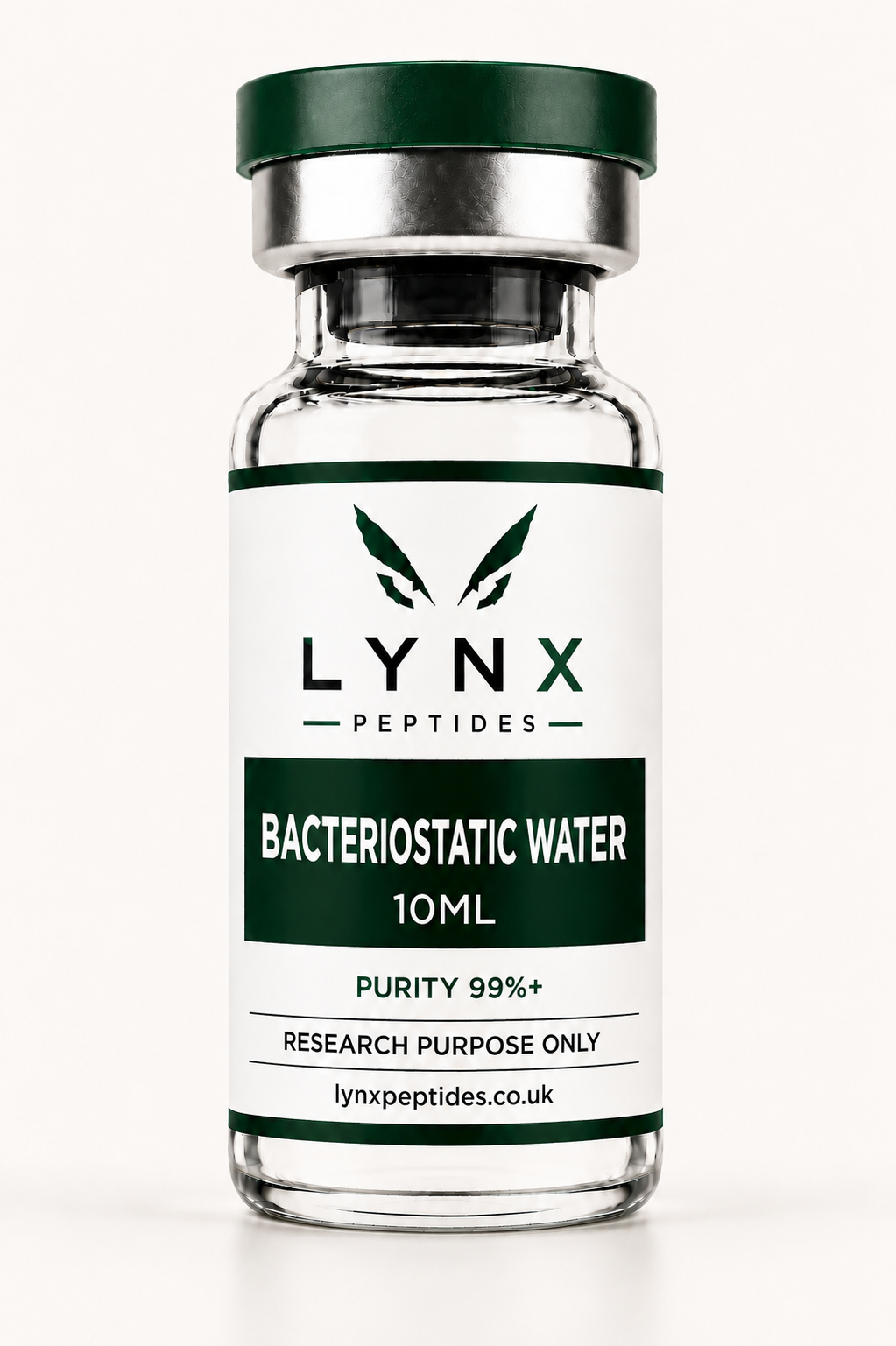
A laboratory diluent becomes part of the experiment as soon as a compound is dissolved in it. Bacteriostatic Water contains 0.9% benzyl alcohol in sterile water: the preservative slows microbial growth during repeated vial access, while the water provides the liquid medium. It is neither a peptide nor an active component intended to reproduce the biology of the dissolved material.
That distinction matters in cell culture and protein work. A preservative can affect a protein’s conformation or interfere with an assay, so compatibility belongs in the experimental design rather than being assumed from the word “water”. Preservative-free sterile water offers a different formulation where benzyl alcohol is unsuitable. Neither diluent sterilises contaminated powder; aseptic handling and the stated in-use period remain separate requirements.
Research applications
Use as a laboratory diluent where the compound specification and in-vitro method permit a benzyl-alcohol-containing solution. The 10mL volume can support more than one reconstitution procedure, subject to the required volumes and the vial’s in-use limit.
Check diluent compatibility before starting: the preservative can be relevant to experimental conditions and assay interpretation. The water is ready to use and does not itself require reconstitution.
Bacteriostatic Water vs Sterile Water
The central difference is the preservative. Bacteriostatic water contains benzyl alcohol; preservative-free sterile water does not.
| Feature | Bacteriostatic water | Preservative-free sterile water |
|---|---|---|
| Preservative | 0.9% benzyl alcohol | None |
| Vial access | Repeated entry with aseptic handling | Typically single-use; follow the label |
| Laboratory dilution | Where compatible with the research method | Where a preservative-free diluent is required |
Where an experimental design requires avoiding a preservative, a compatible preservative-free diluent may be more appropriate. Neither option removes the need for aseptic handling.
Product specifications
- Product
- Bacteriostatic Water
- Volume
- 10mL
- Chemical class
- Preserved aqueous laboratory material
- Composition
- Sterile water with 0.9% benzyl alcohol
- Benzyl alcohol
- 9mg/mL
- Total benzyl alcohol
- 90mg per 10mL vial
- Preservative
- Benzyl alcohol
- Appearance
- Clear, colourless solution
- Form
- Ready-to-use solution
- Storage
- 20–25°C, away from direct light
- Freezing
- Do not freeze
- In-use period
- 28 days after first puncture, or printed expiry if earlier
- Research use
- In-vitro laboratory research only
Storage & Reconstitution
Store unopened at 20–25°C, away from direct light. Do not freeze. Record the first-puncture date and discard after 28 days, or at the printed expiry if earlier.
This diluent is supplied ready to use and does not need reconstitution. Check compatibility with the compound and laboratory method. Clean the stopper using laboratory aseptic technique and use sterile equipment for each withdrawal. Do not return withdrawn solution to the vial.
- Do not use the diluent if it becomes cloudy, contains visible particles or has a damaged seal.
- The diluent’s in-use limit does not establish the stability of a compound dissolved in it.
Laboratory handling
- Inspect the vial and seal before use.
- Clean the stopper according to your laboratory’s aseptic procedure.
- Use sterile laboratory equipment for each withdrawal.
- Do not return withdrawn material to the source vial.
- Introduce diluent gently when reconstituting lyophilised material, following the compound’s protocol.
Why does it contain benzyl alcohol?
At 0.9%, benzyl alcohol acts as an antimicrobial preservative. It limits microbial growth following repeated access under appropriate conditions.
Preservation is only one part of contamination control. It cannot guarantee sterility after poor handling, so aseptic technique remains necessary.
Research overview
Repeated access to a liquid formulation creates opportunities for contamination. Published work has examined both antimicrobial preservatives and the handling of opened multiple-dose vials.
The references below provide context for preservative use and vial handling. They are not tests of the current Lynx vial or evidence of a product-specific batch result.
Research references
Antimicrobial preservative use in parenteral products: past and present.
Meyer BK, Ni A, Hu B, Shi L. Journal of Pharmaceutical Sciences. 2007;96(12):3155–3167. DOI: 10.1002/jps.20976
A review of antimicrobial preservatives in formulations, including their interaction with peptide and protein products.
View on PubMed: Antimicrobial preservative use in parenteral products: past and present.Bacterial contamination of multiple-dose vials: a prevalence study.
Mattner F, Gastmeier P. American Journal of Infection Control. 2004;32(1):12–16. DOI: 10.1016/j.ajic.2003.06.004
A hospital-based study examining opened multiple-dose vials and the importance of recording opening dates and following handling instructions.
View on PubMed: Bacterial contamination of multiple-dose vials: a prevalence study.
Bacteriostatic Water Price (UK)
Bacteriostatic Water 10 mL is supplied as a ready-to-use laboratory diluent. Current pricing and availability are shown below.
| Vial size | Current price | Status |
|---|---|---|
| 10 mL | £5.49 | Checking stock |
Bacteriostatic Water FAQs
What is Bacteriostatic Water?
Bacteriostatic Water is sterile water containing 0.9% benzyl alcohol, supplied as a laboratory diluent. The water is the liquid in which a compatible compound can dissolve; benzyl alcohol helps limit microbial growth. It is not an active peptide, and the preservative becomes part of the final solution, which matters when planning an assay.
How does it differ from plain sterile water?
Plain sterile water contains no preservative; Bacteriostatic Water contains benzyl alcohol. That difference can affect a laboratory experiment because cells and proteins may respond to the preservative as well as the compound being tested. The choice depends on the assay's requirements, not simply on whether both liquids look clear.
Is the 10mL vial supplied as powder or liquid?
It is a clear, colourless liquid, supplied as a laboratory diluent rather than a powder. The 10mL label describes its volume, not the strength of a peptide. Once a compound is dissolved in it, that compound's concentration depends on the amount added and the final solution volume.
Can the same diluent be used for every research compound?
No. A compound must dissolve in the chosen diluent, and the assay must tolerate its ingredients. Benzyl alcohol can affect biological samples, so a clear solution alone does not establish compatibility. A laboratory method should account for both solubility and the preservative, including any effect it may have on the measurement.
How should the vial be stored after opening?
Keep it at 20–25°C, protected from direct light, and do not freeze it. Lynx specifies a maximum of 28 days after first puncture, or the printed expiry if earlier. That is the diluent's handling limit; a compound dissolved in it may have a shorter stability period.
Does the preservative replace aseptic handling?
No. Benzyl alcohol helps limit microbial growth, but it does not sterilise a contaminated solution. Clean vial access and sterile laboratory equipment are still needed for every withdrawal. This matters because a preserved diluent can still introduce contamination into an experiment if it is handled poorly, even when the liquid looks clear.
Can I buy Bacteriostatic Water in the UK for research?
Yes. Lynx supplies 10mL Bacteriostatic Water for laboratory use in the UK. The product page shows whether it is currently available.
Is a Certificate of Analysis available for Bacteriostatic Water?
There is no batch-specific COA for this Bacteriostatic Water in the published Lynx library. Its listed ingredients and handling details are product information, not independent test results.