On this page
What is peptide aggregation?
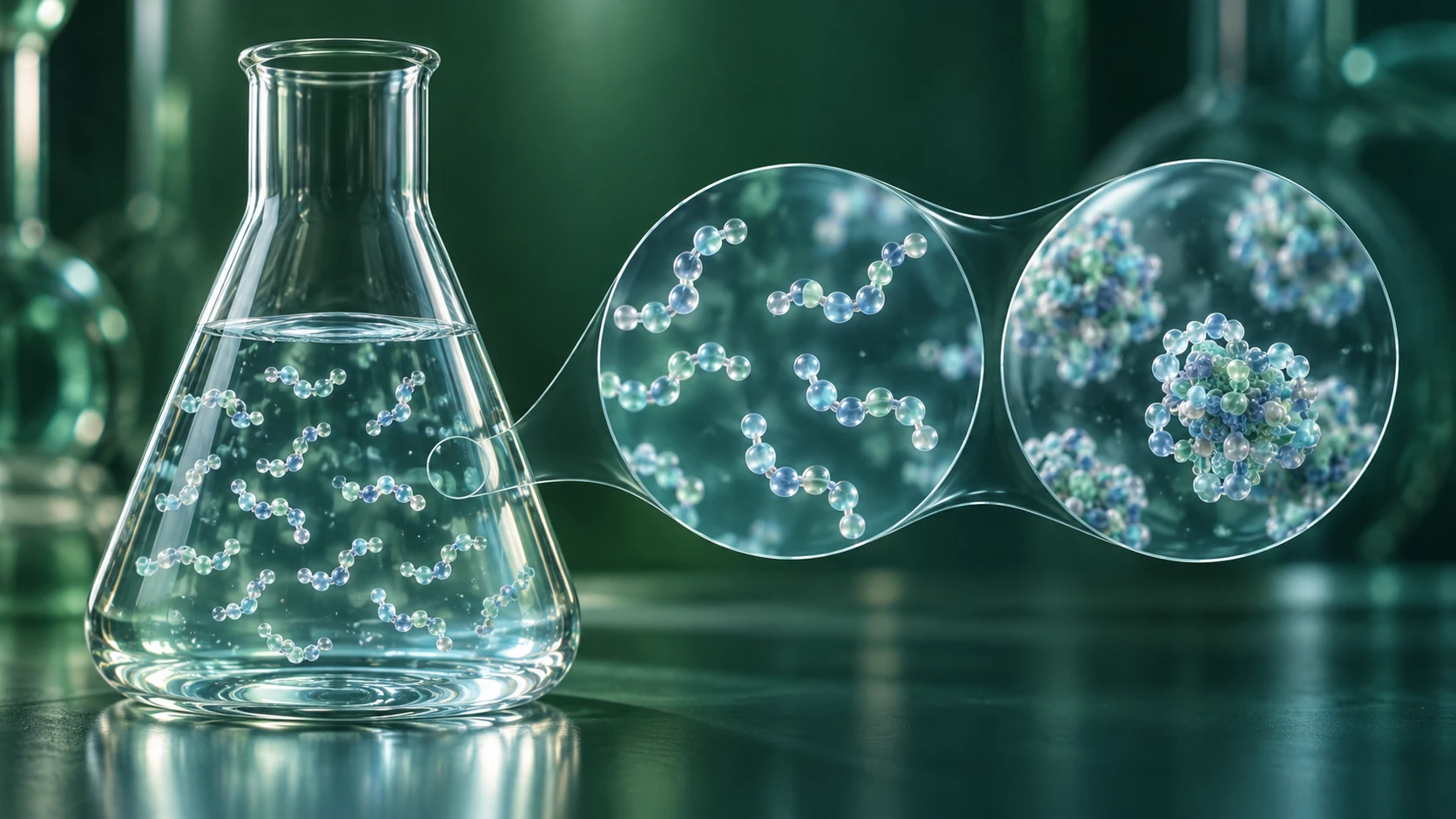
Aggregation is the association of peptide molecules into larger assemblies. Those assemblies may range from small groups of molecules to much larger structures. The term describes a process or a resulting population, not one universal shape. It does not necessarily mean that a sample becomes visibly cloudy or forms a sediment.
Some assemblies remain dispersed in the liquid and are too small or too dilute to be seen directly. Others grow, rearrange or separate from the surrounding medium. Whether an association is reversible, ordered or persistent depends on the peptide and the conditions, rather than the word “aggregate” itself.
Oligomer is often used for an assembly containing a relatively small number of molecular units. The exact meaning should be read in the methods of the paper concerned. A method that reports larger species does not automatically determine their complete structure, number of units or biological properties.
What is peptide precipitation?
Precipitation means that material separates from a solution into a solid phase. The separated material may appear as fine particles, flocs, a deposit or a more obvious sediment. A solid phase can contain disordered material or more ordered structures. The visible appearance does not establish which has formed.
Solubility concerns how much of a specified substance can be present in a saturated solution under stated conditions. Peptide Solubility Explained distinguishes that limit from dissolution rate and recovery. A change in the environment may make previously dissolved material separate, but the change and identity of the resulting solid need investigation.
A deposit in a peptide-labelled sample is not necessarily made entirely of intact peptide. It could include other constituents or contaminants. Calling it peptide precipitation is a proposed interpretation until suitable measurements establish what separated and how it relates to the original sample.
Why the two processes are often confused
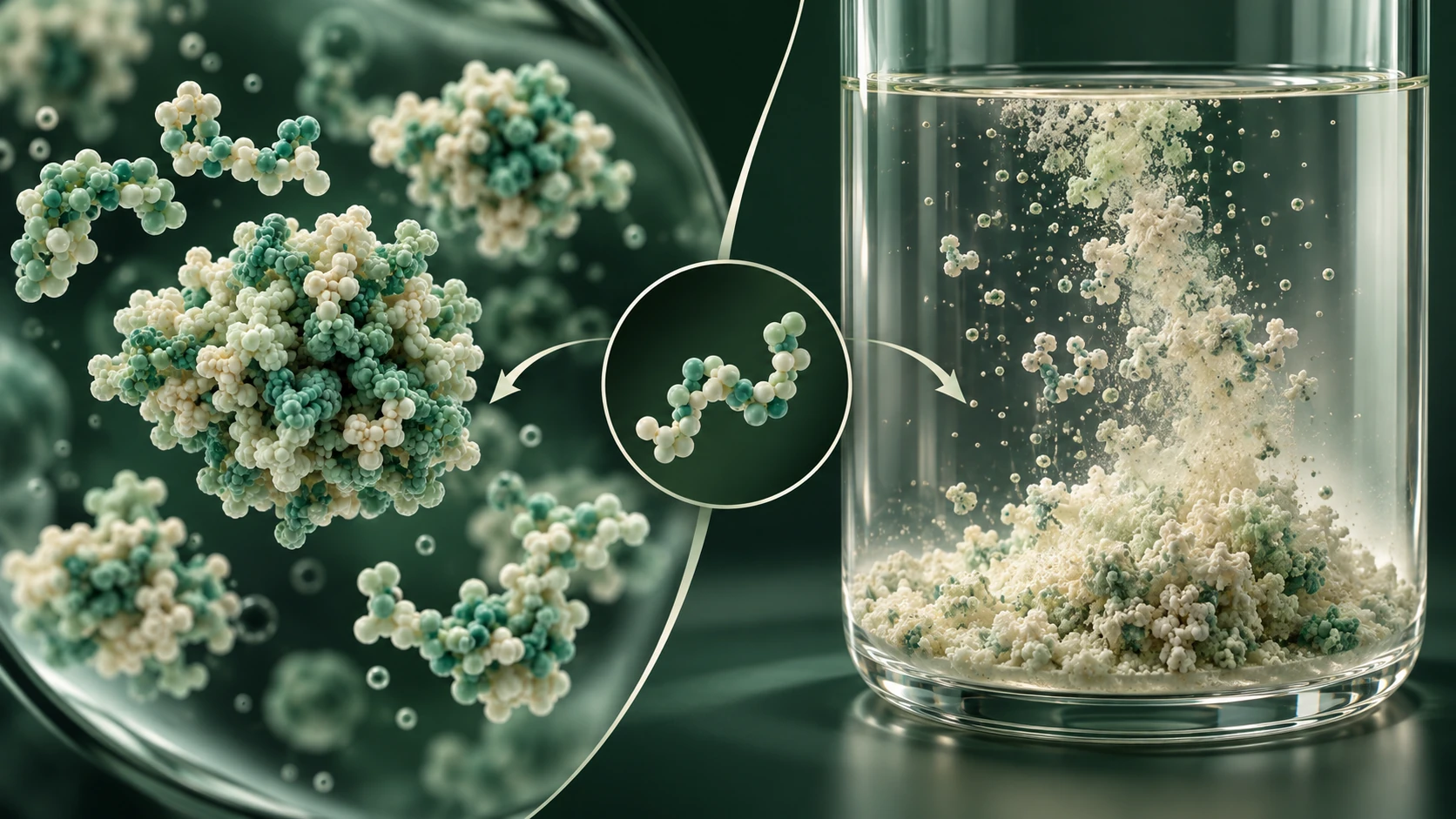
Molecular association can contribute to the formation of an insoluble phase, so aggregation and precipitation may be stages in the same history. They are not synonymous. Associated species may remain in the liquid, while a solid may separate through processes that are not described adequately as progressive peptide aggregation.
The distinction matters when describing an experiment. A detector finding an associated population in a clear liquid supports a different statement from a study measuring material recovered from a pellet. Both can be valid observations without demonstrating the same physical state or pathway.
Record the observation before naming the mechanism. “Cloudiness appeared after a change in conditions” preserves what was seen. “The peptide formed a particular aggregate” adds an identity and structural claim. Those additional claims need evidence instead of being inferred from the presence of particles alone.
Sequence influences association, but does not settle it
The peptide backbone and side chains can interact with solvent and neighbouring molecules. Charged groups, non-polar regions and hydrogen-bonding opportunities contribute to that balance. Sequence order, terminal modifications and chain connectivity affect the molecular surfaces available for interaction.
In Sarma and colleagues’ molecular simulations, selected pentapeptides differed in calculated solubility and association behaviour. The study examined particular model sequences and molecular interactions. It supports discussing sequence-dependent behaviour, not assigning a measured aggregation tendency to every peptide or ranking Lynx catalogue materials.
Read How to Read a Peptide Sequence before assuming two similar names denote the same material. A short chain is not automatically protected from association, and a longer chain is not automatically insoluble. Structure provides hypotheses that must be checked under the conditions actually studied.
Concentration and the solution environment change the balance
Concentration affects how frequently molecules encounter one another and can alter the distribution of associated species. The relationship need not be linear. A threshold observed in one experiment depends on the peptide, medium, time and measurement rather than establishing a universal concentration limit.
pH can change ionisation, while salts affect electrostatic interactions and introduce ion-specific effects. Temperature, solvent composition and interfaces can also influence the physical state. These variables interact, so adjusting one cannot be assumed to correct every sample or preserve its chemical identity.
For example, Marek and colleagues studied ionic-strength effects on amylin amyloid formation. Their findings involved both screening and ion-specific behaviour. Amylin is a defined model peptide in that work, not a stand-in for all research materials. The experiment does not supply generic advice to add salt or predict which catalogue sample will form particles.
The sample history can be as important as the final conditions
Two samples with the same nominal final composition can have different histories. Time spent at intermediate conditions, contact with different surfaces or repeated exposure changes may influence which species are present. A measurement therefore needs a clear sampling time and a record of relevant preparation and storage events.
During freezing, the remaining liquid can become locally concentrated as ice forms. Freeze-Thaw Cycles and Peptide Stability explains why a cycle changes more than the thermometer reading. It does not follow that every frozen peptide sample aggregates, or that a particular cycle count determines its outcome.
Some associated states may dissociate when conditions change, while others persist. Reversibility is a property to test. Restored clarity alone cannot show that the original distribution has returned or that all material is recovered. It also cannot exclude chemical changes that occurred during the same history.
Physical instability is different from chemical degradation
Noncovalent association can occur without changing the covalent identity of each peptide molecule. Chemical degradation changes that identity, for example through oxidation, cleavage or deamidation. The processes can occur together, and chemical modifications may influence subsequent association or separation.
Hawe and colleagues’ oxytocin formulation study identified several degradation products, including covalently linked species, under its specified stress conditions. It illustrates why a larger species may involve chemistry as well as physical association. Those results cannot diagnose the origin of an unexplained particle in another peptide sample.
The Oxidation and Deamidation Guide covers chemical pathways. Neither a dissolved state nor a high chromatographic percentage guarantees the absence of all physical and chemical changes. A useful report states the attributes measured and avoids using “stable” without defining what remained within limits.
Why a clear sample does not prove stability
Visual inspection can reveal colour changes, particles or cloudiness under the viewing conditions used. It is a useful observation, but its sensitivity depends on lighting, container, background and the observer. Smaller assemblies and low concentrations of particles may escape direct observation.
Cloudiness is also not a unique molecular signature. It reflects how light interacts with the sample, not an independent identification of peptide aggregates. A comparison with appropriate blanks can help determine whether the medium or container contributes to what is seen, without proving a detailed mechanism.
A photograph documents an appearance at one moment. It cannot establish chemical identity, total recoverable content, sterility or endotoxin status. A clear-looking sample is therefore not a general quality certificate, and the absence of a visible change is not equivalent to the absence of a measurable change.
How laboratories investigate association and separated material
The choice of method begins with the question. Light scattering can examine aspects of particle size or behaviour, but its interpretation depends on the sample and measurement model. Large particles can disproportionately influence a signal. A reported size should not be mistaken for a fully resolved inventory of every species present.
Size-exclusion chromatography can help separate species by behaviour related to hydrodynamic size. Microscopy may show selected structures or particles. Both approaches have preparation and detection limits. Dilution, filtration, separation and the measurement environment may alter the population before it is observed.
Chemical analysis addresses another part of the problem. HPLC vs LC-MS explains the difference between separation and mass-based detection. A sample prepared for chromatography may not retain the physical state of the original liquid. ICH Q2(R2) supports selecting suitable, complementary analytical procedures rather than claiming one instrument answers every question.
Sampling determines what a result represents
If a laboratory measures only the liquid above settled material, the result describes that fraction. It cannot by itself account for the original total. A recovery assessment may need to consider separated material, surface losses and the sampling procedure, with suitable evidence for what each fraction contains.
The analytical-peptide recommendations from Hoofnagle and colleagues emphasise characterisation and handling considerations in mass-spectrometry assays. Their context is useful for thinking about recovery, not proof that any particular retail material has an aggregation problem. The Storage Guide explains why records and container history belong alongside the measurements.
Physical observations also should not be confused with unrelated quality attributes. Endotoxins vs Peptide Purity explains why neither chemical purity nor appearance establishes endotoxin absence. Keep the interpretation as narrow as the actual result supports. This Lynx Guide provides no personal-use preparation instructions, and research materials are not intended for human or veterinary use.
References and evidence scope
- Sarma et al. Peptide Solubility Limits: Backbone and Side-Chain Interactions. Journal of Physical Chemistry B, 2018. DOI: 10.1021/acs.jpcb.7b10734. Molecular simulations of selected pentapeptides. Not experimental rankings of Lynx materials.
- Marek et al. Ionic Strength Effects on Amyloid Formation by Amylin Are a Complicated Interplay between Debye Screening, Ion Selectivity, and Hofmeister Effects. Biochemistry, 2012. DOI: 10.1021/bi300574r. Defined amylin aggregation experiments. Not all peptide aggregation or generic salt advice.
- Hawe et al. Towards heat-stable oxytocin formulations: analysis of degradation kinetics and identification of degradation products. Pharmaceutical Research, 2009. DOI: 10.1007/s11095-009-9878-2. Specified oxytocin solutions under accelerated conditions. Not a shelf-life prediction for another peptide.
- ICH Q2(R2). Validation of Analytical Procedures, 2023. Analytical specificity, suitable performance and complementary procedures. Not a claim of Lynx validation.
- Hoofnagle et al. Recommendations for the Generation, Quantification, Storage, and Handling of Peptides Used for Mass Spectrometry-Based Assays. Clinical Chemistry, 2016. DOI: 10.1373/clinchem.2015.250563. Analytical peptide standards and handling/recovery considerations. Not universal catalogue stability.