On this page
What counts as a freeze–thaw cycle?
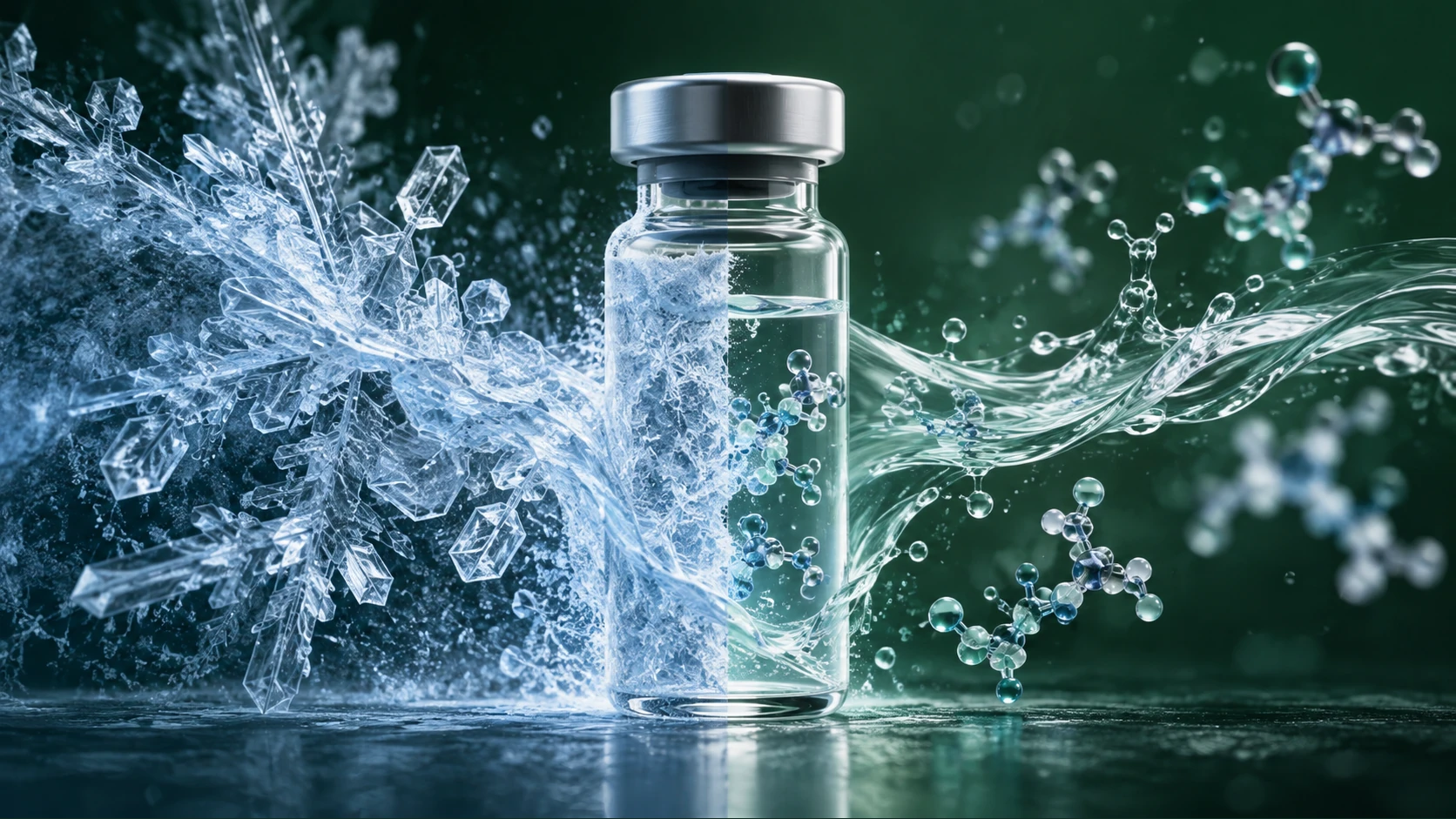
A freeze–thaw cycle takes a sample through freezing and subsequent thawing. In laboratory research, this usually refers to a solution rather than an unopened dry powder. Continuous frozen storage and repeated transitions are different exposure histories.
A cycle count leaves important details unstated: the sample volume, container, temperature reached, duration, rate of cooling and warming, and whether thawing was complete. Two studies reporting three cycles may therefore have applied different stresses. Air-temperature records also do not necessarily describe the temperature throughout the sample.
This guide examines the mechanisms and evidence behind those differences. The general storage guide covers supplier specifications, packaging and handling records. Neither guide assigns a universal temperature, shelf life or permitted number of cycles.
Ice formation creates a changing local environment
As water forms ice, many dissolved substances are excluded from the growing crystals. The remaining liquid can become more concentrated than the starting solution. Peptide molecules, salts and other constituents are then exposed to conditions that the original bulk concentration does not describe.
Freezing can also separate components into different phases. Heller, Carpenter and Randolph studied freeze-concentration-induced phase separation in a defined polyethylene glycol and dextran system during freeze-drying. That experiment demonstrates a formulation effect. It does not show that every research peptide separates in the same way.
Buffer components need not remain in their original proportions. Pikal-Cleland and colleagues observed buffer-dependent pH changes and enzyme activity loss during freezing of beta-galactosidase solutions. This is protein-model evidence for a possible stress mechanism, not a measurement of a short peptide's behaviour. A room-temperature pH value should not be assumed to describe every region of a frozen sample.
Aggregation, precipitation and surface loss are different
Aggregation means that molecules associate into larger assemblies. Precipitation means that material leaves the dissolved phase as a solid. The two can overlap, but neither necessarily involves cleavage or another change to the peptide's covalent structure. Some associations can reverse when conditions change. Others can persist.
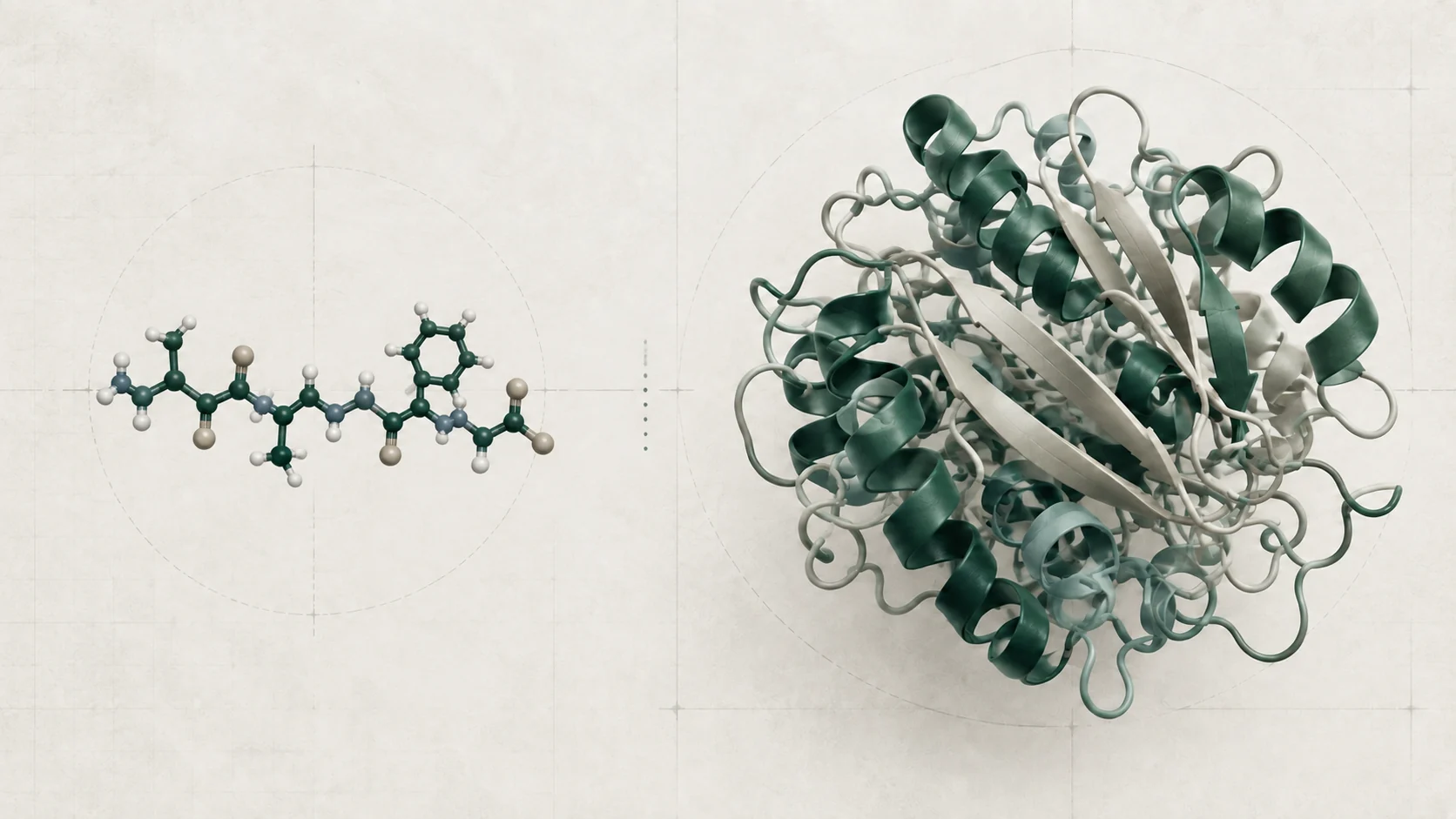
New ice–liquid interfaces create additional surfaces during freezing. A review of interfacial stress in biologics discusses these interfaces and the proposed mechanisms of protein destabilisation. Its protein-focused findings should not be transferred wholesale to shorter peptides. Peptides vs Proteins explains why chain size and organisation matter when comparing the evidence.
Material can also attach to the container. These routes of loss complicate interpretation: less peptide in the sampled liquid need not mean that the whole container contains less peptide, or that every missing molecule has degraded. A deposit is a reason to investigate, not a chemical identification. A clear solution can still contain changes too small to see.
Chemical degradation needs chemical evidence
Oxidation, deamidation and bond cleavage alter molecular composition or connectivity. They are different from a peptide simply becoming less recoverable from solution. Freezing may reduce some reaction rates, while changes in local concentration or pH can create other conditions. Thawing adds time at a different temperature.
Hawe and colleagues investigated oxytocin degradation across defined pH and temperature conditions, identifying degradation products with complementary analytical methods. This study supports a relationship between conditions and chemical pathways in that peptide system. It is not a repeated-cycle study or a storage specification for other compounds.
A new chromatographic peak, a mass change or declining intact-peptide content can help distinguish chemical change from physical loss. Each measurement needs suitable controls and assignments. The oxidation and deamidation guide explains these pathways in more detail. Neither a normal appearance nor an unchanged dominant mass peak proves that all quality attributes are unchanged.
Why repeated freezing does not affect every peptide identically
Sequence, modifications, concentration, solvent composition and the container together define the sample. Changing any of these can change the interpretation of a stability experiment. A study of a digested protein mixture also differs from one involving a purified, formulated peptide.
Hoofnagle and colleagues examined peptides used in mass-spectrometry assays. Their freeze–thaw experiments reported similar average peak areas under the tested storage conditions, alongside greater variability after ten cycles. The result distinguishes average signal from measurement reproducibility. It does not establish that ten cycles are acceptable for every peptide, or that every molecule remained chemically unchanged.
The same publication examines concentration- and container-related recovery. Its findings are useful when planning analytical controls, but remain specific to the sequences, mixtures and methods examined. A published tolerance statement should identify its material and endpoint rather than become a rule for an entire catalogue.
What a controlled stability investigation should distinguish
Start with a defined question. Is the experiment assessing intact-peptide content, reproducible analytical recovery, physical state or a relevant biological response? These endpoints can change independently. A signal-based study cannot answer all of them at once.
For a laboratory assessment, compare a recorded cycle history with an appropriate control from the same starting material. Consider both the effect of the transitions and the time spent stored or thawed. Replicates and documented sampling help distinguish variability from a systematic change. The acceptance criterion should be justified before interpreting the result.
| Observation or test | What it addresses | What remains unresolved |
|---|---|---|
| Visual observation | Visible deposits, cloudiness or colour changes | Identity, amount and small or invisible changes |
| Chromatography with suitable detection | Recoverable components and resolved degradation signals | Unresolved components, response differences and losses before injection |
| Mass spectrometry | Mass or fragmentation evidence for detected species | Absolute content without a suitable quantitative method |
| Particle or size assessment | Assemblies in the range addressed by the method | Complete chemical identity or every particle size |
| A justified functional assay | Response in the specified experimental system | Other functions, batch equivalence or clinical outcomes |
Interpret a result against the same sample form, formulation and exposure history. A negative finding means no change was demonstrated by the measurements used. It does not establish unlimited stability. Follow the actual material specification, and seek supporting data when its limits are unclear.
Lynx materials are for laboratory research only, not for human or veterinary use, diagnosis or treatment.
References and evidence scope
- Hoofnagle AN et al. Recommendations for the Generation, Quantification, Storage, and Handling of Peptides Used for Mass Spectrometry-Based Assays. Clinical Chemistry, 2016. DOI: 10.1373/clinchem.2015.250563.
- Heller MC, Carpenter JF and Randolph TW. Manipulation of lyophilization-induced phase separation: implications for pharmaceutical proteins. Biotechnology Progress, 1997. Defined polymer formulation. Not a peptide-catalogue stability test.
- Pikal-Cleland KA et al. Protein denaturation during freezing and thawing in phosphate buffer systems: monomeric and tetrameric beta-galactosidase. Archives of Biochemistry and Biophysics, 2000. DOI: 10.1006/abbi.2000.2088.
- Interfacial Stress in the Development of Biologics: Fundamental Understanding, Current Practice, and Future Perspective. Review of biologics. Mechanistic context.
- Hawe A et al. Towards heat-stable oxytocin formulations: analysis of degradation kinetics and identification of degradation products. Pharmaceutical Research, 2009. DOI: 10.1007/s11095-009-9878-2.