On this page
What bacterial endotoxins are
Bacterial endotoxins are lipopolysaccharides associated with the outer membrane of Gram-negative bacteria. They are not peptide synthesis by-products. Their biological effects and their analytical detection concern a different class of material from the intended peptide.
Endotoxin can be present without viable bacteria being detected. Consequently, a result about living microorganisms cannot automatically answer a question about their components. Likewise, detecting endotoxin does not identify which organism was present or establish when contamination occurred.
Pyrogens are substances capable of provoking fever. Endotoxins are one important group, not the whole category. EDQM distinguishes endotoxin detection from broader pyrogen testing. A report using one of these terms should identify the actual assay and its scope.
Why HPLC purity cannot establish endotoxin status
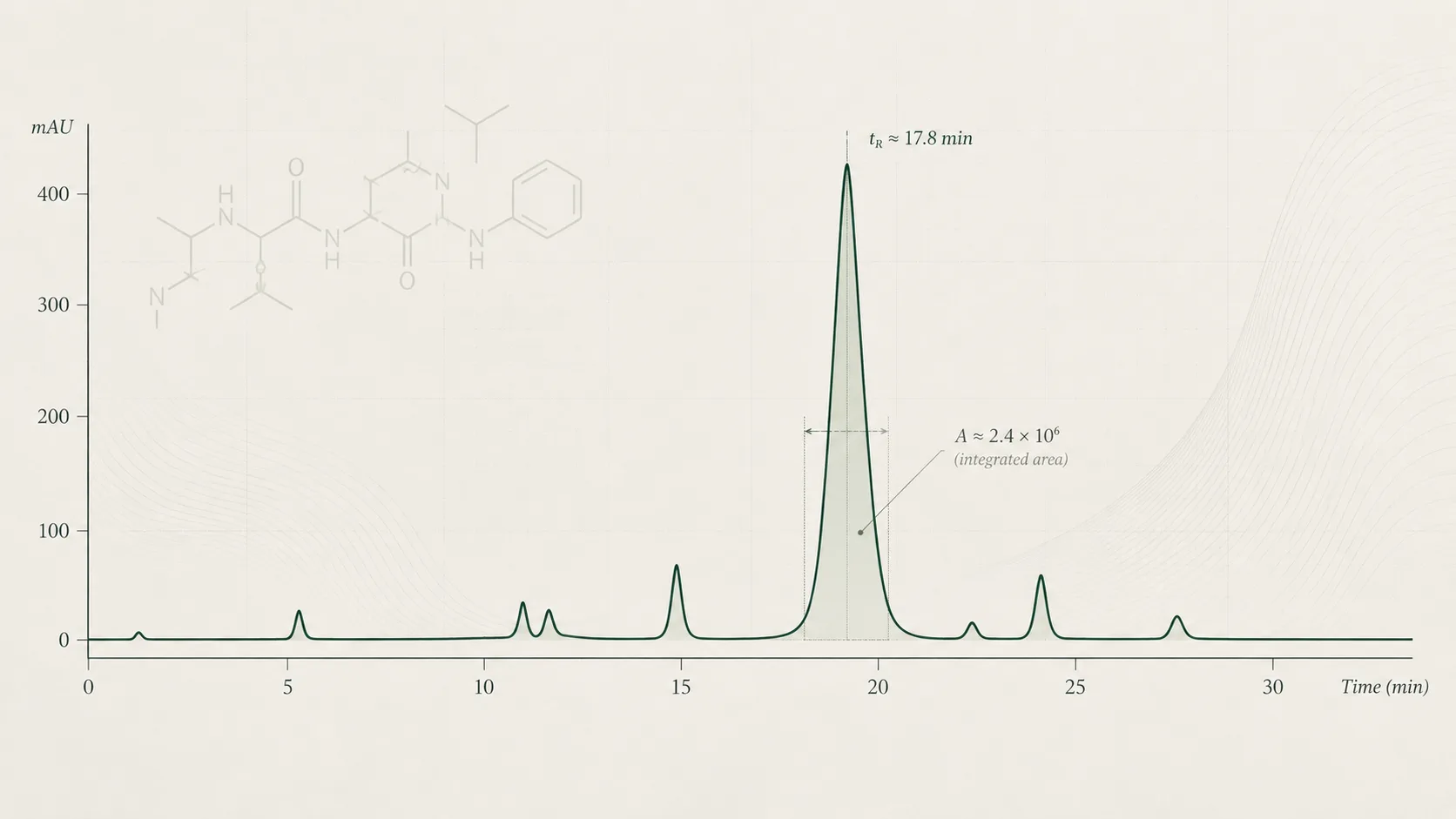
A typical HPLC area-purity result compares the signal assigned to the main peptide with a defined total of integrated chromatographic signals. Separation, detector response and integration rules determine that calculation. It is not a search for every possible contaminant.
NIST’s peptide purity research illustrates why assigning mass-fraction purity needs complementary measurements. Even a chemical purity value with a clear measurement basis should not be converted into a microbiological conclusion.
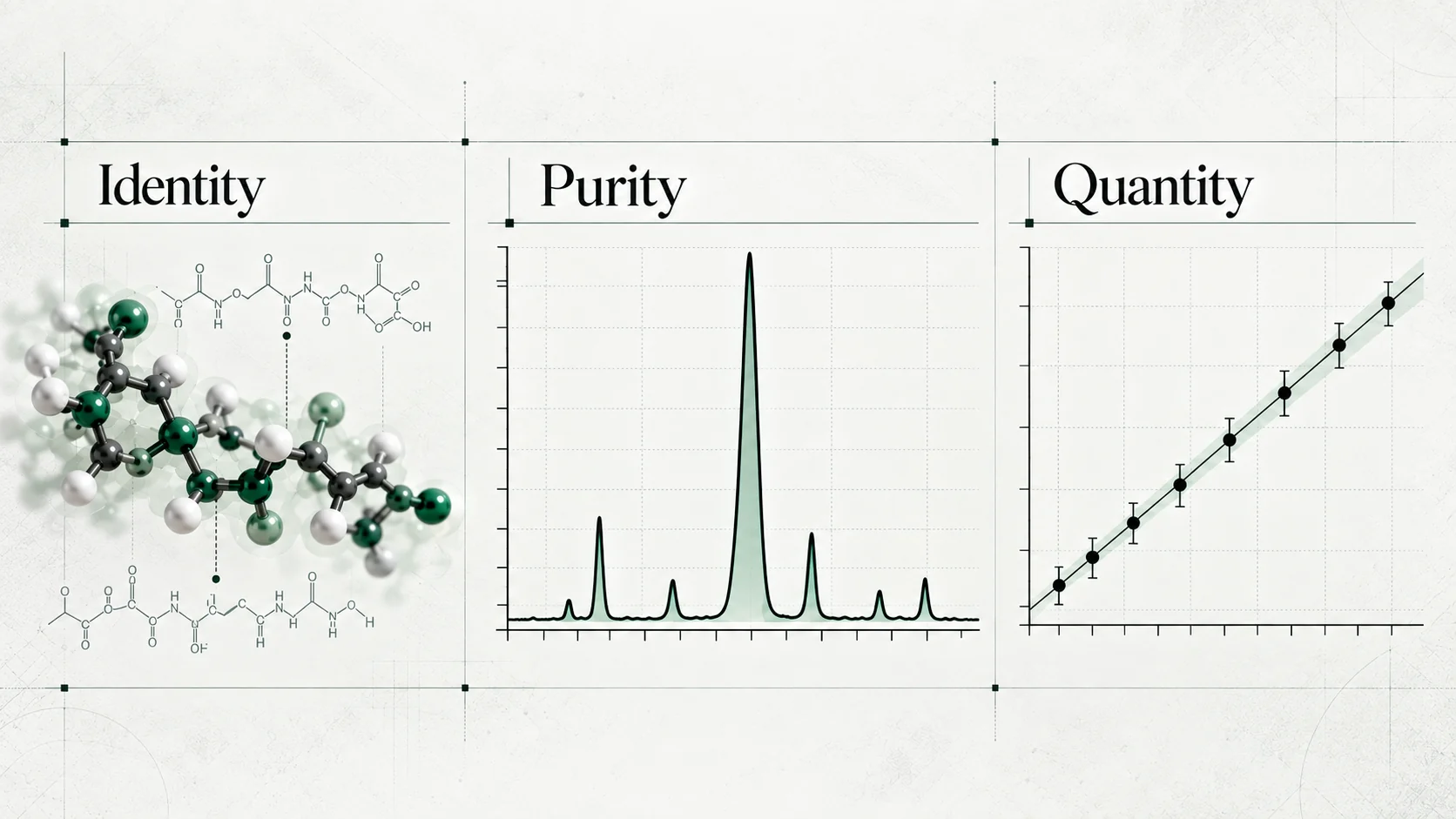
An HPLC purity report alone does not demonstrate a validated endotoxin assay, its sensitivity, sample suitability or result. It cannot establish that a sample is endotoxin-free. Conversely, an acceptable endotoxin result does not establish peptide identity, chemical purity or measured content. The identity, purity and quantity guide explains these chemical distinctions.
Four quality attributes that should not be conflated
| Observation or test | What it addresses | What remains unresolved |
|---|---|---|
| Chemical purity | The specified chemical measurement, such as chromatographic area purity | Endotoxin, viable microorganisms and sterility unless separately assessed |
| Microbiological quality | Specified viable counts or named organisms under the method used | Every microorganism or nonliving microbial component |
| Sterility testing | Evidence concerning viable microorganisms under the stated test conditions | An endotoxin result or unrestricted assurance about every unit |
| Bacterial endotoxin testing | Assayable endotoxin relative to a standard and stated reporting limit | Sterility, non-endotoxin pyrogens or chemical purity |
These distinctions are reflected in the separate European Pharmacopoeia texts for microbiological quality, sterility and bacterial endotoxins. A pass is meaningful only alongside the relevant method, criterion and sample identification.
“Not detected” is a statement about a test's capability and conditions. It is not proof of absolute absence. A sterility test also has a sampling scope: interpreting it requires more than a word on a certificate. Do not infer a medicinal-product quality standard from an analytical report for a research material.
How endotoxin assays obtain a signal
Limulus amoebocyte lysate, or LAL, uses reagents derived from horseshoe-crab blood cells. Endotoxin activates a reaction cascade. Depending on the method, the observable endpoint is a clot, a change in turbidity or a colour signal. The assay is distinct from chromatographic separation of a peptide.
Recombinant methods use specified manufactured proteins in place of animal-derived lysate. Recombinant factor C, or rFC, uses the endotoxin-responsive component to produce a measurable signal. Not all recombinant reagents contain the same components. The reagent and readout must be identified when comparing results.
Kang and colleagues compared rFC and LAL assays using reference endotoxin and biopharmaceutical samples. They assessed method performance and found interference in some sample matrices. Their results support testing suitability for a particular material. They do not establish that either assay works without validation in every peptide sample.
Sample interference can change what the assay detects
A sample matrix is everything in the tested preparation apart from the analyte of interest. Its constituents can suppress or enhance a signal. A low apparent result is difficult to interpret if the method's ability to recover endotoxin in that matrix has not been demonstrated.
A spike-recovery control adds a known endotoxin amount to the sample and assesses the response. Standards, blanks and suitable controls help investigate whether the assay is behaving as expected. Recovery of a spike addresses method suitability. It does not prove that the unspiked sample contains no endotoxin.
In Kang's study, dilution overcame some interference. Dilution also reduces the amount of sample entering the assay and affects the reporting capability for the original material. It must therefore be justified rather than used to obtain a preferred result.
The FDA’s 2026 endotoxin-testing guidance discusses method suitability and the importance of sample storage and handling. This US regulatory guidance is cited for analytical principles, not as evidence of Lynx compliance or testing. Results depend on the sample history as well as the assay itself.
What to look for in an endotoxin report
An endotoxin unit, EU, expresses activity relative to an endotoxin standard. It should not be treated as a universal mass conversion. EU/mL, EU/mg and EU per tested container describe different denominators. One cannot be substituted for another without the relevant sample information.
- Match the material, sample code and available batch reference.
- Identify the method and reagent, rather than relying on an “endotoxin tested” label.
- Read the result, units and reporting limit together.
- Check the sample preparation, dilution and the relationship to the original material.
- Look for method-suitability information and applicable controls.
- Identify the stated criterion and the scope of any pass/fail conclusion.
- Record characteristics that were not tested.
The COA-reading guide provides a broader document checklist. A report without an endotoxin result leaves endotoxin status unestablished. It does not prove contamination. This article makes no claim that a particular Lynx product or batch has passed endotoxin or sterility testing.
There is no universal acceptance limit for every laboratory experiment. The material's intended research context and the validated method determine the appropriate question. A chemical purity percentage cannot supply the missing criterion or result.
Lynx materials are for laboratory research only, not for human or veterinary use, diagnosis or treatment.
References and testing scope
- EDQM. Endotoxin and Pyrogen Testing, 2020. Assay principles. Not used as a statement of current compendial implementation dates.
- Kang DH et al. A Study on the Application of Recombinant Factor C (rFC) Assay Using Biopharmaceuticals. Microorganisms, 2024. DOI: 10.3390/microorganisms12030516.
- FDA. Pyrogen and Endotoxins Testing: Questions and Answers, Edition 2, March 2026. Guidance for regulated products, not a Lynx batch result.
- NIST. State-of-the-art and trends for the SI traceable value assignment of the purity of peptides using the model compound angiotensin I. Chemical measurement context.
- EDQM. Harmonisation status for general texts. Separate microbiological, sterility and endotoxin texts.