On this page
Identity and naming
Melanotan I, often shortened to MT1 or MT-I, is the α-melanocyte-stimulating hormone analogue [Nle4,D-Phe7]-α-MSH, also called NDP-MSH and afamelanotide. The substitutions replace methionine at position 4 with norleucine and L-phenylalanine at position 7 with D-phenylalanine. Sawyer et al., the original analogue study describes its synthesis and biological investigation.
Melanotan II, or MT2/MT-II, is a different, shorter analogue with a side-chain lactam linkage. It is not another name for afamelanotide. The first preparative solution phase synthesis of melanotan II establishes the specified structure and chemical characterisation.
Shared naming does not make a research vial equivalent to an authorised medicine. The Melanotan I and Melanotan II overviews provide compound-specific study context.
Read the complete sequences
Melanotan I: 13 residues
Ac-Ser-Tyr-Ser-Nle-Glu-His-D-Phe-Arg-Trp-Gly-Lys-Pro-Val-NH2
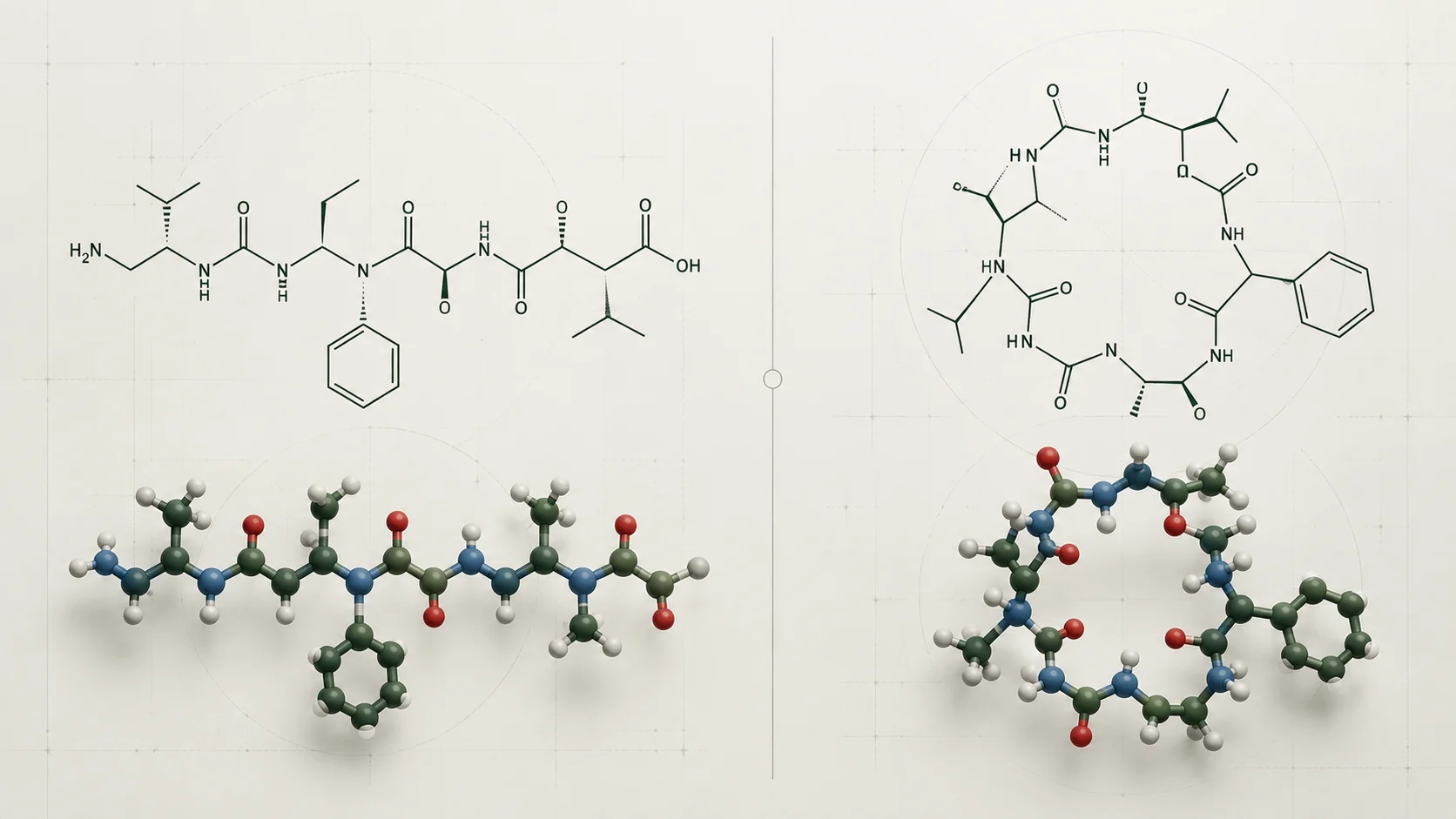
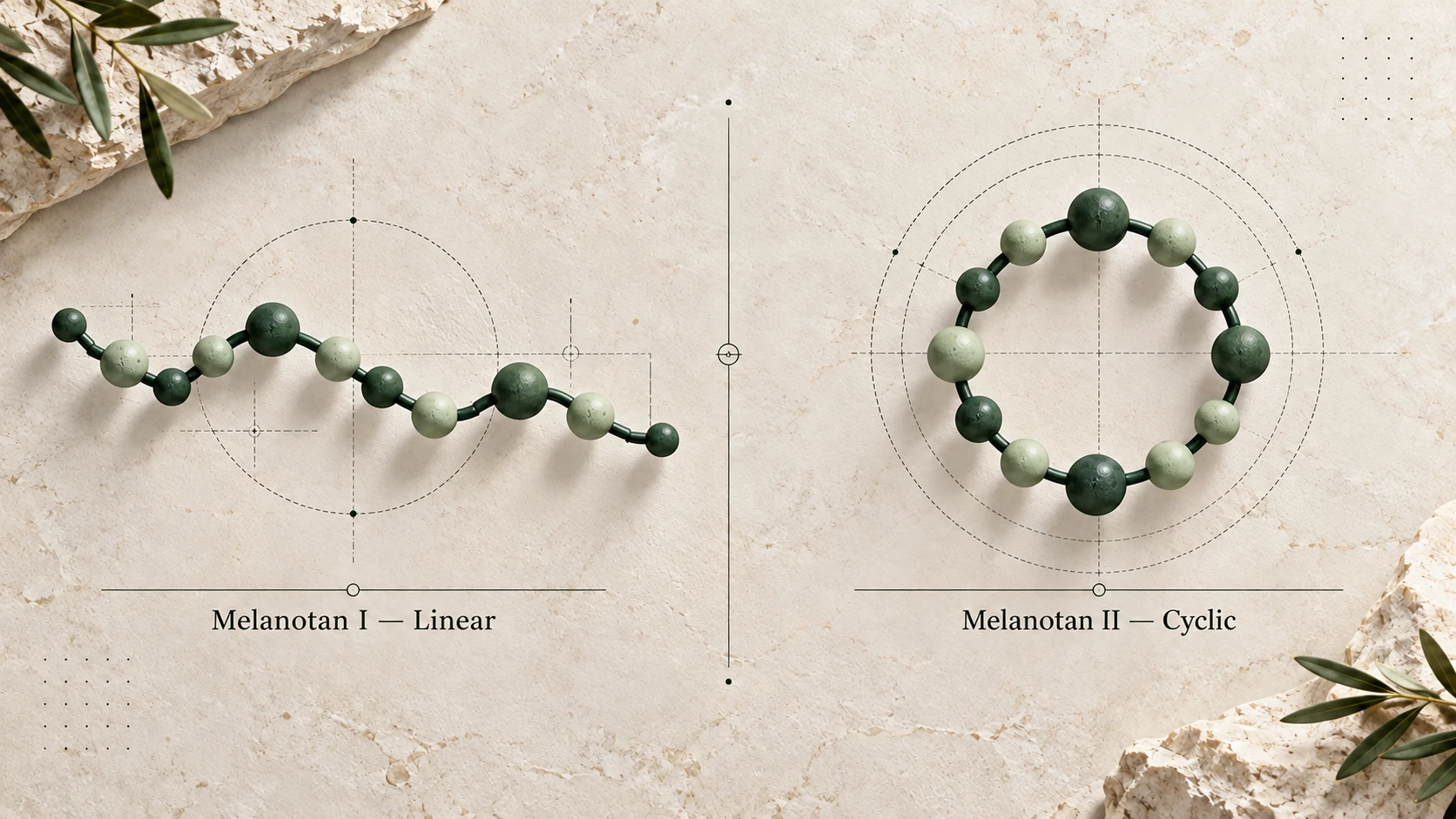
The chain is linear in topology. Ac denotes N-terminal acetylation and NH2 denotes C-terminal amidation. Neither modification joins the ends into a ring. The EMA afamelanotide assessment identifies NDP-MSH and describes sequence and stereochemical characterisation.
Melanotan II: seven residues
Ac-Nle-cyclo[Asp-His-D-Phe-Arg-Trp-Lys]-NH2
The acetylated norleucine precedes the six-residue bracketed segment, making seven residues overall. The Asp side-chain carboxyl and Lys side-chain amino group form a lactam, an intramolecular amide linkage. It is not a head-to-tail ring of the entire backbone. The first preparative solution phase synthesis of melanotan II describes this connectivity.
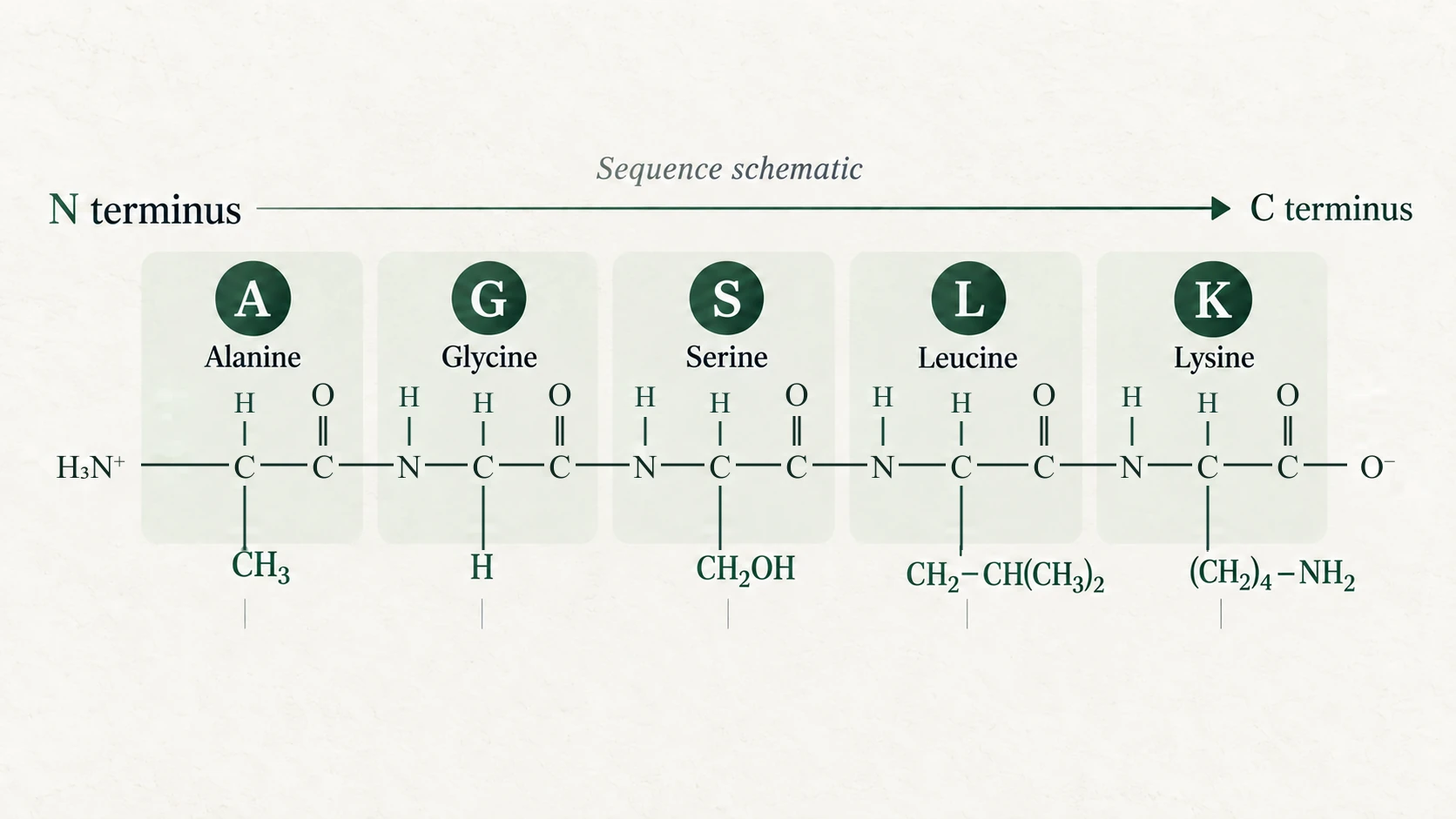
MT-II is related to the α-MSH 4–10 region, with substitutions and ring closure. Parent α-MSH position numbers in a paper differ from positions counted 1–7 along the shorter analogue. Use the sequence guide to interpret numbering, D configuration and nonstandard residues such as Nle.
Structural comparison at a glance
| Feature | Melanotan I | Melanotan II |
|---|---|---|
| Residue count | 13 | 7 |
| Topology | Open-chain peptide | Asp-to-Lys side-chain lactam ring |
| N-terminal group | Acetyl | Acetyl |
| C-terminal group | Amide | Amide |
| Shared sequence motif | His-D-Phe-Arg-Trp | His-D-Phe-Arg-Trp |
| Relationship to α-MSH | Full 13-residue analogue with Nle4 and D-Phe7 | Modified 4–10-region analogue with a lactam constraint |
| Meaning of the structure | A defined molecular form | A different defined molecular form, not a universal stability or safety advantage |
Sources: original NDP-MSH research, The first preparative solution phase synthesis of melanotan II and the EMA assessment. Linear vs Cyclic Peptides explains why topology and three-dimensional conformation are different concepts.
Receptor research and pharmacological distinctions
Binding measures interaction with a receptor, while functional assays examine a resulting response, such as second-messenger signalling. A result depends on the receptor subtype, species, expression system and endpoint. Binding affinity and functional potency should not be substituted for one another.
NDP-MSH should not be described as strictly MC1R-selective. A primary radioligand study of expressed melanocortin receptor subtypes examined binding at MC1, MC3 and MC5 receptors. MC1-related pigment biology is one research context, not its entire receptor profile.
MT-II is also used as a nonselective melanocortin agonist. A 2022 primary study replacing the MT-II lactam with other linkers compared receptor binding and functional responses in related analogues. Those modified compounds are not MT-II itself. The study illustrates why small structural changes need their own pharmacological measurements.
The shared His-D-Phe-Arg-Trp motif helps explain their relationship within melanocortin research. Different surrounding residues and connectivity mean their complete pharmacological profiles cannot be inferred from the motif alone. No universal potency ranking is given here.
What published studies establish
Melanotan I and afamelanotide formulations
The early NDP-MSH work investigated a synthetic analogue in experimental biological systems. Later randomised trials of afamelanotide in erythropoietic protoporphyria studied a defined implant formulation in patients with that disease. The endpoint, formulation and population are essential parts of the evidence.
Melanotan II
Dorr et al., a 1996 phase-I pilot involved only three participants. It reported pigmentation-related observations and adverse effects including nausea, fatigue and somnolence. Such a small study cannot establish general safety, rare adverse-event rates or outcomes from an independently supplied research vial.
Neither these separate studies nor the structural comparison constitutes a head-to-head clinical assessment of Lynx MT1 and MT2 materials. Human investigation of one formulation does not convert another material into a clinically validated product.
Analytical identity and characterisation
Check the exact sequence, terminal groups, D-Phe configuration and, for MT-II, the Asp-to-Lys linkage. An intact-mass match can support the expected composition but cannot by itself distinguish every sequence or stereochemical alternative or locate a ring closure.
The MT-II synthesis paper reports chromatographic, mass-spectrometric and NMR characterisation. The EMA afamelanotide assessment describes complementary sequence, stereochemical and spectroscopic methods. These are examples of structural evidence in their respective development programmes, not evidence that a Lynx batch underwent those same tests.
For a supplied research material, read its batch-specific report and state only the conclusions actually supported. Mass Spectrometry, Analytical Testing and the COA guide explain the distinction between expected identity, tested identity, chromatographic purity and content.
Common research questions
- Is MT-II simply half of MT-I?
- No. It has a shorter modified sequence and a particular side-chain ring. Residue count alone misses that connectivity.
- Does cyclic mean stable under every storage condition?
- No. A ring constrains connectivity but does not establish shelf life. Read the storage guide for the evidence needed.
- Can findings be transferred between the two?
- Only where the actual molecular form, experimental system and endpoint support the comparison. A shared motif is not enough.
- Does afamelanotide's medicinal use validate a research-only vial?
- No. Authorisation and clinical evidence concern specified medicinal products and conditions.
Lynx materials are for laboratory research only, not for human or veterinary use. This guide provides no preparation-for-injection, dosing or personal-use instructions.
References and scope
- Sawyer TK et al. 4-Norleucine, 7-D-phenylalanine-alpha-melanocyte-stimulating hormone: a highly potent alpha-melanotropin with ultralong biological activity. PNAS, 1980. PMID 6777774.
- The first preparative solution phase synthesis of melanotan II. Ryakhovsky VV et al. Beilstein Journal of Organic Chemistry, 2008. DOI 10.3762/bjoc.4.39.
- Characterisation of melanocortin receptor subtypes by radioligand binding analysis. European Journal of Pharmacology, 1995. PMID 7774675.
- Tomassi S et al. CLIPSing Melanotan-II to Discover Multiple Functionally Selective hMCR Agonists. Journal of Medicinal Chemistry, 2022. PMID 35188390. DOI 10.1021/acs.jmedchem.1c01848. Related analogue experiments.
- Langendonk JG et al. Afamelanotide for Erythropoietic Protoporphyria. New England Journal of Medicine, 2015. PMID 26132941.
- Dorr RT et al. Evaluation of melanotan-II, a superpotent cyclic melanotropic peptide in a pilot phase-I clinical study. Life Sciences, 1996. PMID 8637402. DOI 10.1016/0024-3205(96)00160-9.
- EMA Scenesse assessment and product information and afamelanotide public assessment report.