What is Melanotan I?
Melanotan I retains the 13-residue, linear α-MSH framework with two defining changes: norleucine at position 4 and D-phenylalanine at position 7. Early experiments found greater resistance to serum degradation and altered melanocortin activity. It provides a useful comparison with cyclic Melanotan II when examining how sequence and conformation change receptor responses.
Receptor assays measure signalling and pigmentation-related responses under defined conditions. The human literature for the same parent compound includes afamelanotide implants, notably studies in erythropoietic protoporphyria and alongside phototherapy in vitiligo. Those trials provide substantive human evidence, but for a specific formulation and clinical setting. A lyophilised research vial is not the regulated implant, and the results should be described in that context rather than converted into a general promise about pigmentation.
Related scientific guides: Melanotan I and II: structural differences.
Melanotan I Research Areas
Pain-free sunlight exposure increased with afamelanotide implants in two blinded trials involving 168 people with erythropoietic protoporphyria. Quality-of-life measures improved, and the European trial recorded fewer phototoxic reactions. Adverse events were mostly mild. This is useful human evidence for a regulated implant in a specific condition, with formulation and population boundaries that matter when discussing Melanotan I.
Langendonk et al. · N Engl J Med · 2015PubMed
Repigmentation occurred earlier and was greater with an afamelanotide implant plus narrowband UV-B than with UV-B alone in a 55-person vitiligo trial. The clearest differences were in darker skin phototypes; erythema occurred in both groups and nausea and minor infections were recorded with combination treatment. The result belongs to an implant–phototherapy combination, not to a research vial or the peptide alone.
Lim et al. · JAMA Dermatol · 2015PubMed
Molecular profile
- Compound
- Melanotan I
- Amount
- 10 mg
- Sequence
- Ac-Ser-Tyr-
Ser-Nle- Glu-His- D-Phe-Arg- Trp-Gly- Lys-Pro-Val-NH2 - Residue count
- 13
- Molecular formula
- C78H111N21O19
- Molecular weight
- 1646.8 g/mol
- CAS number
- 75921-69-6
- Chemical class
- Synthetic alpha-melanocyte-stimulating hormone analogue
- Classification
- Research peptide
- Parent molecule
- Afamelanotide (Melanotan I)
- Available vial sizes
- 10 mg
Analytical verification
- Lynx report reference
- UKLY-878
- Reported purity
- 99.553%
- Analysis method
- RP-HPLC + ESI-MS
- Identity result
- Confirmed: Melanotan I
- Analysis date
- 4 Sept 2026
- Report date
- 4 Sept 2026
Storage & Reconstitution
Store in appropriate cool, dry conditions. Refer to product-specific storage information when published.
Vials are supplied separately from bacteriostatic water and other preparation supplies.
For laboratory handling context, read Research peptide storage and stability. Product-specific information and the laboratory method take precedence.
For laboratory preparation, allow the sealed vial to reach room temperature before opening. Wipe the vial stopper and bacteriostatic-water stopper with an alcohol wipe. Add bacteriostatic water slowly down the inside wall of the vial, then swirl gently until dissolved. Do not shake.
Research literature
Melanotan I Price (UK)
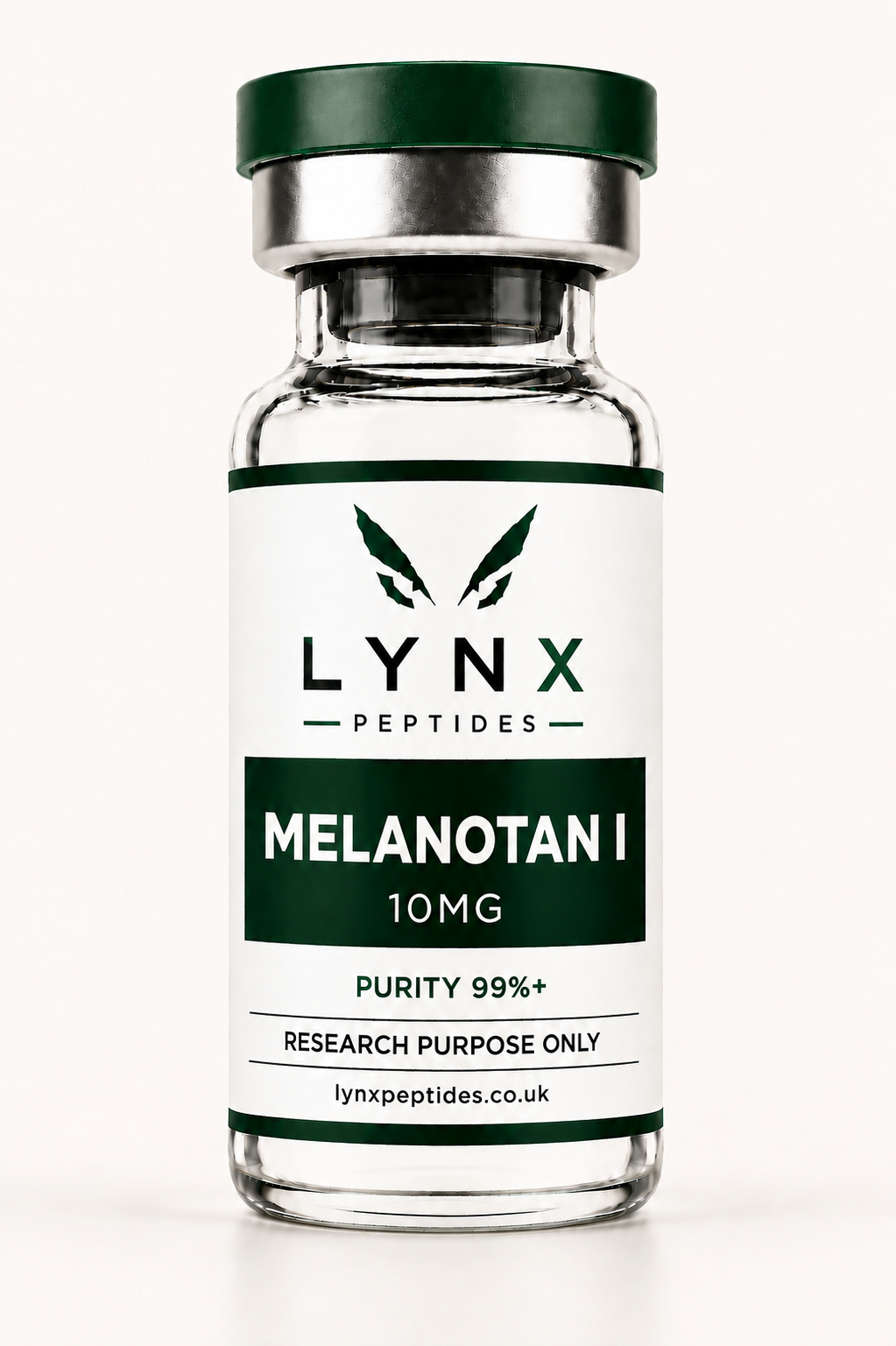
Melanotan I is supplied in 10 mg vials for laboratory research. The current price is £19.99.
Current availability is shown below. UK orders of £49.99 or more qualify for free standard shipping. Eligible working-day orders placed before 4 PM are dispatched the same day.
| Vial size | Current price | Price / mg | Status |
|---|---|---|---|
| 10 mg | £19.99 | £2.00/mg | Checking stock |
Common questions about Melanotan I
What is Melanotan I?
Melanotan I is a synthetic analogue of alpha-MSH with a linear chain of 13 amino acids. Its research is closely associated with melanocortin signalling, particularly MC1-related pigmentation measurements. Changes in its amino-acid sequence distinguish it from natural alpha-MSH, allowing researchers to examine how molecular design affects receptor binding and the resulting cellular response.
How does Melanotan I differ from Melanotan II?
Melanotan I is a longer, linear alpha-MSH analogue; Melanotan II is shorter and has a cyclic structure. Both are studied at melanocortin receptors, but their different shapes and substitutions affect binding and activity profiles. Melanotan I is closely associated with MC1-related pigmentation research, while Melanotan II is also studied across MC3, MC4 and MC5; neither name alone establishes receptor selectivity.
What changes distinguish Melanotan I from alpha-MSH?
The reference structure replaces methionine with norleucine at position 4 and uses D-phenylalanine at position 7. These changes alter the peptide's chemistry and how it is presented to receptors. Researchers compare the analogue with alpha-MSH to examine stability and receptor responses, rather than treating the substitutions as simply making a larger amount of the natural hormone.
Is Melanotan I the same name as afamelanotide?
Afamelanotide is the recognised name for the NDP-alpha-MSH analogue associated with Melanotan I. The molecular name can therefore appear in both laboratory and clinical literature. A formulated medicine described in a clinical paper is still a different product from a laboratory vial, so the preparation and context matter as well as the name.
What does melanocortin signalling mean?
It is the cellular response produced when a compound interacts with a melanocortin receptor. The family contains several receptor subtypes with different biological roles, so pigmentation is only one possible measurement. Knowing which subtype an experiment uses helps explain why two related alpha-MSH analogues can give different responses, even though both belong to the melanocortin research family.
Why does the D-Phe7 substitution matter in Melanotan I?
D-Phe7 places a different three-dimensional form of phenylalanine at position 7 of the reference peptide. Receptors and enzymes recognise molecular shape, not just the names of the amino acids present. Comparing the analogue with alpha-MSH therefore examines how a specific structural change affects binding and stability, rather than simply increasing the amount of the parent hormone.
Can I buy Melanotan I in the UK for research?
Yes. Melanotan I is listed by Lynx in 10mg vials for laboratory use only, supplied within the UK. The page shows its current availability.
Is Lynx Melanotan I independently tested?
Melanotan I's 10mg certificate is UKLY-878. The purity result is 99.553%, measured using RP-HPLC + ESI-MS.