On this page
What is KPV?
KPV is the one-letter sequence for lysine, proline and valine joined in that order. In three-letter notation it is Lys-Pro-Val. A peptide containing three amino-acid residues is called a tripeptide. The name identifies a sequence, rather than a formulation, brand or demonstrated therapeutic effect.
The same three residues occur at the C-terminal end of alpha-melanocyte-stimulating hormone, usually abbreviated alpha-MSH. Describing KPV as derived from that sequence explains its molecular context. It does not mean that an isolated synthetic tripeptide is the intact hormone, a tissue extract, or a substitute with the same biological behaviour.
The What Is a Peptide? Guide explains residues and peptide bonds. Those fundamentals matter here because a shared sequence segment does not transfer every property of a larger molecule to the smaller fragment. The experimental material and measured response still need to be identified.
Reading Lys-Pro-Val as a molecular description
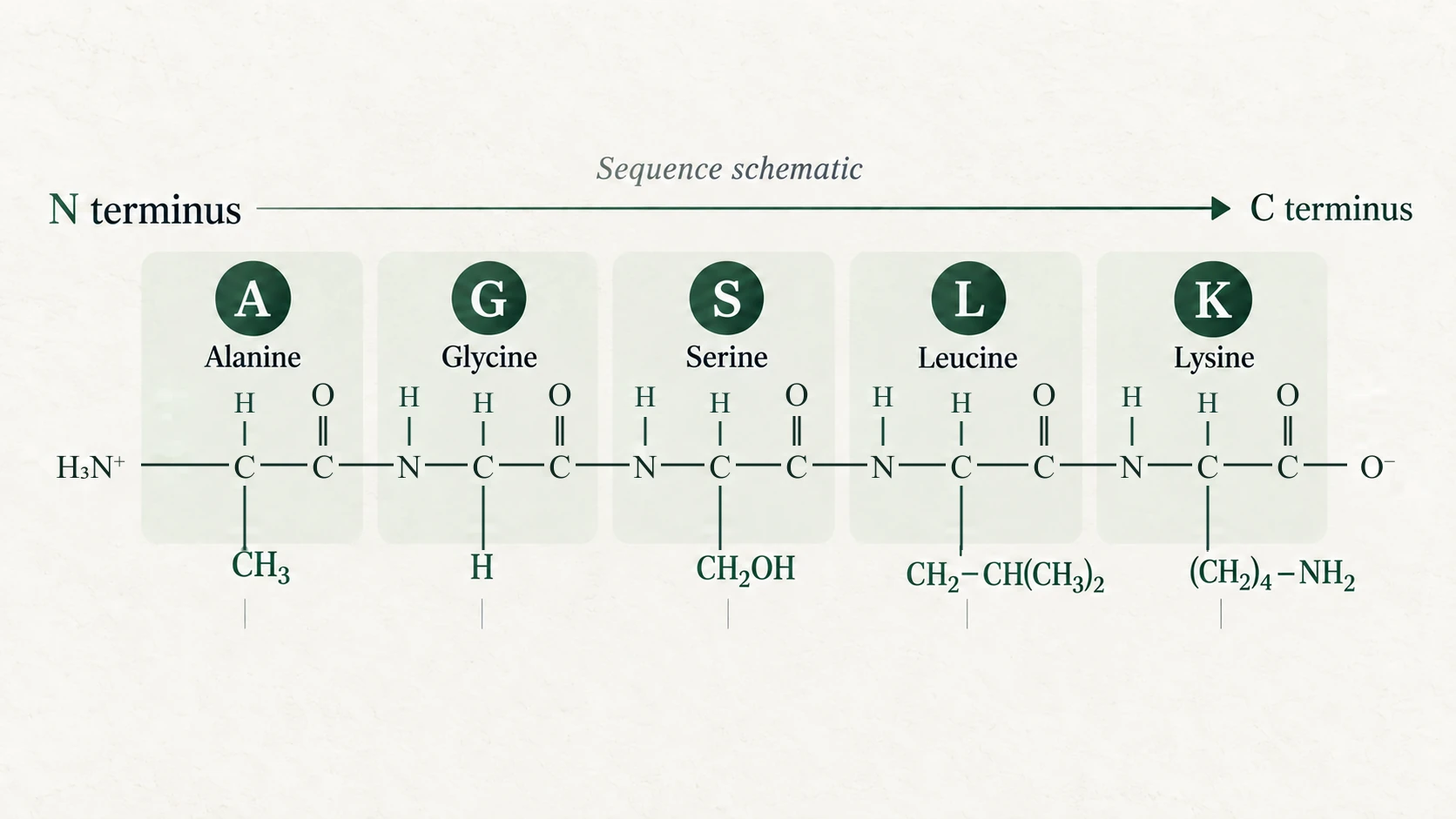
Peptide sequences are normally read from the N-terminal end to the C-terminal end. IUPAC peptide nomenclature provides the residue symbols and naming conventions. In KPV, K means lysine, not potassium. P means proline, and V means valine. The letters describe residue order, not three separate ingredients mixed together.
Lysine has an ionisable side chain. Proline incorporates its backbone nitrogen into a ring, which affects the conformations accessible to a peptide chain. Valine has a branched, non-polar side chain. These features help explain why the sequence is chemically distinctive, but they do not yield a measured solubility, transport rate or biological response on their own.
A complete molecular specification also identifies stereochemistry and terminal groups. An acetylated N terminus or amidated C terminus changes the molecule even when the shorthand letters remain KPV. Read How to Read a Peptide Sequence alongside a paper's materials section, rather than assuming a short name resolves every chemical detail.
Why a small peptide is not a miniature hormone
Removing most of a hormone changes its molecular surface, possible conformations and interactions. A receptor or transporter encounters that complete surface, not simply a familiar sequence label. KPV therefore needs its own experimental characterisation. Its relationship to alpha-MSH is a reason to investigate it, not a shortcut around measurement.
Small size can make some analytical descriptions simpler: a three-residue chain has fewer sequence positions to specify than a longer peptide. It does not make biological exposure predictable. Enzymatic breakdown, transport into cells, distribution and the surrounding medium are separate questions. A residue count cannot establish that a material reaches a relevant site in a living organism.
KPV is ordinarily discussed as a linear tripeptide. This distinguishes its chain connectivity from a deliberately cyclised analogue, not from every folded shape it may adopt. Linear vs Cyclic Peptides explains that topology. KPV vs BPC-157 compares two distinct sequences without treating them as interchangeable materials.
Cellular uptake and signalling are different questions
A compound outside a cell may need a route across the membrane before it can influence an intracellular process. PepT1 is a transporter associated with uptake of dipeptides and tripeptides. Transport is not the same as activation of a hormone receptor, and a transport finding should not be rewritten as a complete receptor mechanism.
In Dalmasso and colleagues’ 2008 study, cultured intestinal epithelial and immune-cell systems were used to examine KPV uptake and inflammatory-signalling responses. The investigators reported PepT1-associated uptake and changes in NF-kappaB and MAP kinase readouts under the studied conditions. These are experimentally defined cellular observations.
NF-kappaB and MAP kinases participate in cellular signalling, while cytokine measurements describe other parts of the response. A change in one readout does not automatically establish every downstream effect. Human-derived cell lines are useful models, but the word “human” in their description does not turn a culture experiment into a clinical trial.
What makes a mechanistic experiment informative?
A useful comparison identifies both the stimulus and the response. For example, an experiment may compare stimulated cells with and without a peptide, alongside unstimulated controls. Without that structure, a lower signal could be attributed to the compound even when the underlying culture conditions differ.
Researchers also need to distinguish a specific pathway response from loss of viable cells or interference with the assay itself. Reporter activity, protein measurements, gene expression and secreted mediators answer related but different questions. Agreement across appropriately controlled methods strengthens an interpretation. It does not remove the boundaries of the model.
Transporter expression is another variable. Cells with different uptake capacity need not experience the same intracellular exposure even when the surrounding concentration is identical. A careful account names the cell system and what was measured, instead of using “anti-inflammatory” as a label that implies one settled mechanism or a guaranteed outcome.
What the mouse studies add
Dalmasso's paper also investigated chemically induced colitis in mice. A separate study by Kannengiesser and colleagues examined KPV in murine colitis models, including a transfer model and experiments involving animals with a nonfunctional melanocortin-1 receptor. The authors reported changes in specified inflammatory and recovery endpoints.
The MC1R experiments support a more limited conclusion than a universal receptor assignment: some observed activity did not require normally functioning MC1R in that model. They do not identify every possible target of KPV or establish that receptors and transporters contribute in the same way in all tissues.
Animal experiments bring together exposure, tissue responses and interactions that cell cultures cannot reproduce. They remain models of particular processes. A chemically induced mouse condition is not identical to a chronic human disease, and improved model endpoints cannot establish clinical effectiveness, long-term safety or a suitable human administration method.
What the evidence supports, and what it leaves unresolved
These primary papers support discussion of KPV as an experimental peptide studied in inflammatory biology. They do not support describing a retail vial as a clinically proven treatment. The studies cited here are preclinical, and the account does not establish a clinically validated benefit or safety profile in people.
A clinically useful conclusion would require more than repeating the same broad endpoint in a different model. Relevant questions include the exact material, exposure, reproducibility, comparison group, meaningful outcomes and adverse effects. Results must also be interpreted alongside the study duration and the sensitivity of the methods used to detect harms.
An absence of reported toxicity in a selected experiment is not evidence that every possible exposure is safe. Nor does a promising mechanism prove that a treatment will work. The uncertainty is part of the scientific result, rather than a gap that can be filled with claims about the parent hormone or another peptide.
Material identity and experimental conditions matter
Research using free peptide should be distinguished from research using modified termini, conjugates, encapsulation or engineered delivery systems. A carrier may change protection from breakdown, localisation and exposure. Findings from that combined system cannot be assigned automatically to an independently supplied, unconjugated material.
Solvent composition, pH and other constituents also influence a sample. Peptide Solubility Explained separates visible dissolution from measured recovery. A clear sample does not demonstrate a particular molecular form, and sequence-based reasoning cannot substitute for observations under the actual experimental conditions.
Analytical evidence should be matched to the question. HPLC vs LC-MS explains why chromatographic purity and mass-based identity are separate assessments. A published KPV experiment does not verify the contents of a Lynx batch, its biological activity or its equivalence to the paper's preparation. Such claims require their own supporting documentation.
How to read a KPV claim without losing its context
Start with the material: does the paper give the sequence, termini and source, and is KPV studied alone or as part of a formulation? Then identify the model. Cell signalling, mouse pathology and outcomes in people occupy different levels of evidence, even when the same biological vocabulary appears in their descriptions.
Next ask what changed, how it was measured and what it was compared with. A reduction in a marker is a result for that marker. It may help explain a pathway without settling the clinical importance of the change. Keep measured observations separate from hypotheses in the discussion or future-treatment language in a paper's conclusion.
Finally, look for limitations and independent replication before drawing a wider conclusion. This Guide is published by Lynx Peptides as scientific reference material, not as independent product verification. Lynx materials are supplied for laboratory research, not human or veterinary use. No dosing, administration or personal-use preparation advice is provided.
References and evidence scope
- IUPAC-IUB Joint Commission: Nomenclature and Symbolism for Amino Acids and Peptides, sections 3AA-20 and 3AA-21 Sequence direction, residue symbols and peptide nomenclature.
- Dalmasso et al. PepT1-mediated tripeptide KPV uptake reduces intestinal inflammation. Gastroenterology, 2008. DOI: 10.1053/j.gastro.2007.10.026. Cultured intestinal epithelial/immune cells and chemically induced mouse colitis. Not a human treatment trial.
- Kannengiesser et al. Melanocortin-derived tripeptide KPV has anti-inflammatory potential in murine models of inflammatory bowel disease. Inflammatory Bowel Diseases, 2008. DOI: 10.1002/ibd.20334. Mouse colitis models, including animals with nonfunctional MC1R. Not clinical efficacy or a complete receptor assignment.