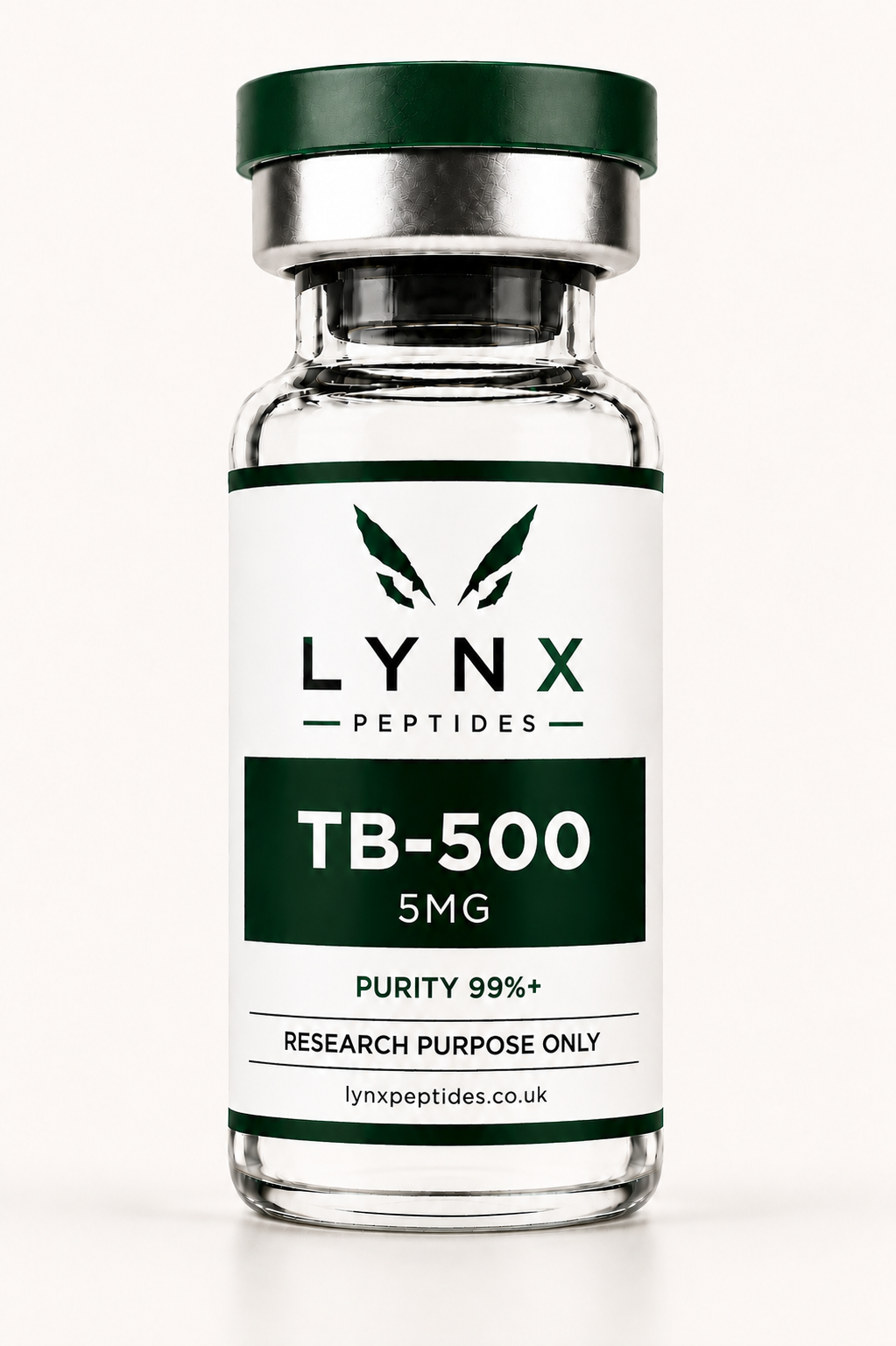
What is TB-500?
The Lynx molecular profile specifies TB-500 as synthetic, N-terminally acetylated thymosin β4 with 43 residues. Full-length thymosin β4 binds individual actin molecules, helping regulate the available pool from which cells assemble their cytoskeleton. That connection links its biochemical literature with cell shape, movement and endothelial migration.
The name TB-500 is also used for the shorter acetylated sequence Ac-LKKTETQ. Fragment identity and metabolism studies cannot be treated as measurements of the full-length molecule simply because the trade name matches. This page therefore starts from the Lynx structural specification and separates full-length research from fragment-specific context. Existing report terminology still warrants supplier clarification. Sequence-matched evidence is useful for explaining the biology; analytical confirmation tied to the actual batch is a separate question.
Related scientific guides: BPC-157 and TB-500: molecular identity and evidence limits. Full-length thymosin β4 and shorter fragments sold as TB-500 are distinct materials; the trade name alone does not establish molecular identity.
TB-500 Research Areas
Actin binding depended on residues distributed across full-length thymosin β4, not only its central short motif. Several substitutions markedly weakened association or stability of the actin complex. This helps explain why the complete molecule and an isolated fragment are distinct biochemical tools.
Au et al. · Biochemistry · 2008PubMed
Full-length thymosin β4 promoted directional movement of cultured human endothelial cells and migration into an experimental scratch. Matrix metalloproteinase production also increased. These cell and implanted-matrix observations connect actin-related biology with vascular-cell movement, without making the assay a human wound-treatment result.
Malinda et al. · FASEB journal : official publication of the Federation of American Societies for Experimental Biology · 1997PubMed
An analysed TB-500 preparation contained Ac-LKKTETQ, the acetylated seven-residue thymosin β4 fragment. Chromatography and mass spectrometry established the identity in that preparation and supported detection methods. The result concerns a fragment, not full-length 43-residue thymosin β4, and is analytical evidence rather than a demonstration of tissue repair.
Esposito et al. · Drug Test Anal · 2012PubMed
Only the metabolite Ac-LKKTE produced a significant wound-closure signal among the TB-500 fragment-related compounds tested in a fibroblast assay. The parent acetylated fragment was also tracked through serum, enzyme and rat-urine experiments, with different metabolites persisting for different periods. These are fragment-specific metabolism and cell findings, not results for full-length thymosin β4.
Rahaman et al. · J Chromatogr B · 2024PubMed
Ocular discomfort and corneal staining were lower with a full-length thymosin β4 eye-drop preparation than with vehicle at the final follow-up in a nine-person blinded trial of severe dry eye. Treatment lasted 28 days, followed by another 28 days of observation. The very small sample and local eye-drop formulation give limited human context for thymosin β4, not an outcome established for the Lynx TB-500 vial or its shorter namesake fragments.
Sosne et al. · Cornea · 2015PubMed
Molecular profile
- Compound
- TB-500
- Amount
- 5 mg
- Sequence
- Ac-SDKPDMAEIEKFDKSKLKKTETQEKNPLPSKETIEQEKQAGES-OH
- Residue count
- 43
- Molecular formula
- C212H350N56O78S
- Molecular weight
- 4963 g/mol
- CAS number
- 77591-33-4
- Chemical class
- Synthetic N-terminally acetylated peptide
- Full compound name
- Thymosin beta-4 (43-residue peptide)
- Classification
- Research peptide
- Parent molecule
- Thymosin beta-4 (N-acetylated, 43 residues)
- Available vial sizes
- 5 mg, 10 mg
Analytical verification
- Lynx report reference
- UKLY-374
- Reported purity
- >99%
- Analysis method
- RP-HPLC (purity, report as found)
- Identity result
- Confirmed: TB-500
- Analysis date
- 20 Aug 2026
- Report date
- 20 Aug 2026
Storage & Reconstitution
Store in appropriate cool, dry conditions. Refer to product-specific storage information when published.
Vials are supplied separately from bacteriostatic water and other preparation supplies.
For laboratory handling context, read Research peptide storage and stability. Product-specific information and the laboratory method take precedence.
For laboratory preparation, allow the sealed vial to reach room temperature before opening. Wipe the vial stopper and bacteriostatic-water stopper with an alcohol wipe. Add bacteriostatic water slowly down the inside wall of the vial, then swirl gently until dissolved. Do not shake.
Research literature
- Synthesis and characterization of the N-terminal acetylated 17-23 fragment of thymosin beta 4 identified in TB-500, a product suspected to possess doping potential.Esposito et al. · Drug Test Anal · 2012PubMed
- Simultaneous quantification of TB-500 and its metabolites in in-vitro experiments and rats by UHPLC-Q-Exactive orbitrap MS/MS and their screening by wound healing activities in-vitro.Rahaman et al. · J Chromatogr B · 2024PubMed
- Effects of BPC-157 and TB-500 on Achilles tendon healing in rats: A histopathological and biomechanical study.Biçer et al. · Jt Dis Relat Surg · 2026PubMed
- Widely distributed residues in thymosin beta4 are critical for actin binding.Au et al. · Biochemistry · 2008PubMed
- Thymosin beta 4 stimulates directional migration of human umbilical vein endothelial cells.Malinda et al. · FASEB journal : official publication of the Federation of American Societies for Experimental Biology · 1997PubMed
- Thymosin β4 significantly improves signs and symptoms of severe dry eye in a phase 2 randomized trial.Sosne et al. · Cornea · 2015PubMed
TB-500 Price (UK)
TB-500 is supplied in 5 mg and 10 mg vial sizes for laboratory research. UK prices are 5 mg at £22.99 and 10 mg at £38.99.
Current availability is shown below. UK orders of £49.99 or more qualify for free standard shipping. Eligible working-day orders placed before 4 PM are dispatched the same day.
| Vial size | Current price | Price / mg | Status |
|---|---|---|---|
| 5 mg | £22.99 | £4.60/mg | Checking stock |
| 10 mgBest value | £38.99 | £3.90/mg | Checking stock |
Common questions about TB-500
What is TB-500?
TB-500 is associated with thymosin β4, a peptide involved in actin-related cell biology. The Lynx profile uses the acetylated, full-length 43-amino-acid reference, while some papers use TB-500 for a shorter fragment. That difference matters because the complete peptide and a fragment do not contain the same structural features, even when the literature uses a shared name.
How does TB-500 differ from BPC-157?
The Lynx TB-500 profile uses a 43-amino-acid thymosin β4 reference, whose research includes actin organisation and cell movement. BPC-157 is a 15-amino-acid peptide studied in migration, attachment and tissue-response signalling. Their research can overlap at the level of a cell response, but the molecules and biological processes being examined are different.
How does the individual TB-500 vial differ from the BPC-157 blend?
Individual TB-500 lets a laboratory examine the thymosin β4-related component without BPC-157. The blend adds BPC-157, whose research includes migration and attachment signalling, and fixes the two at equal listed masses. Separate compounds allow each to be varied independently, making it possible to distinguish one peptide's response from that of the combined preparation.
Why is actin binding discussed in thymosin β4 research?
Actin is a protein that helps cells maintain their shape and move. Full-length thymosin β4 binds actin, making that interaction central to research into cellular organisation and movement. This connects the molecule's chemistry with a measurable cell process; a short thymosin fragment may not reproduce the complete peptide's actin-binding behaviour.
What is actin sequestration in thymosin beta-4 research?
It means binding individual actin molecules and holding them outside the growing actin filaments that form part of a cell's skeleton. Full-length thymosin beta-4 is studied for that interaction. The balance between free and bound actin helps explain its connection with cell shape and movement, rather than treating actin binding as a general tissue-repair claim.
What does acetylated mean in the TB-500 profile?
The reference profile includes an acetyl group at the beginning of the thymosin beta-4 chain. It is a chemical modification of that peptide, not a separate ingredient or extra amino acid. Checking the modification alongside the sequence helps identify the preparation being compared, particularly when a paper uses TB-500 for a shorter fragment.
Can I buy TB-500 in the UK for research?
Yes. Individual TB-500 vials are offered in 5mg and 10mg strengths for laboratory work in the UK. Each option has its own stock status.
Are the TB-500 vial strengths batch tested?
For TB-500 5mg, UKLY-374 shows purity above 99% by RP-HPLC. The 10mg report is UKLY-360, with 99.69% purity using HPLC-UV/MS.