What is RT3?
RT3 brings together a research interest in three metabolic receptor systems: GIP, GLP-1 and glucagon. GIP and GLP-1 are incretin pathways involved in glucose-dependent insulin responses, while glucagon signalling has a different role in fuel availability and energy metabolism. Studying them together asks a broader question than measuring the response to one receptor alone.
Published triple-receptor peptide designs use a lipid attachment to bind albumin, a protein in the blood, and slow clearance. This extended-circulation design lets studies examine sustained signalling rather than only a brief receptor response. It describes the preparation in the cited design studies; the linked RT3 certificates provide the analytical results for the supplied vial strengths.
The human research includes phase 2 trials measuring body weight, HbA1c and adverse events in defined participant groups. Those results help explain why the three-pathway approach attracts metabolic research interest, but laboratory signalling, clinical outcomes and safety are different measurements. RT3 is supplied for in-vitro research, not human or veterinary use.
RT3 Research Areas
Body weight decreased more than with placebo in a 48-week phase 2 trial involving 338 adults with obesity or overweight and a related condition. Gastrointestinal adverse events and temporary heart-rate increases were also reported. The study measured a specific investigational preparation in a defined participant group, rather than testing the suitability of research vials for human use.
Jastreboff et al. · N Engl J Med · 2023PubMed
HbA1c decreased more than with placebo in all but the lowest-exposure group in a phase 2 trial involving 281 adults with type 2 diabetes. Some groups also exceeded the active comparator, and body weight decreased. Gastrointestinal adverse events were common, so glucose measurements and tolerability both form part of the trial findings.
Rosenstock et al. · Lancet · 2023PubMed
Molecular profile
- Compound
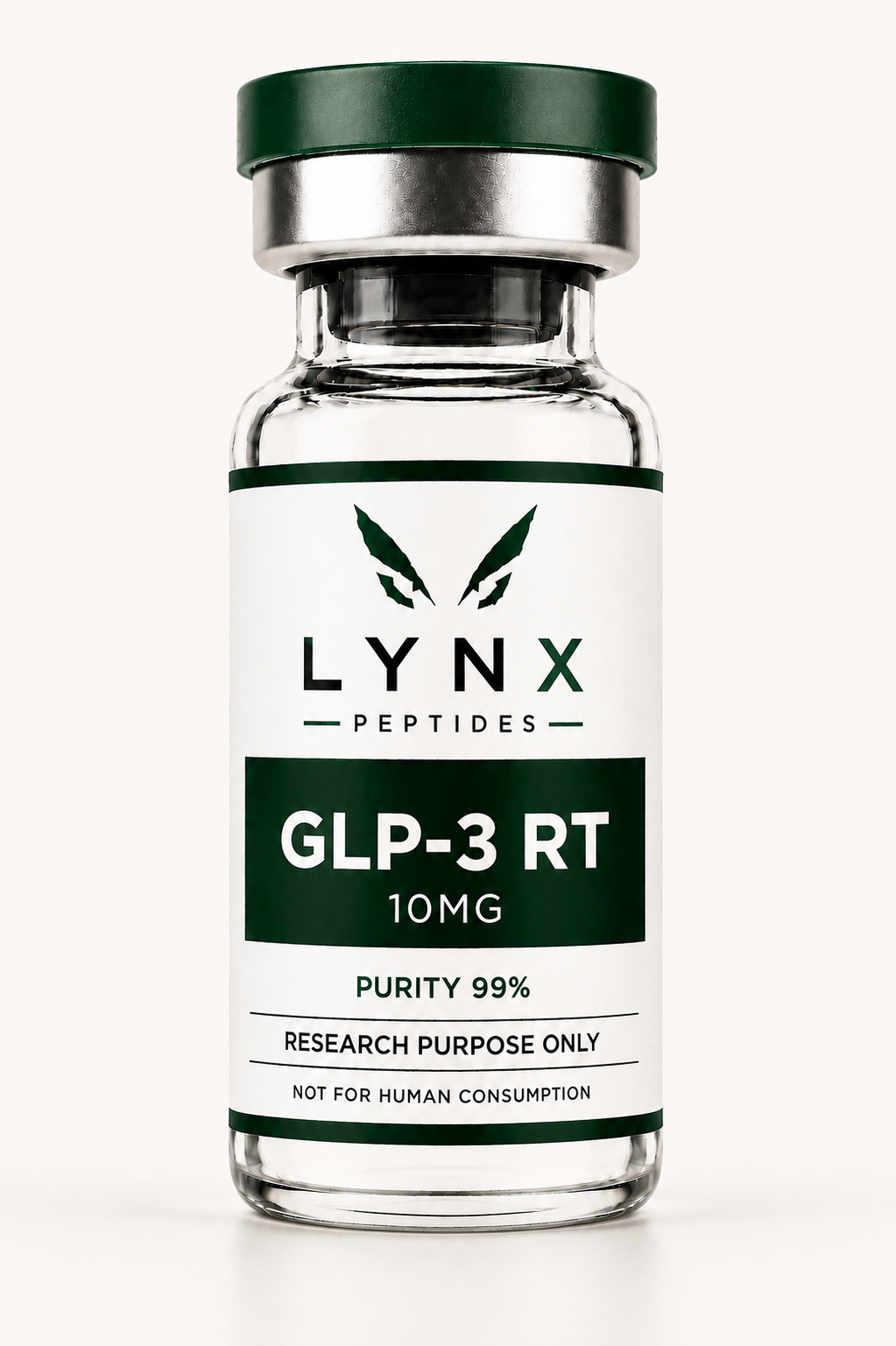
- RT3
- Amount
- 10 mg
- Residue count
- 39
- Chemical class
- Synthetic metabolic research peptide
- Classification
- Metabolic research
- Available vial sizes
- 10 mg, 20 mg, 30 mg
Analytical verification
- Lynx report reference
- UKLY-291
- Reported purity
- 99.602%
- Analysis method
- RP-HPLC (purity, report as found)
- Identity result
- Confirmed: RT3
- Analysis date
- 7 Aug 2026
- Report date
- 7 Aug 2026
Storage & Reconstitution
Store in appropriate cool, dry conditions. Refer to product-specific storage information when published.
Vials are supplied separately from bacteriostatic water and other preparation supplies.
For laboratory handling context, read Research peptide storage and stability. Product-specific information and the laboratory method take precedence.
For laboratory preparation, allow the sealed vial to reach room temperature before opening. Wipe the vial stopper and bacteriostatic-water stopper with an alcohol wipe. Add bacteriostatic water slowly down the inside wall of the vial, then swirl gently until dissolved. Do not shake.
Research literature
RT3 Price (UK)
RT3 is supplied in 10 mg, 20 mg and 30 mg vial sizes for laboratory research. UK prices are 10 mg at £59.99, 20 mg at £99.99 and 30 mg at £134.99.
Current availability is shown below. UK orders of £49.99 or more qualify for free standard shipping. Eligible working-day orders placed before 4 PM are dispatched the same day.
| Vial size | Current price | Price / mg | Status |
|---|---|---|---|
| 10 mg | £59.99 | £6.00/mg | Checking stock |
| 20 mg | £99.99 | £5.00/mg | Checking stock |
| 30 mgBest value | £134.99 | £4.50/mg | Checking stock |
Common questions about RT3
What is RT3?
RT3 is a synthetic 39-residue research peptide associated with triple-receptor metabolic research. The linked studies examine GIP, GLP-1 and glucagon receptor signalling, which connect glucose regulation with broader energy metabolism. This research asks how those pathways interact when studied together, rather than treating metabolic signalling as a response controlled by just one receptor.
How do the 10mg, 20mg and 30mg RT3 vials differ?
The strengths supply different amounts of RT3, not different receptor combinations. Each vial size has its own certificate and purity result, which are linked separately on the product page. The amount available for preparation changes with vial size; a laboratory's final concentration depends on its preparation, rather than the strength label alone.
Which three receptor systems are associated with RT3 research?
The linked research examines GIP, GLP-1 and glucagon receptors. GIP and GLP-1 are part of incretin signalling associated with glucose-dependent insulin responses, while glucagon contributes a different input into fuel and energy metabolism. Studying the three together lets researchers examine their interaction, rather than assuming each receptor adds the same type of metabolic signal.
How does triple-receptor research differ from single- or dual-receptor research?
A single-receptor agonist is studied at one target; a dual agonist at two, and a triple agonist at three. The useful distinction is which biological signals are combined, not simply how many targets are listed. In the linked RT3 research, the glucagon pathway adds a different metabolic input alongside GIP and GLP-1, making the balance between pathways part of the question.
Why is the glucagon receptor relevant in metabolic research?
Glucagon signalling helps regulate how the liver handles fuel and releases glucose, and is also studied in energy expenditure. That makes it a different input from incretin-related signalling. Including it in a multi-receptor experiment allows researchers to examine the balance between glucose regulation and other metabolic responses, rather than assuming every pathway acts in the same direction.
What does lipidation mean in triple-receptor peptide research?
Lipidation adds a fatty-acid-based group to a peptide. In the published triple-receptor design, it enables albumin binding and helps slow clearance, allowing longer-lasting exposure to be studied alongside receptor activity. This describes the preparation used in the cited design research; the linked RT3 certificates show the analytical results for the supplied vial strengths.
Can I buy RT3 in the UK for research?
Yes. RT3 is listed for UK in-vitro laboratory research in 10mg, 20mg and 30mg options. Stock is displayed for each vial size.
How are the RT3 vial strengths batch tested?
RT3's 10mg result is 99.602% by RP-HPLC (UKLY-291). The 20mg sample reports 99.0% using RP-HPLC (UKLY-573), while 30mg reports 99.0% by RP-HPLC (UKLY-488).