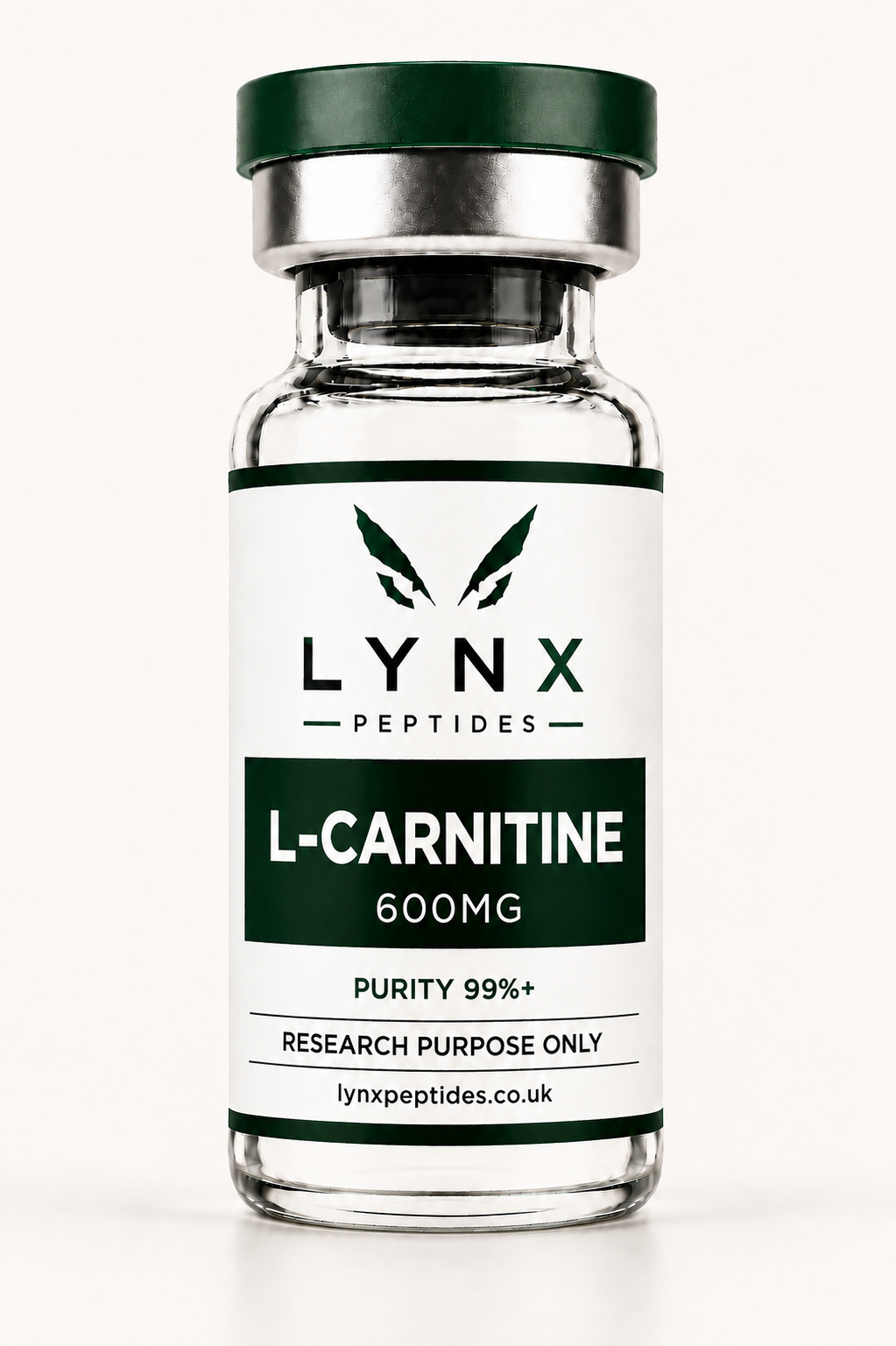
What is L-Carnitine?
L-Carnitine is a small non-peptide metabolite involved in the mitochondrial handling of fatty-acyl groups. The carnitine shuttle transfers long-chain acyl groups across the inner mitochondrial membrane so they can enter β-oxidation. This involves several proteins with different jobs, rather than carnitine carrying an intact free fatty acid directly across the membrane.
That established biochemical role makes it relevant to studies of fuel selection, mitochondrial function and acylcarnitine patterns. Cellular uptake and retention also depend on transporters such as OCTN2. Human supplementation studies add a broader metabolic literature, but their findings vary with population and protocol: small individual trials include null results, while pooled analyses report modest average changes with substantial variation. Those observations are kept separate from the identity and intended laboratory role of the supplied material.
L-Carnitine Research Areas
Cellular carnitine availability depends on uptake and retention as well as biosynthesis. The OCTN2 transporter is central to this balance; defects can greatly reduce cellular accumulation and increase urinary losses. This biochemical and clinical-genetic context explains why adding carnitine and having an intact transport system are different experimental variables.
Longo et al. · Biochim Biophys Acta · 2016PubMed
Pooled results from 41 L-carnitine trials involving 2,900 adults favoured lower fasting glucose, HbA1c and estimated insulin resistance. Results varied substantially between trials, with very high statistical heterogeneity and differences by population and study duration. The average change therefore describes a diverse supplementation literature rather than one consistent metabolic response.
Zamani et al. · Front Nutr · 2022PubMed
Across 37 trials involving 2,292 adults, pooled L-carnitine results showed modest reductions in body weight, BMI and fat mass, but no significant change in waist circumference or body-fat percentage. Restricting the analysis to higher-quality trials retained only the body-weight finding. Differences between populations and protocols remain important when interpreting the average result.
Talenezhad et al. · Clin Nutr ESPEN · 2020PubMed
Insulin sensitivity and lipid profiles did not change significantly with L-carnitine in a four-week placebo-controlled trial involving 12 adults with type 2 diabetes. Only six received L-carnitine. This small null trial is a useful counterpoint to pooled results from larger, more varied supplementation literatures.
González-Ortiz et al. · Ann Nutr Metab · 2008PubMed
Molecular profile
- Compound
- L-Carnitine
- Amount
- 600 mg
- Molecular formula
- C7H15NO3
- Molecular weight
- 161.20 g/mol
- CAS number
- 541-15-1
- Chemical class
- Quaternary ammonium compound
- Classification
- Research compound
- Parent molecule
- L-Carnitine (levocarnitine)
- Available vial sizes
- 600 mg
Analytical verification
A certificate is not currently published for L-Carnitine (600 mg).
Storage & Reconstitution
Store in appropriate cool, dry conditions. Refer to product-specific storage information when published.
Vials are supplied separately from bacteriostatic water and other preparation supplies.
For laboratory preparation, allow the sealed vial to reach room temperature before opening. Wipe the vial stopper and bacteriostatic-water stopper with an alcohol wipe. Add bacteriostatic water slowly down the inside wall of the vial, then swirl gently until dissolved. Do not shake.
Research literature
- The effects of L-carnitine supplementation on glycemic markers in adults: A systematic review and dose-response meta-analysis.Zamani et al. · Front Nutr · 2022PubMed
- Effects of l-carnitine supplementation on weight loss and body composition: A systematic review and meta-analysis of 37 randomized controlled clinical trials with dose-response analysis.Talenezhad et al. · Clin Nutr ESPEN · 2020PubMed
- Effect of oral L-carnitine administration on insulin sensitivity and lipid profile in type 2 diabetes mellitus patients.González-Ortiz et al. · Ann Nutr Metab · 2008PubMed
- Carnitine transport and fatty acid oxidation.Longo et al. · Biochim Biophys Acta · 2016PubMed
L-Carnitine Price (UK)
L-Carnitine is supplied in 600 mg vials for laboratory research. The current price is £28.99.
Current availability is shown below. UK orders of £49.99 or more qualify for free standard shipping. Eligible working-day orders placed before 4 PM are dispatched the same day.
| Vial size | Current price | Price / mg | Status |
|---|---|---|---|
| 600 mg | £28.99 | £0.05/mg | Checking stock |
Common questions about L-Carnitine
What is L-Carnitine?
L-Carnitine is a small, non-peptide compound involved in energy metabolism. It helps the carnitine shuttle carry long-chain fatty-acyl groups into mitochondria, where they can be broken down. Its research therefore concerns how cells move and use fuel, rather than the receptor signalling associated with many peptides in the catalogue.
Is L-Carnitine a peptide?
No. L-Carnitine is a small metabolite, not a chain of amino acids linked together as a peptide. Its role in the carnitine shuttle gives it a different chemical and experimental purpose. Grouping it with laboratory research compounds does not change that identity or mean it acts through the same pathways as the peptide products.
What does the ‘L’ in L-Carnitine mean?
The 'L' identifies the molecule's stereochemical form: the three-dimensional arrangement of its atoms. Biological enzymes recognise molecular shape, so two forms with the same atoms are not automatically equivalent in a cell. The letter is part of the compound's identity, not a strength label or a description of how much is in the vial.
How does the carnitine shuttle work?
Long-chain fatty-acyl groups cannot simply cross the inner mitochondrial membrane on their own. Enzymes transfer them onto carnitine, a transporter carries them across, and another enzyme transfers them back. This shuttle links movement of fuel with its breakdown, so experiments can distinguish transport into mitochondria from the reactions that use the fuel once it arrives.
How does L-Carnitine differ from acetyl-L-carnitine?
Acetyl-L-carnitine has an acetyl group attached to carnitine, making it a different chemical form. That changes what is present in the experimental preparation, even though the two compounds are closely related. This vial supplies L-Carnitine, not the acetylated form, so comparisons need to identify the compound actually used rather than relying on the shared carnitine name.
Which fuels are relevant to carnitine-shuttle research?
The shuttle transports long-chain fatty-acyl groups into mitochondria, where they can be broken down. These come from fatty acids; they are not the same fuel as glucose. This makes carnitine-shuttle experiments useful for separating transport of those groups from their later breakdown, rather than treating all cellular energy production as one process.
Can I buy L-Carnitine in the UK for research?
Yes. L-Carnitine is included in the Lynx UK catalogue as a 600mg research compound. Refer to its live stock indicator before ordering for laboratory work.
Is a Certificate of Analysis available for L-Carnitine?
Lynx has not published a batch-specific COA for this L-Carnitine product. There is currently no linked laboratory report showing its measured purity or test method.