What is MOTS-C?
MOTS-C is a 16-residue mitochondrial-derived peptide mapped to a short open reading frame within the mitochondrial 12S rRNA region. The term “mitochondrial-derived” describes its genetic origin; its research significance lies in signalling between cellular metabolism and stress responses, rather than in acting as a structural part of the respiratory chain.
The initial work connected MOTS-C with folate and purine metabolism and activation of AMPK, an energy-sensing pathway. Mouse experiments added observations on insulin sensitivity and high-fat-diet metabolic responses. Separate cell work found movement of MOTS-C into the nucleus under metabolic stress, where gene-expression changes involved antioxidant-response elements and NRF2-related signalling. This combination of origin, metabolic effects and nuclear communication gives the peptide a distinctive experimental role, while the mechanistic findings remain chiefly cellular and preclinical.
MOTS-C Research Areas
MOTS-C linked mitochondrial peptide signalling with folate and purine metabolism and AMPK activation in the initial cell experiments. Mouse work found prevention of age- and high-fat-diet-associated insulin resistance and diet-induced obesity. These results established a metabolic research direction, while the genetic origin and cellular mechanism remain distinct from the animal outcomes.
Lee et al. · Cell Metab · 2015PubMed
MOTS-C moved into the nucleus during metabolic stress in cell experiments, with AMPK-dependent localisation and changes in stress-responsive gene expression. Under glucose restriction, the response involved antioxidant-response elements and interaction with NRF2-related transcriptional machinery. This gives a cellular explanation for mitochondrial–nuclear communication, rather than a measured clinical outcome.
Kim et al. · Cell Metab · 2018PubMed
Molecular profile
- Compound
- MOTS-C
- Amount
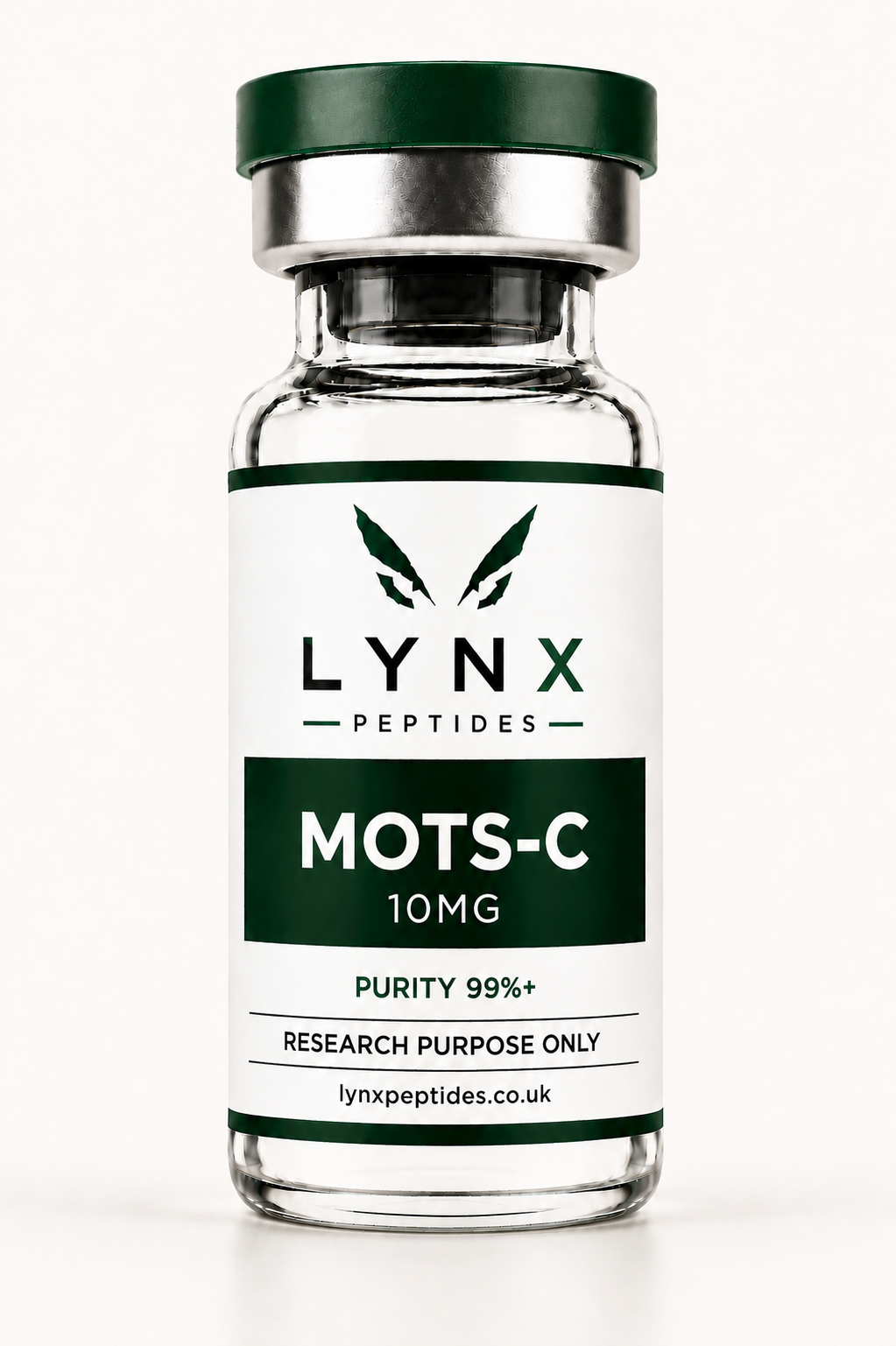
- 10 mg
- Sequence
- MRWQEMGYIFYPRKLR
- Residue count
- 16
- Molecular formula
- C101H152N28O22S2
- Molecular weight
- 2174.6 g/mol
- CAS number
- 1627580-64-6
- Chemical class
- Mitochondrial-derived peptide
- Classification
- Research peptide
- Parent molecule
- MOTS-c
- Available vial sizes
- 10 mg, 40 mg
Analytical verification
- Lynx report reference
- UKLY-179
- Reported purity
- 99.23%
- Analysis method
- RP-HPLC (UV 214 nm)
- Identity result
- Confirmed: MOTS-C
- Analysis date
- 7 Aug 2026
- Report date
- 7 Aug 2026
Storage & Reconstitution
Store in appropriate cool, dry conditions. Refer to product-specific storage information when published.
Vials are supplied separately from bacteriostatic water and other preparation supplies.
For laboratory handling context, read Research peptide storage and stability. Product-specific information and the laboratory method take precedence.
For laboratory preparation, allow the sealed vial to reach room temperature before opening. Wipe the vial stopper and bacteriostatic-water stopper with an alcohol wipe. Add bacteriostatic water slowly down the inside wall of the vial, then swirl gently until dissolved. Do not shake.
Research literature
- The mitochondrial-derived peptide MOTS-c promotes metabolic homeostasis and reduces obesity and insulin resistance.Lee et al. · Cell Metab · 2015PubMed
- The Mitochondrial-Encoded Peptide MOTS-c Translocates to the Nucleus to Regulate Nuclear Gene Expression in Response to Metabolic Stress.Kim et al. · Cell Metab · 2018PubMed
MOTS-C Price (UK)
MOTS-C is supplied in 10 mg and 40 mg vial sizes for laboratory research. UK prices are 10 mg at £24.99 and 40 mg at £69.99.
Current availability is shown below. UK orders of £49.99 or more qualify for free standard shipping. Eligible working-day orders placed before 4 PM are dispatched the same day.
| Vial size | Current price | Price / mg | Status |
|---|---|---|---|
| 10 mg | £24.99 | £2.50/mg | Checking stock |
| 40 mgBest value | £69.99 | £1.75/mg | Checking stock |
Common questions about MOTS-C
What is MOTS-C?
MOTS-C is a 16-amino-acid peptide whose genetic origin is in mitochondrial DNA. Its research examines metabolic stress and communication between mitochondria and the nucleus. That makes it interesting beyond energy production alone: experiments explore whether a mitochondria-derived signal can influence how the cell responds to changes in fuel availability and stress.
Why is MOTS-C called mitochondrial-derived?
The coding region for MOTS-C was identified within mitochondrial 12S ribosomal RNA. Mitochondria have their own DNA, separate from the DNA in the nucleus, so the name describes the peptide's genetic origin. It does not mean MOTS-C is part of the respiratory chain; its research instead explores signalling from mitochondria to other parts of the cell.
How do the 10mg and 40mg MOTS-C vials differ?
They supply different amounts of the same listed 16-amino-acid peptide, rather than different molecular designs. Each strength has its own certificate and reported result. A larger vial changes the amount available for laboratory preparation, not the peptide's sequence, so the experimental concentration and the batch report remain separate details to check.
Why is AMPK discussed in MOTS-C research?
AMPK helps cells adjust their metabolism when their energy state changes. MOTS-C experiments in cells and mice have linked it to AMPK activation and metabolic responses. Measuring that pathway helps researchers investigate how the peptide connects to energy sensing, rather than assuming every metabolic change is explained by the amount of fuel a cell contains.
Can MOTS-C move into the cell nucleus?
Yes, movement into the nucleus has been reported in experimental models of metabolic stress. There, MOTS-C was associated with changes in stress-responsive gene expression. This is a distinctive part of its research because it connects a peptide encoded by mitochondrial DNA with activity in the nucleus, rather than limiting its role to the mitochondria where its coding region was found.
Is MOTS-C a fragment of a respiratory-chain protein?
No. MOTS-C's coding region is associated with mitochondrial 12S ribosomal RNA, rather than one of the familiar respiratory-chain proteins. Its research concerns a small signalling peptide and cellular stress responses. This helps explain the term mitochondrial-derived: it describes a genetic origin, not a piece of the machinery that directly produces energy.
Can I buy MOTS-C in the UK for research?
Yes. Lynx lists 10mg and 40mg MOTS-C for research laboratories in the UK. Select a strength to see its current availability.
Are both MOTS-C vial strengths batch tested?
The MOTS-C results differ by strength: 10mg is 99.23% by RP-HPLC (UV 214 nm) on UKLY-179. For 40mg, UKLY-792 shows 99.04% with HPLC-UV/MS testing.