What is NAD+?
NAD+ is a dinucleotide coenzyme, not a peptide. In redox reactions it accepts electrons to form NADH; this cycling helps link fuel breakdown with energy metabolism. It also serves as a consumed substrate for enzymes including sirtuins, PARPs and CD38, where its chemical breakdown supports protein modification and signalling rather than electron transfer alone.
The difference between cycling and consumption explains why NAD concentration, synthesis and turnover are separate measurements. Isotope tracing shows that metabolic flux can differ greatly between tissues even when concentration measurements look similar. Location also matters: mitochondrial, cytosolic and nuclear pools provide different environments for NAD-dependent enzymes. Laboratory use therefore spans enzyme assays, redox measurements and metabolic tracing, with interpretation tied to the compartment and reaction being studied rather than a single whole-cell “NAD level”.
NAD+ Research Areas
NAD+ connects metabolism with signalling in two ways: it cycles with NADH in redox reactions and is consumed by enzymes such as sirtuins, PARPs and CD38. De-novo and salvage pathways replenish the available pools. This biochemical framework explains why concentration, synthesis and consumption need separate measurements.
Yang et al. · Biochim Biophys Acta · 2016PubMed
Sirtuins respond to NAD+ availability differently from enzymes that sense NADH or the NAD+:NADH ratio. The biochemical evidence reviewed supports NAD+ sensing by sirtuins, rather than direct sensing of NADH or the ratio in the same way. This distinction separates redox balance from the supply of a consumed enzyme substrate.
Anderson et al. · Biochim Biophys Acta Bioenerg · 2017PubMed
NAD-dependent reactions operate in distinct mitochondrial, cytosolic and nuclear environments. Local cofactor concentrations and enzyme abundance can make a change important in one compartment but less relevant in another. This explains why a bulk cellular NAD measurement does not describe every redox or signalling reaction equally.
Kulkarni et al. · Antioxid Redox Signal · 2019PubMed
Isotope tracing revealed substantial differences in NAD synthesis and consumption between tissues. Cell lines relied on nicotinamide and consumed NAD through pathways including PARPs and sirtuins, while liver-derived nicotinamide supported wider tissue metabolism. Measuring turnover therefore gives information that a single NAD concentration cannot provide.
Liu et al. · Cell Metab · 2018PubMed
Molecular profile
- Compound
- NAD+
- Amount
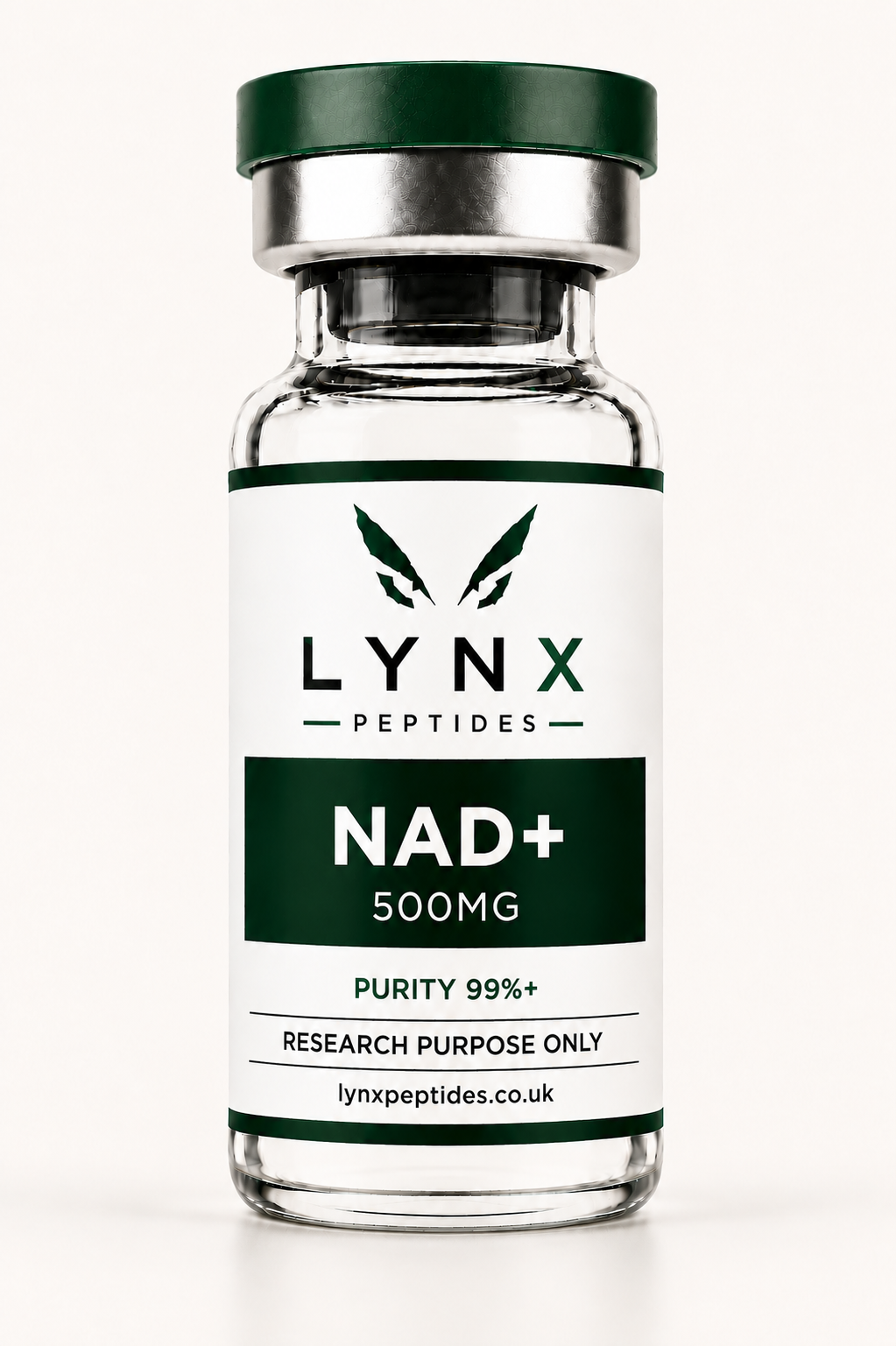
- 500 mg
- Molecular formula
- C21H27N7O14P2
- Molecular weight
- 663.4 g/mol
- CAS number
- 53-84-9
- Chemical class
- Dinucleotide coenzyme
- Full compound name
- Nicotinamide adenine dinucleotide
- Classification
- Research compound
- Parent molecule
- NAD+ (oxidized beta-nicotinamide adenine dinucleotide)
- Available vial sizes
- 500 mg
Analytical verification
- Lynx report reference
- UKLY-239
- Reported purity
- 99.62%
- Analysis method
- RP-HPLC + ESI-MS
- Identity result
- Confirmed: NAD+
- Analysis date
- 4 Sept 2026
- Report date
- 4 Sept 2026
Storage & Reconstitution
Store in appropriate cool, dry conditions. Refer to product-specific storage information when published.
Vials are supplied separately from bacteriostatic water and other preparation supplies.
For laboratory preparation, allow the sealed vial to reach room temperature before opening. Wipe the vial stopper and bacteriostatic-water stopper with an alcohol wipe. Add bacteriostatic water slowly down the inside wall of the vial, then swirl gently until dissolved. Do not shake.
Research literature
- NAD(+) metabolism: Bioenergetics, signaling and manipulation for therapy.Yang et al. · Biochim Biophys Acta · 2016PubMed
- Metabolic control by sirtuins and other enzymes that sense NAD(+), NADH, or their ratio.Anderson et al. · Biochim Biophys Acta Bioenerg · 2017PubMed
- Cellular Compartmentation and the Redox/Nonredox Functions of NAD().Kulkarni et al. · Antioxid Redox Signal · 2019PubMed
- Quantitative Analysis of NAD Synthesis-Breakdown Fluxes.Liu et al. · Cell Metab · 2018PubMed
NAD+ Price (UK)
NAD+ is supplied in 500 mg vials for laboratory research. The current price is £49.99.
Current availability is shown below. UK orders of £49.99 or more qualify for free standard shipping. Eligible working-day orders placed before 4 PM are dispatched the same day.
| Vial size | Current price | Price / mg | Status |
|---|---|---|---|
| 500 mg | £49.99 | £0.10/mg | Checking stock |
Common questions about NAD+
What is NAD+?
NAD+ is the oxidised form of nicotinamide adenine dinucleotide, a coenzyme rather than a peptide. It helps transfer electrons in metabolic reactions and is also used by enzymes such as sirtuins and PARPs. Those roles link it to both energy metabolism and other cellular processes, so a change in NAD+ can be studied in several different ways.
What is the relationship between NAD+ and NADH?
NAD+ accepts electrons to become NADH; NADH can pass them on and return to NAD+. This cycle helps connect reactions that release energy with reactions that use it. Measuring the balance between the two can therefore tell a laboratory something different from measuring total NAD alone, because the chemical state matters as well as the overall amount.
Is NAD+ the same as NMN or NR?
No. NMN and NR are precursors that cells can use in pathways producing NAD+. NAD+ is the coenzyme itself, not one of those starting compounds. An experiment supplying a precursor examines its conversion as well as the resulting NAD pool, while using NAD+ starts with a different chemical preparation and a different experimental question.
How does NAD+ differ from glutathione?
NAD+ cycles with NADH in electron-transfer reactions and is also consumed by some enzymes. Glutathione works through a sulfur-containing group and can form the oxidised compound GSSG. Both are relevant to redox biology, but they measure and influence different parts of it; one cannot be substituted for the other simply because both appear in oxidative-stress research.
Why can NAD+ levels differ between parts of a cell?
Cells maintain NAD pools in compartments such as mitochondria and the nucleus, where different reactions take place. A whole-cell measurement combines those pools and may miss a change restricted to one area. Looking at the compartment helps a laboratory connect an NAD result to the relevant metabolic or enzyme process, rather than assuming the whole cell changed equally.
Why is there a plus sign in NAD+?
The plus sign identifies the oxidised form, including the positively charged nicotinamide ring. During an electron-transfer reaction, that part of the molecule changes as NAD+ becomes NADH. The notation distinguishes chemical states of the coenzyme, not a stronger formulation or an extra ingredient, which matters when interpreting NAD-related redox measurements.
Can I buy NAD+ in the UK for research?
Yes. NAD+ is offered in 500mg vials through the Lynx UK laboratory research catalogue. Availability of the coenzyme is shown in the product listing.
What analytical testing is available for NAD+?
The NAD+ certificate, UKLY-239, reports a 99.62% purity result for the 500mg sample. It uses RP-HPLC + ESI-MS.