What is Glutathione?
Reduced glutathione is a three-residue molecule with an unusual connection: glutamate joins cysteine through its γ-carboxyl group, followed by glycine. The cysteine thiol is central to its chemistry. When two glutathione molecules form a disulfide, they become oxidised glutathione, GSSG; this is a different form from the reduced GSH supplied here.
Cells use GSH in peroxide-handling enzymes, conjugation reactions and reversible modification of protein thiols. Glutathione reductase uses NADPH to help recycle GSSG back to GSH, while two synthetic enzymes maintain the cellular supply. These linked processes make glutathione useful in experiments on oxidative stress and redox signalling. A measurement of GSH alone gives only part of that picture: sample oxidation, GSSG concentration and enzyme activity all affect how the result should be read.
Glutathione Research Areas
Glutathione participates in peroxide removal, electrophile conjugation and reversible protein-thiol modification. Its oxidation to GSSG is coupled to some of these reactions, while glutathione reductase and NADPH support recycling. This integrated biochemistry explains why antioxidant, detoxification and signalling readouts can respond differently to the same glutathione pool.
Averill-Bates et al. · Vitam Horm · 2023PubMed
Glutathione supply is controlled by a two-enzyme synthetic pathway, with regulation responding to cellular redox conditions. Its cysteine thiol also participates in reversible protein S-glutathionylation and related signalling chemistry. These mechanisms distinguish changes in synthesis from changes in oxidation or protein-bound glutathione.
Zhang et al. · Semin Cell Dev Biol · 2012PubMed
The measured GSH:GSSG balance can change during sample handling as well as in the biological system. Chromatographic, electrophoretic and other detection methods therefore depend on preserving the sample’s redox state before measurement. This analytical review explains why a glutathione result needs a clear preparation method, rather than being read as a direct measure of antioxidant performance.
Monostori et al. · J Chromatogr B · 2009PubMed
Molecular profile
- Compound
- Glutathione
- Amount
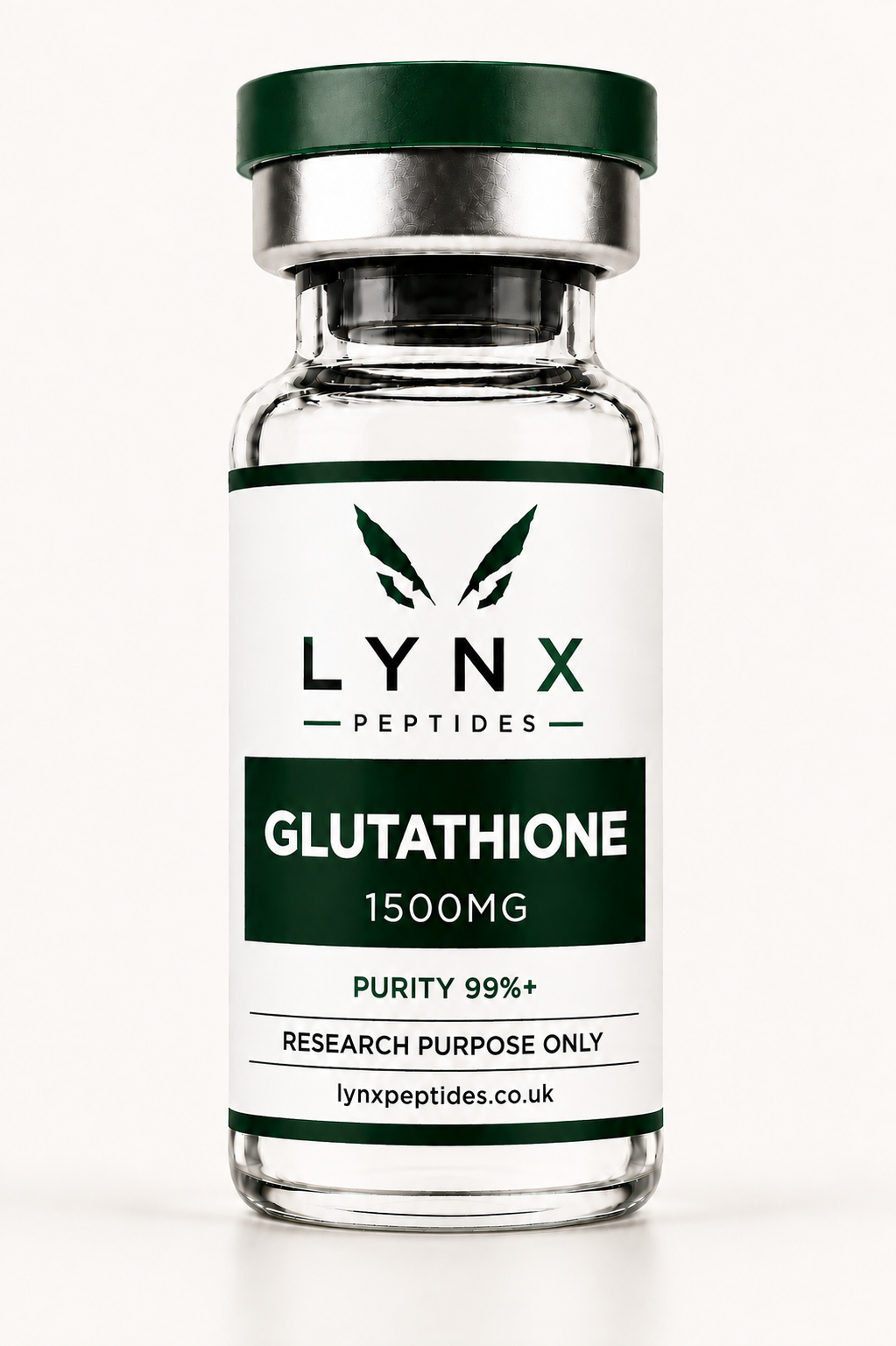
- 1500 mg
- Sequence
- gamma-Glu-Cys-Gly
- Residue count
- 3
- Molecular formula
- C10H17N3O6S
- Molecular weight
- 307.33 g/mol
- CAS number
- 70-18-8
- Chemical class
- Tripeptide
- Classification
- Research compound
- Components
- Glutamate; cysteine; glycine
- Formal name
- L-gamma-glutamyl-L-cysteinyl-glycine
- Available vial sizes
- 1500 mg
Analytical verification
- Lynx report reference
- UKLY-943
- Reported purity
- 99.95%
- Analysis method
- RP-HPLC + ESI-MS
- Identity result
- Confirmed: Glutathione
- Analysis date
- 3 Sept 2026
- Report date
- 3 Sept 2026
Storage & Reconstitution
Store in appropriate cool, dry conditions. Refer to product-specific storage information when published.
Vials are supplied separately from bacteriostatic water and other preparation supplies.
For laboratory preparation, allow the sealed vial to reach room temperature before opening. Wipe the vial stopper and bacteriostatic-water stopper with an alcohol wipe. Add bacteriostatic water slowly down the inside wall of the vial, then swirl gently until dissolved. Do not shake.
- Sample oxidation can change the measured GSH:GSSG balance. Preserve the sample’s redox state using the analytical method’s preparation procedure.
Research literature
- The antioxidant glutathione.Averill-Bates et al. · Vitam Horm · 2023PubMed
- Glutathione synthesis and its role in redox signaling.Zhang et al. · Semin Cell Dev Biol · 2012PubMed
- Determination of glutathione and glutathione disulfide in biological samples: an in-depth review.Monostori et al. · J Chromatogr B · 2009PubMed
Glutathione Price (UK)
Glutathione is a 1500 mg research blend containing Glutamate, cysteine and glycine. The current price is £33.99.
Current availability is shown below. UK orders of £49.99 or more qualify for free standard shipping. Eligible working-day orders placed before 4 PM are dispatched the same day.
| Vial size | Current price | Price / mg | Status |
|---|---|---|---|
| 1500 mg | £33.99 | £0.02/mg | Checking stock |
Common questions about Glutathione
What is glutathione?
Glutathione is a small peptide made from glutamate, cysteine and glycine. Its reduced form, GSH, participates in redox reactions: chemical reactions that move electrons and help cells manage oxidation. The cysteine group is central to that chemistry, which is why research often measures the balance between reduced and oxidised glutathione rather than just the total amount.
What is the difference between reduced and oxidised glutathione?
Reduced glutathione is GSH; oxidised glutathione, GSSG, consists of two glutathione molecules joined by a disulfide bond. Their balance changes during redox reactions. Measuring both gives a laboratory more information about an oxidative-stress experiment than measuring total glutathione alone, because the same overall amount can be distributed differently between the two forms.
Is Lynx glutathione the reduced form?
Yes. The product specification identifies it as reduced glutathione, GSH, rather than oxidised glutathione, GSSG. The distinction matters because the two forms play different parts in redox reactions. A laboratory using GSH can study how it changes during oxidation, while accounting for any conversion that occurs during preparation or measurement.
How does glutathione differ from NAD+?
Both take part in redox biology, but they do different chemical jobs. Glutathione works through its sulfur-containing group and can form GSSG; NAD+ accepts electrons to become NADH and is also used by several enzymes. They are therefore different tools for studying oxidation and metabolism, not interchangeable versions of one cellular antioxidant.
Why can sample handling change a glutathione measurement?
Reduced glutathione can oxidise while a sample is being prepared. If that happens, the measured GSH/GSSG balance includes a change caused by handling, not just the original biological sample. This is why preparation conditions matter: a laboratory needs to distinguish a genuine experimental response from oxidation introduced before the measurement was taken.
What is unusual about glutathione's peptide bond?
The bond between glutamate and cysteine uses glutamate's side-chain carboxyl group, rather than the usual backbone connection. This is why glutathione is described as a gamma-linked tripeptide. The arrangement is part of its chemical identity, while the cysteine sulfur group provides the redox chemistry; those two features explain different aspects of the molecule.
Can I buy Glutathione in the UK for research?
Yes. Lynx lists reduced glutathione in a 1500mg vial for in-vitro research, supplied from the UK. The product listing carries its latest stock status.
What testing is available for Lynx glutathione?
The 1500mg glutathione sample shows 99.95% purity on certificate UKLY-943. The stated method is RP-HPLC + ESI-MS.