
On this page
Do peptides really expire?
Peptide samples can undergo chemical or physical changes with time. Whether a particular sample remains suitable for a laboratory purpose depends on which attributes matter and the limits set for them. “Expired” usually describes a date-based specification or control decision, rather than one chemical event occurring at midnight.
A date should therefore be read with its stated conditions. It may apply to unopened dry material in the original container, not a solution made later or a sample transferred to a different vessel. These are different material histories, even when their sequence names are identical.
Equally, no visible change before a date proves that every relevant attribute is unchanged. A peptide can retain its appearance while its composition or recoverable amount changes. The scientific question is what evidence supports the assigned period, not whether the powder still looks familiar.
Expiry dates and retest dates answer different questions
The pharmaceutical guideline ICH Q1A(R2) distinguishes a shelf life from a retest period. In that framework, shelf life concerns remaining within an approved specification under labelled storage conditions. A retest period identifies when a drug substance needs reassessment before further use. These definitions are useful context, not medicinal approval or a shelf-life claim for Lynx materials.
A retest date is not an automatic extension of an expiry date. Reassessment needs suitable tests, acceptance criteria and a documented decision made by the responsible laboratory or supplier. Passing one selected test cannot silently replace all the requirements attached to a material specification.
Research-supplier labels may use different conventions. Check what the date actually refers to and whether the supporting specification covers the stated material form and container. If the wording or evidence is missing, the correct conclusion is that the dating basis is unestablished, not that the material has a proven unlimited lifetime.
Dry powder and solution are different stability problems
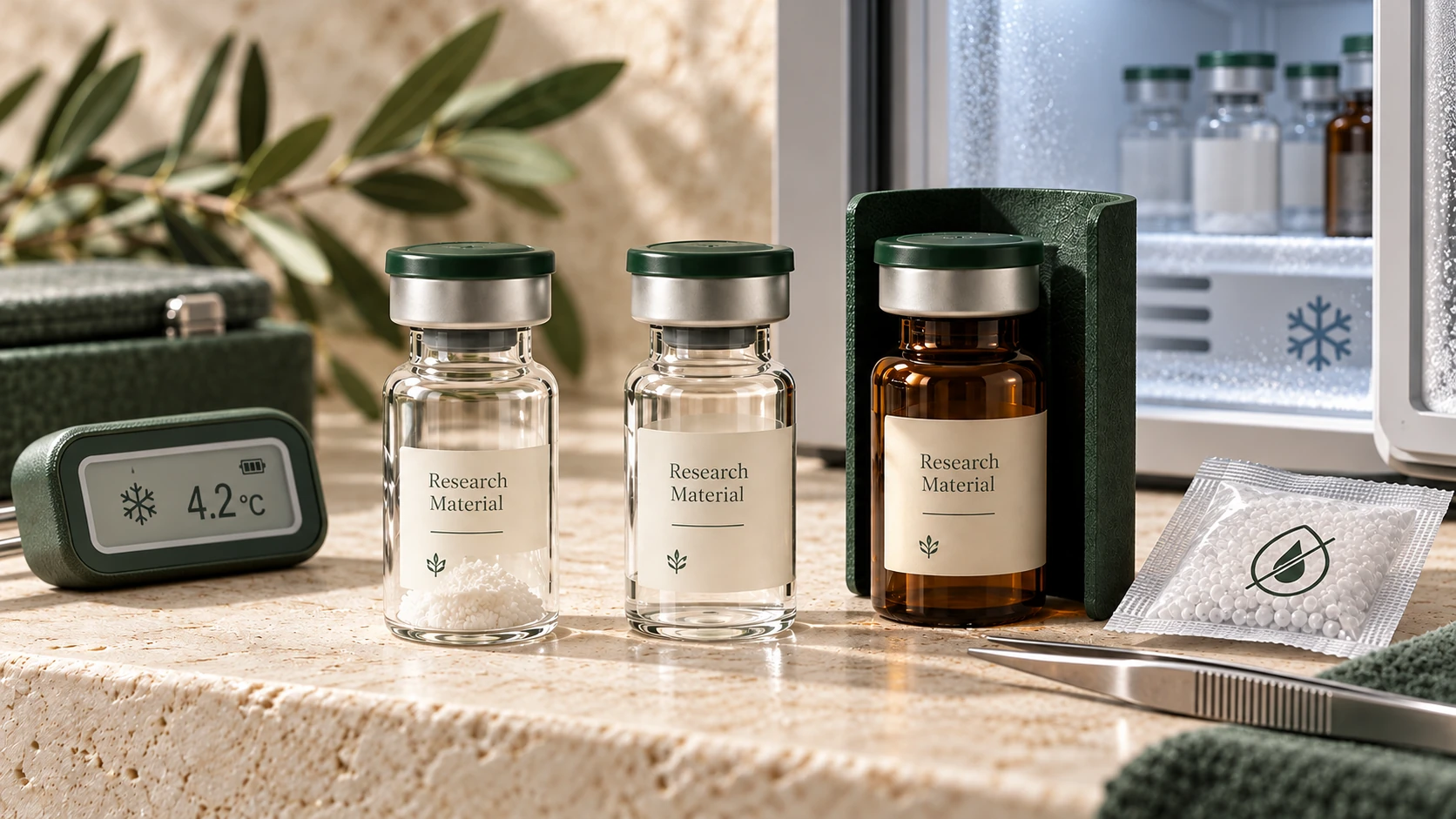
Lyophilisation removes much of the water through a controlled drying process. It can change the environment in which a peptide is stored, but it does not make the molecule immune to change. Residual moisture, formulation components and the effectiveness of the container closure remain relevant to the dry material.
Once dissolved, a peptide encounters a new medium. pH, salts, concentration, dissolved gases and contact with the vessel can affect recovery or chemical change. A dating period established for sealed powder does not establish a period for that solution. Lyophilised Peptides Explained describes what the supplied physical form does and does not mean.
The distinction is about evidence, not a blanket rule that one form always lasts longer. A well-characterised solution and an incompletely characterised powder cannot be ranked from their appearance alone. A useful comparison keeps sequence, formulation, packaging, temperature history and measured endpoints explicit.
Time can affect chemistry, physical state and recovery
Chemical change can include oxidation, deamidation or cleavage, depending on the structure and environment. Such processes alter molecules. Peptide Oxidation and Deamidation explains why the susceptible groups and experimental conditions matter rather than supporting one degradation rate for all peptides.
Physical change includes association into larger species, precipitation and loss onto surfaces. A sample can lose recoverable material without every remaining molecule being chemically altered. Conversely, a chemically modified peptide can remain dissolved. Chemical and physical stability should therefore be assessed as related but separate questions.
For example, Hawe and colleagues investigated oxytocin degradation in specified aqueous formulations under accelerated conditions. They found formulation-dependent chemical changes, including modified and linked species. This illustrates why mechanisms and methods matter. The findings cannot be used to assign an expiry date to another peptide or a different supplier's preparation.
Storage history is part of the sample description
A storage instruction describes an intended condition. An exposure record describes what actually happened. Temperature excursions, repeated opening, moisture exposure, light and transport history may differ between containers nominally stored in the same place. A single current temperature reading does not reconstruct the preceding history.
Freezing also introduces transitions and local changes in the solution environment. Freeze-Thaw Cycles and Peptide Stability separates cycle count from the details of cooling, thawing and formulation. Neither a low storage temperature nor a small number of cycles supplies a universal guarantee.
Records should connect the batch, container, physical form and relevant dates. How to Store Research Peptides explains this documentation approach. Recording uncertainty honestly is more useful than reconstructing an ideal history after a sample has already been moved, opened or left under undocumented conditions.
How laboratories investigate stability over time
A stability study starts by defining the material and what acceptable performance means for the intended purpose. It then measures relevant attributes at planned time points under specified conditions. Without an initial result, later measurements may show a state but cannot establish how much the sample has changed.
Useful comparisons include consistent sampling, appropriate controls and enough independent observations to distinguish a real trend from analytical variation. Measurements should address the suspected failure modes: chemical identity, impurities, content, physical state or other relevant properties. The exact combination depends on the material and laboratory question.
Packaging is part of that study description. Results from one closure, headspace or vessel material may not represent another. A period supported for a defined preparation should remain attached to that preparation, rather than becoming a sequence-wide claim or an assumption that every batch behaves identically.
Stress testing is useful, but not a calendar shortcut
Accelerated studies expose materials to conditions intended to reveal change more quickly. They can help identify pathways and compare formulations. Translating such results into a period under other conditions requires a justified model and supporting observations. A generic conversion between warm storage and cold storage is not sufficient.
An elevated temperature or a different medium can change which process dominates. A fitted model may describe the experiment accurately while failing outside its range. Extrapolation also needs to account for uncertainty rather than reporting a precise date unsupported by the measurements.
Real-time data address the conditions and duration actually observed. A no-change result remains bounded by the tested interval, method sensitivity and acceptance criteria. It does not prove that no change occurred at any scale or that the same result will continue indefinitely. This Guide supplies no universal month count or storage temperature.
A stability result is only as specific as its measurement
An analytical method needs to distinguish relevant changes from the intended peptide. ICH Q2(R2) provides a framework for analytical performance and specificity. It is cited for measurement principles, not as evidence that Lynx has validated a particular stability programme or that research products meet medicinal release standards.
A high HPLC area percentage can coexist with reduced total recovery, unresolved components or changes outside the detector's view. HPLC Peptide Purity Explained covers those limits. Identity evidence and a calibrated content assessment may answer questions that area percentage alone leaves open.
Handling can affect the measurement as well as the stored material. Hoofnagle and colleagues discuss analytical peptide standards and the importance of characterisation, storage and recovery. Their assay context does not establish stability for every research peptide, but it shows why sample preparation should not be treated as invisible to the result.
What a COA can and cannot tell you about shelf life
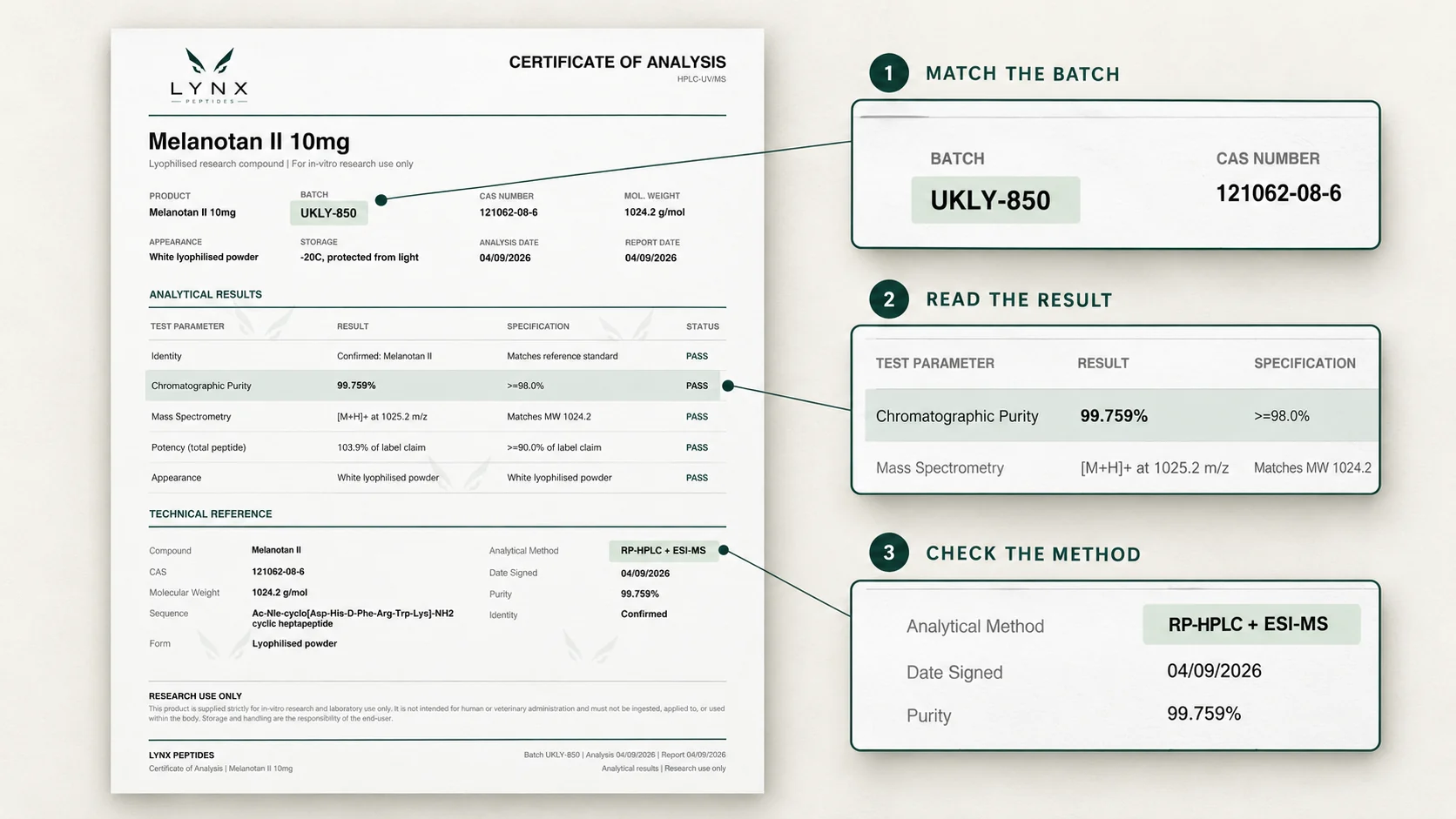
A Certificate of Analysis reports specified results for an identified sample and testing occasion. The report date, analysis date and batch date may differ. None automatically defines an expiry period. A historical result documents what the stated tests found at that time, within their methods and reporting limits.
The COA Guide explains how to match sample identifiers, methods and results. For shelf-life interpretation, also ask whether there are later observations, a stability protocol and a specification covering the actual storage conditions. A single old report cannot provide the missing time series.
Repeated tests should be comparable before their numbers are treated as a trend. Changes in method, sampling fraction or reporting basis can resemble material change or conceal it. Missing evidence does not prove degradation, but it also cannot justify an assurance that the sample is still within all relevant limits.
Keep the conclusion tied to the available evidence
When reviewing a date, identify whether it is an expiry date, a retest date or simply a document date. Then check the material form, storage specification, recorded history and tests supporting the period. If an assumption cannot be verified, state that uncertainty rather than replacing it with a rule borrowed from another peptide.
Appearance can prompt an investigation, but cannot extend a specification. An apparently unchanged sample and a previously high purity result do not establish suitability for every experiment. Decisions about further laboratory use belong within the responsible organisation's material-control procedures and the evidence available to it.
Lynx publishes this Guide as scientific explanation, not a product-specific dating certificate. It does not assign new expiry periods to catalogue materials, authorise use beyond a labelled date or provide human-use preparation advice. Research materials are not supplied for human or veterinary use.
References and evidence scope
- ICH Q1A(R2). Stability Testing of New Drug Substances and Products, 2003. Pharmaceutical stability terminology and study principles. Not a Lynx shelf-life specification or evidence of medicinal approval.
- ICH Q2(R2). Validation of Analytical Procedures, 2023. Analytical specificity, suitable performance and complementary procedures. Not a claim of Lynx validation.
- Hoofnagle et al. Recommendations for the Generation, Quantification, Storage, and Handling of Peptides Used for Mass Spectrometry-Based Assays. Clinical Chemistry, 2016. DOI: 10.1373/clinchem.2015.250563. Analytical peptide standards and handling/recovery considerations. Not universal catalogue stability.
- Hawe et al. Towards heat-stable oxytocin formulations: analysis of degradation kinetics and identification of degradation products. Pharmaceutical Research, 2009. DOI: 10.1007/s11095-009-9878-2. Specified oxytocin solutions under accelerated conditions. Not a shelf-life prediction for another peptide.