What is Semax?
Semax is the seven-residue sequence Met-Glu-His-Phe-Pro-Gly-Pro. The first four residues correspond to ACTH(4–7), with a Pro-Gly-Pro extension; the molecule should therefore be distinguished from the intact ACTH hormone. Its research emphasis is neurobiology, including neurotrophin responses, cellular stress and experimental neurological injury.
Rodent work has measured BDNF protein, BDNF and TrkB gene expression, and activation of the TrkB pathway. The response can differ by brain region, which matters when interpreting an overall claim about neurotrophin signalling. Human reports include neurological comparisons and a small motor-neuron-disease series with null functional and electrophysiological findings despite a subjective quality-of-life change. These different outcomes are more informative than a broad cognitive claim, particularly given the limited independent replication of much of the literature.
Semax Research Areas
BDNF increased in rat basal forebrain after Semax, whereas the cerebellum did not show the same response. Specific, reversible binding was also measured in membrane preparations from the basal forebrain. The regional difference helps connect the peptide with neurotrophin biology without assuming a uniform response throughout the brain.
Dolotov et al. · Journal of neurochemistry · 2006PubMed
Semax increased BDNF protein, BDNF and TrkB transcripts, and TrkB phosphorylation in rat hippocampus. A behavioural task also changed under the experimental conditions. These connected molecular measurements support a neurotrophin research theme, while a rodent learning task remains distinct from a human cognitive outcome.
Dolotov et al. · Brain research · 2006PubMed
Semax did not alter partial denervation or clinical functional estimates in an open-label series of 27 people with motor-neuron disease. Emotional and motivational quality-of-life measures improved temporarily, despite the null functional findings. Without a blinded control group, the subjective change cannot be confidently attributed to the peptide.
Serdiuk et al. · Zh Nevrol Psikhiatr · 2007PubMed
Selected neurological deficits, particularly motor findings, regressed faster in a Semax group than in a conventional-treatment comparison after acute ischaemic stroke. The report compared 30 treated patients with 80 controls receiving intensive care. Without a clearly described randomised, blinded allocation, differences between the groups and their care remain plausible explanations for part of the result.
Gusev et al. · Zh Nevrol Psikhiatr · 1997PubMed
Molecular profile
- Compound
- Semax
- Amount
- 10 mg
- Sequence
- MEHFPGP
- Residue count
- 7
- Molecular formula
- C37H51N9O10S
- Molecular weight
- 813.9 g/mol
- CAS number
- 80714-61-0
- Chemical class
- Synthetic ACTH-derived heptapeptide
- Classification
- Neuropeptide
- Parent molecule
- Semax
- Available vial sizes
- 10 mg
Analytical verification
- Lynx report reference
- UKLY-448
- Reported purity
- 99.94%
- Analysis method
- RP-HPLC + ESI-MS
- Identity result
- Confirmed: Semax
- Analysis date
- 4 Sept 2026
- Report date
- 4 Sept 2026
Storage & Reconstitution
Store in appropriate cool, dry conditions. Refer to product-specific storage information when published.
Vials are supplied separately from bacteriostatic water and other preparation supplies.
For laboratory handling context, read Research peptide storage and stability. Product-specific information and the laboratory method take precedence.
For laboratory preparation, allow the sealed vial to reach room temperature before opening. Wipe the vial stopper and bacteriostatic-water stopper with an alcohol wipe. Add bacteriostatic water slowly down the inside wall of the vial, then swirl gently until dissolved. Do not shake.
Research literature
- [Effectiveness of semax in acute period of hemispheric ischemic stroke (a clinical and electrophysiological study)].Gusev et al. · Zh Nevrol Psikhiatr · 1997PubMed
- [The study of chronic partial denervation and quality of life in patients with motor neuron disease treated with semax].Serdiuk et al. · Zh Nevrol Psikhiatr · 2007PubMed
- Semax, an analogue of adrenocorticotropin (4-10), binds specifically and increases levels of brain-derived neurotrophic factor protein in rat basal forebrain.Dolotov et al. · Journal of neurochemistry · 2006PubMed
- Semax, an analog of ACTH(4-10) with cognitive effects, regulates BDNF and trkB expression in the rat hippocampus.Dolotov et al. · Brain research · 2006PubMed
Semax Price (UK)
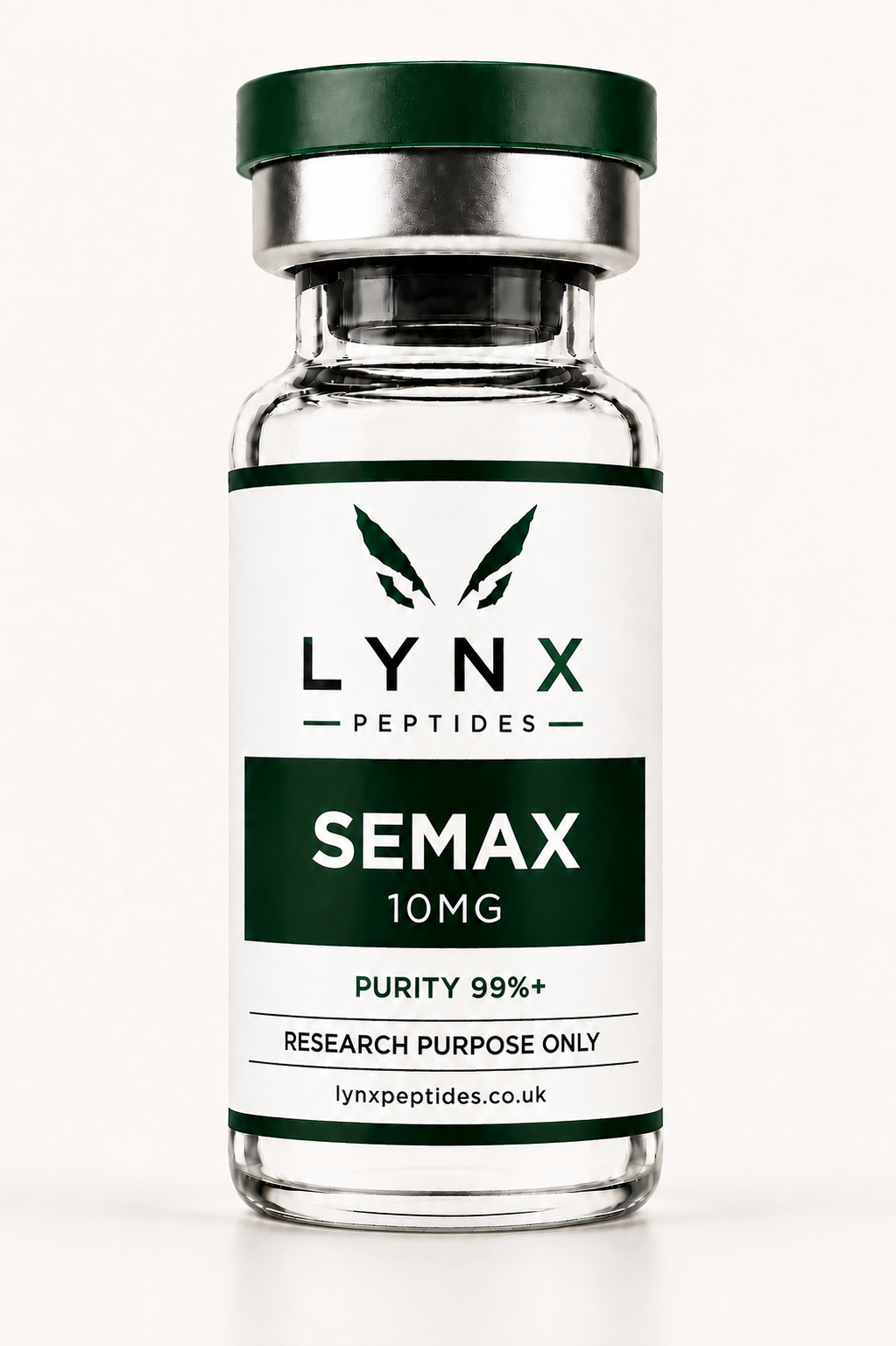
Semax is supplied in 10 mg vials for laboratory research. The current price is £24.99.
Current availability is shown below. UK orders of £49.99 or more qualify for free standard shipping. Eligible working-day orders placed before 4 PM are dispatched the same day.
| Vial size | Current price | Price / mg | Status |
|---|---|---|---|
| 10 mg | £24.99 | £2.50/mg | Checking stock |
Common questions about Semax
What is Semax?
Semax is a synthetic seven-amino-acid peptide with an ACTH-derived starting sequence and a Pro-Gly-Pro tail. Its research includes neurotrophin signalling and gene-expression responses in experimental brain models. The combined sequence is the molecule being studied, rather than the complete ACTH hormone or the three-amino-acid tail on its own.
How is Semax related to ACTH?
Semax's first four amino acids match ACTH(4–7), followed by a Pro-Gly-Pro extension. ACTH is a larger hormone, so this relationship describes the fragment used in Semax's design rather than making Semax the whole hormone. Researchers examine the modified peptide's responses directly, instead of assuming it retains every action associated with full-length ACTH.
How does Semax differ from Selank?
Semax begins with an ACTH-derived sequence; Selank begins with a tuftsin-derived one. Their shared Pro-Gly-Pro tail does not make the full molecules identical. Semax studies include BDNF and neurotrophin signalling, while Selank research includes neurotransmission-related gene expression, giving laboratories different structural starting points and different measurements to investigate.
Why is BDNF mentioned in Semax research?
BDNF is a protein involved in neuronal signalling, and TrkB is a receptor associated with that system. Rat experiments have measured changes in BDNF expression, protein levels and TrkB-related activity after Semax exposure. Those measurements help explore a cellular mechanism in a particular brain region, rather than directly measuring a general improvement in human cognition.
Is Semax the same as its Pro-Gly-Pro tail?
No. Pro-Gly-Pro makes up only the final three amino acids; Semax also contains the ACTH-derived starting portion. Joining them creates a different molecule from the tail alone. Comparing the complete peptide with a fragment can help a laboratory examine which structural features contribute to a response, rather than attributing every finding to the shared tail.
What does ACTH(4–7) mean in Semax's description?
The numbers identify positions 4 through 7 in the larger ACTH peptide: Met-Glu-His-Phe. Semax joins that short segment to Pro-Gly-Pro. The notation explains where part of the design comes from, not that Semax contains the whole ACTH hormone; experiments with the modified fragment ask a different question from experiments with full-length ACTH.
Can I buy Semax in the UK for research?
Yes. Semax is listed as a 10mg peptide for UK laboratory research, separate from Selank. The ordering area shows whether it is currently in stock.
Is Lynx Semax independently tested?
The 10mg Semax report uses RP-HPLC + ESI-MS and gives purity 99.94%. Its reference is UKLY-448.