What is Selank?
Selank combines the four-residue tuftsin sequence Thr-Lys-Pro-Arg with a terminal Pro-Gly-Pro extension. This gives it seven residues and a different starting structure from the ACTH-derived peptide Semax, despite their shared tail. Its neurobiological literature includes enzyme activity, neurotransmission-related gene expression and behavioural measurements.
Rat frontal-cortex experiments found changes in genes associated with GABAergic and other signalling systems. Separate biochemical work recorded inhibition of enkephalin breakdown. These observations suggest several possible contributions to its biology, rather than identifying Selank as a selective GABA-receptor agonist. Small human comparisons add anxiety-scale findings, but the limited trial detail and geographically concentrated literature make replication particularly important. Keeping enzyme, transcriptional and clinical observations separate gives a clearer account of what has actually been measured.
Selank Research Areas
Selank changed the expression of multiple neurotransmission-related genes in rat frontal cortex. Some early changes correlated with those produced by GABA, but the pattern also involved other signalling systems. A transcriptional resemblance supports investigation of GABA-associated biology; it is not a direct demonstration of selective GABA-receptor agonism.
Volkova et al. · Frontiers in pharmacology · 2016PubMed
Anxiety-score changes were reported as similar with Selank and medazepam in a comparison involving 62 patients, with additional antiasthenic observations in the Selank group. An enkephalin-related blood measurement also changed. The small clinical comparison does not provide clearly described masking or randomisation, limiting confidence in a treatment-specific interpretation.
Zozulia et al. · Zh Nevrol Psikhiatr · 2008PubMed
A comparison involving 60 patients reported anxiety-scale and quality-of-life improvements with Selank, including persistence of the reported anxiety effect for a week. Limited allocation and outcome detail makes the size and reliability of the treatment-specific effect difficult to judge. The report offers early clinical context rather than a strong basis for a general claim.
Medvedev et al. · Zh Nevrol Psikhiatr · 2014PubMed
Molecular profile
- Compound
- Selank
- Amount
- 10 mg
- Sequence
- Thr-Lys-
Pro-Arg- Pro-Gly-Pro - Residue count
- 7
- Molecular formula
- C33H57N11O9
- Molecular weight
- 751.9 g/mol
- CAS number
- 129954-34-3
- Chemical class
- Synthetic heptapeptide and tuftsin analogue
- Classification
- Neuropeptide
- Parent molecule
- Selank
- Available vial sizes
- 10 mg
Analytical verification
- Lynx report reference
- UKLY-318
- Reported purity
- 99.63%
- Analysis method
- RP-HPLC + ESI-MS
- Identity result
- Confirmed: Selank
- Analysis date
- 4 Sept 2026
- Report date
- 4 Sept 2026
Storage & Reconstitution
Store in appropriate cool, dry conditions. Refer to product-specific storage information when published.
Vials are supplied separately from bacteriostatic water and other preparation supplies.
For laboratory handling context, read Research peptide storage and stability. Product-specific information and the laboratory method take precedence.
For laboratory preparation, allow the sealed vial to reach room temperature before opening. Wipe the vial stopper and bacteriostatic-water stopper with an alcohol wipe. Add bacteriostatic water slowly down the inside wall of the vial, then swirl gently until dissolved. Do not shake.
Research literature
- [Efficacy and possible mechanisms of action of a new peptide anxiolytic selank in the therapy of generalized anxiety disorders and neurasthenia].Zozulia et al. · Zh Nevrol Psikhiatr · 2008PubMed
- [A comparison of the anxiolytic effect and tolerability of selank and phenazepam in the treatment of anxiety disorders].Medvedev et al. · Zh Nevrol Psikhiatr · 2014PubMed
- Selank Administration Affects the Expression of Some Genes Involved in GABAergic Neurotransmission.Volkova et al. · Frontiers in pharmacology · 2016PubMed
Selank Price (UK)
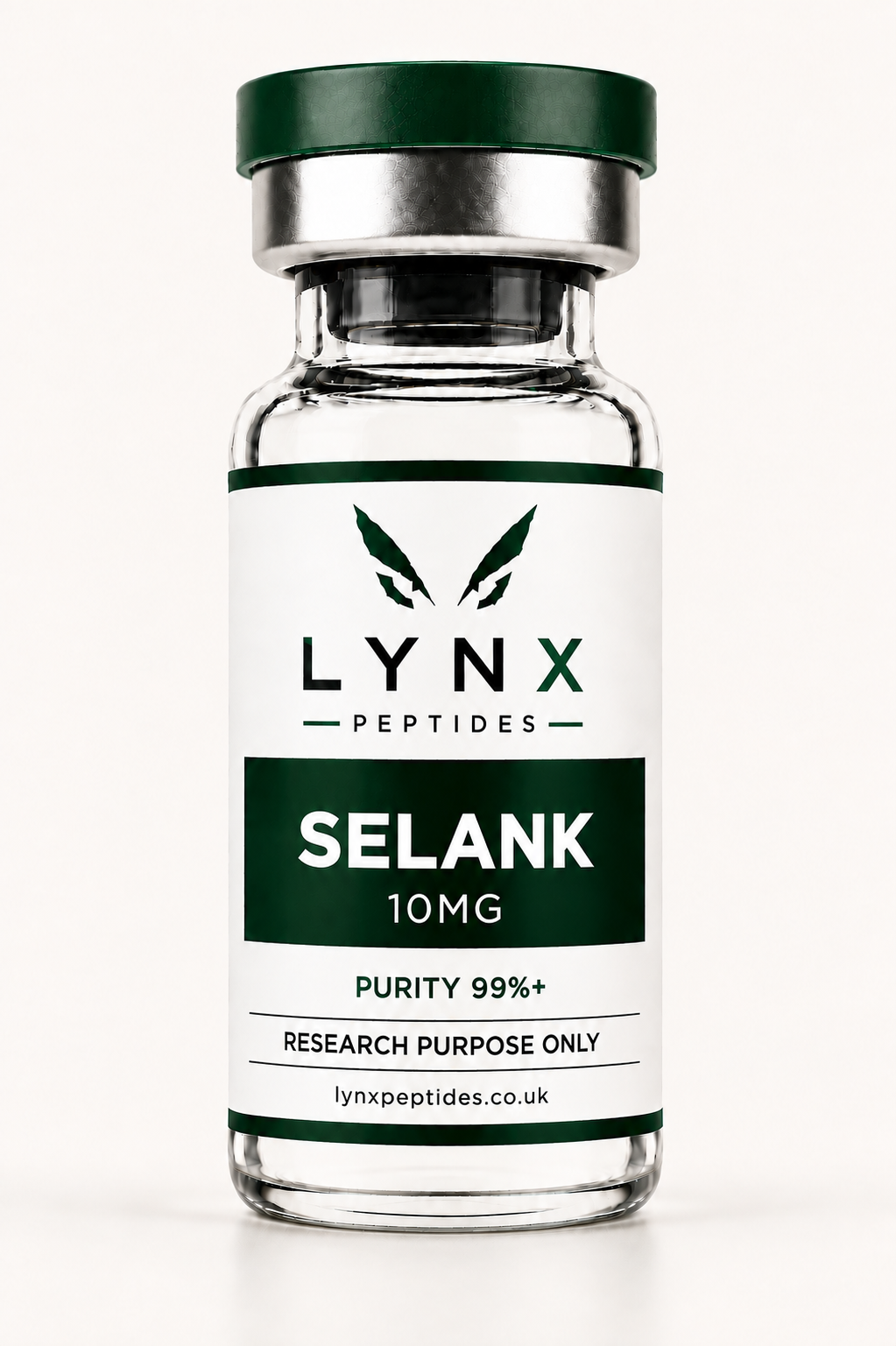
Selank is supplied in 10 mg vials for laboratory research. The current price is £24.99.
Current availability is shown below. UK orders of £49.99 or more qualify for free standard shipping. Eligible working-day orders placed before 4 PM are dispatched the same day.
| Vial size | Current price | Price / mg | Status |
|---|---|---|---|
| 10 mg | £24.99 | £2.50/mg | Checking stock |
Common questions about Selank
What is Selank?
Selank is a synthetic seven-amino-acid peptide derived from tuftsin, with an added Pro-Gly-Pro sequence. Its research includes neuropeptide signalling and changes in genes involved in neurotransmission. That interest concerns measurable responses in experimental models, rather than making Selank another name for a neurotransmitter or assuming that it directly activates every receptor associated with those genes.
How is Selank related to tuftsin?
Selank starts with tuftsin's Thr-Lys-Pro-Arg sequence and adds Pro-Gly-Pro, producing a seven-amino-acid peptide. The extension makes it a distinct molecule rather than tuftsin in a larger vial. This relationship explains its structural origin, while Selank's own experiments are needed to describe how the extended peptide behaves in a particular cell or signalling model.
How does Selank differ from Semax?
Selank has a tuftsin-derived starting sequence; Semax has an ACTH-derived one. Both contain seven amino acids and a Pro-Gly-Pro tail, but the rest of their structures differ. Selank research includes neurotransmission-related gene responses, while Semax studies include neurotrophin signalling, so the shared tail is not enough to treat the two peptides as interchangeable.
What does GABA-related Selank research measure?
Some Selank studies measure changes in genes involved in GABA-related neurotransmission. GABA is a neurotransmitter, while gene expression measures how actively cells use particular genes. Comparing those responses helps explore a possible connection with the GABA system, but it is a different experiment from showing that Selank directly binds to or activates a GABA receptor.
Is Selank a mixture of several peptides?
No. Selank is one defined seven-amino-acid molecule. The tuftsin-derived portion and Pro-Gly-Pro tail are chemically joined in its sequence, not supplied as separate ingredients. Studying the complete peptide therefore asks a different question from adding tuftsin or the tail alone, even though those components help explain how the molecule was designed.
What is tuftsin, the peptide Selank is based on?
Tuftsin is a four-amino-acid peptide associated with immune-cell activity. Selank extends that sequence with Pro-Gly-Pro, making a different seven-amino-acid molecule. Knowing the starting sequence helps explain its design, but Selank's neurobiological experiments examine the extended peptide itself, rather than assuming that it reproduces every response reported for tuftsin.
Can I buy Selank in the UK for research?
Yes. Lynx includes 10mg Selank in its UK research range for laboratory use. Its individual product page shows current stock.
What testing supports the Selank batch?
UKLY-318 is Selank's 10mg certificate, with a purity result of 99.63% from RP-HPLC + ESI-MS testing.