What is Pinealon?
Pinealon is the synthetic tripeptide Glu-Asp-Arg, often abbreviated EDR. Its three-residue structure has been explored in cellular stress and neuronal models, including work on proposed interactions with nucleic acids. The small sequence is useful for asking focused questions about uptake and cellular responses, but its simplicity does not by itself establish a gene-regulatory mechanism.
In neurons generated from older donors’ fibroblasts, EDR reduced oxidative DNA damage and was among the peptides that increased dendritic branching. Other ageing-related measurements stayed unchanged. That mixed pattern gives a more useful account than describing a general reversal of cellular ageing. The research programme is relatively narrow, and proposed molecular explanations need to be weighed against direct measurements and independent replication. A limited human report involving Pinealon and another peptide offers much weaker context than the better-characterised cell experiment.
Pinealon Research Areas
EDR reduced oxidative DNA damage in induced neurons made from older donors’ fibroblasts. EDR and the other tested peptides also increased dendritic branching and length, while the tripeptides left mitochondrial and lysosomal activity and p16 unchanged. The mixed response is more specific than a general reversal of neuronal ageing and belongs to an in-vitro model.
Kraskovskaya et al. · Int J Mol Sci · 2024PubMed
Fluorescence-labelled Pinealon and other short peptides entered HeLa cells and produced nuclear signals. Separate fluorescence experiments suggested sequence-dependent interactions with nucleic-acid preparations. Labelling and the assay system are important context: these observations motivate mechanistic work but do not settle how unlabelled EDR regulates genes in neurons.
Fedoreyeva et al. · Biochemistry. Biokhimiia · 2011PubMed
A small report involving Pinealon and Vesugen described changes in cellular and metabolic ageing-related measures, alongside pro-oxidant activity and lower circulating CD34-positive markers. Inconsistent participant counts and sparse methods make interpretation uncertain. Neither a favourable “biological age” conclusion nor a general antioxidant claim is justified by this report alone.
Meshchaninov et al. · Adv Gerontol · 2015PubMed
Molecular profile
- Compound
- Pinealon
- Amount
- 10 mg
- Sequence
- Glu-Asp-Arg (EDR)
- Residue count
- 3
- Molecular formula
- C15H26N6O8
- Molecular weight
- 418.40 g/mol
- CAS number
- 175175-23-2
- Chemical class
- Synthetic short peptide
- Classification
- Neuropeptide
- Parent molecule
- Pinealon
- Available vial sizes
- 10 mg
Analytical verification
- Lynx report reference
- UKLY-138
- Reported purity
- 98.8%
- Analysis method
- RP-HPLC (UV)
- Identity result
- Confirmed: Pinealon
- Analysis date
- 27 Jul 2026
- Report date
- 27 Jul 2026
Storage & Reconstitution
Store in appropriate cool, dry conditions. Refer to product-specific storage information when published.
Vials are supplied separately from bacteriostatic water and other preparation supplies.
For laboratory handling context, read Research peptide storage and stability. Product-specific information and the laboratory method take precedence.
For laboratory preparation, allow the sealed vial to reach room temperature before opening. Wipe the vial stopper and bacteriostatic-water stopper with an alcohol wipe. Add bacteriostatic water slowly down the inside wall of the vial, then swirl gently until dissolved. Do not shake.
Research literature
- [EFFECT OF SYNTHETIC PEPTIDES ON AGING OF PATIENTS WITH CHRONIC POLYMORBIDITY AND ORGANIC BRAIN SYNDROME OF THE CENTRAL NERVOUS SYSTEM IN REMISSION].Meshchaninov et al. · Adv Gerontol · 2015PubMed
- Short Peptides Protect Fibroblast-Derived Induced Neurons from Age-Related Changes.Kraskovskaya et al. · Int J Mol Sci · 2024PubMed
- Penetration of short fluorescence-labeled peptides into the nucleus in HeLa cells and in vitro specific interaction of the peptides with deoxyribooligonucleotides and DNA.Fedoreyeva et al. · Biochemistry. Biokhimiia · 2011PubMed
Pinealon Price (UK)
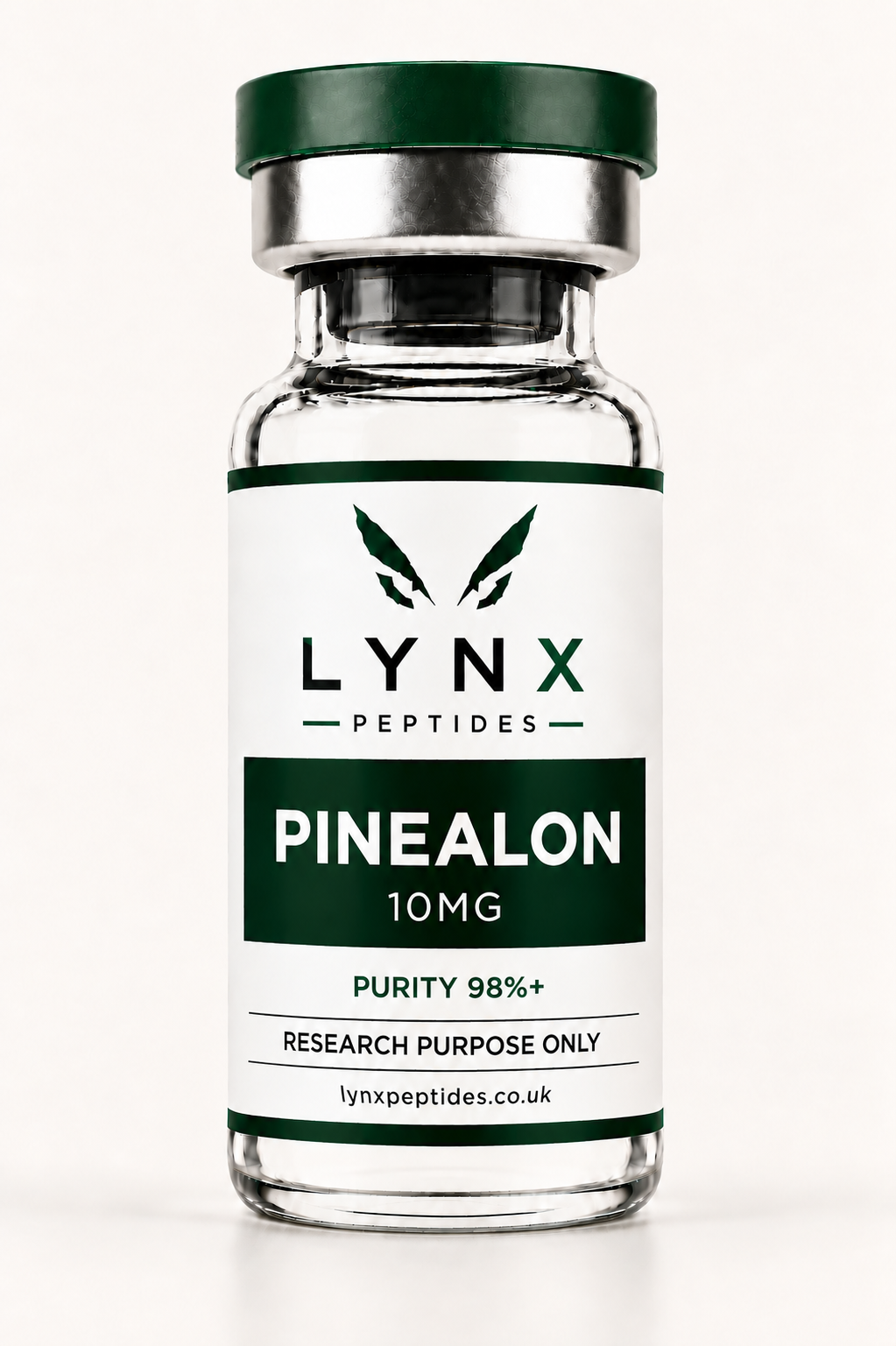
Pinealon is supplied in 10 mg vials for laboratory research. The current price is £29.99.
Current availability is shown below. UK orders of £49.99 or more qualify for free standard shipping. Eligible working-day orders placed before 4 PM are dispatched the same day.
| Vial size | Current price | Price / mg | Status |
|---|---|---|---|
| 10 mg | £29.99 | £3.00/mg | Checking stock |
Common questions about Pinealon
What is Pinealon?
Pinealon is a synthetic three-amino-acid peptide with the sequence Glu-Asp-Arg, abbreviated EDR. It is studied in cellular-stress and neuronal models. Its short, defined sequence gives laboratories a specific molecule to examine when measuring cell shape or stress responses, rather than a mixture of peptides or the broader activity of a parent hormone.
What does the EDR sequence mean?
EDR is the one-letter shorthand for Pinealon's three amino acids: glutamate, aspartate and arginine. Their order defines the peptide, not extra ingredients or a different strength. A short name can hide that specificity, so checking the sequence helps ensure that an experiment uses Pinealon rather than another three-amino-acid compound.
How does Pinealon differ from Semax and Selank?
Pinealon contains three amino acids, while Semax and Selank each contain seven and have ACTH-derived or tuftsin-derived structures. Their research also asks different questions: Pinealon work includes cellular stress and neuronal models, while Semax and Selank studies examine neurotrophin or neurotransmission-related responses. A shared neuropeptide category does not make their molecules or findings interchangeable.
What kinds of neuronal models have used Pinealon?
Pinealon studies include cultured cells and neurons made from fibroblasts. These systems let researchers examine changes in cell shape and responses to stress under controlled conditions. They are useful for studying cellular processes, but a measurement in a dish is different from measuring memory or cognition in a person.
Why is Pinealon described as a short peptide?
Pinealon has only three amino acids, making it a tripeptide rather than a longer hormone-like chain. That gives it a simple, defined structure for cellular experiments. Small size does not by itself establish entry into a cell or its nucleus; those steps are measured separately from any change in cell shape, stress response or gene activity.
Is EDR a mixture of three free amino acids?
No. Pinealon is a peptide in which glutamate, aspartate and arginine are joined in a defined order. Supplying the three amino acids separately would give a different chemical preparation. The EDR sequence identifies the complete molecule used in the experiments, so its findings cannot simply be attributed to a loose mixture of its ingredients.
Can I buy Pinealon in the UK for research?
Yes. The 10mg Pinealon vial is supplied by Lynx for laboratory research with UK fulfilment. This page gives its live stock information.
Is the Pinealon batch independently tested?
Pinealon's 10mg report is UKLY-138, showing purity 98.8% by RP-HPLC (UV).