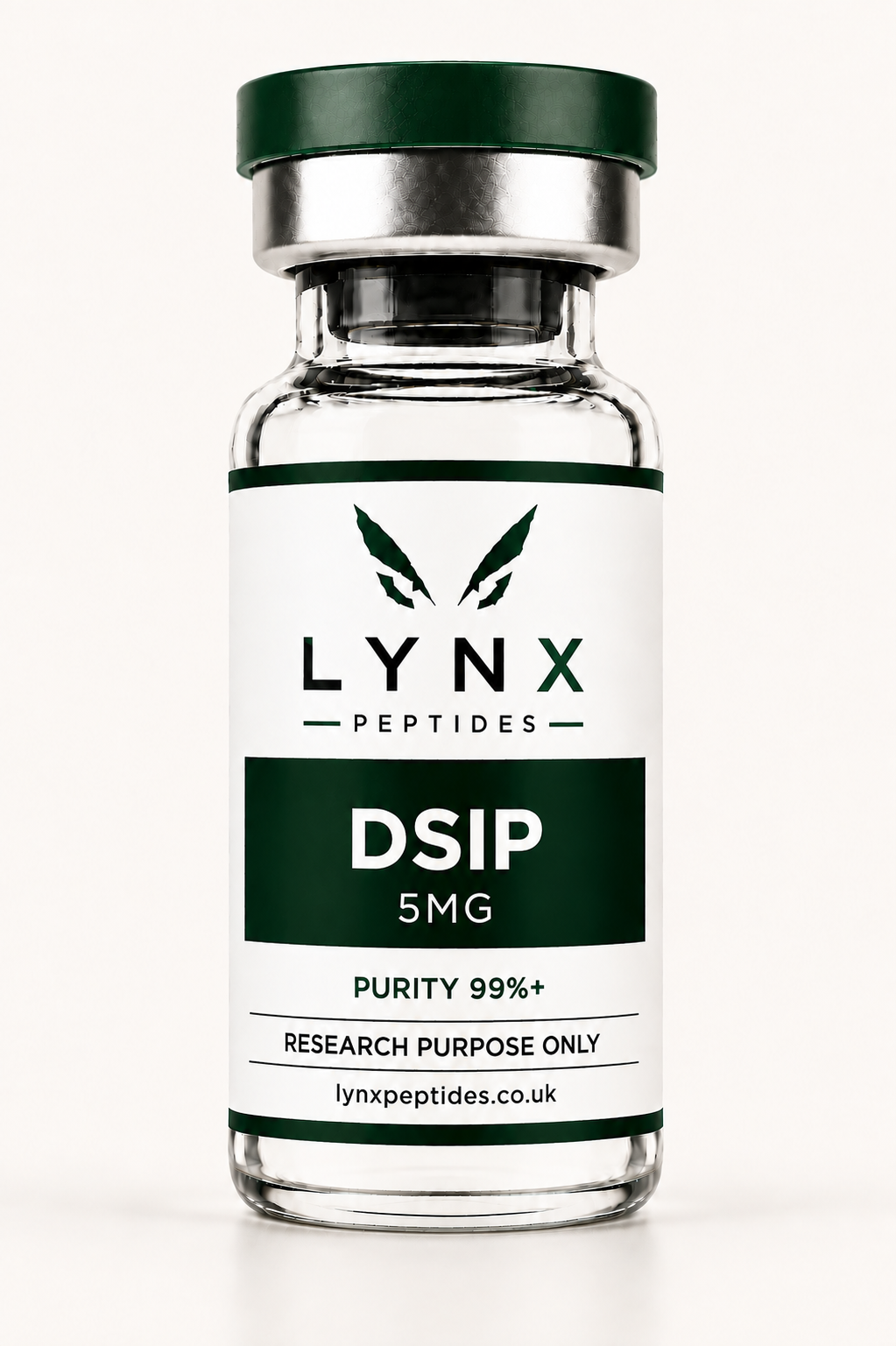
What is DSIP?
DSIP takes its name from early experiments linking a nine-residue peptide with delta-wave EEG activity. The synthetic sequence is Trp-Ala-Gly-Gly-Asp-Ala-Ser-Gly-Glu. Although the chemical structure is well defined, its proposed role as a naturally occurring sleep-regulating signal remains much less settled: a dedicated receptor and an established precursor pathway have not resolved that question.
Its literature is particularly useful for seeing how experimental conditions change an apparent response. Some early animal experiments recorded more slow-wave sleep; another rat experiment found no sleep increase and later wakefulness. A small human crossover experiment adds short-term sleep observations, rather than a robust clinical evidence base. DSIP is therefore better understood as a tool for investigating sleep physiology and disputed neuropeptide biology than as a compound with one proven, predictable sleep mechanism.
DSIP Research Areas
More sleep was recorded shortly after DSIP than after placebo in a double-blind crossover experiment involving six healthy volunteers. Subsequent night recordings also showed changes in sleep onset and efficiency without a classic sedation pattern. The very small sample and short observation period make this early human physiology context rather than reliable evidence for treating sleep disorders.
Schneider-Helmert et al. · Int J Clin Pharmacol Ther Toxicol · 1981PubMed
Slow-wave sleep and total sleep increased by about 20% after DSIP in one rat experiment, whereas the vehicle group showed no comparable baseline change. The peptide was delivered directly into the brain. This is a specific experimental response rather than a consistent result across all DSIP sleep models.
Ursin et al. · Neurosci Lett · 1983PubMed
DSIP did not increase sleep when given at the start of the dark period in rats. Wakefulness increased later in the recording, while brain temperature was unchanged. The contrast with earlier sleep-promoting observations makes timing and experimental conditions central to interpreting this literature.
Obál et al. · Pharmacol Biochem Behav · 1985PubMed
Molecular profile
- Compound
- DSIP
- Amount
- 5 mg
- Sequence
- Trp-Ala-
Gly-Gly- Asp-Ala- Ser-Gly-Glu - Residue count
- 9
- Molecular formula
- C35H48N10O15
- Molecular weight
- 848.8 g/mol
- CAS number
- 62568-57-4
- Chemical class
- Synthetic nonapeptide
- Full compound name
- Delta sleep-inducing peptide
- Classification
- Neuropeptide
- Parent molecule
- Delta sleep-inducing peptide
- Available vial sizes
- 5 mg
Analytical verification
- Lynx report reference
- UKLY-832
- Reported purity
- 99.07%
- Analysis method
- RP-HPLC + ESI-MS
- Identity result
- Confirmed - DSIP
- Analysis date
- 19 Jun 2026
- Report date
- 22 Jun 2026
Storage & Reconstitution
Store in appropriate cool, dry conditions. Refer to product-specific storage information when published.
Vials are supplied separately from bacteriostatic water and other preparation supplies.
For laboratory handling context, read Research peptide storage and stability. Product-specific information and the laboratory method take precedence.
For laboratory preparation, allow the sealed vial to reach room temperature before opening. Wipe the vial stopper and bacteriostatic-water stopper with an alcohol wipe. Add bacteriostatic water slowly down the inside wall of the vial, then swirl gently until dissolved. Do not shake.
Research literature
- Acute and delayed effects of DSIP (delta sleep-inducing peptide) on human sleep behavior.Schneider-Helmert et al. · Int J Clin Pharmacol Ther Toxicol · 1981PubMed
- Synthetic delta-sleep-inducing peptide improves sleep in insomniacs.Schneider-Helmert et al. · Lancet · 1981PubMed
- Increased sleep following intracerebroventricular injection of the delta sleep-inducing peptide in rats.Ursin et al. · Neurosci Lett · 1983PubMed
- Effects of intracerebroventricular injection of delta sleep-inducing peptide (DSIP) and an analogue on sleep and brain temperature in rats at night.Obál et al. · Pharmacol Biochem Behav · 1985PubMed
DSIP Price (UK)
DSIP is supplied in 5 mg vials for laboratory research. The current price is £18.99.
Current availability is shown below. UK orders of £49.99 or more qualify for free standard shipping. Eligible working-day orders placed before 4 PM are dispatched the same day.
| Vial size | Current price | Price / mg | Status |
|---|---|---|---|
| 5 mg | £18.99 | £3.80/mg | Checking stock |
Common questions about DSIP
What is DSIP?
DSIP stands for delta sleep-inducing peptide, a synthetic peptide containing nine amino acids. Its name comes from early sleep and brain-wave experiments, rather than a guaranteed effect. The interesting research question is how that defined peptide relates to recorded sleep patterns and electrical activity, which are measurable but different aspects of a sleep experiment.
What sequence does DSIP contain?
DSIP's sequence is Trp-Ala-Gly-Gly-Asp-Ala-Ser-Gly-Glu. Those nine amino acids, in that order, define the peptide; 'nonapeptide' simply means a peptide with nine residues. A defined sequence lets laboratories compare the same molecule across experiments, even when the biological role or receptor responsible for a response is still being investigated.
Why does DSIP have ‘delta’ in its name?
Delta refers to slow electrical activity recorded in the brain using EEG. Early DSIP experiments examined that activity alongside sleep-related observations. The distinction is useful because a change in brain-wave activity is not the same measurement as total time asleep; the name alone does not explain which part of an experiment changed.
Is DSIP a hormone with a clearly identified receptor?
DSIP does not have a firmly established natural signalling system with a clearly identified receptor and precursor pathway. Its synthetic sequence is defined, but that is different from knowing how it functions naturally. This makes sleep-pattern and brain-wave findings interesting to examine without assuming they have the same mechanistic explanation as a well-characterised hormone.
How does DSIP differ from Semax or Selank?
DSIP is a nine-amino-acid peptide with a research history centred on sleep-related and EEG measurements. Semax and Selank are seven-amino-acid peptides derived from different parent sequences, with research into neurotrophin or neurotransmission-related responses. Sharing a broad neuropeptide category does not give them the same structure, pathway or experimental purpose.
Why is DSIP described as a neuropeptide?
The term reflects its research connection with the nervous system, including sleep observations and electrical activity in the brain. It does not mean that every aspect of its natural signalling role is established. DSIP's nine-amino-acid sequence gives experiments a defined molecule, while its relationship with sleep patterns remains a separate biological question.
Can I buy DSIP in the UK for research?
Yes. DSIP is available through the Lynx UK research catalogue as a 5mg laboratory peptide. The stock indicator shows its current availability.
Is the DSIP batch independently tested?
UKLY-832 reports purity 99.07% for DSIP using RP-HPLC + ESI-MS. It is the report linked to the 5mg vial.