On this page
First define what “CJC-1295 + ipamorelin” means
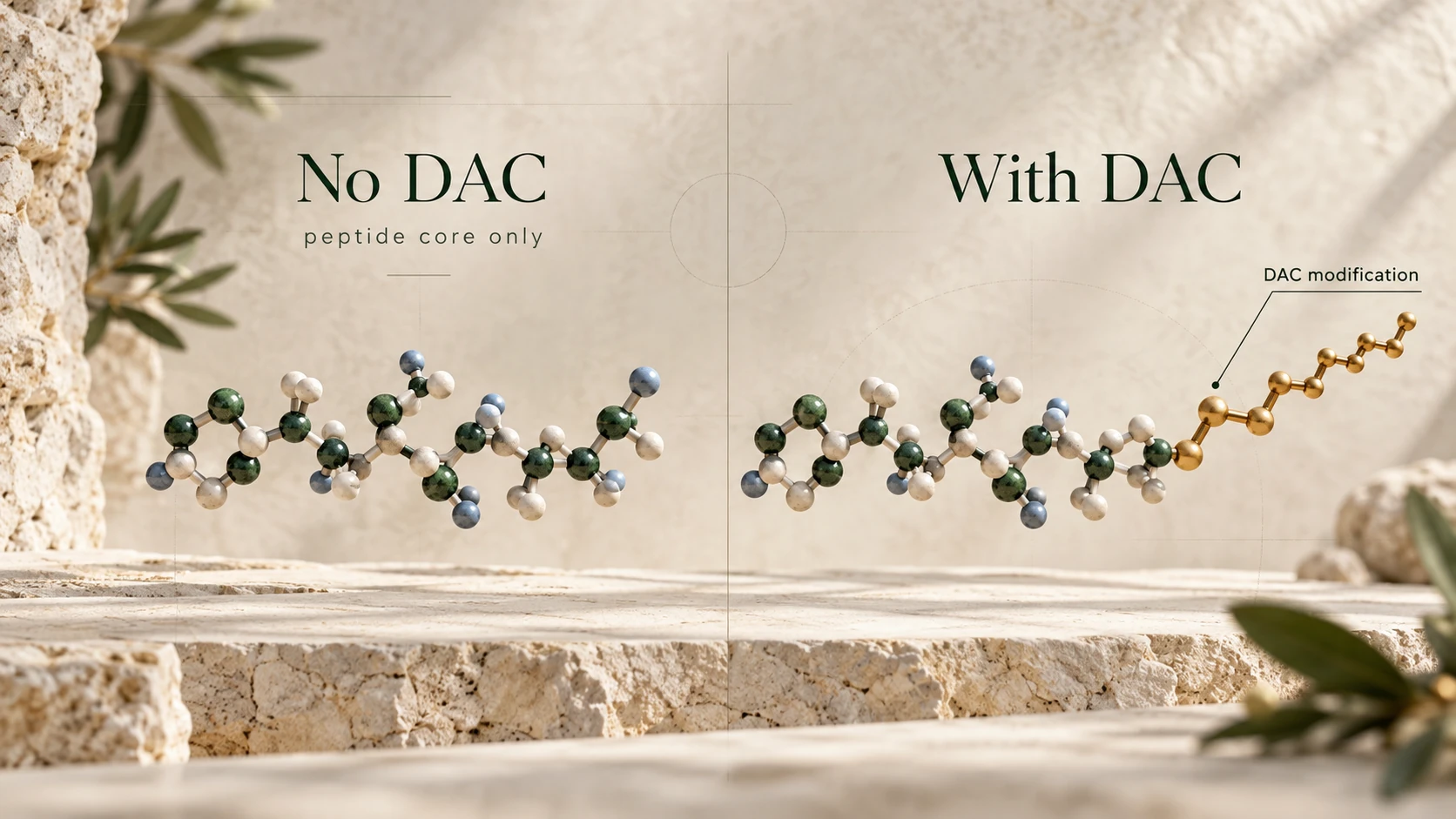
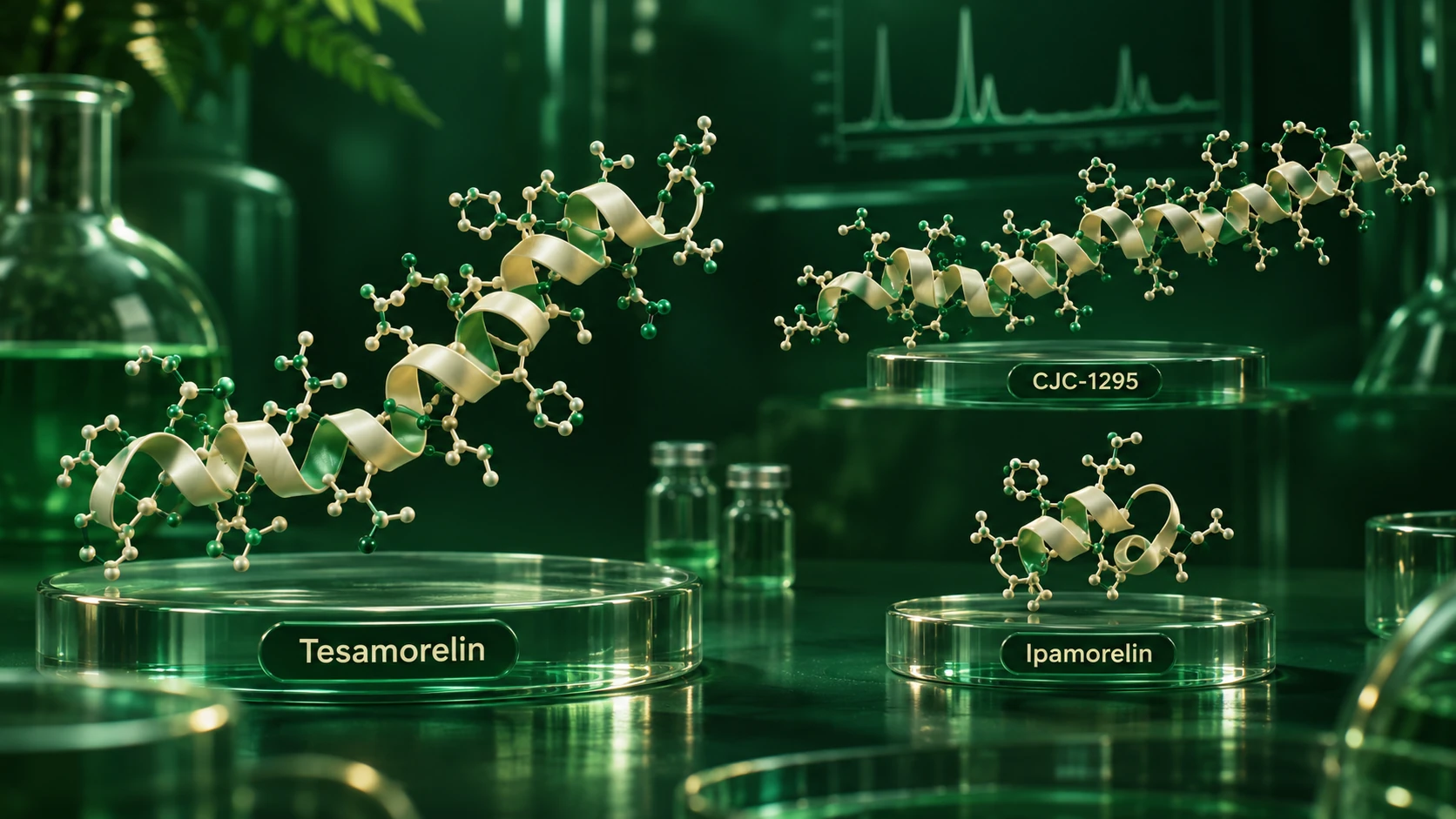
Tesamorelin names one synthetic GHRH analogue. “CJC-1295 + ipamorelin” names two proposed components, and its first component is often described inconsistently. A label may refer to albumin-binding CJC-1295 with DAC or to a shorter-acting modified GRF(1–29) commonly sold under “no DAC” terminology.
For the catalogue descriptions, see tesamorelin, CJC-1295 with DAC, CJC-1295 without DAC and the CJC-1295 and ipamorelin blend. The blend listing describes the supplied research material.
Those descriptions cannot be exchanged when interpreting a paper. The 2006 CJC-1295 human trials studied a long-acting analogue with the albumin-binding design. They did not test every material later marketed using the CJC-1295 name.
Before comparing biological claims, establish the sequence, terminal groups and whether the DAC modification is present. The existing DAC and no-DAC comparison explains the naming problem in more detail. A blend name alone leaves too much of the molecular question open.
GHRH analogues and ghrelin-receptor agonism
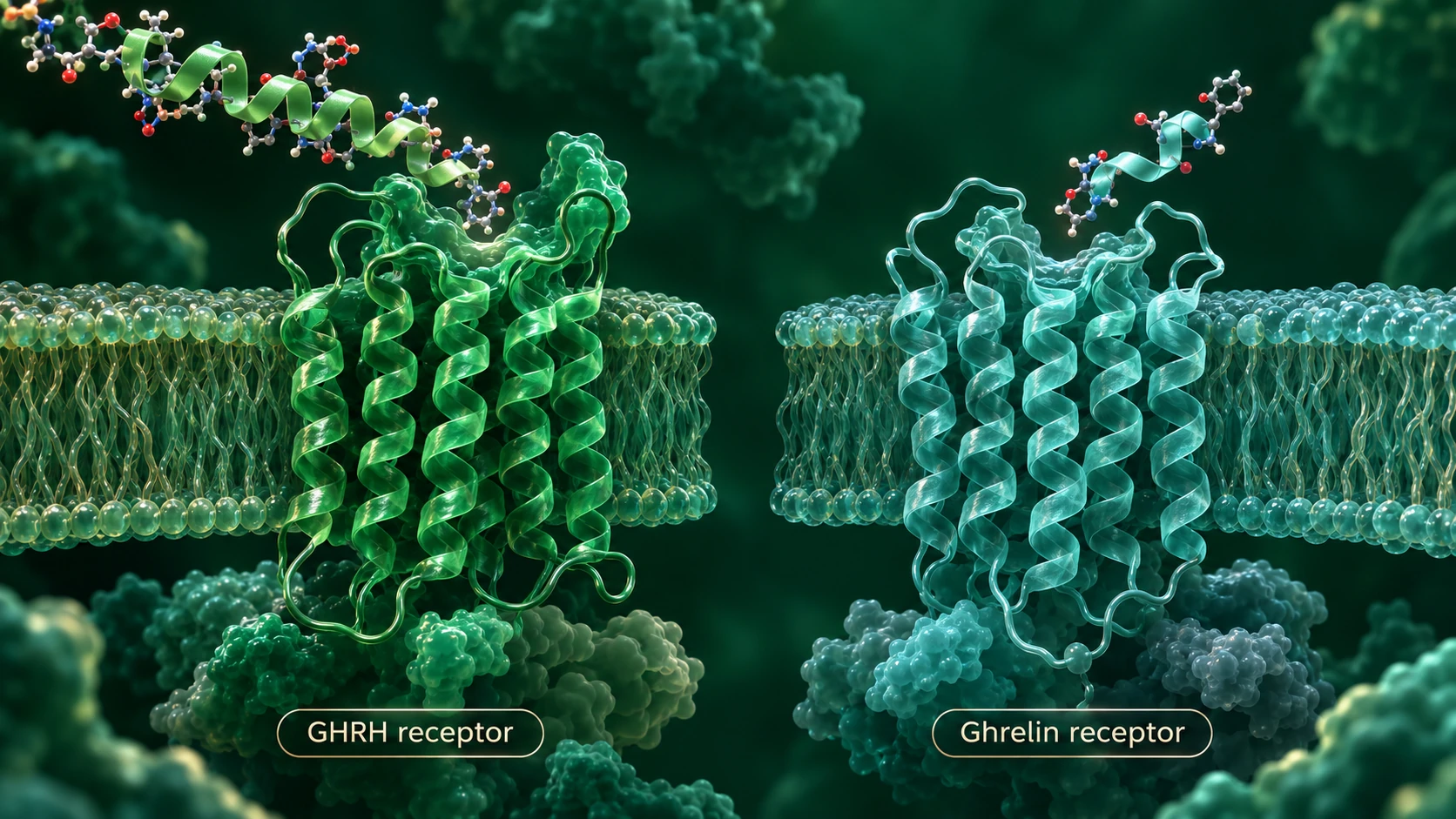
Tesamorelin and the CJC-related materials discussed here belong to GHRH-analogue research. Ipamorelin acts through the ghrelin-receptor system. These pathways can influence GH secretion through different receptor inputs.
That provides a rationale for asking whether a combination changes a hormone response. It does not establish that adding ipamorelin improves a clinical outcome, nor that a response will match tesamorelin. Feedback and baseline endocrine state remain part of the system.
A well-described experiment also distinguishes peptide exposure from GH and downstream IGF-1. The duration of a detectable peptide, the time course of GH and the time course of IGF-1 are different quantities. Treating all three as one “half-life” conceals what was actually measured.
Three evidence streams, not one combination trial
| Material | Study context | What it does not supply |
|---|---|---|
| Tesamorelin | Placebo-controlled trials in HIV-associated abdominal adiposity | A comparison with a CJC-1295/ipamorelin combination |
| Albumin-binding CJC-1295 | Short healthy-adult studies of exposure, GH and IGF-1 | Evidence for a no-DAC product or the named two-component mixture |
| Ipamorelin | Volunteer endocrine work and a separate postoperative trial | A clinical result for coadministration with CJC-1295 |
| Ghrelin plus GHRH | Human endocrine interaction experiment | Direct evidence for substituting the synthetic peptides |
Combining the conclusions of these publications on a diagram does not turn them into a trial in which the same participants received the proposed combination. Each paper keeps its own experimental material, population and endpoint.
DAC changes the exposure question
The drug affinity complex modification was designed to support association with circulating albumin. In the Teichman trials, the estimated CJC-1295 half-life was 5.8–8.1 days. That estimate describes the studied long-acting material and its measurement conditions.
It should not be applied to modified GRF(1–29) without the albumin-binding group. Nor can it predict the behaviour of ipamorelin simply because the two names appear together. A mixture contains components with potentially different exposure profiles.
This matters even for a purely mechanistic comparison. A brief receptor input and a prolonged exposure can produce different sampling requirements. An occasional hormone measurement may miss changes in pulse timing or confuse a sustained mean concentration with a change in pulse amplitude.
Clinical outcome evidence stays with its intervention
Tesamorelin’s cited trials evaluated defined clinical populations and included imaging-based outcomes. CJC-1295’s early healthy-adult trials focused on pharmacokinetics and endocrine responses. These are different stages of investigation.
Ipamorelin’s placebo-controlled bowel-resection study did not show a significant difference in its key efficacy analysis. That result neither validates nor disproves a CJC-1295/ipamorelin combination for an unrelated outcome. It tells us what happened in the postoperative study.
The primary sources selected for this Guide contain no direct clinical comparison of tesamorelin with that combination. This is a scoped evidence statement, rather than a claim that an exhaustive search can prove no experiment has ever occurred. A proposed comparison should be supported by a traceable study record, not by repeating a stack’s name.
Synergy needs an experiment that can measure it
Hataya and colleagues reported a synergistic GH response with ghrelin and GHRH in humans. The materials were ghrelin and GHRH, not CJC-1295 plus ipamorelin. Substituting analogues creates another hypothesis.
To test an interaction, a useful design compares each component alone, the combination and an appropriate control under matched conditions. It also defines the additive expectation. A larger response to two agents than to either agent alone may be compatible with several explanations and does not, by itself, prove synergy.
Even a demonstrated endocrine interaction would leave clinical benefit and harms to be measured. More signalling is not automatically a desirable result. Research on interactions also needs the exact identities and relative amounts of both components, rather than a generic total blend mass.
Safety and material quality require separate evidence
The US tesamorelin label identifies clinically important risks and contraindications. An established label provides a defined context for a medicinal product. A sparse safety record for another intervention does not make it safer by default.
For a combination, investigators must consider both components and the consequences of co-exposure. A single-agent tolerability study cannot settle those questions. Long-term risk, interactions and use in populations excluded from the cited trials remain distinct uncertainties.
Analytical work should establish each component’s identity and amount. A clean chromatogram of a mixture cannot be interpreted as proof of the intended ratio without appropriate assignments and quantitative methods. The testing Guide explains the measurement distinctions.
Lynx materials are supplied for laboratory research only, not for human or veterinary use, diagnosis or treatment. This Guide provides no dosing or administration instructions.
Frequently asked questions
Does “CJC-1295” always mean the DAC form?
No. Commercial terminology varies. Identify the sequence and albumin-binding modification before applying a published finding.
Is a two-peptide combination equivalent to tesamorelin?
The cited studies do not establish equivalence. Receptor rationale and separate component studies cannot replace a direct comparison.
Is the proposed combination proven synergistic?
The human ghrelin/GHRH interaction paper is relevant background, but it did not test CJC-1295 plus ipamorelin. A claim for that combination requires its own controlled evidence.
Can these studies establish a better option for personal use?
They address specified research questions and do not provide a validated personal-use selection rule.
References and study scope
- Prolonged stimulation of growth hormone (GH) and insulin-like growth factor I secretion by CJC-1295, a long-acting analog of GH-releasing hormone, in healthy adults. Teichman et al., 2006. Short human trials of albumin-binding CJC-1295.
- A low dose of ghrelin stimulates growth hormone (GH) release synergistically with GH-releasing hormone in humans. Hataya et al., 2001. Human endocrine experiment using ghrelin and GHRH, not the named synthetic combination.
- Ipamorelin, the first selective growth hormone secretagogue. Raun et al., 1998. Primary cell and animal pharmacology.
- Pharmacokinetic-pharmacodynamic modeling of ipamorelin, a growth hormone releasing peptide, in human volunteers. Gobburu et al., 1999. Human pharmacokinetic and endocrine study.
- Prospective, randomized, controlled, proof-of-concept study of the Ghrelin mimetic ipamorelin for the management of postoperative ileus in bowel resection patients. Beck et al., 2014. Human placebo-controlled postoperative trial.
- Metabolic effects of a growth hormone-releasing factor in patients with HIV. Falutz et al., 2007. Randomised human trial in HIV-associated abdominal adiposity.
- EGRIFTA WR prescribing information. US FDA, 2025. US medicinal-product label, not a UK catalogue authorisation.