On this page
The molecular difference comes first
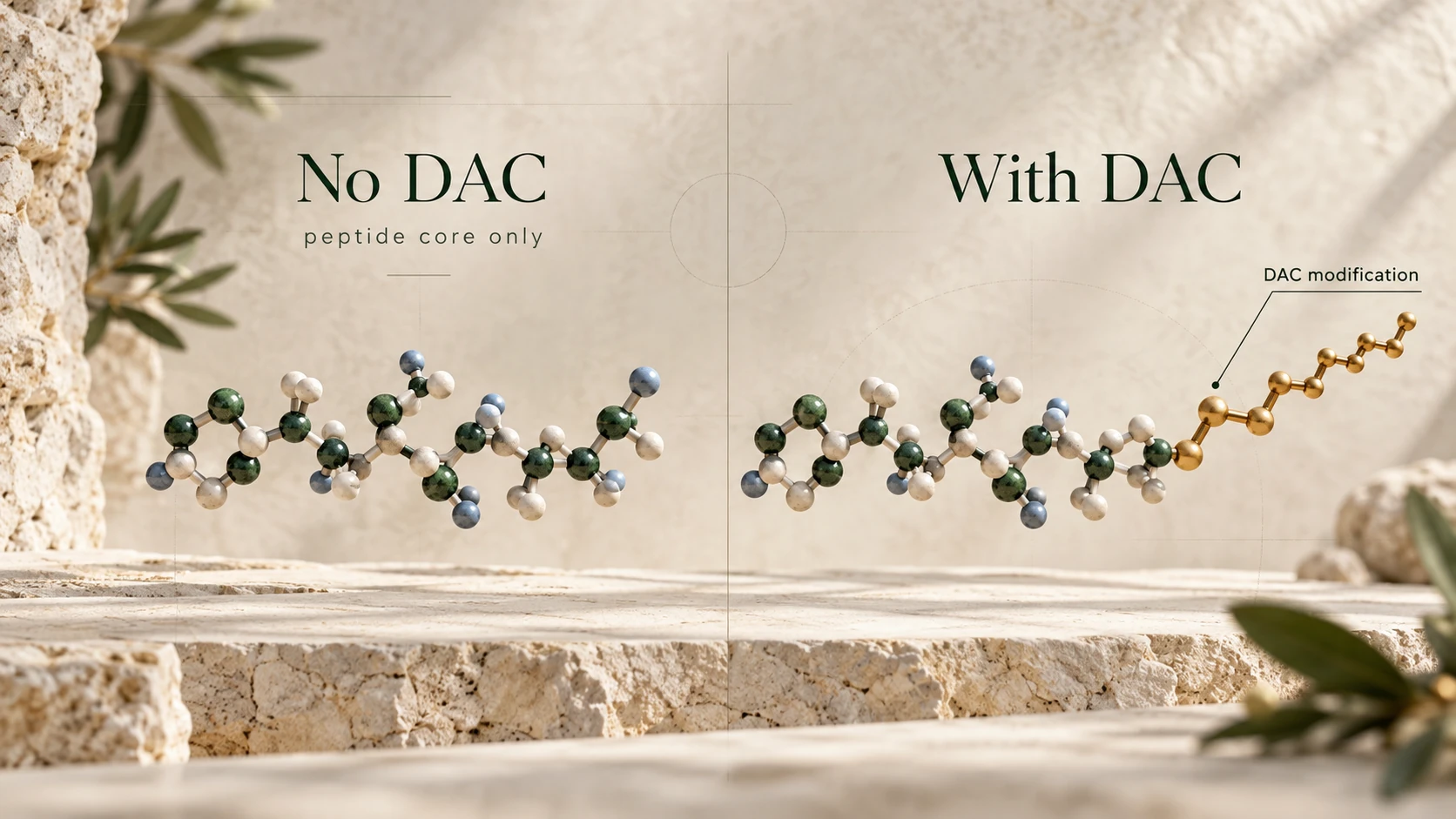
CJC-1295 with DAC and materials sold as CJC-1295 without DAC differ in a modification designed to attach the peptide to albumin, a protein in blood. DAC means drug affinity complex. Removing that feature changes the material being investigated, not just its name.
The original development work examined modified analogues of the first 29 residues of growth hormone-releasing hormone (GHRH), also called growth hormone-releasing factor (GRF). The selected CJC-1295 had four substitutions in this core and an additional chemically modified lysine at its C-terminus. Jetté and colleagues (2005) describe the albumin-reactive analogue. “No DAC” is a commercial naming convention, so the sequence, stereochemistry and terminal chemistry still need checking.
| Feature | With DAC | Without DAC |
|---|---|---|
| Peptide core | Modified GRF(1–29) core plus a modified terminal lysine in the development paper. | A 29-residue modified GRF(1–29) material in the current Lynx catalogue specification. |
| DAC chemistry | A maleimide-containing group attached to the added lysine provides the albumin-reactive feature. | The albumin-reactive DAC feature is absent. The label does not specify every other modification. |
| Lynx documentation | The curated profile records the same four core substitutions, an added DAC-modified lysine and a C-terminal amide, giving 30 residues. | The catalogue specification records D-Ala2, Gln8, Ala15 and Leu27 in the core, with a C-terminal amide. |
| Evidence transfer | Studies must identify the DAC-bearing material and measured endpoint. | DAC exposure results cannot establish the exposure of an unidentified no-DAC material. |
These catalogue descriptions are documentation statements, not independent confirmation of a particular batch. This comparison uses the documented structural features rather than assigning a universal molecular mass to the trade name.
Albumin binding and sequence substitutions do different jobs
In the DAC design, the maleimide group reacts with the free thiol of albumin at cysteine 34. A thiol is a sulphur-containing chemical group. The resulting attachment is covalent, rather than a temporary association inferred from the word “binding”. Jetté’s work examined conjugation and biological responses in laboratory systems and rats. Read the original DAC development study.
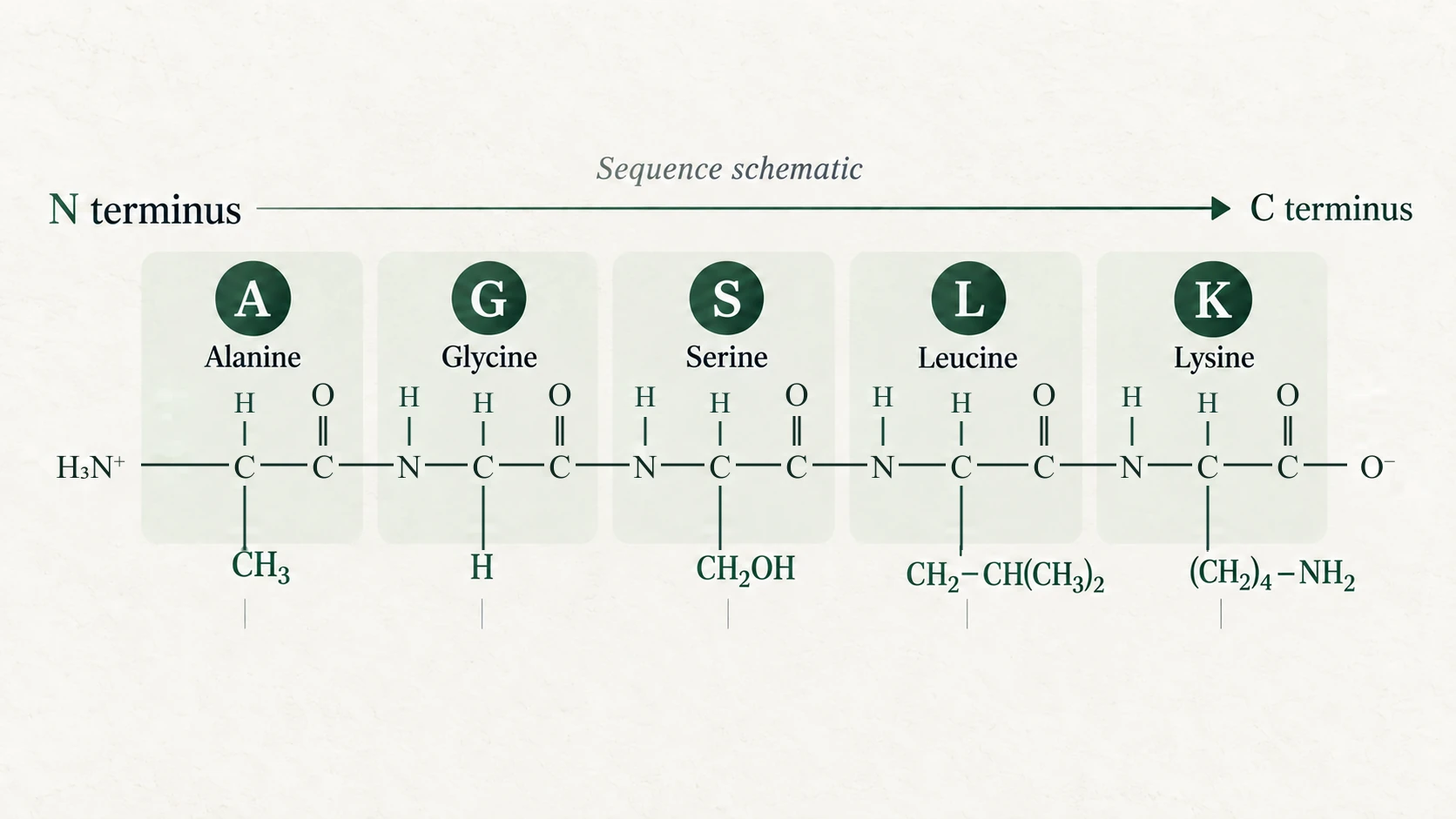
Changes within the peptide sequence and attachment to a carrier protein are separate structural features. A D-amino acid substitution changes residue stereochemistry, the spatial arrangement of that residue. The DAC group adds different chemistry. A document that confirms one feature does not establish the other.
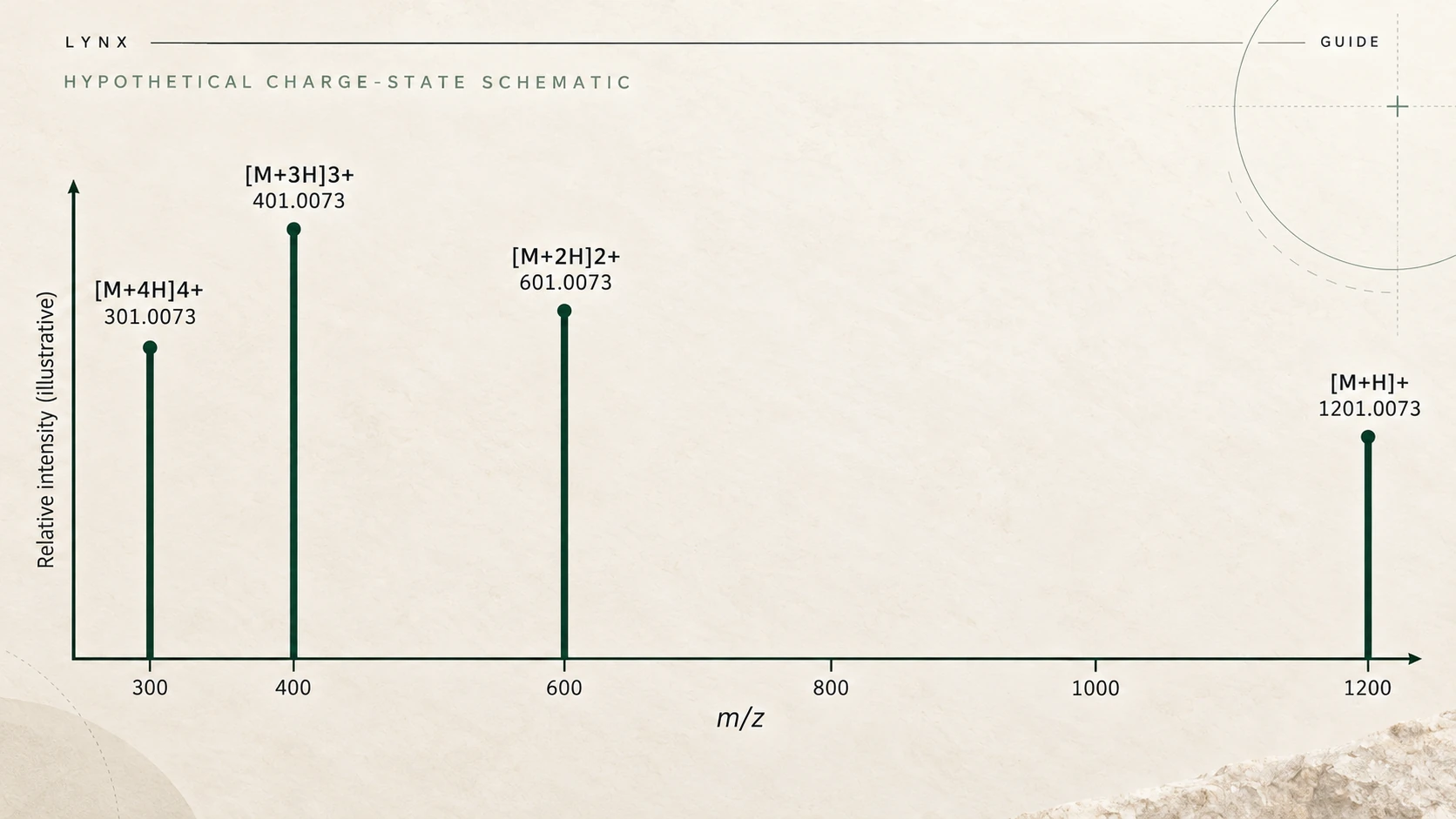
That distinction matters when interpreting analytical results. The free peptide and an albumin conjugate are different analytes. The mass spectrometry Guide explains why measured ions must be related to the proposed structure, rather than treated as a standalone identity certificate.
What the human studies measured
Teichman and colleagues (2006) investigated the long-acting CJC-1295 analogue in two randomised, placebo-controlled, double-blind studies lasting 28 and 49 days in healthy adults. The reported estimated peptide half-life was 5.8–8.1 days. That estimate belongs to the studied material and conditions. It is not a universal value for products labelled CJC-1295.
The investigators also measured growth hormone (GH) and insulin-like growth factor I (IGF-I). Peptide exposure, GH concentrations and IGF-I concentrations describe different parts of the response. An increase in a downstream hormone is not a direct measurement of how much intact peptide remains.
The trials provide short-term human pharmacokinetic and endocrine observations. They do not establish long-term safety, clinical benefit or equivalence to no-DAC materials. Their findings are not instructions for human use.
| Measurement | Question answered | Limit |
|---|---|---|
| Peptide pharmacokinetics | How did concentrations of the studied analogue change over time? | Depends on material identity, sampling and the assay. |
| Mean GH or GH exposure | How much GH was measured across a sampling period? | Does not alone describe individual pulses. |
| GH pulsatility | How were the frequency and amplitude of pulses affected? | Requires suitably frequent sampling and pulse analysis. |
| IGF-I concentration | How did a downstream endocrine marker change? | Does not establish a clinical outcome. |
Sustained exposure does not mean absent GH pulses
Ionescu and Frohman (2006) examined GH secretion a week after CJC-1295 in healthy men. Mean and trough GH and IGF-I were higher, while GH pulse frequency and amplitude were not significantly changed. The result does not support the blanket claim that DAC eliminates normal GH pulses.
A sustained concentration and a pulsatile response can coexist. Comparing a single hormone result with a densely sampled pulse-analysis study would obscure that difference. Interpretation needs the sampling schedule, assay and endpoint definition.
The Lynx Research Library has separate entries for CJC-1295 with DAC and CJC-1295 without DAC. Its CJC-1295 + Ipamorelin article addresses a further distinction, the presence of another compound. Findings for a single DAC analogue do not automatically establish the behaviour of that combination.
Identifying a no-DAC material
Henninge and colleagues (2010) analysed an unknown preparation by liquid chromatography with high-resolution tandem mass spectrometry. They identified a 29-residue peptide with a C-terminal amide and proposed a sequence consistent with material marketed as CJC-1295. This is evidence about that sample, not proof that every product using the name has the same structure.
For a meaningful comparison, documentation should establish the full residue sequence, any D-residues, terminal groups and the presence or absence of the DAC-bearing extension. The proposed formula and expected mass must agree with those details. Batch and sample identifiers then connect the molecular specification to the analytical report.
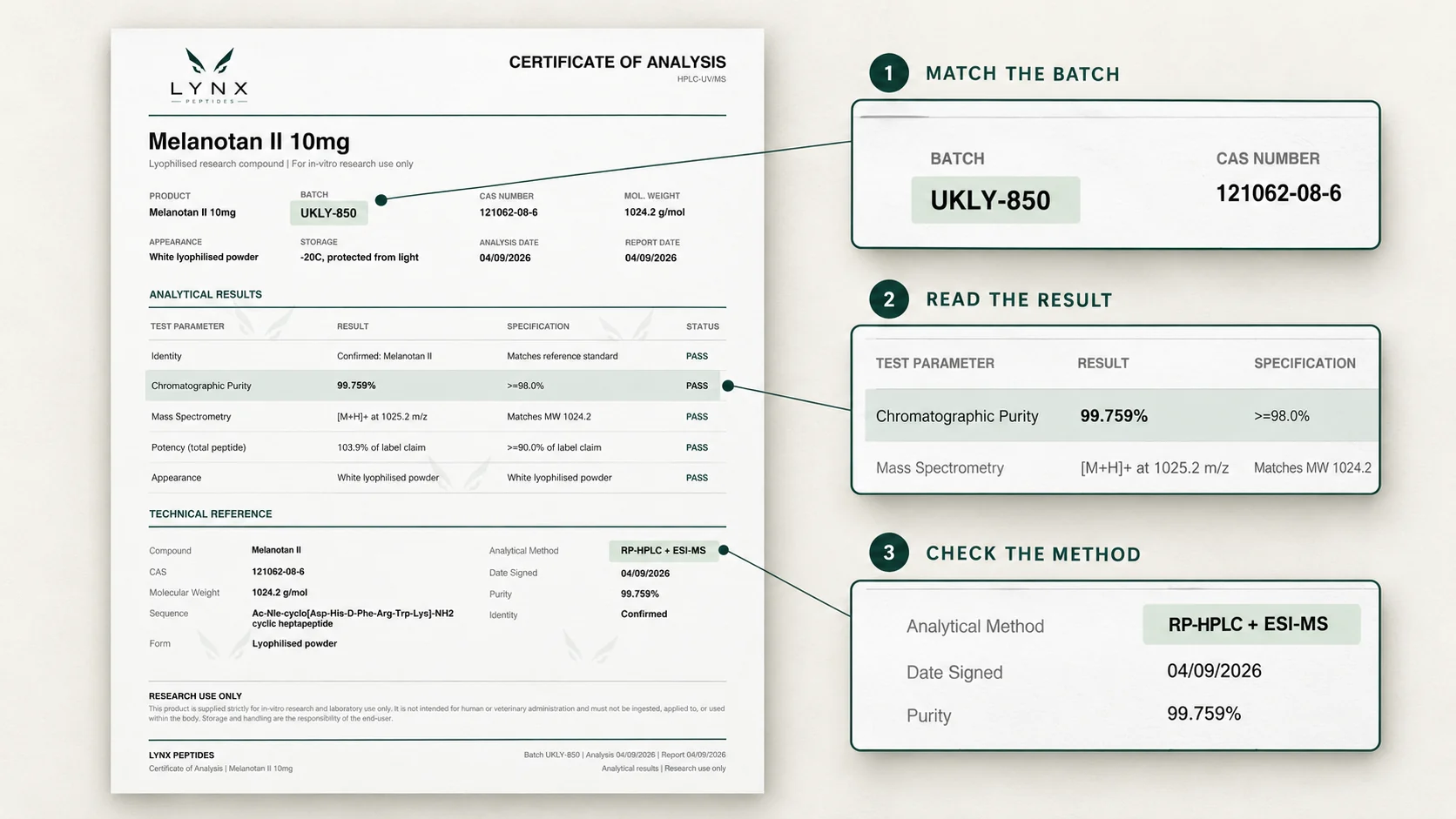
A chromatographic purity percentage addresses the separation and measurement used in that report. It does not, by itself, resolve a naming dispute or confirm every structural modification. The Certificate of Analysis Guide explains how to read identity, method and sample information together.
The remaining evidence gap
The cited literature covers DAC development, short-term human endocrine observations and identification of one separately analysed preparation. It does not provide a controlled human comparison establishing superiority between the Lynx with-DAC and no-DAC materials.
A listed sequence identifies the proposed material, while a batch-linked analysis tests the supplied sample. Borrowing another supplier’s molecular mass or the DAC sequence does not strengthen that connection. Comparisons should state whether a feature comes from the catalogue specification, a primary paper or analysis of the particular sample.
This article concerns scientific interpretation. It provides no treatment, administration or product-selection advice.
Primary references
- Jetté et al. (2005). Development of an albumin-reactive GRF analogue. Endocrinology. PMID 15817669. DOI 10.1210/en.2004-1286.
- Teichman et al. (2006). CJC-1295 pharmacokinetic and endocrine studies in healthy adults. Journal of Clinical Endocrinology & Metabolism. PMID 16352683. DOI 10.1210/jc.2005-1536.
- Ionescu and Frohman (2006). GH pulsatility following CJC-1295. Journal of Clinical Endocrinology & Metabolism. PMID 17018654. DOI 10.1210/jc.2006-1702.
- Henninge et al. (2010). Analytical identification of a CJC-1295-labelled preparation. Drug Testing and Analysis. PMID 21204297. DOI 10.1002/dta.233.