What is GHK-CU?
GHK-Cu links a small peptide with metal coordination. GHK is glycyl-L-histidyl-L-lysine, a tripeptide identified in human plasma; binding copper(II) gives it a chemically distinct form. The distinction matters because the peptide, copper complex and free copper can behave differently in the same experimental medium. Copper content and competing ligands influence which species an assay actually contains.
Much of the biological literature concerns the extracellular matrix: the collagen-rich framework around cells, together with glycosaminoglycans and proteoglycans. Fibroblast and wound-model experiments address both construction of that matrix and its turnover, rather than a simple increase in collagen alone. Other work explores endothelial responses and gene-expression patterns. Human topical evidence adds a narrower perspective: a very small post-laser study found a difference in participants’ own assessment of skin quality but no objective between-group advantage. These different kinds of evidence are considered separately below.
GHK-CU Research Areas
GHK-Cu increased collagen and glycosaminoglycan accumulation in a rat wound-chamber model, with higher type I and III collagen messenger RNA. Dermatan sulfate also formed a larger share of the measured glycosaminoglycans, while TGF-β messenger RNA did not increase. The concentration-dependent changes show that matrix composition, not collagen alone, is relevant to the response in this artificial wound environment.
Maquart et al. · J Clin Invest · 1993PubMed
GHK-Cu changed matrix composition as well as total accumulation in rat wounds. Chondroitin sulfate and dermatan sulfate increased, while decorin expression rose and biglycan expression fell in wound tissue. Dermal fibroblast cultures reproduced the decorin increase but not the biglycan change. The different responses show why “more matrix” is less informative than identifying which matrix components changed.
Siméon et al. · The Journal of investigative dermatology · 2000PubMed
GHK-Cu increased MMP-2 expression and secretion of its regulators TIMP-1 and TIMP-2 in dermal fibroblast cultures. Copper ions reproduced the MMP-2 response, whereas copper-free GHK did not. The finding broadens matrix biology from making connective tissue to regulating its breakdown and remodelling.
Siméon et al. · Life Sci · 2000PubMed
Liposomal GHK-Cu increased proliferation in cultured endothelial cells and enhanced growth-factor and cell-cycle protein measurements. In a mouse scald model, vascular and proliferation markers were stronger and wound closure was faster than with free GHK-Cu. The liposome is part of the result: these observations do not describe an equivalent response from unencapsulated copper peptide.
Wang et al. · Wound Repair Regen · 2017PubMed
GHK emerged from a gene-expression screen as a candidate for reversing an emphysema-associated pattern. Follow-up lung fibroblast experiments found changes in actin organisation and integrin β1, and restored collagen contraction and remodelling in cells from COPD lungs. This is screening and cellular work on GHK, not a human treatment result or automatic evidence for GHK-Cu.
Campbell et al. · Genome medicine · 2012PubMed
A small human trial found no objective advantage for a GHK-Cu skin-care regimen after circumoral CO₂ laser resurfacing. Among the 13 people who completed it, computer analysis and blinded assessment found no significant difference in redness resolution, wrinkles or overall skin quality. Participants using GHK-Cu did report significantly greater improvement in their own assessment of overall skin quality at 12 weeks. The contrast between objective and subjective outcomes is useful, but the tiny sample offers only limited human context.
Miller et al. · Arch Facial Plast Surg · 2006PubMed
Molecular profile
- Compound
- GHK-CU
- Amount
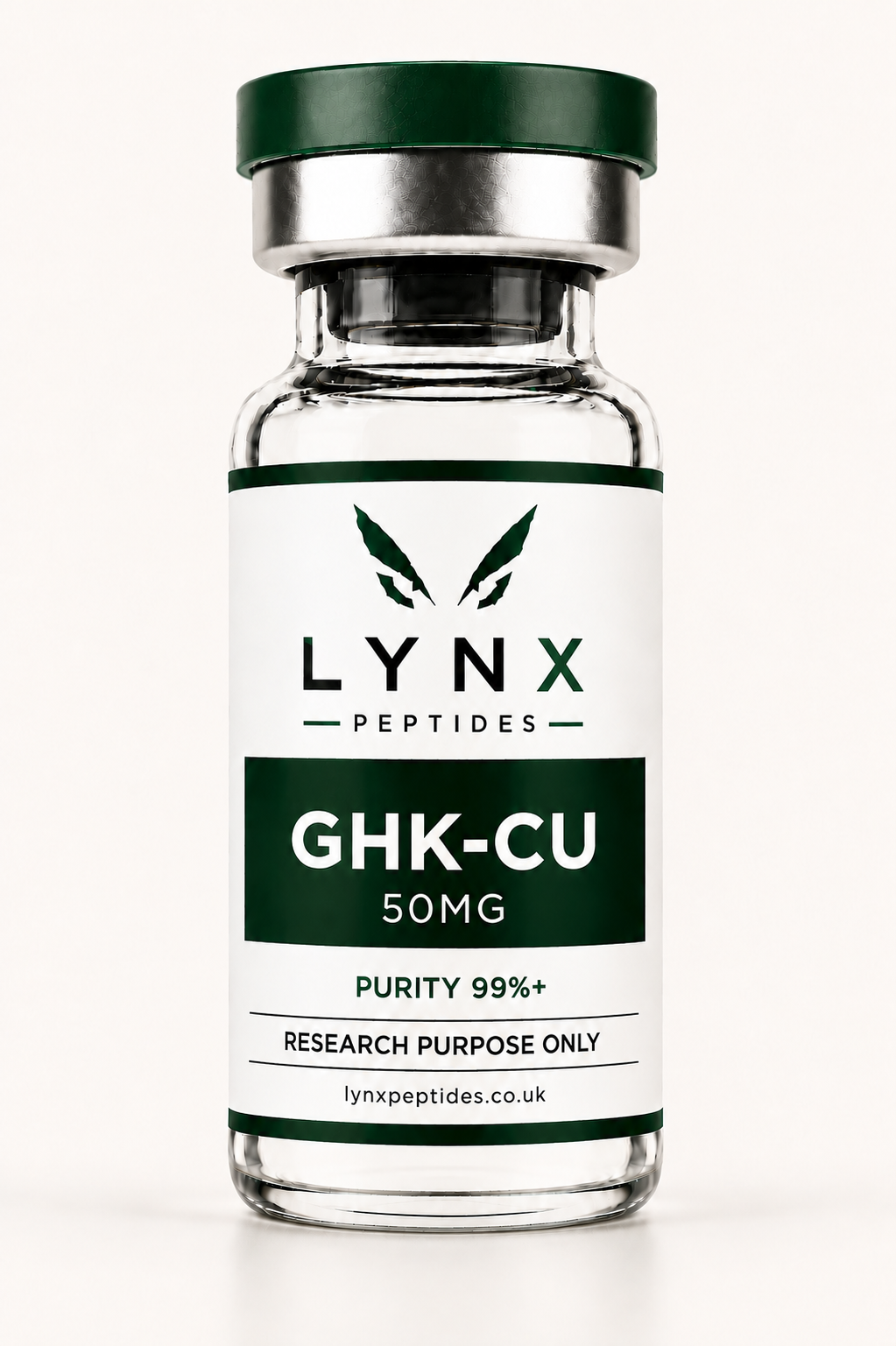
- 50 mg
- Sequence
- Glycyl-L-histidyl-L-lysine
- Residue count
- 3
- Molecular formula
- C14H23CuN6O4+
- Molecular weight
- 402.92 g/mol
- CAS number
- 89030-95-5
- Chemical class
- Copper peptide complex
- Full compound name
- Glycyl-L-histidyl-L-lysine copper complex
- Classification
- Copper peptide
- Parent molecule
- GHK-Cu (1:1 copper complex)
- Available vial sizes
- 50 mg, 100 mg
Analytical verification
- Lynx report reference
- UKLY-747
- Reported purity
- >99%
- Analysis method
- RP-HPLC
- Identity result
- Confirmed - GHK-Cu
- Analysis date
- 7 Aug 2026
- Report date
- 7 Aug 2026
Storage & Reconstitution
Store in appropriate cool, dry conditions. Refer to product-specific storage information when published.
Vials are supplied separately from bacteriostatic water and other preparation supplies.
For laboratory handling context, read Research peptide storage and stability. Product-specific information and the laboratory method take precedence.
For laboratory preparation, allow the sealed vial to reach room temperature before opening. Wipe the vial stopper and bacteriostatic-water stopper with an alcohol wipe. Add bacteriostatic water slowly down the inside wall of the vial, then swirl gently until dissolved. Do not shake.
Research literature
- In vivo stimulation of connective tissue accumulation by the tripeptide-copper complex glycyl-L-histidyl-L-lysine-Cu2+ in rat experimental wounds.Maquart et al. · J Clin Invest · 1993PubMed
- GHK-Cu-liposomes accelerate scald wound healing in mice by promoting cell proliferation and angiogenesis.Wang et al. · Wound Repair Regen · 2017PubMed
- Effects of topical copper tripeptide complex on CO2 laser-resurfaced skin.Miller et al. · Arch Facial Plast Surg · 2006PubMed
- Expression of glycosaminoglycans and small proteoglycans in wounds: modulation by the tripeptide-copper complex glycyl-L-histidyl-L-lysine-Cu(2+).Siméon et al. · The Journal of investigative dermatology · 2000PubMed
- The tripeptide-copper complex glycyl-L-histidyl-L-lysine-Cu2+ stimulates matrix metalloproteinase-2 expression by fibroblast cultures.Siméon et al. · Life Sci · 2000PubMed
- A gene expression signature of emphysema-related lung destruction and its reversal by the tripeptide GHK.Campbell et al. · Genome medicine · 2012PubMed
GHK-CU Price (UK)
GHK-CU is supplied in 50 mg and 100 mg vial sizes for laboratory research. UK prices are 50 mg at £19.99 and 100 mg at £29.99.
Current availability is shown below. UK orders of £49.99 or more qualify for free standard shipping. Eligible working-day orders placed before 4 PM are dispatched the same day.
| Vial size | Current price | Price / mg | Status |
|---|---|---|---|
| 50 mg | £19.99 | £0.40/mg | Checking stock |
| 100 mgBest value | £29.99 | £0.30/mg | Checking stock |
Common questions about GHK-CU
What is GHK-Cu?
GHK-Cu is a copper complex of glycyl-L-histidyl-L-lysine, a peptide made from three amino acids. Copper binding gives it different chemical behaviour from the free GHK peptide. Its research includes copper handling, cell responses and the matrix surrounding cells, making the metal-bound form an important detail rather than just an alternative product name.
Why is GHK-Cu blue?
Copper changes the way the GHK complex absorbs visible light, producing its characteristic blue colour. The colour comes from the copper-bound form, not the free peptide. It is a useful visual feature of this chemistry, but shade can vary with concentration and solution conditions; it cannot replace an analytical measurement of identity or purity.
What happens when GHK binds copper?
GHK holds a copper ion through several binding points, forming a metal-peptide complex rather than a simple mixture of unrelated ingredients. That changes how the peptide and copper behave in solution. The balance depends on pH, copper amount and other molecules present, so laboratories consider those conditions when comparing copper-binding or cell-response experiments.
How does copper-bound GHK differ from free GHK?
Free GHK contains the same three-amino-acid peptide without bound copper. Adding copper changes its colour, chemistry and interactions in a laboratory preparation. This matters because an experiment using free GHK may be examining a different chemical environment from one using GHK-Cu; the peptide name alone is not enough to treat those findings as interchangeable.
How is GHK-Cu related to GLOW and KLOW?
GHK-Cu is one component of both blends. GLOW combines it with BPC-157 and TB-500; KLOW also adds KPV, bringing inflammatory-signalling research into the formulation. The individual GHK-Cu vial allows copper-peptide chemistry to be studied separately, while the blends introduce additional compounds whose contributions need to be considered when interpreting a combined response.
What does GHK gene-expression research actually refer to?
Gene expression describes how actively cells use particular genes, not whether damaged genes have been repaired. A widely quoted GHK analysis used data from cultured PC3 and MCF7 cells. Those results help explore cellular responses, but they are not a study of thousands of genes being repaired in people or a clinical test of this GHK-Cu vial.
Do the 50mg and 100mg GHK-Cu vials contain different compounds?
No. Both strengths list the same copper-bound GHK compound; the difference is the amount supplied. Each strength has its own analytical report, so the purity result belongs to the selected vial option. A larger amount does not mean a different copper-binding structure, and the prepared concentration depends on the laboratory's final solution volume.
Can I buy GHK-CU in the UK for research?
Yes. Lynx supplies GHK-Cu in 50mg and 100mg options for laboratory and in-vitro research in the UK. Stock is shown separately for the two strengths.
How are the GHK-Cu vial strengths batch tested?
For 50mg GHK-Cu, UKLY-747 gives purity above 99% using RP-HPLC. The 100mg certificate, UKLY-501, reports 99.95% by RP-HPLC (UV 214 nm).