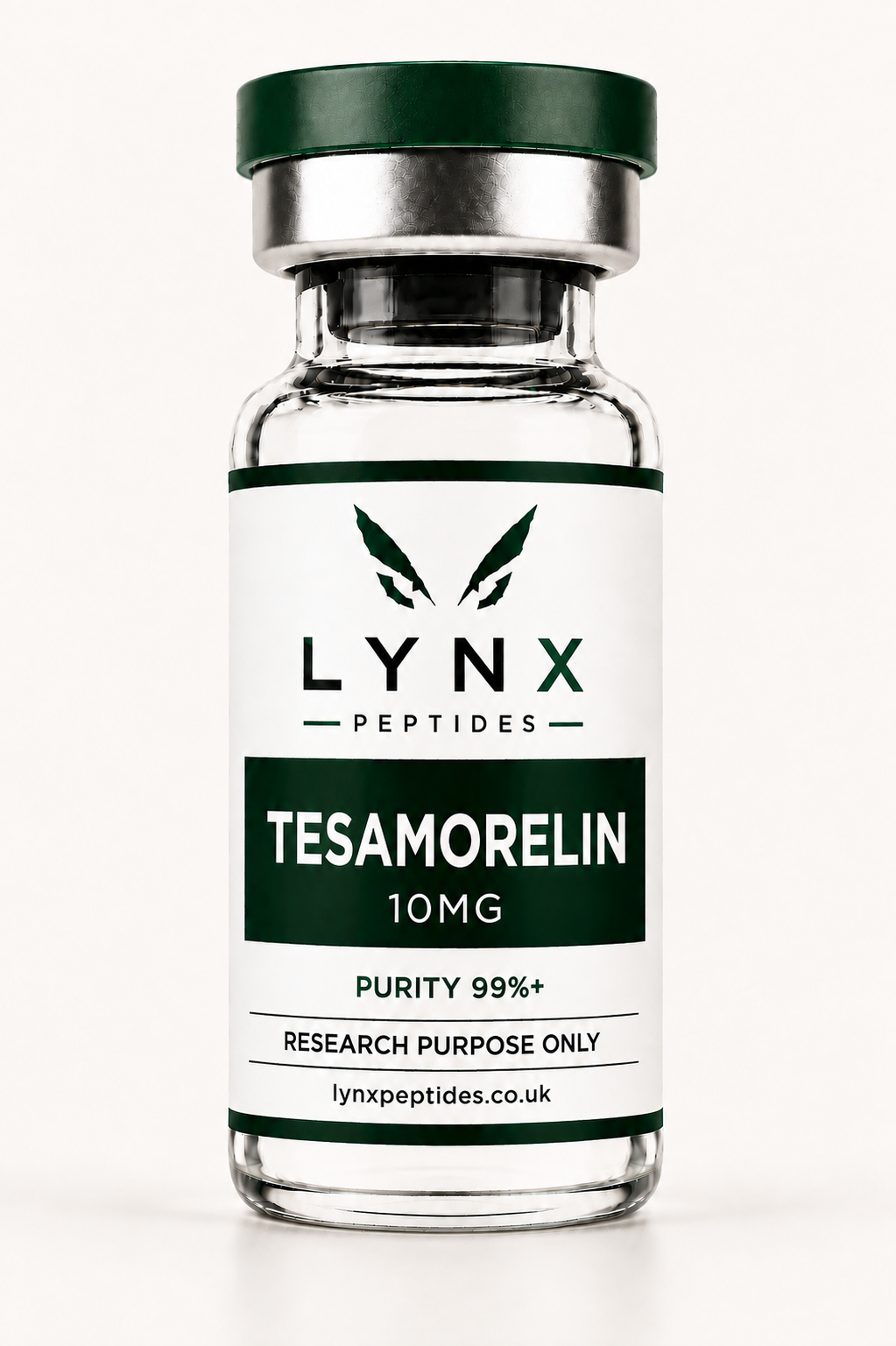
What is Tesamorelin?
Tesamorelin is a 44-residue GHRH analogue with an N-terminal trans-3-hexenoyl modification. It retains the full-length GHRH framework while changing its susceptibility to enzymatic breakdown. The GHRH receptor provides the entry point into pituitary growth-hormone release, with IGF-I responses measured further downstream.
Its evidence base includes defined human clinical preparations, making it different from many predominantly preclinical catalogue peptides. Trials in people with HIV-associated abdominal fat accumulation measured visceral fat and endocrine responses, while a smaller study examined liver fat and glucose changes. The population and formulation are part of those results. They explain the clinical research context without establishing that a catalogue vial has the same analytical identity, delivery characteristics or outcome as the trial medicine.
Tesamorelin Research Areas
The trans-3-hexenoyl modification of tesamorelin slowed degradation in rat, dog and human plasma compared with native GHRH. Animal experiments recorded prolonged endocrine responses; repeated exposure also produced reversible liver, kidney and blood-related findings in dogs. Molecular stability therefore explains part of the pharmacology without implying that longer exposure is free of biological consequences.
Ferdinandi et al. · Basic & clinical pharmacology & toxicology · 2007PubMed
Visceral fat decreased with a defined tesamorelin preparation in a blinded trial involving 404 people with HIV-associated abdominal fat accumulation. IGF-I increased, without a significant glucose change during the initial six-month phase. Continued treatment maintained the visceral-fat reduction, whereas switching to placebo rapidly lost it. The population, clinical preparation and treatment-dependent response are central to interpreting the result.
Falutz et al. · J Acquir Immune Defic Syndr · 2010PubMed
Visceral fat and liver-fat measurements decreased relative to placebo in a six-month tesamorelin trial enrolling 50 adults with HIV-associated abdominal fat accumulation; 48 received study treatment. Fasting glucose rose early, although between-group glucose differences were not significant at six months. The small trial adds liver-fat context without resolving the durability or clinical importance of that change.
Stanley et al. · JAMA · 2014PubMed
Molecular profile
- Compound
- Tesamorelin
- Amount
- 10 mg
- Sequence
- trans-3-hexenoyl-YADAIFTNSYRKVLGQLSARKLLQDIMSRQQGESNQERGARARL-NH2
- Residue count
- 44
- Molecular formula
- C221H366N72O67S
- Molecular weight
- 5136 g/mol
- CAS number
- 218949-48-5
- Chemical class
- Synthetic stabilised growth hormone-releasing hormone analogue
- Classification
- Research peptide
- Parent molecule
- Tesamorelin (free base)
- Available vial sizes
- 5 mg, 10 mg
Analytical verification
- Lynx report reference
- UKLY-500
- Reported purity
- 99.1%
- Analysis method
- RP-HPLC
- Identity result
- Confirmed - Tesamorelin
- Analysis date
- 27 Jul 2026
- Report date
- 27 Jul 2026
Storage & Reconstitution
Store in appropriate cool, dry conditions. Refer to product-specific storage information when published.
Vials are supplied separately from bacteriostatic water and other preparation supplies.
For laboratory handling context, read Research peptide storage and stability. Product-specific information and the laboratory method take precedence.
For laboratory preparation, allow the sealed vial to reach room temperature before opening. Wipe the vial stopper and bacteriostatic-water stopper with an alcohol wipe. Add bacteriostatic water slowly down the inside wall of the vial, then swirl gently until dissolved. Do not shake.
Research literature
- Effects of tesamorelin, a growth hormone-releasing factor, in HIV-infected patients with abdominal fat accumulation: a randomized placebo-controlled trial with a safety extension.Falutz et al. · J Acquir Immune Defic Syndr · 2010PubMed
- Effect of tesamorelin on visceral fat and liver fat in HIV-infected patients with abdominal fat accumulation: a randomized clinical trial.Stanley et al. · JAMA · 2014PubMed
- Non-clinical pharmacology and safety evaluation of TH9507, a human growth hormone-releasing factor analogue.Ferdinandi et al. · Basic & clinical pharmacology & toxicology · 2007PubMed
Tesamorelin Price (UK)
Tesamorelin is supplied in 5 mg and 10 mg vial sizes for laboratory research. UK prices are 5 mg at £31.99 and 10 mg at £47.99.
Current availability is shown below. UK orders of £49.99 or more qualify for free standard shipping. Eligible working-day orders placed before 4 PM are dispatched the same day.
| Vial size | Current price | Price / mg | Status |
|---|---|---|---|
| 5 mg | £31.99 | £6.40/mg | Checking stock |
| 10 mgBest value | £47.99 | £4.80/mg | Checking stock |
Common questions about Tesamorelin
What is Tesamorelin?
Tesamorelin is a synthetic analogue of human growth hormone-releasing hormone, studied through the GHRH receptor. Its reference structure has 44 amino acids and a modification at the beginning of the chain. This gives researchers a defined GHRH-related design to examine, rather than treating every peptide associated with growth-hormone biology as acting through the same receptor.
How does Tesamorelin differ from Ipamorelin?
Tesamorelin acts through the GHRH pathway, while Ipamorelin is a smaller peptide acting through the ghrelin receptor. Both relate to growth-hormone signalling, but they provide different upstream inputs. Comparing the two helps distinguish receptor-specific responses, rather than assuming that a shared downstream hormone measurement means the compounds work in the same way.
How does Tesamorelin differ from CJC-1295 with DAC?
Both are GHRH-related analogues, but their modifications have different designs. Tesamorelin has an N-terminal trans-3-hexenoyl group, while CJC-1295 with DAC has an albumin-binding feature that changes persistence in circulation. Researchers distinguish the specific molecule and its exposure characteristics, rather than treating the shared GHRH pathway as proof that the two preparations behave identically.
What is distinctive about Tesamorelin's N-terminal modification?
A trans-3-hexenoyl group is attached at the beginning of Tesamorelin as part of its stabilising design. The modification changes the molecule relative to native GHRH, but is not the albumin-binding DAC feature found in CJC-1295. This explains why the location and type of a modification matter, rather than grouping all modified GHRH peptides together.
Do the 5mg and 10mg Tesamorelin vials have different molecular designs?
No. Both strengths list the same 44-residue Tesamorelin analogue with its N-terminal modification. The strength changes the amount supplied, not the peptide's GHRH-related design. A laboratory's prepared concentration depends on the amount used and final volume, so the vial label and the molecule's structure describe different details.
Why is IGF-I measured in Tesamorelin research?
IGF-I is a downstream measurement in growth-hormone biology, whereas Tesamorelin starts at the GHRH receptor pathway. Measuring it can help describe what follows that upstream signal. A receptor assay and an IGF-I measurement therefore capture different stages of the response, which is why research reports distinguish the initiating peptide from the growth factor measured later.
Can I buy Tesamorelin in the UK for research?
Yes. Lynx supplies Tesamorelin as 5mg and 10mg research vials from the UK. Availability for laboratory use is shown against each strength.
How are the Tesamorelin vial strengths tested?
Tesamorelin 5mg has a 98.21% purity result from RP-HPLC + ESI-MS (UKLY-935). Its 10mg certificate, UKLY-500, gives 99.1% using RP-HPLC.