What is IGF-1 LR3?
IGF-1 LR3 was designed to separate aspects of IGF receptor signalling from the effects of IGF-binding proteins. It retains the IGF-I domain but adds a 13-residue N-terminal extension and replaces the native glutamate at position 3 with arginine, producing an 83-residue analogue. The Arg3 numbering refers to the IGF-I portion rather than the first residue of the extended chain.
Binding proteins can hold back IGF molecules in culture medium and change how much reaches a receptor. Comparative experiments show that LR3’s altered interactions with those proteins can account for stronger responses in some cell systems, while a system without detectable binding proteins produced a different ranking. This dependence on the medium is central to its research use. Native IGF-I experiments help explain the pathway, but identity-matched LR3 work is needed when attributing a result to the analogue.
IGF-1 LR3 Research Areas
Long-[Arg3]-IGF-I produced stronger responses than native IGF-I in cell systems that released IGF-binding proteins, but was less potent in a fibroblast system without detectable binding proteins. Receptor and binding-protein comparisons linked this contrast to altered IGFBP interactions. The medium therefore helps determine the analogue’s apparent biological potency.
Francis et al. · Journal of molecular endocrinology · 1992PubMed
Solution-structure measurements showed that Long-[Arg3]-IGF-I retained the overall IGF-I domain with changes near the N-terminus and a flexible extension. The structural differences help explain altered binding-protein interactions. They describe the characterised analogue rather than confirming the folding or sequence of a separate commercial batch.
Laajoki et al. · The Journal of biological chemistry · 2000PubMed
Native IGF-I promoted proliferation and differentiation in child-derived skeletal-muscle cell cultures and partly opposed inhibition associated with TNF-α. Responses differed from adult-derived cultures, illustrating how the cellular setting changes growth-factor biology. The material was native IGF-I, so this is pathway context rather than a result for IGF-1 LR3.
Grohmann et al. · J Physiol · 2005PubMed
Molecular profile
- Compound
- IGF-1 LR3
- Amount
- 1 mg
- Sequence
- MFPAMPLLSLFVNGPRTLCGAELVDALQFVCGDRGFYFNKPTGYGSSSRRAPQTGIVDECCFRSCDLRRLEMYCAPLKPAKSA
- Residue count
- 83
- Chemical class
- Synthetic insulin-like growth factor 1 analogue
- Classification
- Research peptide
- Alternate research names
- Long-R3 IGF-1
- Available vial sizes
- 1 mg
Analytical verification
- Lynx report reference
- UKLY-227
- Reported purity
- 98.134%
- Analysis method
- RP-HPLC + ESI-MS
- Identity result
- Confirmed: IGF-1 LR3
- Analysis date
- 6 Mar 2026
- Report date
- 6 Mar 2026
Storage & Reconstitution
Store in appropriate cool, dry conditions. Refer to product-specific storage information when published.
Vials are supplied separately from bacteriostatic water and other preparation supplies.
For laboratory handling context, read Research peptide storage and stability. Product-specific information and the laboratory method take precedence.
For laboratory preparation, allow the sealed vial to reach room temperature before opening. Wipe the vial stopper and bacteriostatic-water stopper with an alcohol wipe. Add bacteriostatic water slowly down the inside wall of the vial, then swirl gently until dissolved. Do not shake.
Research literature
- Isolation and validation of human prepubertal skeletal muscle cells: maturation and metabolic effects of IGF-I, IGFBP-3 and TNFalpha.Grohmann et al. · J Physiol · 2005PubMed
- Novel recombinant fusion protein analogues of insulin-like growth factor (IGF)-I indicate the relative importance of IGF-binding protein and receptor binding for enhanced biological potency.Francis et al. · Journal of molecular endocrinology · 1992PubMed
- Solution structure and backbone dynamics of long-[Arg(3)]insulin-like growth factor-I.Laajoki et al. · The Journal of biological chemistry · 2000PubMed
IGF-1 LR3 Price (UK)
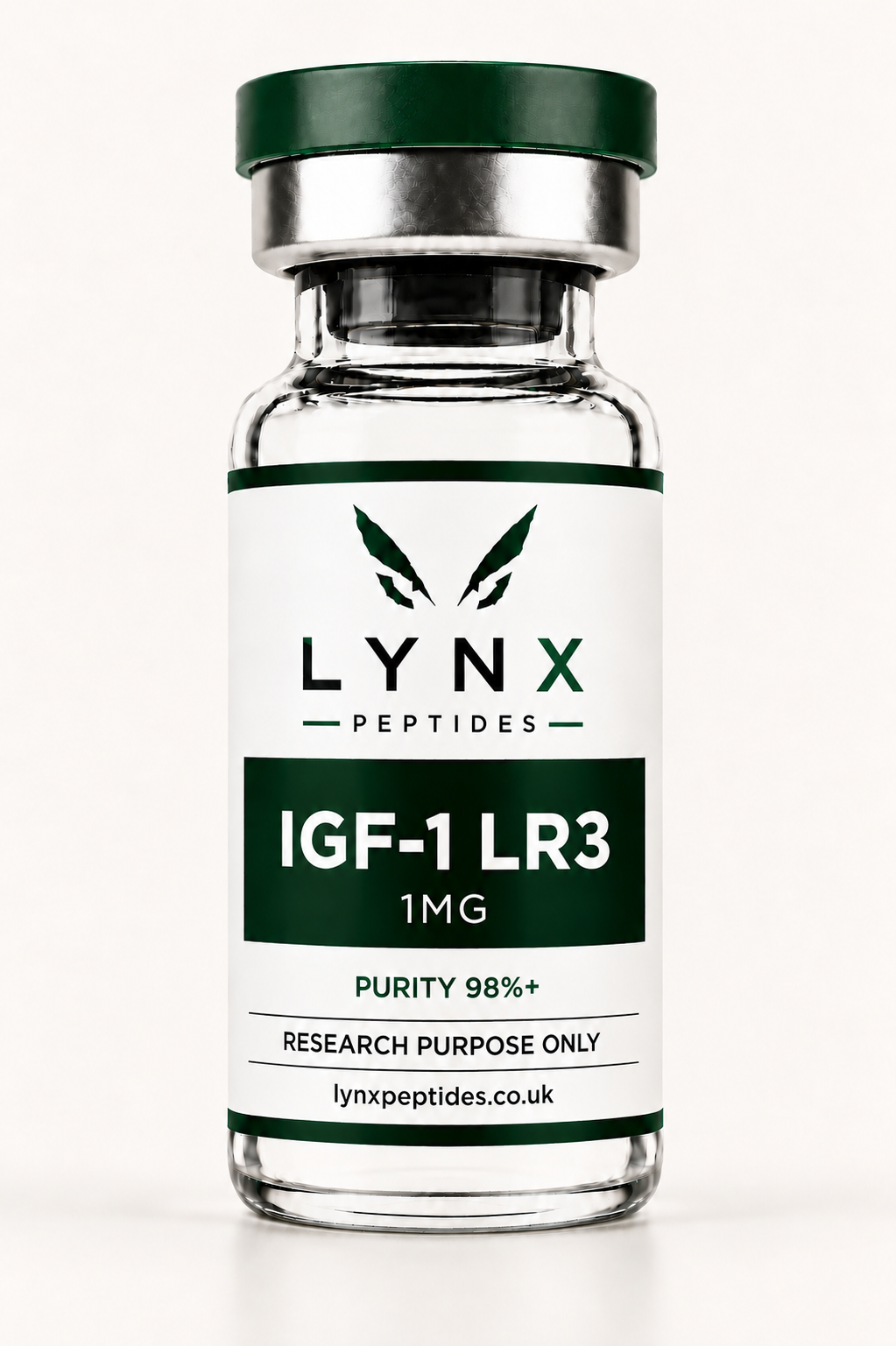
IGF-1 LR3 is supplied in 1 mg vials for laboratory research. The current price is £49.99.
Current availability is shown below. UK orders of £49.99 or more qualify for free standard shipping. Eligible working-day orders placed before 4 PM are dispatched the same day.
| Vial size | Current price | Price / mg | Status |
|---|---|---|---|
| 1 mg | £49.99 | £49.99/mg | Checking stock |
Common questions about IGF-1 LR3
What is IGF-1 LR3?
IGF-1 LR3 is a modified form of insulin-like growth factor I, with an extra 13-amino-acid segment and an arginine substitution in the IGF-I portion. The reference sequence has 83 amino acids. These changes reduce its interaction with IGF-binding proteins, making it useful for examining how binding proteins influence the amount of growth factor available to cells.
What does ‘Long R3’ mean?
'Long' refers to a 13-amino-acid extension at the beginning of the molecule. 'R3' means arginine replaces glutamate at position 3 of the IGF-I portion, not position 3 of the whole extended peptide. Those modifications affect binding-protein interactions, so the name identifies a particular molecular design rather than simply a larger vial of ordinary IGF-I.
How does IGF-1 LR3 differ from native IGF-I?
LR3 has an added N-terminal segment and an Arg3 substitution, which reduce its affinity for IGF-binding proteins. Native IGF-I lacks those changes. Because binding proteins can hold growth factor away from receptors, changing those interactions can alter a cell-culture response; researchers therefore compare the analogue and native molecule as distinct preparations, not just different names.
Why do IGF-binding proteins matter in cell experiments?
IGF-binding proteins bind growth factors and affect how much is available to reach receptors. LR3 interacts with them differently from native IGF-I, so the proteins present in a culture can influence the measured response. Knowing the culture conditions helps separate a change in available peptide from a change in the cells' receptor signalling.
How does IGF-1 LR3 differ from a GHRH analogue?
IGF-1 LR3 is studied at the insulin-like growth factor signalling level. GHRH analogues such as CJC-1295 target a different receptor pathway further upstream in growth-hormone biology. That distinction matters when choosing an experimental measurement: a response at an IGF receptor is not the same process as a response initiated at a GHRH receptor.
Does IGF-1 LR3 retain the IGF-I part of the molecule?
Yes. Its reference design contains the IGF-I portion with an Arg3 substitution, plus a 13-amino-acid extension at the beginning. The modification does not replace the whole growth-factor framework. That lets experiments compare a related signalling molecule with altered binding-protein interactions, rather than comparing IGF-I with an unrelated peptide acting at a different receptor.
Can I buy IGF-1 LR3 in the UK for research?
Yes. The Lynx catalogue includes a 1mg IGF-1 LR3 vial for laboratory research in the UK. Check this page for availability of the LR3 analogue.
Is Lynx IGF-1 LR3 batch tested?
Certificate UKLY-227 gives the 1mg IGF-1 LR3 sample a purity result of 98.134%, tested using RP-HPLC + ESI-MS.