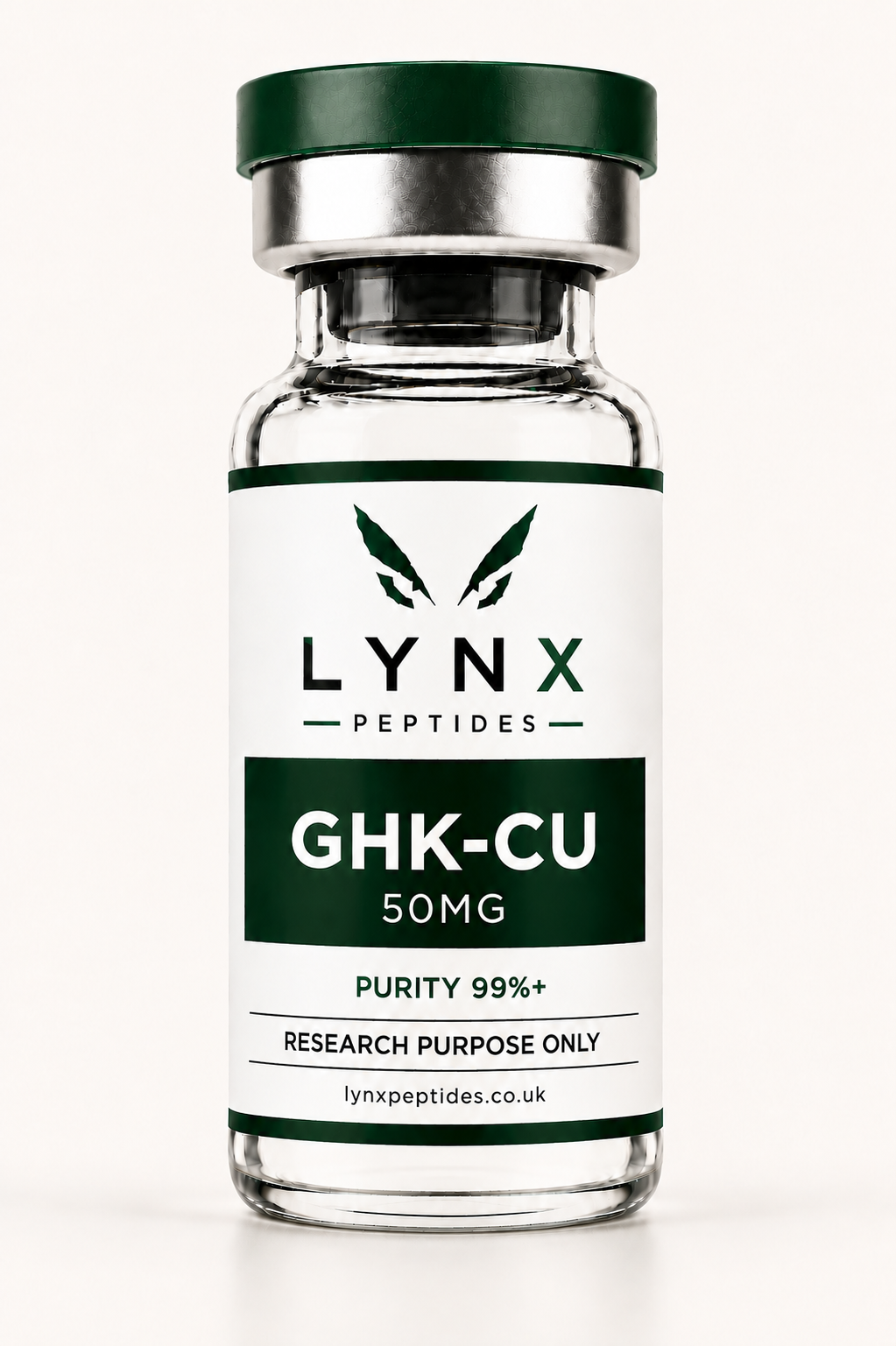
GHK-CU
A copper-binding tripeptide investigated in fibroblast activity and extracellular-matrix remodelling.
Individually£19.99
In this set£17.19
RESEARCH USE NOTICE
All products on this website are supplied strictly for in-vitro laboratory research.
They are not intended for human or veterinary use, therapeutic application, or bodily introduction.
By entering this site, you confirm:
FIRST-TIME CUSTOMERS
Enter your email and receive a one-time discount code, plus Lynx updates and restock emails, subject to eligibility.
Check your inbox. If eligible, your unique 10% welcome code will be sent by email.
POPULAR SEARCHES
Press Esc to close
Research Set
Inflammatory signalling and tissue-response pathways: GHK-CU and KPV.
Save 14% · £6.30
Checking stock
A copper-binding tripeptide investigated in fibroblast activity and extracellular-matrix remodelling.
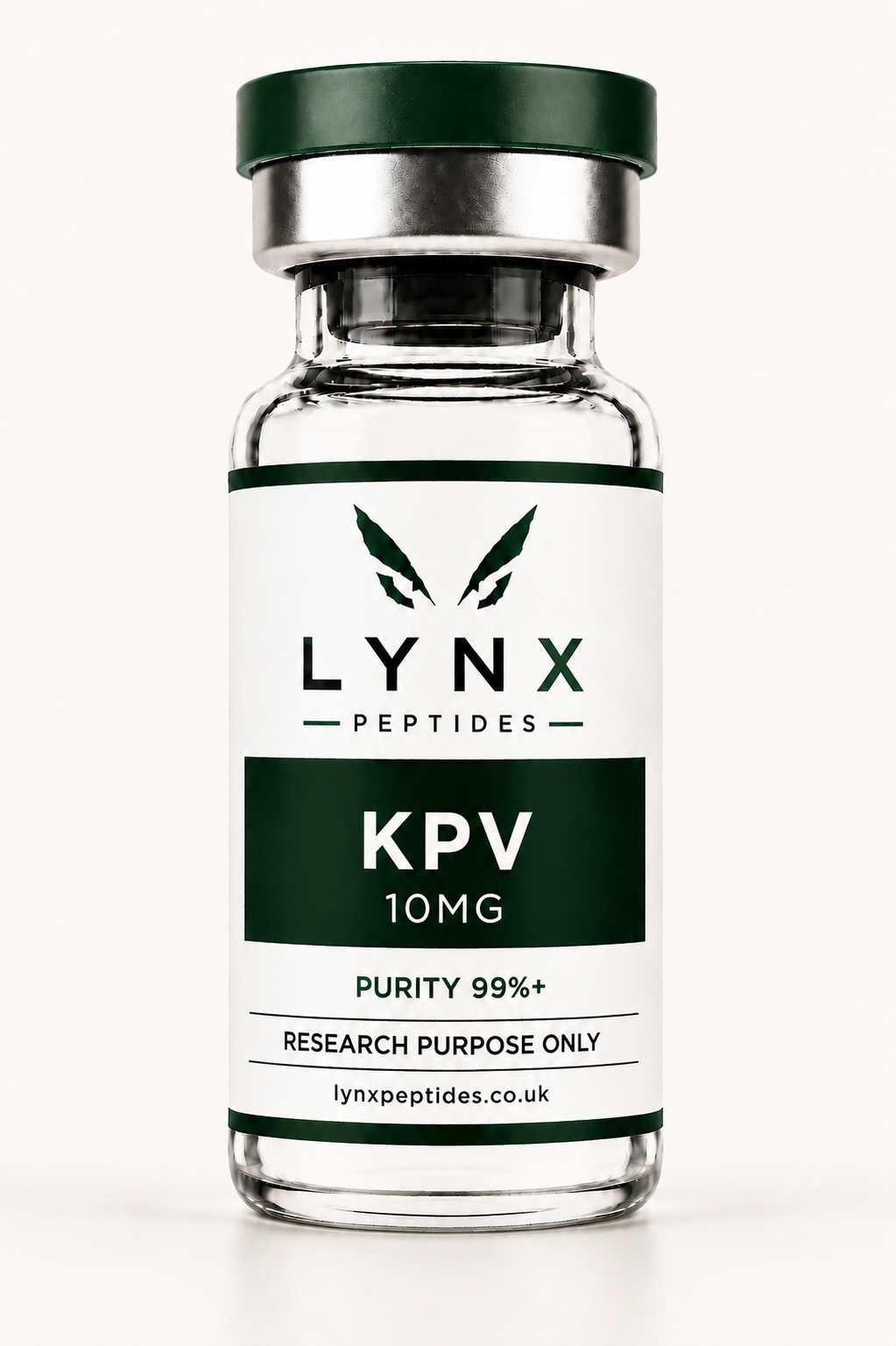
The C-terminal tripeptide of alpha-MSH, investigated in inflammatory signalling and peptide-transport models.
This set places two distinct experimental areas within one inflammatory-pathways context. GHK-CU research examines how a copper-binding tripeptide affects fibroblasts and extracellular-matrix production and turnover; KPV research examines how an alpha-MSH-derived tripeptide enters cells and modifies inflammatory signalling. The compounds remain separate and no synergy between them is implied.
GHK is the tripeptide glycyl-L-histidyl-L-lysine. Its strong affinity for copper(II) produces the GHK-Cu complex, which has been used to investigate fibroblast behaviour, extracellular-matrix biology and experimental wound repair. This places GHK-CU within research on both matrix production and the controlled remodelling of connective tissue.
In cultured fibroblasts, Maquart and colleagues found that GHK-Cu increased collagen synthesis without increasing cell number, demonstrating a direct change in matrix production rather than an effect explained simply by cell proliferation. A later rat wound-chamber experiment provided in-vivo, preclinical evidence: local GHK-Cu exposure increased dry weight, DNA, total protein, collagen and glycosaminoglycan content. Type I and III collagen messenger RNA increased, as did the relative proportion of dermatan sulfate, while TGF-beta messenger RNA did not. These measurements showed accumulation of several extracellular-matrix components in an experimental wound model, not a demonstrated human treatment effect. Matrix biology also requires turnover; producing collagen without regulated degradation would not describe normal remodelling. In dermal fibroblast cultures, GHK-Cu increased MMP-2 messenger RNA and extracellular MMP-2 levels. The same study reported increased secretion of TIMP-1 and TIMP-2, endogenous inhibitors that regulate metalloproteinase activity. Copper ions reproduced the MMP-2 response, whereas uncomplexed GHK did not, pointing to a copper-dependent element in that experiment. Together, these findings make GHK-CU relevant to investigations of fibroblast activity, matrix synthesis and the balance between extracellular-matrix deposition and remodelling.
KPV is the tripeptide Lys-Pro-Val and corresponds to the C-terminal three amino acids of alpha-melanocyte-stimulating hormone (alpha-MSH). It has been investigated independently of the full hormone in experiments on inflammatory signalling, cellular uptake and melanocortin-derived peptide biology; it is not an approved treatment.
In cytokine-stimulated human intestinal epithelial cells and Jurkat T cells, investigators reported that nanomolar KPV reduced NF-kappaB reporter activation, MAP-kinase phosphorylation and pro-inflammatory cytokine expression or secretion. Transport experiments then identified KPV as a substrate of PepT1, a membrane transporter for dipeptides and tripeptides. PepT1 is normally prominent in the small intestine and can be induced in the inflamed colon; blocking or altering transporter availability changed the cellular response to KPV, linking uptake to the measured signalling effects. The same study tested KPV in mice with DSS- or TNBS-induced colitis and reported lower pro-inflammatory cytokine expression and histological inflammation. A separate study used DSS colitis and CD45RB-high T-cell-transfer colitis, two different murine models of intestinal inflammation. KPV-treated animals showed reduced inflammatory infiltrates, lower colonic myeloperoxidase activity and improved histological or body-weight endpoints. Responses in mice with non-functional MC1R suggested that the findings were at least partly independent of that receptor. Earlier mouse peritonitis experiments likewise found reduced neutrophil accumulation without the cAMP response expected from canonical melanocortin-receptor activation. These cell and animal findings make the mechanism scientifically interesting, but receptor independence is not completely resolved and human efficacy was not established by these studies.
GHK-CU and KPV are two different tripeptides studied in distinct areas of biological research. GHK-CU binds copper and has been investigated extensively in fibroblast and extracellular-matrix research, including collagen production and the processes involved in matrix remodelling. KPV is derived from the C-terminal sequence of alpha-MSH and is studied primarily in inflammatory-signalling research, where experiments have examined pathways such as NF-κB and MAP kinase, as well as cellular transport through the peptide transporter PepT1. In simple terms, GHK-CU research is centred more heavily on how tissue matrix is produced and remodelled, while KPV research focuses more heavily on how inflammatory signals are regulated at a cellular level.
Extracellular matrix is continually produced, organised and degraded. Collagen and glycosaminoglycan measurements describe deposition, while MMP-2 and its TIMP regulators help researchers examine remodelling. Measuring both processes gives a more complete experimental picture than collagen synthesis alone.
PepT1 transports dipeptides and tripeptides across cell membranes, making it a plausible uptake route for KPV. In intestinal epithelial and immune-cell experiments, transporter availability was linked to KPV uptake and to changes in inflammatory-signalling readouts. This is a transport mechanism observed in experimental systems, not proof of a clinical outcome.
GHK-CU provides a route into fibroblast and extracellular-matrix responses associated with tissue remodelling. KPV provides a separate route into cytokine-responsive signalling, peptide transport and inflammatory-cell behaviour. The set places these complementary research areas side by side without implying synergy or physical combination.
Yes. GHK-CU and KPV are supplied as two separate vials within the Research Set. They are not combined into a single vial. Each compound retains its own strength, product identity and associated documentation.