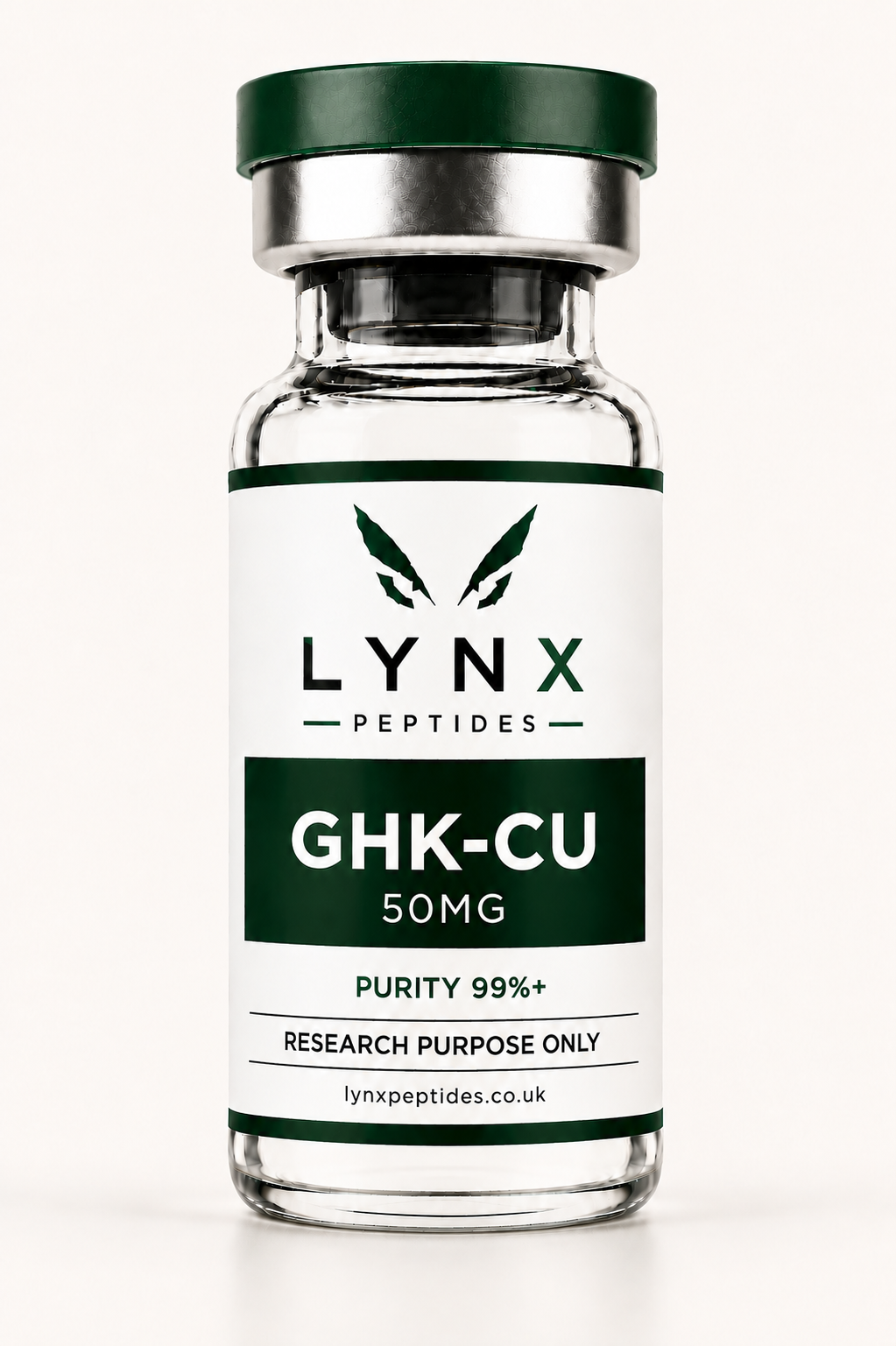
GHK-CU
A copper-binding tripeptide investigated in dermal fibroblast, collagen and extracellular-matrix models.
Individually£19.99
In this set£17.39
RESEARCH USE NOTICE
All products on this website are supplied strictly for in-vitro laboratory research.
They are not intended for human or veterinary use, therapeutic application, or bodily introduction.
By entering this site, you confirm:
FIRST-TIME CUSTOMERS
Enter your email and receive a one-time discount code, plus Lynx updates and restock emails, subject to eligibility.
Check your inbox. If eligible, your unique 10% welcome code will be sent by email.
POPULAR SEARCHES
Press Esc to close
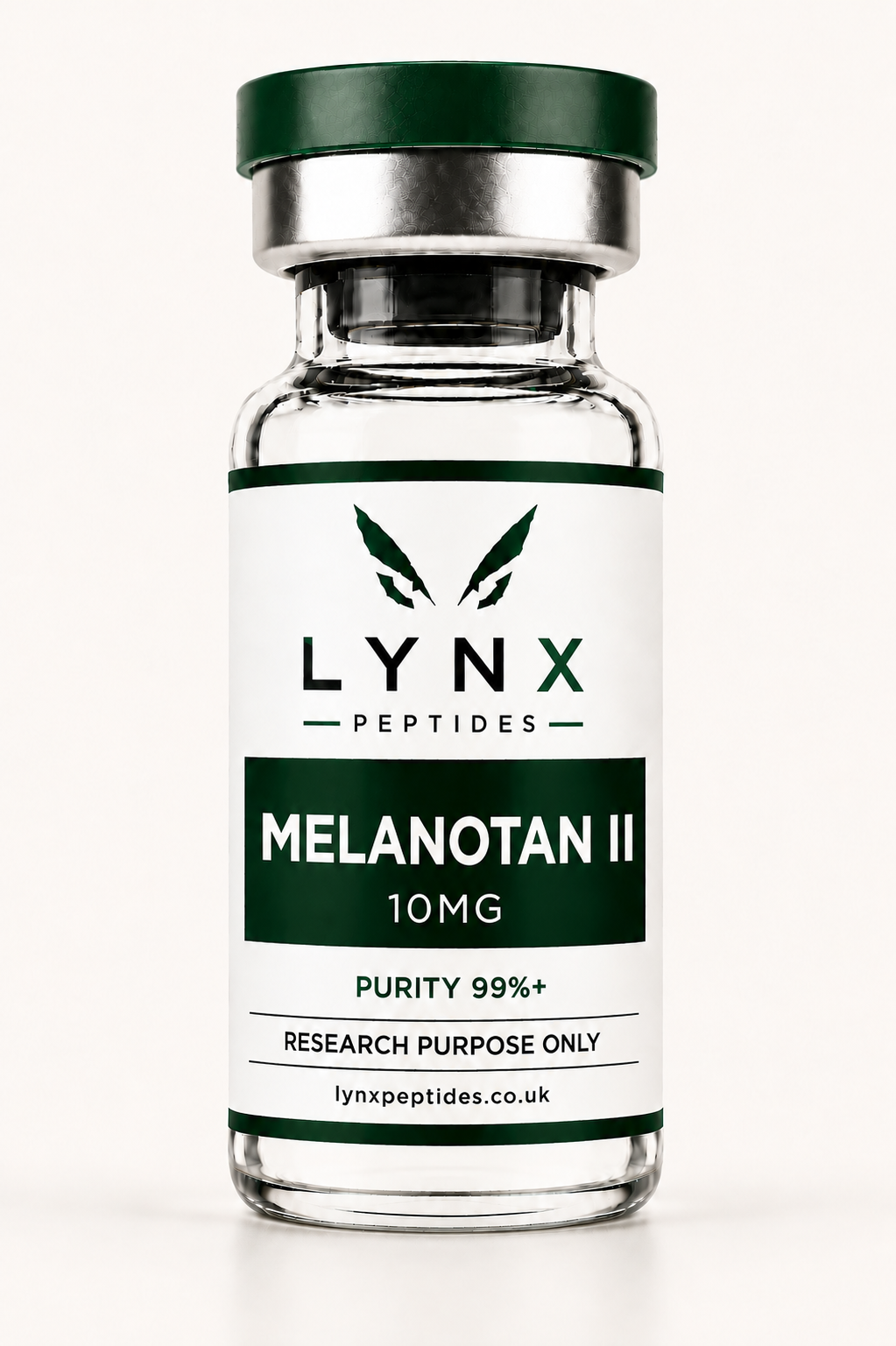
Research Set
Dermal biology and pigmentation pathways: GHK-CU and Melanotan II.
Save 13% · £5.85
Checking stock
A copper-binding tripeptide investigated in dermal fibroblast, collagen and extracellular-matrix models.
A synthetic cyclic alpha-MSH analogue used to investigate melanocortin-receptor pharmacology and pigmentation biology.
GHK-CU and Melanotan II represent two distinct areas of dermal-biology research. GHK-CU has been investigated in fibroblast activity, extracellular-matrix production and tissue-remodelling processes, while Melanotan II is studied through the melanocortin receptor system, including signalling involved in melanocyte and pigmentation biology. Examining these different pathways within the same research category provides a broader view of the cellular, structural and signalling processes studied across dermal biology.
GHK is the tripeptide glycyl-L-histidyl-L-lysine; its residues coordinate copper(II) to form GHK-Cu. Researchers have used this complex to examine dermal fibroblasts, collagen synthesis, extracellular-matrix biology and matrix remodelling.
A classic 1988 fibroblast-culture experiment reported that GHK-Cu increased collagen synthesis without increasing cell number. That distinction indicates altered collagen production by the cultured cells rather than an apparent increase caused simply by having more fibroblasts. Subsequent work extended the investigation beyond collagen alone. In rat experimental wounds, an animal and therefore preclinical model, GHK-Cu produced concentration-dependent increases in dry weight, DNA, total protein, collagen and glycosaminoglycans. The investigators also reported increased type I and III collagen messenger RNA and a higher relative proportion of dermatan sulfate, describing accumulation of several extracellular-matrix-associated components rather than a demonstrated human outcome. Matrix biology includes controlled breakdown as well as production. In dermal fibroblast cultures, GHK-Cu increased matrix metalloproteinase-2 (MMP-2) messenger RNA and extracellular MMP-2 levels. MMP-2 participates in matrix-protein degradation and remodelling; the same experiment found increased secretion of TIMP-1 and TIMP-2, endogenous regulators that inhibit matrix metalloproteinases. Copper ions reproduced the MMP-2 response, whereas uncomplexed GHK did not in that model. GHK-CU research therefore extends beyond a simplified “collagen peptide” description to experimental investigation of both extracellular-matrix production and regulated turnover.
Melanotan II (MT-II) is a synthetic cyclic peptide analogue derived from alpha-melanocyte-stimulating hormone and the wider melanocortin peptide system. Its sequence and lactam-bridged structure were developed for potent melanocortin-receptor activity, but MT-II is an agonist across multiple receptor subtypes rather than an MC1R-selective ligand.
Melanocortin receptors are G-protein-coupled receptors whose subtypes occur across different biological systems. MT-II has potent agonist activity at multiple members of this family, including MC1R, MC3R, MC4R and MC5R; it is not highly selective for a single subtype. Consequently, an observed response must be interpreted in relation to receptor subtype, tissue, route or model, and experimental design. MC1R is especially relevant to dermal biology because its signalling in melanocytes is associated with melanogenesis and pigment regulation. An early Phase I experiment used a single-blind, alternating saline/MT-II design in only three normal male volunteers. Investigators reported increased pigmentation in two participants, alongside mild nausea at multiple tested levels. At the higher tested level, one participant experienced somnolence and fatigue, and spontaneous penile erections were also observed. This very small pilot established observations under a controlled design, but it cannot provide definitive evidence of clinical efficacy or a broad safety profile. The MT-II scaffold has also supported structure-activity experiments at human MC3R, MC4R and MC5R. Altering individual residues or peptide topology changed affinity, potency and subtype selectivity; alanine replacement experiments, for example, identified major roles for Arg, Phe and Trp and showed that side-chain arrangement was critical. These findings make MT-II useful for investigating how cyclic-peptide sequence and conformation shape melanocortin-receptor pharmacology.
GHK-CU and Melanotan II are structurally and biologically distinct compounds. GHK-CU is a copper-binding tripeptide investigated primarily in fibroblast and extracellular-matrix biology, including collagen production and matrix remodelling. Melanotan II is a synthetic cyclic melanocortin analogue studied for its activity at melanocortin receptors, including pathways associated with melanocyte and pigmentation biology. Their inclusion within Dermal Biology therefore reflects two different areas of research within the same broader biological field.
GHK-CU research has examined several aspects of extracellular-matrix biology, particularly the behaviour of dermal fibroblasts. Experimental studies have measured collagen synthesis, glycosaminoglycan production and changes in matrix-remodelling systems involving matrix metalloproteinases and their inhibitors. These models allow researchers to examine how extracellular matrix is produced, organised and remodelled over time.
Melanotan II is a potent cyclic analogue of the melanocortin peptide system and has activity at multiple melanocortin receptor subtypes. In dermal research, MC1R is particularly relevant because melanocortin signalling in melanocytes is closely connected with melanogenesis and pigmentation biology. Because Melanotan II is not selective for a single melanocortin receptor, researchers also use it to investigate how receptor subtype and experimental model influence melanocortin responses.
The two compounds represent different areas of dermal-biology research. GHK-CU is primarily associated with experimental work involving fibroblasts, extracellular-matrix production and remodelling, whereas Melanotan II is used to investigate melanocortin-receptor signalling and pigmentation biology. Bringing these research areas into one set provides two distinct compounds for examining structural and signalling processes within the broader field of dermal biology.
Yes. GHK-CU and Melanotan II are supplied as two separate vials within the Research Set. They are not combined into a single vial. Each compound retains its own strength, product identity and associated documentation.